


Nightborn Movie Ending Explained (Yön lapsi): Hanna Bergholm’s Nightborn (Yön lapsi) doesn’t end so much as it sheds its skin. For most of its runtime, the film presents itself as a raw, unflinching portrait of new motherhood spiraling into crisis. Saga, played with exhausted intensity by Seidi Haarla, is drowning. Her baby, Kuura, isn’t right. He cries differently. He eats strangely. He grows at a pace that feels impossible. The doctors find nothing. Her husband Jon, played by Rupert Grint in a role that deliberately plays against his affable screen persona, dismisses her fears as exhaustion or something worse. The film sits in this space of ambiguity for a long time, letting you wonder whether you’re watching a psychological unraveling or something genuinely supernatural.
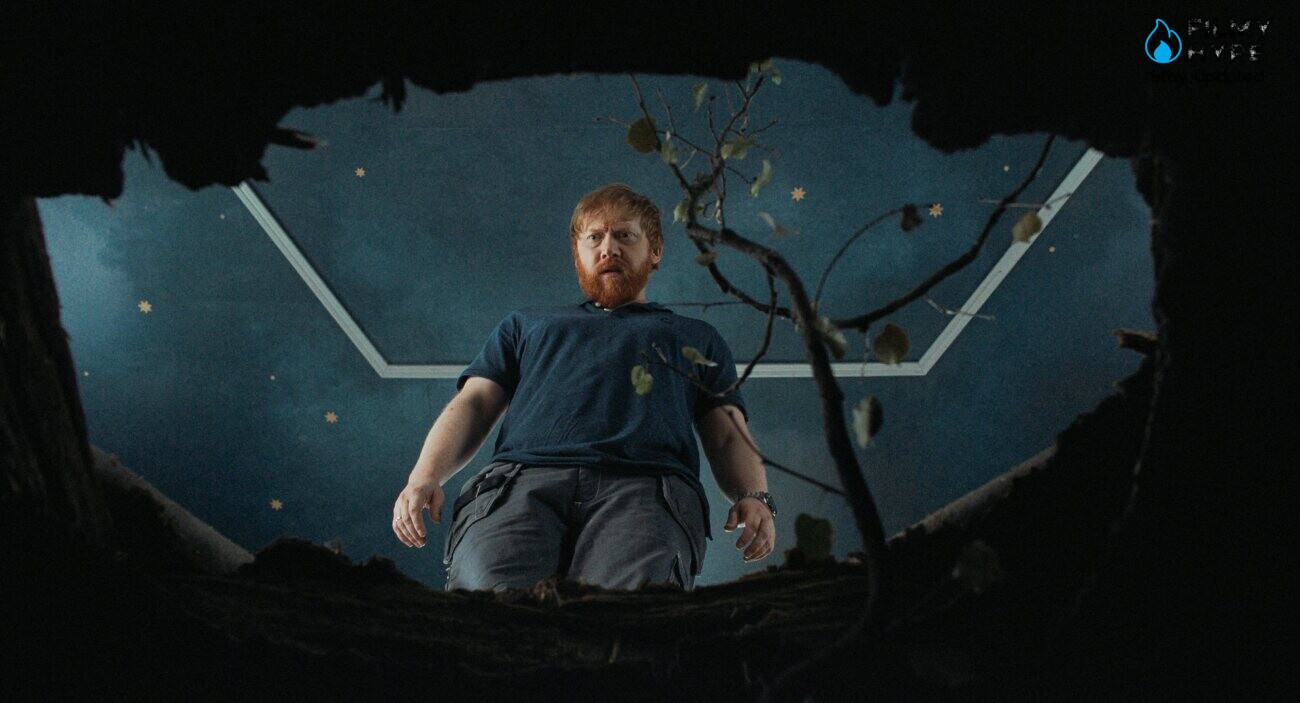
The movie never fully spells out where Kuura comes from or what exactly lives in that forest. But it leaves just enough breadcrumbs to piece together what’s really happening by the final scene. Here’s a full breakdown of the ending, starring Seidi Haarla and Rupert Grint. Then the final act arrives, and Bergholm stops being subtle. By the time the credits roll, a tree has burst through a house, a woman has eaten her husband’s heart, and a creature made of branches and moss is welcoming a child into the forest. If you’re sitting there trying to piece together what just happened, that’s the intended response. The film doesn’t explain itself neatly. But it leaves enough breadcrumbs to follow.
Major spoilers ahead.
Nightborn Movie Ending Explained (Yön lapsi): So What Actually Is Kuura?
For most of the runtime, Bergholm lets the story sit in ambiguous territory — is Saga simply unraveling under the weight of new motherhood? Nobody around her believes her when she insists something’s genuinely wrong with her baby, and the doctors can’t find anything medically explainable either.
But as the film pushes forward, it becomes harder and harder to read Kuura as anything other than something inhuman. His body grows at an unnatural rate, he’s covered in thick hair, he craves blood and raw meat, and he seems to share some kind of instinctive connection with the forest surrounding the house. This isn’t a child with an undiagnosed condition. This is something else entirely.
The film deliberately avoids naming exactly what Kuura is, but it scatters enough references to Finnish folklore — creatures resembling trolls, or older nature spirits tied to the forest — to make the implication fairly clear. Bergholm isn’t interested in explaining the full mythology. She’s interested in letting the mystery linger all the way to the credits.
Why Does Iron Hurt Him?
One recurring detail that ends up mattering a lot: the iron wire strung around the family’s old house. Early on, it plays like a fairly mundane security measure. It’s only later that the film reveals iron actually causes Kuura real, physical pain.
That detail is pulled straight from older Nordic folk beliefs, where iron was traditionally used as a ward against supernatural beings. Functionally, it’s the film’s clearest confirmation that Kuura doesn’t belong to the human, domestic world the house represents. He belongs to the forest — and the house, iron wire and all, was never anything more than a temporary, uneasy containment.
Why Does Jon Die?
Jon spends nearly the entire film in denial. He never accepts that Kuura is genuinely dangerous, choosing instead to believe that Saga is either losing her grip on reality or simply failing as a mother — unable to set boundaries, unable to love properly. It’s easier for him to blame his wife than to confront what’s actually growing under his roof.
Eventually, convinced that the only fix is distance, Jon decides he’ll take the baby away from Saga entirely, hoping a more “proper” upbringing can suppress whatever wild instinct is driving Kuura’s behavior. That decision is what finally forces the confrontation the whole film has been building toward.
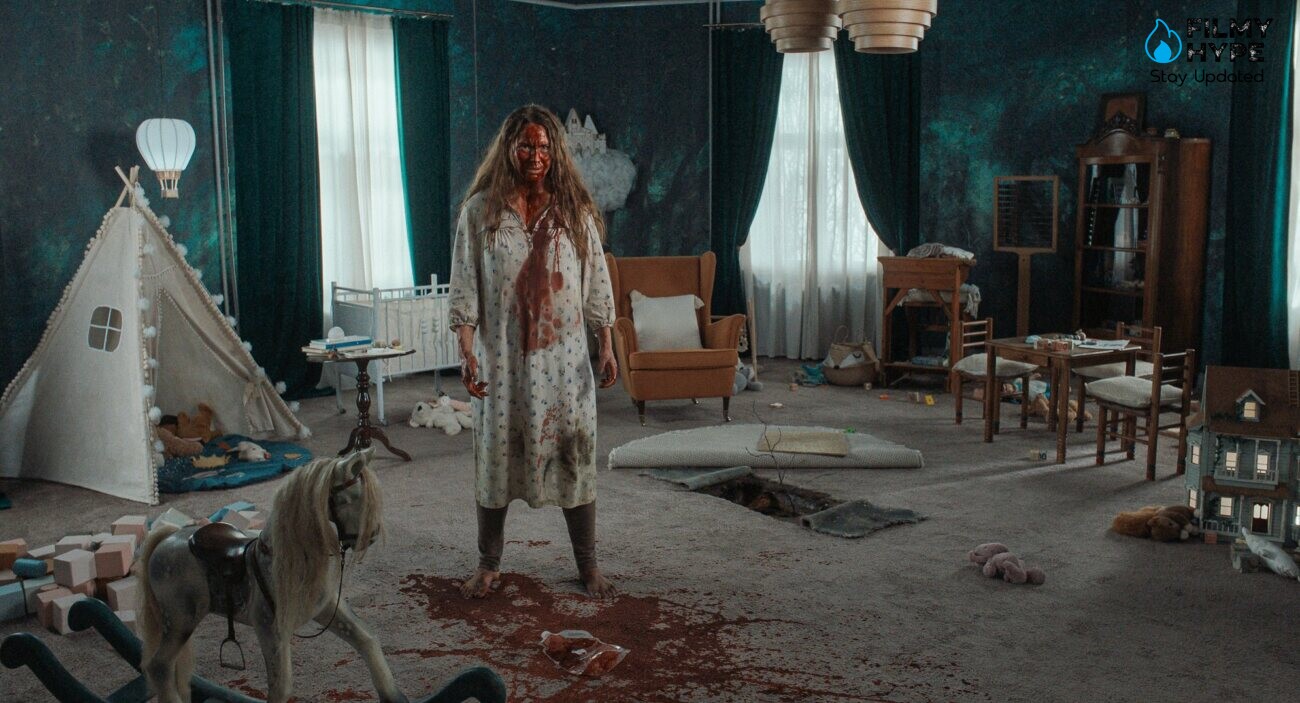
During that final clash, whatever force protects Kuura erupts into the house itself — a massive tree bursts violently through the walls, its branches impaling Jon and killing him almost instantly. It’s a crucial distinction that the film is careful to make: Saga isn’t the one who kills her husband. It’s the forest itself, responding to a threat against Kuura, that claims the house — and Jon along with it.
What Does It Mean When Saga Eats Jon’s Heart?
This is, without question, the film’s most disturbing beat. As Kuura begins feeding on his father’s body — the same hunger for human flesh and blood he’s shown before — Saga takes Jon’s heart for herself and eats it too.
It’s the moment that finalizes her transformation. Up until this point, Saga has been caught in a constant tug-of-war: trying to protect her son while also clinging to some version of the human, socially acceptable life she and Jon built together. Eating Jon’s heart severs that last connection completely. She’s no longer trying to fix Kuura, explain him to anyone, or convince the world she’s not losing her mind. She simply accepts what he is. And, by extension, what she’s become too.
Who’s the Creature Waiting for Kuura in the Forest?
After Jon’s death, Kuura runs out of the house naked and heads straight for the trees. Waiting for him there is a strange, semi-humanoid figure made of branches and moss, dropping down as if welcoming him home.
The film never identifies this being outright, but everything about the scene suggests it belongs to the same ancient lineage Kuura himself comes from. Its plant-like, tree-bound form reinforces something the movie’s been hinting at from the start: the forest wasn’t just a backdrop. It’s been alive — and watching this family — the entire time. Kuura isn’t some isolated anomaly. He’s part of a much older community that’s existed alongside, or beneath, the human world all along.
What Does the Forest Actually Represent?
From the opening scenes, the forest carries an air of mystery, but by the end, it’s clearly functioning as more than just a setting — it’s the thematic opposite of Saga and Jon’s house. The house stands for order, for the traditional nuclear family, for the attempt to explain and control something that resists explanation. The forest stands for instinct, freedom, and everything that exists outside — and before — human social rules.
So when Kuura finally leaves the house and runs into the trees, he isn’t fleeing. He’s going home.
What Is the Ending Really Saying About Motherhood?
Strip away the monster-movie mechanics, and Nightborn is really a film about the terror and isolation that can come with early motherhood, dialed up to a supernatural extreme.
Kuura functions as a kind of extreme metaphor: a child who feels destructive, hostile, and utterly draining — someone who seems to consume his mother’s entire sense of self, mirroring a fear plenty of new mothers quietly carry about being consumed by the demands of motherhood itself. Everyone around Saga minimizes what she’s going through, brushing off her fear and exhaustion as ordinary new-parent fatigue, which mirrors a very real pattern of how postpartum struggles and mental health can get dismissed by the people closest to a new mother.
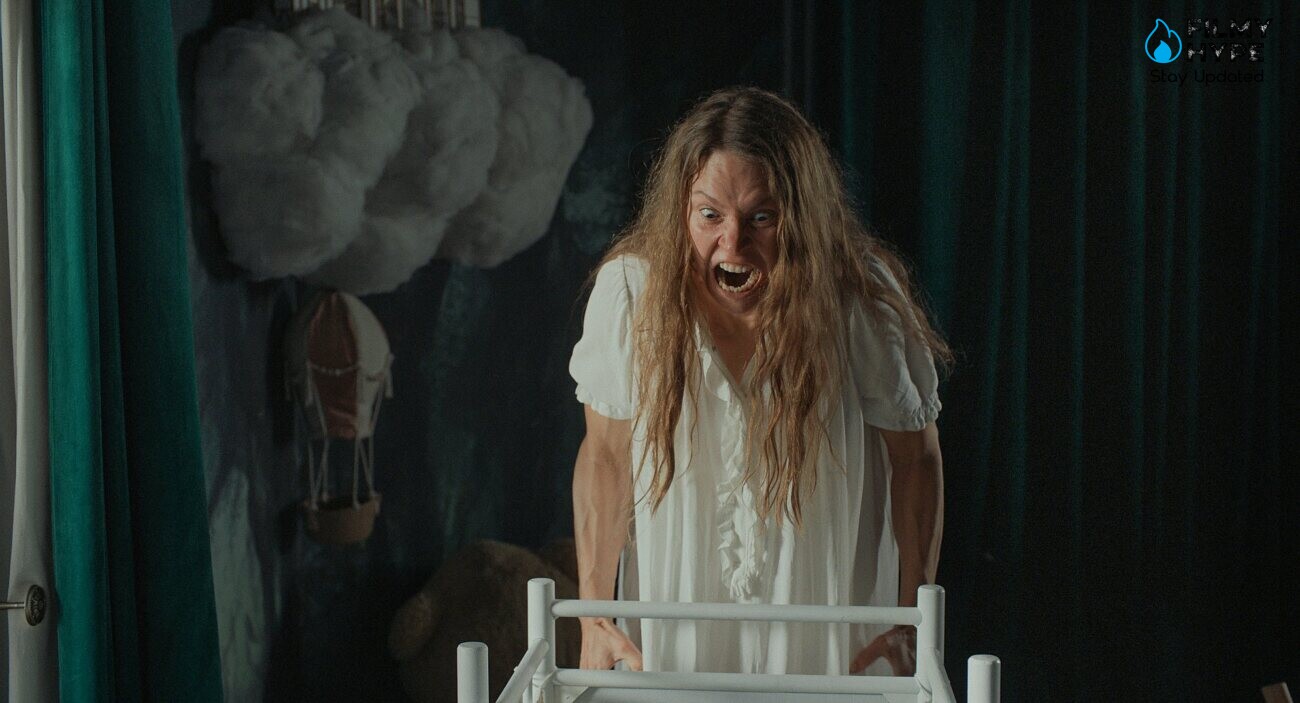
The film never confirms a purely supernatural explanation, and it never confirms a purely psychological one either. Before Saga gets pregnant, she and Jon move into her grandmother’s old house, right next to a forest already steeped in old warnings and legend — her grandmother had even cautioned about strange creatures living there. That backstory, combined with the very literal creature waiting in the trees at the end, leans the film toward the supernatural reading. But the emotional throughline — a mother who feels like she’s the only one who truly sees and understands her child, while everyone else insists she’s simply unwell — reads just as clearly as a story about postpartum depression and maternal isolation.
Bergholm doesn’t seem interested in making viewers pick one interpretation over the other. The horror-movie elements are the vehicle; the real subject is what happens to a woman when the people around her refuse to believe what she’s experiencing, and what she’s ultimately willing to accept — or become — out of love for a child no one else can understand.
Why the Ending Feels So Unsettling?
There’s no triumphant showdown here, and no return to normal life waiting on the other side of it. Saga doesn’t defeat the monster, and she doesn’t get her old life back either. Instead, she does the opposite: she walks away from the human world entirely, choosing to fully embrace the primitive, instinctual existence her son belongs to.
That’s ultimately what makes the ending land as disturbing rather than cathartic. It isn’t a story about overcoming fear for your child. It’s a story about how far unconditional love can push a person — past every social boundary, past grief, past the person you used to be — until there’s nothing left of the old life to go back to.