


Unmadham Movie Review and Ratings
Cast: Kunchacko Boban, Lijomol Jose, Raina Radhakrishnan, Kiran Peethambaran, Sudheesh
Director: Kiran Das
Where to Watch: In Theaters
Filmyhype.com Ratings: 3.5/5 (three and a half stars)
There’s a well-worn conversation in acting circles about the toll that “method acting” can take on a performer — the emotional exhaustion, the strained relationships, the way a character can start bleeding into a person’s actual life if they stay in the role too long. Unmadham, in its own strange and interesting way, applies that same idea to writing instead of acting. Call it method writing: what happens when a storyteller doesn’t just research a story, but starts living inside it.
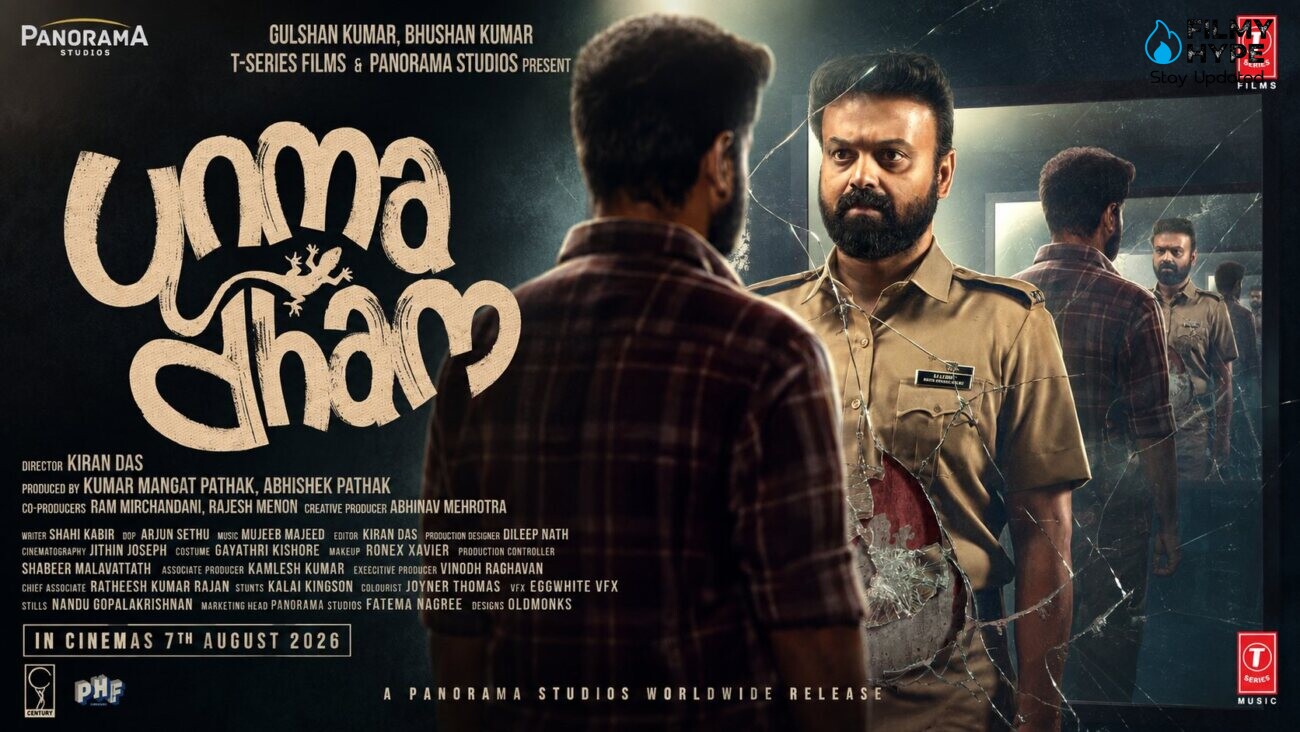
Directed by Kiran Das — making his directorial debut after years as an editor — and written by Shahi Kabir, who’s now reunited with Kunchacko Boban following their earlier run of police dramas together, Unmadham hit theaters on July 31, 2026. It’s already generating a fair amount of conversation for the way it blends procedural crime drama, personal breakdown, and supernatural horror into a single story, and reactions so far have been genuinely split.
Unmadham Movie Review: What’s the Movie Actually About?
Kunchacko Boban plays Shelly, a police constable who’s spent years trying — and mostly failing — to break through as a screenwriter. Lijomol Jose plays his wife, Soumya, who’s grown tired of shouldering the household’s finances and responsibilities while her husband chases a dream that hasn’t paid off yet, even if part of her still wants to see him succeed.
After a transfer, Shelly stumbles onto an old, unsolved case file that nobody at his new station wants to touch — the file tied to the unexplained death of a young woman years earlier, one that’s picked up a reputation for bad luck among the officers who’ve handled it. Sensing the makings of a genuinely compelling script, Shelly starts digging into it on his own. And as he gets deeper, the boundaries between real investigation, his own imagination, and something that might be genuinely supernatural start to dissolve — while his marriage and mental state both come under mounting pressure.
Unmadham Movie Review and Analysis
Early reactions on social media and from theatergoers have landed in a fairly consistent place: strong marks for the performance at the center of the film, more mixed feelings about everything surrounding it. Kunchacko Boban’s work as Shelly has been the most consistently praised element, with plenty of viewers pointing to how convincingly he sells the character’s mounting frustration, ambition, and slow mental unraveling.
The first half tends to get the most goodwill — the slower build, the domestic tension between Shelly and Soumya, and the inherently intriguing hook of a “cursed” case file that nobody wants to reopen. Several viewers described the midpoint as the film’s strongest stretch, praising its ability to sustain real tension. Where the reception cools off noticeably is the back half. Some viewers felt the story lost its edge somewhere in the second half, becoming more predictable and struggling to weave its psychological and supernatural strands into something cohesive. The consensus seems to be that the ending doesn’t land with nearly the same impact as the setup promised.
Taken together, the overall sentiment lands closer to “worth one watch” than an outright triumph — real appreciation for the lead performance, but real reservations about the writing and pacing. If you’re drawn to slower, atmosphere-driven Malayalam thrillers, and especially if you’ve enjoyed Kunchacko Boban’s recent run of police roles, there’s probably enough here to hold your attention. If you prefer tighter plotting or a clean resolution, you may find yourself losing patience by the end. For most people, this reads as a reasonably solid theatrical outing if your expectations are calibrated correctly — and a perfectly fine one to wait for on streaming if a big-screen experience isn’t essential to you.
How the Film Actually Builds Its Premise
The opening scene does a lot of quiet work: we meet Shelly on a film set, nervously waiting for a director’s verdict on a script he’s written. The director’s feedback is telling — he’s clearly impressed by the technical craft on display, the way Shelly structures his character arcs, but he isn’t moved by the story itself. He wants something that actually resonates emotionally, not just something well-constructed. It’s an efficient way for the film to establish exactly what Shelly is missing: the skill is there, but he hasn’t yet found a story worth telling with real conviction.
That’s precisely what the cursed case file offers him. Cop lore around the station insists that anyone who touches Keerthana’s file invites one of a few bad outcomes — sudden suspension, a rash of unexplained deaths nearby, or blood ending up on an officer’s uniform. Shelly, smelling a story too good to pass up, starts investigating anyway. Before long, he finds himself seemingly targeted by the anger of the dead woman herself, played by Raina Radhakrishnan, and pulled into a situation he can’t walk away from without uncovering what actually happened to her.
A Writer Who Keeps Getting More Interesting
Credit where it’s due: Shahi Kabir manages to make yet another police-centered story feel fresh, which is no small feat at this point in his career. Even with Unmadham‘s genuine flaws, and its clear debt to a handful of earlier films working similar territory, the psychological core of the story is genuinely gripping, thanks largely to how carefully Kabir constructs it. It’s a continuation of the growth he showed with Ronth in 2025 — he handles sensitive, tricky subject matter with real maturity here too, working hard not to send the wrong message even when the film isn’t without its problems.
There’s a smart bit of self-awareness built into how the film handles its own superstition, too. Every officer at the Kongad station buys into the idea that touching Keerthana’s file invites disaster. But later, another officer — played by Kottayam Nazeer — points out, almost offhandedly, that suspensions, unexplained deaths, and bloodstained uniforms are just an unfortunate part of police work generally, cursed file or not. It’s a clever way of acknowledging how deeply superstition runs through even a profession built on evidence and procedure, without the film ever endorsing that superstition as fact. Kabir lets reason push back against it, but never at the cost of the story’s horror elements.
Threading Psychology and Horror Without Losing the Plot
Much like Fazil’s genre-defining Manichitrathazhu from 1993, Unmadham works hard to keep its psychological and supernatural elements in balance without tipping into something illogical. The film is upfront that Shelly is dealing with schizophrenia, which gives real grounding to his claims that he’s communicating with Keerthana and that she’s guiding him toward the truth of her death. That diagnosis doesn’t defuse the tension, either — the film wisely keeps its focus on Shelly’s internal battle with what he believes is Keerthana’s influence, steering clear of the more generic horror-movie tropes that could have flattened the story.
That said, the film does occasionally undercut its own careful setup — there are stretches where Shelly is abruptly granted something closer to clairvoyant powers, which sit awkwardly against the more grounded psychological framing established earlier. The dream sequences, where Shelly confronts his fears and the effects of his condition, are visually striking, but Kiran Das lets a number of them run longer than they need to. A recurring hallucination involving lizards following Shelly around adds an effective sense of dread the first few times it appears, but loses its punch through sheer repetition as the film goes on.
By the closing stretch, the line between what’s real and what’s a symptom of Shelly’s condition is deliberately blurred — leaving it genuinely ambiguous whether he’s actually seeing Keerthana’s ghost, or whether he’s pushing his own mental illness to an extreme as part of his method-writing process, chasing authenticity at real personal cost.
Where the Writing Falls Apart
(Spoilers ahead.) The tight, controlled storytelling that made Ronth work is noticeably absent once Unmadham passes its midpoint. The reveal of what actually happened to Keerthana feels rushed and disconnected from everything that came before it — the motive behind her death is so arbitrary that it’s genuinely hard to accept once it’s laid out.
The film also leans on some fairly dated dramatic beats. The marital friction between Shelly and Soumya, along with his psychotic episodes, feels overly familiar rather than fresh, and the script has an uncomfortable habit of painting Soumya as the hot-tempered, nagging wife without ever really reckoning with the fact that she’s the one holding the family together financially because of Shelly’s own irresponsibility.
There’s also a fair amount of narrative sloppiness. The script introduces plot threads with real weight and then simply abandons them. Right before the interval, a young man accused in a POCSO case is brought into Shelly’s station for questioning and beaten badly enough to cough up blood — and then the film just… moves on. We never find out what happens to him. It’s the kind of dropped thread that makes the film’s back half feel less like a deliberate ambiguity and more like a lack of follow-through. Tighter writing overall might have also helped the film distance itself from its clear similarities to Ranjith Sankar’s Pretham (2016) and, to a lesser degree, Fazil’s Vismayathumbathu (2004).
The Craft Holding It Together
Kiran Das’s background as an editor clearly pays off behind the camera. Working alongside cinematographer Arjun Sethu and co-editor Jithin John, he builds an atmosphere that feels genuinely lived-in and unsettling, even when the writing wobbles. There’s a particularly well-executed shot where Soumya embraces Shelly after one of his outbursts — her face kept mostly in shadow to underline her emotional state, while the camera pans to reveal Shelly bathed in red light, visually marking his psychological unraveling. Details like that show up throughout the film and go a long way toward making it feel more polished than its script sometimes deserves.
Mujeeb Majeed’s score deserves real credit too — it consistently elevates scenes that the writing alone can’t quite carry. The performances, meanwhile, land somewhere in the “solid but unremarkable” range across the board, Kunchacko Boban and Lijomol Jose included, even with Boban clearly putting in the most committed work of the cast.
Unmadham Movie Review: The Last Words
Unmadham is a film with a genuinely compelling hook and a lead performance strong enough to carry a fair amount of the story’s weaker stretches. But its ambition to blend police procedural, psychological drama, and folk horror ends up outpacing its ability to actually tie those threads together by the end. If you go in expecting a slow-burn, atmosphere-first thriller rather than a tightly resolved mystery, there’s real craft here worth appreciating — just don’t expect the back half to fully deliver on what the setup promises.