
Furious the True Story Behind the Hulu Thriller: Every so often, a new thriller shows up on a streaming platform and just quietly wrecks the curve. That’s basically what happened with Furious on Hulu. It launched with a 100% score on Rotten Tomatoes, which is the kind of number that makes people immediately go “okay, but is it actually that good, or did critics just not have anything else to compare it to yet?” In this case, it seems to genuinely earn the hype — if you’re the kind of viewer who likes a slow-burn cat-and-mouse hunt, serial killer procedurals, or detectives who are always a step behind the person they’re chasing, this is squarely built for you.
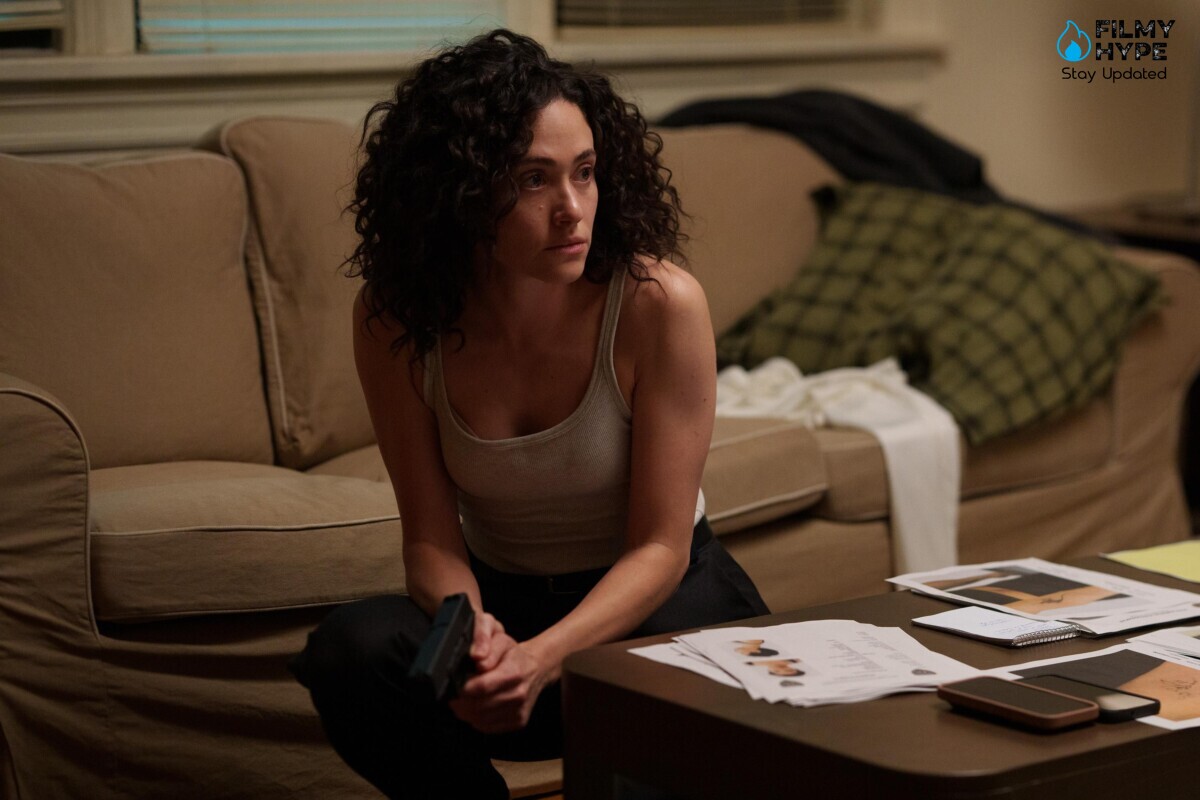
The series stars Emmy Rossum, Scoot McNairy, and Lola Petticrew, and centers on a rookie FBI agent, Alice Black, who’s dealing with a genuinely messy personal life on top of catching what looks, at first, like a fairly straightforward case: someone is killing powerful men, and doing it with a method that’s revealed almost immediately, right in the first episode. So this isn’t really a whodunit in the traditional sense — the mystery isn’t “how did they die,” it’s “who is doing this, and why.”
Furious the True Story Behind the Hulu Thriller: Two Perspectives, One Very Slippery Killer
What makes Furious stand out structurally is that it’s told from two points of view running in parallel. One is Alice’s, as she works the case. The other belongs to the killer — who, notably, doesn’t operate under one fixed identity. This person shifts names, personas, and cover stories constantly, specifically to stay a step ahead of investigators. As the show unfolds, both timelines start filling in each other’s blanks, and we get a slow accumulation of backstory on both women — the hunter and the hunted — until it becomes clear they’re more connected, thematically and otherwise, than either seems to realize at first.
Eventually, Alice puts something together that changes the entire shape of the case: the victims aren’t random. They’re connected. And the killer isn’t just some faceless “villain” racking up a body count for its own sake — she’s operating with an actual mission, a reason, a throughline that makes the murders feel less like chaos and more like a plan being executed with real patience.
What Does “Black Widow” Actually Mean in This Context?
The show leans hard on a real term from criminology: the “black widow” killer. It’s used to describe women who murder their romantic partners — a direct nod to the spider of the same name, famous (accurately or not, depending on the species) for killing its mate once it’s gotten what it needs from him.
In Furious, the thread connecting all the victims is that each of them had a girlfriend who vanished shortly after they were killed. It’s Alice who starts to notice the pattern and puts forward the theory that isn’t really a stretch once you say it out loud: it’s the same woman, every time. Same person, different disguise, different name, different city — but always the girlfriend, always gone right after the body’s found.
The show is also loosely drawing from a specific piece of source material: the 1987 film Black Widow, where an FBI investigator named Alexandra Barnes chases down a woman named Catherine Peterson, who has a habit of marrying wealthy men and then killing them for their inheritances. Furious borrows that basic shape — a killer who cycles through identities and victims — but swaps out the motive almost entirely. Where the 1987 film’s killer is driven by money, the show gives its killer something closer to revenge, which changes the emotional register of the whole story. It’s not about greed anymore. It’s about something that happened to her.
Is Any of This Based on a Real Case?
No — Furious isn’t a dramatization of one specific true crime case. But the “black widow” archetype it’s built around is very much real, and has real, well-documented cases behind it, several of which the show and the film it draws from clearly had in mind.
Judy Buenoano is probably the most infamous example. In Florida in the 1990s, she was found guilty of poisoning her husband with arsenic, killing a fiancé, and murdering her own son. She was ultimately sentenced to death — one of the relatively rare instances of a woman receiving that sentence in the modern era, which is part of why her case became so widely known.
Blanche Taylor Moore is another. On the surface, she was exactly the kind of person nobody suspects — well-liked, respected, unremarkable in her North Carolina community. Underneath that, she’d been using arsenic to slowly poison the people closest to her. Her boyfriend, Raymond Reid, died from it. So, investigators later discovered, did her second husband, Dwight Moore, and her first husband, James Taylor. Even her father-in-law and mother-in-law, both of whom had died years earlier, turned out to have unusually high arsenic levels in their systems when it was all reexamined. It’s a case that unravels the longer you look at it — one death becomes two, becomes four, becomes an entire family history.
Yiya Murano is a slightly different flavor of the same archetype — she wasn’t poisoning romantic partners, but friends and acquaintances, which is why her Netflix documentary treats her as a “black widow” in spirit rather than by strict definition. According to her story, Murano would borrow money from people close to her, and when they came looking to be repaid, she’d poison them instead — a chillingly practical motive dressed up as tragedy each time.
These are just three names out of a much longer, grimmer list of real cases that fit the pattern, and it’s clear that the broader archetype — not any single true story — that Furious, and the 1987 film it echoes, is pulling from.
Why It’s Worth Watching
What seems to be working in Furious‘s favor, beyond the twin-perspective structure, is that it resists making its killer a cartoonish monster. Giving her a mission — and eventually letting the audience understand where that mission comes from — turns the show into something closer to a tragedy than a straightforward thriller. You’re not just watching Alice try to catch someone. You’re watching two damaged trajectories close in on each other, and by the time they finally meet, the show’s already made sure you’re not entirely sure who you’re rooting for.