


Spider-Man: Brand New Day Ending Explained: There’s a version of this movie that could have just been “Spider-Man fights a new villain,” and honestly, nobody would have blamed the filmmakers for playing it safe. Instead, Spider-Man: Brand New Day leans hard into the emotional wreckage left behind by No Way Home and builds an entire film around a much harder question than “who wins the fight.” The real question the movie is asking is: what does it cost a person to be completely forgotten by everyone they love, and what happens when they finally stop trying to hold themselves together alone?
That question ends up mattering more than the villain, more than the action set pieces, and honestly, more than the Hulk, who shows up here in one of the more unexpected subplots of the film. Below is a full walk-through of the plot, how the ending actually plays out, and what all of it is really getting at.
Spider-Man: Brand New Day Ending Explained: Where Peter Parker Is When the Movie Starts
By the time Brand New Day opens, a real chunk of time has passed since Doctor Strange’s spell erased Peter Parker from the world’s memory. He’s not in hiding exactly — he’s just invisible in a much quieter, sadder way. Nobody who once loved him remembers that he exists. He lives by himself in a run-down Queens apartment and has basically given up trying to rebuild any kind of normal life.
What he hasn’t given up on is being Spider-Man. If anything, the role has swallowed him whole. Fighting crime is the one place where he still has purpose, still has a relationship people can see — even if that relationship is entirely with a mask and not with him. His main connection to another human being at this point is Sheila Rivera, a police commissioner who trusts and respects Spider-Man’s work without having any idea who’s underneath the suit, or how lonely that person actually is.
Meanwhile, life has moved on without him for the people who used to matter most. Ned Leeds and MJ are both finishing college. From the outside, they look like they’ve closed that chapter completely. Peter watches them sometimes, from a distance, the way you’d watch strangers — which is essentially what he is to them now.
There’s a small but important detail early on: after the spell took effect, Peter wrote MJ a letter. He wanted to explain everything — who he was to her, what they’d shared, the truth she wasn’t allowed to remember. He never sent it. He convinced himself that staying away was the only way to protect her. That letter becomes a quiet, recurring symbol through the rest of the film — the unspoken thing Peter keeps carrying and refusing to hand over.
Headaches, a Telepath, and a Prison Break
Peter starts getting headaches. At first, they seem minor, easy to ignore — the kind of thing you write off as stress. They don’t stay minor for long.
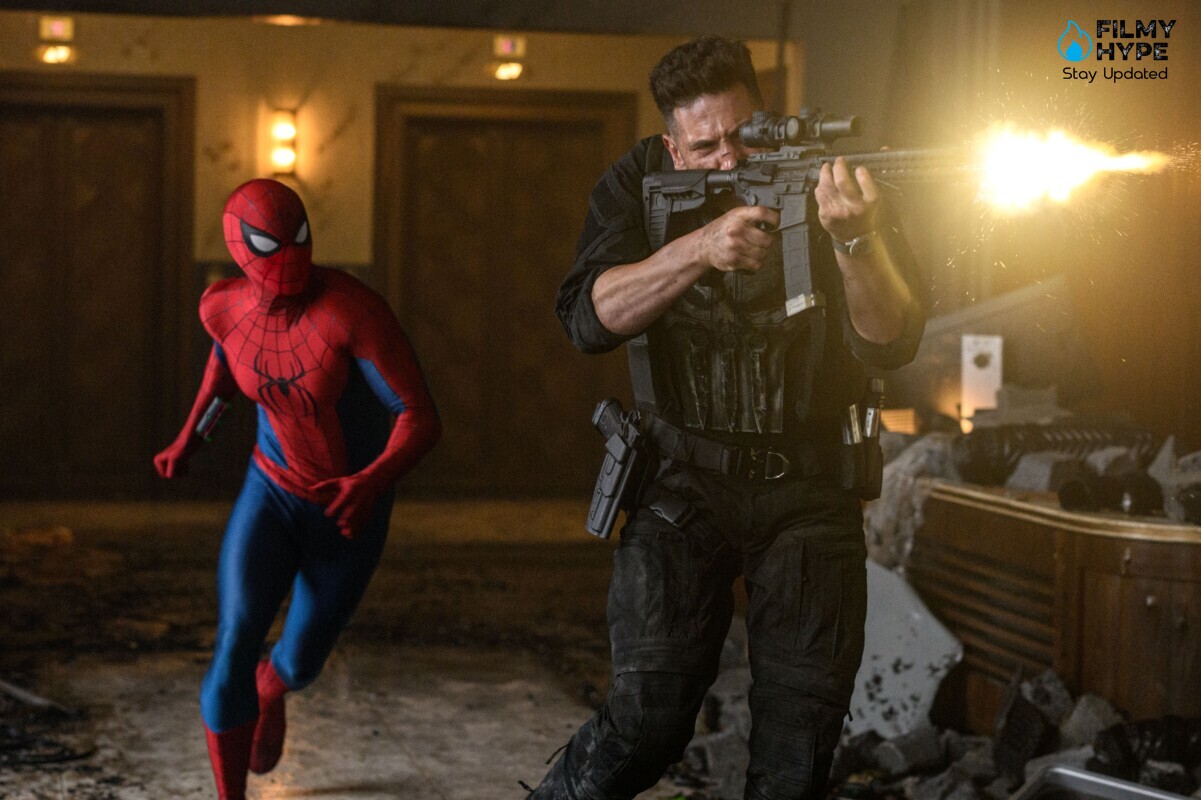
The inciting incident of the movie comes during what looks like a routine mission: an armored vehicle is heading toward a Damage Control facility, and Spider-Man moves to intercept it. He’s not the only one on the scene. Frank Castle — the Punisher — shows up too, and the two of them clash almost immediately over how differently they operate. Frank doesn’t do restraint. Peter does little else. It’s an uneasy, combative partnership from the jump.
Despite both of them trying to stop it, the vehicle reaches the Damage Control site. When it’s finally opened, there’s no criminal inside — just a frightened, disoriented woman who looks like she has no idea how she got there. Then something happens that snaps Peter’s attention into focus: he notices that whatever is controlling the situation isn’t in one body. It’s moving. Jumping from person to person, guard to guard, like a virus with a target.
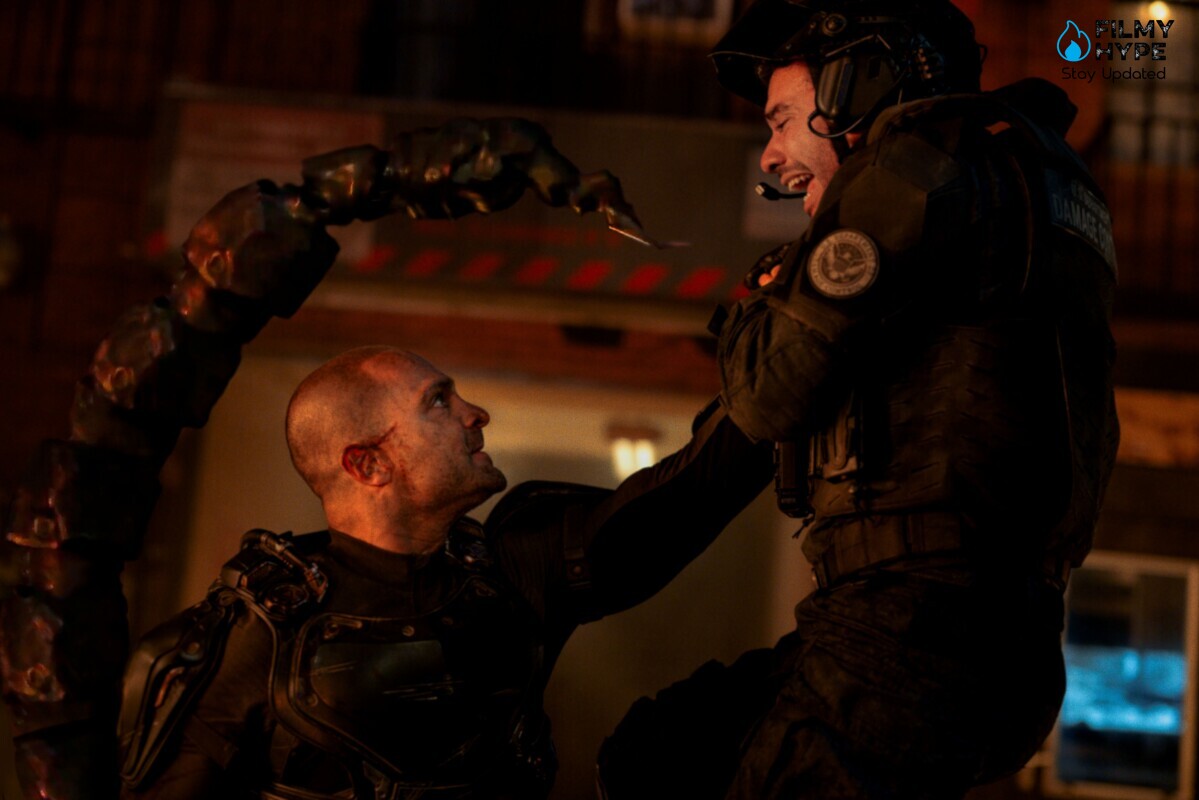
That target turns out to be Scorpio, and the entity engineering the whole breakout wants him free before he can be transferred elsewhere. Spider-Man tries to intervene and nearly succeeds, but arrives just a beat too late. And then, briefly, the presence turns its attention on him directly — slipping into his mind.
It only lasts a few seconds. In that window, whoever this is catches a glimpse of a memory tied to Aunt May before Peter manages to force them out. It’s a small moment, but it plants something the film comes back to in a big way later.
The Search for V-Max
Rattled and needing answers, Peter reaches out to Yelena Belova. She doesn’t know who the telepath is, but she’s picked up chatter — people have been quietly searching for information about something called “V-Max.” Nobody she’s talked to seems to actually know what it means. Not a location, not a project name they can pin down. Just three letters everyone’s whispering about.
Peter’s next stop is Damage Control itself, where he meets Bill Metzger, one of the organization’s senior figures. Metzger walks him through the facility and, almost offhandedly, reveals that Damage Control has been working with the Hand — the ancient ninja organization that’s since been repurposed into something closer to a private paramilitary unit for the agency’s dirtiest jobs. It’s the kind of detail that should probably worry Peter more than it does in the moment, but he’s got a more immediate mystery to chase. When he brings up V-Max directly, Metzger claims total ignorance. It’s the first of several moments where Metzger’s story doesn’t quite line up with what we later learn.
A Party He Wasn’t Invited To
While talking things through with Sheila Rivera, Peter hears something that stops him cold — Ned’s voice, in the same shop, completely unaware Peter’s standing a few feet away. It’s a gut-punch disguised as a coincidence, and Peter can’t help himself. He follows Ned, partly out of curiosity, partly out of something closer to grief, and ends up outside a party MJ is hosting.
He doesn’t go in as himself, obviously — he can’t. He just watches from the edges, taking in a version of normal life that no longer includes him. Ned, he discovers, still hasn’t let go of Spider-Man in the way everyone else seems to have. He’s actually built a tracking app dedicated to following the hero’s movements around the city — a detail the film plants early and pays off hard later.

MJ, for her part, seems unchanged in the ways that matter most to Peter — until he learns she’s engaged to Flash Thompson. That single detail breaks something in him. It’s not just heartbreak in the ordinary sense; it’s confirmation that whatever life he had is genuinely, permanently gone, rebuilt around someone else.
Peter leaves. Alone in his apartment, the headaches come back, worse than before — bad enough that his eyes go completely black and he loses consciousness.
The Mutation Peter Didn’t Ask For
When he wakes up, he’s cocooned in webbing his own body produced without him doing anything at all. An AI analysis of his condition delivers the explanation: his spider hormones have started outpacing anything close to human baseline. The stress of losing MJ — the emotional trauma of that discovery — appears to have triggered a mutation that had been sitting dormant in him this whole time.
There’s barely a moment to process this before Scorpio resurfaces and hits another Damage Control site. Spider-Man rushes to the scene and realizes, mid-fight, that Mac Gargan is under the same kind of telepathic control the earlier guard had been.
Scorpio nearly beats him. Peter’s exhausted, disoriented from the transformation, and not fully in control of himself — and that’s exactly the moment something inside him breaks loose. He throws Scorpio into a police car and keeps hitting him well past the point where it’s necessary. It’s brutal enough that Sheila Rivera, watching, is visibly disturbed by what she’s seeing. This isn’t the Spider-Man she thought she knew.
Bruce Banner’s Question
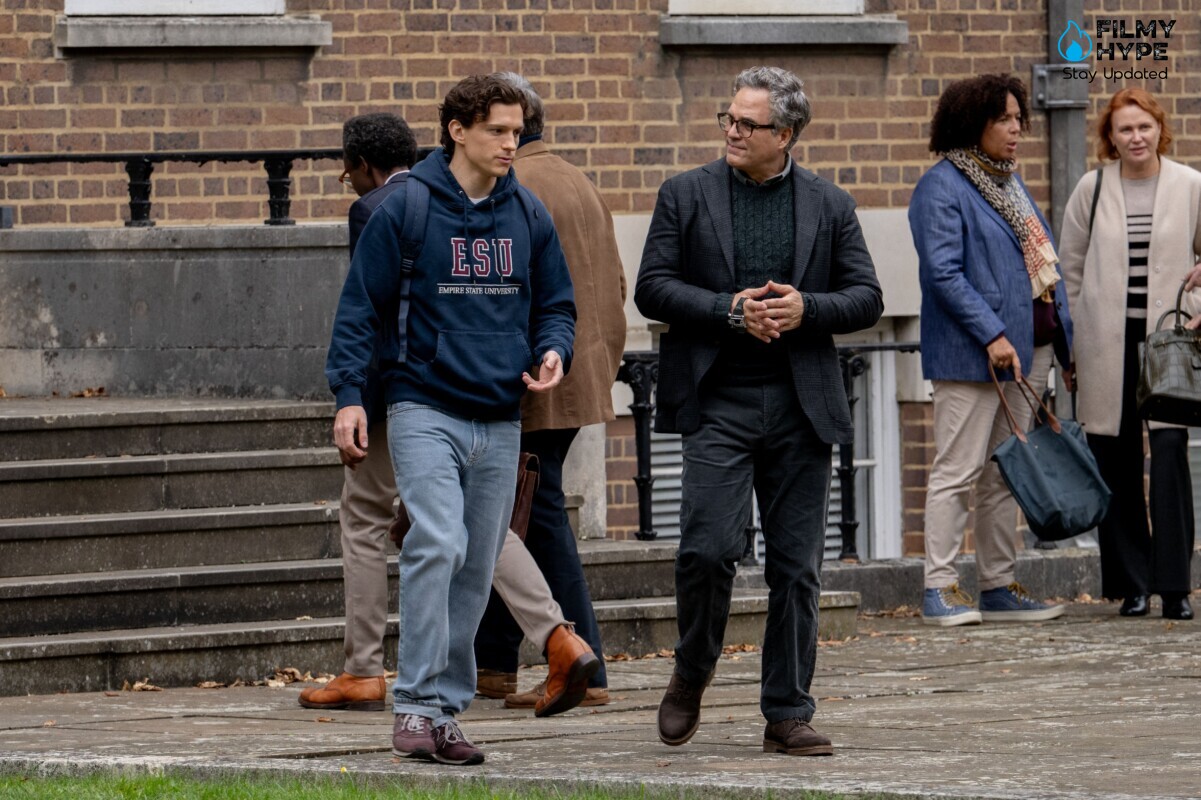
Shaken by his own loss of control, Peter goes looking for someone who might actually understand what’s happening to him — Bruce Banner. Banner’s teaching now, keeping the Hulk contained with an inhibitor of his own. Peter, posing as a student, gets him alone and asks whether it’s possible to suppress a mutation caused by dormant DNA.
Banner’s answer isn’t really an answer. He tells Peter a solution might exist, sure — but then asks him something more pointed: why try to repress that part of himself instead of accepting it?
It’s a question Peter isn’t ready to sit with. He goes home and starts building a chip designed to do exactly what Banner just questioned — suppress the hormonal shift, keep the “animal” side of himself locked down.
The Telepath Finds Him First
While Peter’s working on his fix, the telepath finds her way into his apartment and into his mind — and this time she sees enough to make the connection between Peter and MJ. She decides MJ is leverage, a way to force Spider-Man to back off the investigation entirely.
What follows is a race against the clock. Peter manages to distract her long enough to get to MJ first, pulling her up to a rooftop to keep her safe. What happens next is one of the more emotionally loaded moments in the film — MJ tells him she remembers him. She kisses him. For a few seconds, Peter lets himself believe the spell has somehow broken.
It hasn’t. MJ is being puppeted the entire time, her body and her feelings weaponized against him without her knowledge or consent. Peter manages to break the telepath’s hold and free her, but not before finally getting a clear look at his opponent’s actual face for the first time — a young woman, not the shapeless threat he’s been chasing.
Frank Castle’s Boat and a New Alliance
To keep MJ safe, Peter brings her to Frank Castle, who’s living on a boat docked in New York Harbor. Frank isn’t thrilled about being pulled into this, but he agrees to help anyway.
That night becomes one of the quieter, more human stretches of the film. Peter keeps his mask on the entire time, but MJ — without knowing who she’s really talking to — ends up helping him refine the very chip he’s building to suppress his mutation. In the process, she asks him almost the same question Banner did: why does he want to bury the part of himself that’s changing, instead of learning to live with it? It’s not a coincidence that the film puts that question in two different mouths. It’s building toward Peter finally having to answer it.
Frank, watching all this unfold, tries to figure out what exactly connects Spider-Man to this girl. Peter won’t say. He’s already decided, somewhere in the back of his mind, that giving MJ the old letter — telling her everything — would be a mistake.
Discovering Jane Grey
The telepath finally gets a name: Jane Grey. Beyond that, her history is mostly a blank. Using Ned’s tracking app (the same one built purely out of obsessive fandom), Peter and Frank locate her heading toward a Damage Control facility and move to intercept.
MJ, though, doesn’t stay put. When Frank tries to keep her out of it, she talks her way past him, and Frank ends up leaving to rejoin Peter instead of babysitting her.
By the time Spider-Man reaches the facility, it’s already in ruins. Someone has torn through a security bunker with their bare hands to get to Metzger and his people. Jane, meanwhile, is still combing the wreckage for anything related to V-Max — and finding nothing.
The Hulk Problem
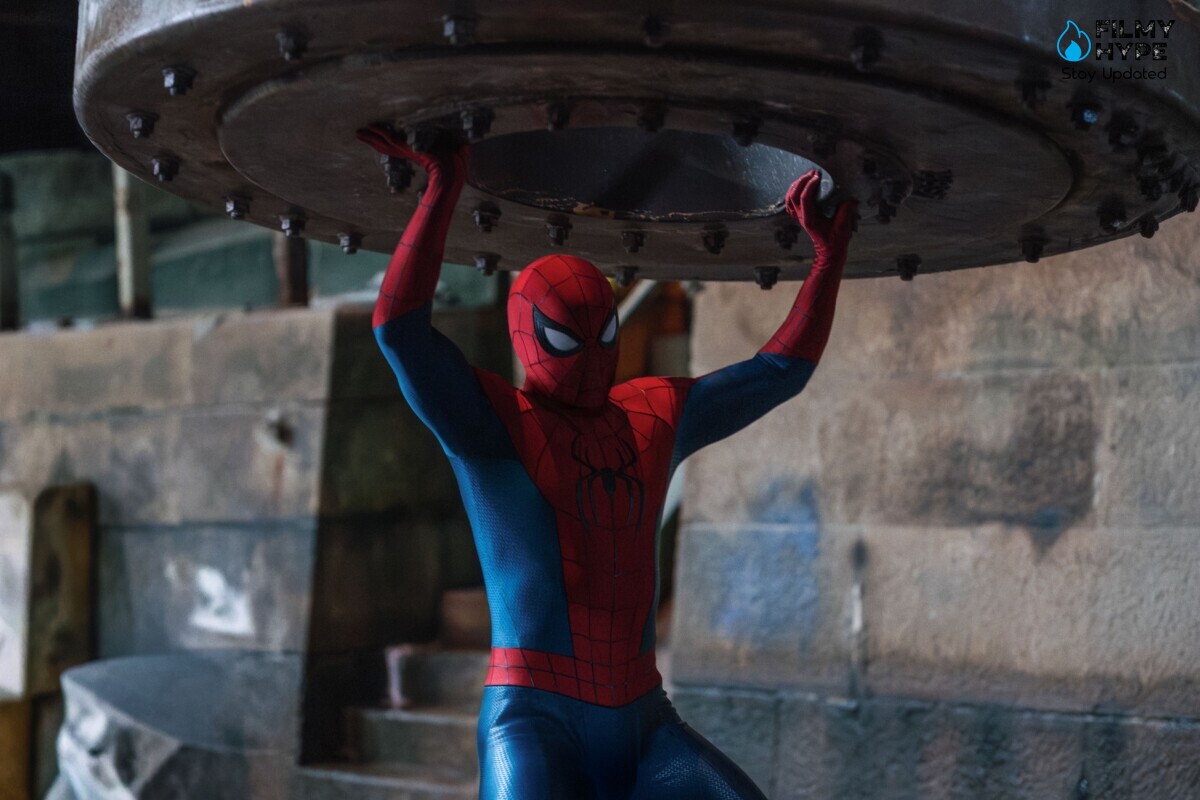
This is where the film takes its biggest structural swing: Peter discovers that Jane has taken control of Bruce Banner, and by extension, the Hulk. What follows is a full-scale, city-block-leveling fight that Spider-Man has no real way of winning alone. It’s only with Frank Castle’s help that he manages to slow the Hulk down at all.
The two of them split up — Frank goes after Jane directly, while Peter stays behind to try to contain Banner. For a brief moment, Banner actually claws his way back to consciousness, breaking through Jane’s control. It doesn’t last. When the Hulk resurfaces, he comes back bigger, angrier, and far less recognizable than before — like whatever “Smart Hulk” personality had been holding things together has been wiped out entirely.
Peter manages to pin him using the building’s own structure, pushing him toward the edge of a collapsing ledge. Even restrained, the Hulk nearly kills him — until something stops him cold. He looks at Peter and seems to recognize him. Rather than risk hurting him further, the Hulk lets himself fall, ending the fight without Peter having to.
Metzger’s Lie
Back at the bunker, Peter finds Jane has taken control of Frank now, using him to hold Metzger at gunpoint, demanding he finally reveal where V-Max actually is. Peter steps in and manages to apply his own control chip to Jane — it works precisely because her body, like his and like Banner’s, runs on the same kind of hormonal, emotion-driven triggers.
Before Metzger can be forced to answer anything, he tranquilizes Jane himself. As she goes under, she says one word: “Sarah.” Metzger claims Sarah was his daughter and that Jane pulled the name out of his memory to manipulate him.
For a moment, the fight seems over. Peter heads back to Frank’s boat to check on MJ.
The Letter, Finally
When he gets there, MJ is holding the letter. She’s read it. There’s no more room to keep any of it hidden, so Peter finally tells her everything — his identity, their history, why he disappeared, and that he loves her.
MJ doesn’t blame him for the choice he made. But she’s honest with him in a way that’s harder to hear than anger would be: she can’t love someone she doesn’t actually remember. Everything Peter’s describing belongs to a life that, as far as her memory is concerned, never happened.
She asks to go home — but before she does, she invites Spider-Man, still masked, to come up and spend time with Ned, who’s never stopped being a devoted fan of the hero. Peter accepts, and the three of them spend an afternoon that feels, at least for a little while, like something they used to have. MJ sketches him without the mask. Ned and Spider-Man click instantly, the way old friends do, even when one of them doesn’t consciously remember why.
When Ned steps away, Peter apologizes to MJ for the rooftop kiss. She tells him there’s nothing to apologize for — she doesn’t remember any of it, because Jane was fully in control of her body at the time.
That single sentence is the crack in the case. If a person who’s fully possessed retains no memory of what happens to their body, then Metzger couldn’t possibly have seen his “daughter” through Jane’s eyes during a moment of possession. His story about Sarah doesn’t hold up. He lied.
Jane’s Real Story
Peter goes straight to Damage Control’s central prison, where Jane has woken up in a room built as part bedroom, part laboratory. Metzger wants to study her — how her power works, how she jumps between minds — and starts putting her through experiments that are less clinical and more like torture.
Under that pressure, Jane’s real history comes out. Sarah wasn’t Metzger’s daughter. She was his sister. The two of them had been abandoned by their mother, left to fend for themselves with powers neither of them understood nor asked for. Damage Control eventually took Sarah into custody; Jane managed to stay hidden. Ever since, her entire life has revolved around finding her sister again.
Metzger confirms Sarah was subjected to experiments of her own. During one brief, desperate moment of psychic contact before she died, Sarah passed Jane the words “V-Max” — and Jane spent years convinced it was a location, a project name, a thread to pull.
It wasn’t. As Metzger keeps pressing her, Jane looks up and sees an air vent grate above her, partially obscured, reading “Vault Max.” Some letters have worn away. What’s left legible is just “V-Max.” That’s it. That’s the whole secret. Sarah wasn’t handing her sister a clue to follow — she was simply looking at the last thing she saw as she died, and it’s the last thing that passed between them.
Jane’s Breaking Point
The realization destroys her. Jane’s response is to unleash the full scope of her power — a psychic shockwave that spreads out roughly a kilometer around the facility, dropping everyone within range under her control. Guards, Hand operatives, anyone caught in the blast radius becomes hers to command.
Peter is the only one who resists it. He walks into a prison now staffed by an army Jane’s turned against him — Hand fighters, weaponized Damage Control guards, all of it converging on him at once. He’s shot repeatedly. His web-shooters stop functioning. For the first time in the film, he’s completely without his usual tools, worn down, and surrounded.
The Chip Comes Off
This is the moment the entire film has been building toward, and it’s not really about beating Jane. It’s about Peter finally accepting the question Banner asked him, the question MJ echoed without even knowing it. He can’t win this fight by continuing to suppress what he’s become. So he doesn’t. He tears the control chip off his own body and stops fighting his own nature.
What comes out the other side isn’t a monster — it’s just a more complete version of Spider-Man. Faster reflexes, greater strength, organic webbing that doesn’t depend on gadgets that can be shot out of commission. Within seconds, he clears the room and reaches Jane, who’s got Metzger cornered and every intention of finishing him.
At the same time, about a kilometer out, Frank Castle is watching through a sniper scope. As far as he’s concerned, Jane is past the point of being talked down, and he lines up a shot.
Aunt May, One Last Time
Jane tells Peter that nobody could understand what she’s going through. Instead of arguing with her, he does something unexpected — he lets her into his mind voluntarily. She sees the memory she’d only glimpsed in fragments earlier: Aunt May, telling him he can do this, that people believe in him even when he can’t see it himself, and that strength isn’t something you’re born with — it’s something you find as you go.
Inside that shared mental space, Peter tells Jane directly that she’s not alone anymore, and that he intends to stay with her even after everything that’s happened. It’s a strange, quiet climax for an action movie — the “final battle” resolved not through force but through Peter offering her the one thing nobody’s given her since she lost her sister: company.
And then his spider-sense picks up Frank’s shot a beat too late to stop it cleanly. He breaks the connection, shoves Jane out of the bullet’s path, and takes it himself, in the back.
The last thing he manages to say before losing consciousness is a warning to Jane to run.
The Aftermath
Frank realizes almost instantly what he’s done — that he’s shot his own ally trying to stop a threat that had, in that exact moment, stopped being one. He gets Peter to a hospital and doesn’t leave his side, staying up through the entire night. Word spreads across New York that Spider-Man’s been hurt, and the city holds its breath waiting for news.
There’s a small, strange grace note buried in here too: even after fleeing, Jane uses her powers remotely to help keep Peter stable, lending him whatever strength she can from a distance. It’s not redemption exactly, but it’s nothing either.
How the Movie Actually Ends
Peter wakes up the next morning with Frank still there — and for the first time in the film, Frank can’t hold back how much this has affected him. Something shifts permanently between them in that moment. Frank stops treating Spider-Man like a liability he tolerates and starts treating him like someone he actually trusts.
Outside, a crowd has gathered, waiting for any word on Spider-Man’s condition. Ned and MJ have left him something too — the drawing MJ made of him, unmasked, during that quiet afternoon on the boat.
To get Peter out without exposing his identity, Frank comes up with a plan: Peter walks out the front entrance dressed as an ordinary person, while Frank puts on the Spider-Man suit and lets the waiting crowd cheer for him instead. Peter watches all of it from a distance, and it lands on him for maybe the first time — even though nobody remembers who he is, the city never stopped caring about what Spider-Man’s given it. Being erased as Peter Parker and being loved as Spider-Man turn out to be two very different things, and this is the moment he actually lets himself feel the second one.
From there, Peter visits Aunt May’s grave. He tells her, essentially, that he finally understands he isn’t carrying all of this by himself anymore.
Jane escapes into the wind, her story left open. Peter never actually defeats her in any conventional sense, because by the end it’s clear that was never really the goal — she wasn’t trying to destroy anything. She was trying to find the sister Damage Control took from her, and that grief doesn’t resolve just because the fighting stops.
MJ, meanwhile, is left thinking about everything Peter told her. She hasn’t recovered any memories. But the film makes a point of showing that whatever existed between them hasn’t been erased so cleanly as the spell intended — something’s still there, even if she can’t name it.
Then there’s Ned. Peter goes to see him one more time, and instead of just observing from a distance the way he has all movie, he actually greets him — using the old handshake the two of them used back when they were inseparable. Ned responds instinctively, without thinking. And in that instant, something in him breaks loose. He remembers. Not everything. But something real.
It’s a small moment with a big implication: Doctor Strange’s spell might not be as permanent, or as absolute, as everyone assumed. Deep emotional bonds and physical habits — the kind of thing your body remembers even when your conscious mind doesn’t — might be enough to crack it open, piece by piece.
What the Ending Is Actually About
Strip away the Hulk fight and the Damage Control conspiracy, and Brand New Day is really a movie about two overlapping ideas: grief you can’t outrun, and the danger of trying to suppress the parts of yourself you’re scared of.
Peter spends almost the entire film trying to control something — his powers, his loneliness, his rage — by locking it away. Every person who matters to him in this story, from Banner to MJ to eventually Jane herself, ends up pushing back on that instinct in one form or another. The moment he finally listens, tearing off the chip in the middle of a losing fight, isn’t just a power-up. It’s the film’s actual thesis: the parts of yourself you’re most afraid of are usually the parts you need most, and pretending they don’t exist just makes you weaker when it counts.
Jane’s arc runs in parallel to this. Her entire character is built around a devastating irony — she spent years chasing a clue that was never a clue at all, just the last image her dying sister happened to be looking at. There was no secret to uncover, no mystery to solve, just grief dressed up as a mission because grief without a mission is unbearable. It’s easy to read her as the villain of the film right up until that final act, and then the movie quietly reframes the entire thing: she was never really Spider-Man’s enemy. She was just someone in more pain than anyone around her realized.
The Post-Credits Scene
After the credits roll, the film cuts to Ned’s Spider-Man tracker — the app he built purely because he never stopped being a fan, even without remembering why that fandom mattered so personally. The signal pings, and it’s not showing New York. It’s not showing Earth at all. According to the map, Spider-Man is somewhere in space.
No context. No explanation for how he got there, who took him, or what’s waiting for him. It’s about as bare a sequel tease as they come, but it lines up with where the film has been steering Peter emotionally the whole time — someone who’s finally stopped running from what he is, right as the story’s ready to take that acceptance somewhere much bigger than Queens.
What’s Left Unresolved
By the time the credits actually finish, the film has deliberately left three threads dangling:
Ned’s memories are starting to resurface, but only in fragments, and there’s no telling how far that goes or how fast.
MJ still can’t consciously remember her history with Peter, but the film is clear that some kind of emotional residue survived the spell, regardless — something closer to instinct than memory.
And Jane Grey is still out there, grieving, unaccounted for, with no clear indication of where her story goes next or whether Peter will ever cross paths with her again.
None of it gets a bow on top. And given everything the film has been arguing — that grief doesn’t resolve on schedule, that healing isn’t the same as forgetting, that some things stay open long after the “story” is supposed to be over — that open-endedness feels less like a sequel-hook cop-out and more like the point.
What the Post-Credit Scene Tells Us?
The sequence shows the Spider-Tracker invented by Ned Leeds to locate Spider-Man wherever he is. We saw the device in the film, enthusiastically introduced by Peter Parker’s friend – now an MIT graduate alongside MJ – and also used by Punisher to keep up with his new partner. But in the post-credit scene, the friendly neighborhood Spider-Man…is no longer in his neighborhood. Not in New York or even on Earth.
The tracker locates it outside the Earth’s borders: it could be in open space or on another planet, or maybe in another space-time. There are many hypotheses, also because the signal comes from a very distant area and presents anomalies sufficient to make a certain reading impossible.
Given the total openness to the Multiverse, nothing tells us that Peter cannot be in another dimension. In this case, Spider-Man would not have actually left Earth, but it is also true that the Spider-Tracker does not specify what kind of distance it is. And even the sentence that concludes the sequence increases curiosity: “Spider-Man will return.” Yes, but where? And when?
What Future for Spidy in the MCU?
The most immediate hypothesis leads to Avengers: Doomsday. The new choral adventure is expected to expand the conflict between different realities, with Doctor Doom set to become a central figure in the final part of the Multiverse Saga. The erratic position detected by the Tracker could therefore depend on an incursion, a fracture between dimensions, or a displacement caused by events beyond Peter’s control. Thus, immediately after having painstakingly rebuilt his daily life, he would find himself in a cosmic battle of enormous dimensions. However, there is no confirmation that Tom Holland appears in Doomsday.
Instead, it could be preparation for Avengers: Secret Wars, and the Battleworld hypothesis becomes stronger. In the comics, Battleworld was born from the union of territories belonging to different universes, which survived the collapse of the Multiverse. Such a location may explain why the Spider-Tracker can no longer associate Peter with Earth.
The connection between Spider-Man and Secret Wars also has important roots in Marvel history. It was during the original saga that the hero obtained the black costume, which later turned out to be the symbiote linked to Venom. Cinema doesn’t necessarily rehash that plot, but the appeal would be hard to ignore. In short, the ambiguity of the post-credit scene is deliberate, and the reason is clear: to keep more possibilities open for Spider-Man’s future, immediate and otherwise. For now, we only know that he will come back, and that’s enough for us.