


Unabomber Movie Ending Explained: Telling Ted Kaczynski’s story without accidentally making him seem charming or sympathetic is a genuinely difficult needle to thread. That difficulty only grows when a film chooses to focus not just on the FBI’s manhunt but on the slow, disturbing process by which a highly intelligent, isolated, and deeply vulnerable young man gradually became the figure the world would eventually know as the Unabomber.
Directed by Janus Metz and streaming on Netflix, Unabomber moves continuously between two timelines: 1958, when a very young Ted Kaczynski enrolls at Harvard and becomes part of psychologist Henry Murray’s controversial experiments (Murray is played by Russell Crowe), and 1995, when FBI linguistics analyst Joanne Miller (Shailene Woodley) tries to convince her superiors that after fifteen years of investigation, they’re still chasing the wrong kind of suspect entirely. The result is a film less interested in simply narrating how Kaczynski was caught and more interested in tracing how specific experiences may have shaped the worldview that eventually led him there.
Unabomber Movie Ending Explained: Who Was Ted Kaczynski, and How Does the Story Begin?
The film opens with one of the Unabomber‘s most devastating attacks. A package arrives at Tom Mosser’s home and detonates shortly after, killing him while his wife and daughter survive. By this point, the Unabomber has already been an active, unidentified threat for sixteen years, sending mail bombs to targets across the United States. Despite a massive, sustained investigation, the FBI still hasn’t managed to identify him. It’s 1995, and something has finally shifted.
The Unabomber has published a roughly 35,000-word manifesto in the press—a dense, ideological document filled with arguments about technology, industrial society, and the erosion of individual freedom. That text is exactly what allows Joanne Miller to realize the FBI may have been pursuing the wrong kind of profile from the start. When agents arrest a suspect who superficially matches the profile they’ve built over the years, Joanne examines his writing and immediately senses something is off—the man is dyslexic. Whoever actually wrote the manifesto demonstrates a level of linguistic and conceptual sophistication that simply doesn’t fit that profile. Her conclusion: they need to start over. The Unabomber isn’t just a violent man hiding somewhere. He’s an intellectual. And with that realization, the film jumps back nearly forty years.
What Happens to Ted Kaczynski at Harvard?
In 1958, Theodore Kaczynski is an exceptionally young student at Harvard—brilliant, curious, and deeply drawn to ideas. During a lecture, he encounters psychology professor Henry Murray, who introduces students to the Thematic Apperception Test, a tool used to probe certain dimensions of personality. Ted is immediately taken with Murray and, around the same time, tries to join the university’s debate group. Murray, observing him, senses that this particular student might be ideal for an experiment he’s conducting — with one complication: Ted is still a minor, meaning parental consent is required.
His family refuses. His father sees the whole endeavor as too abstract and would rather Ted focus on something offering a more secure, practical future. Ted forges his mother’s signature and participates anyway—the moment he voluntarily steps into something whose true nature he doesn’t yet understand.
What Does Murray’s Experiment Actually Involve?
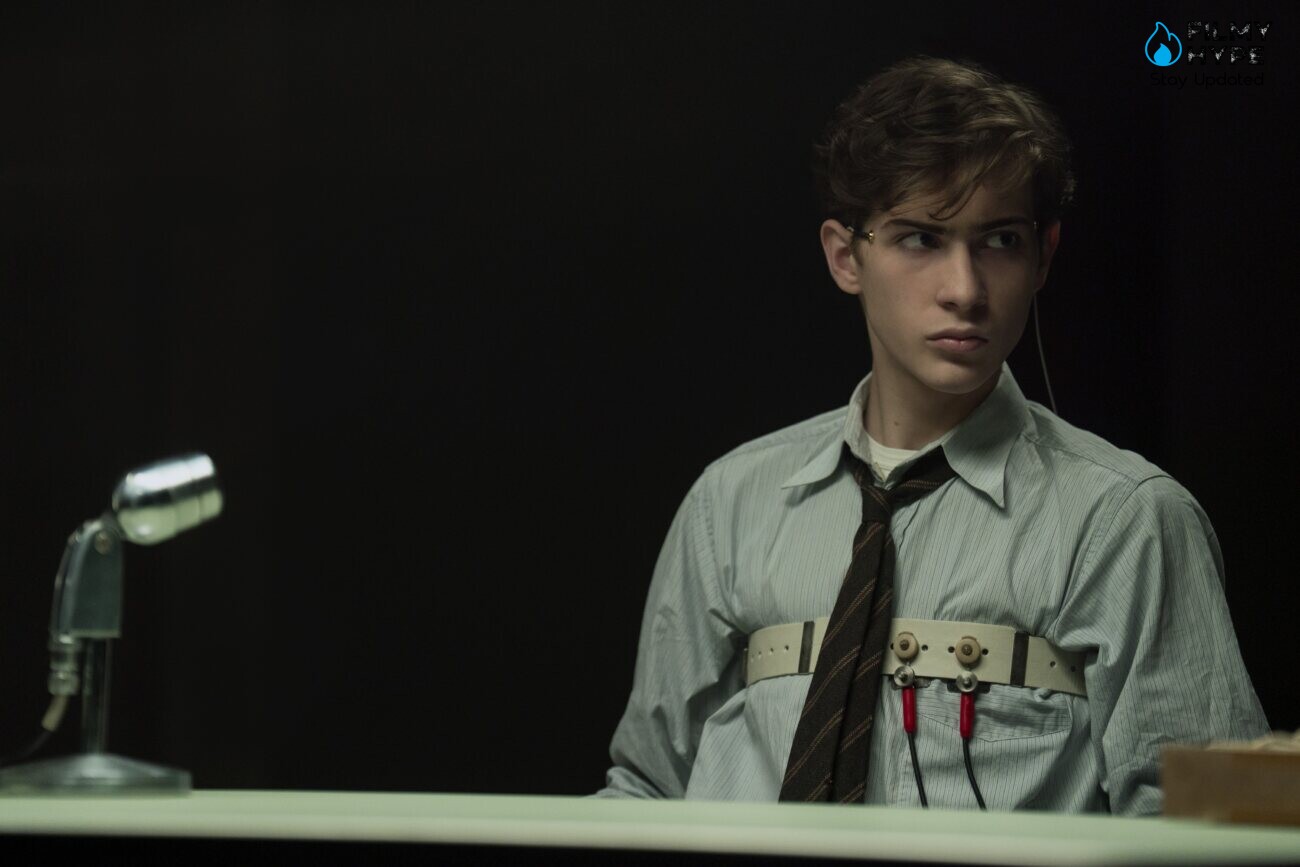
Ted is brought into a room and seated across from a man identified only as “Mr. C.” An assistant explains the setup: the two will debate certain ideas while instruments measure Ted’s physical and psychological responses, with Ted restrained by straps to accurately track his stress levels. Already, something about this should feel unsettling.
Ted is visibly uncomfortable but agrees to continue. What’s framed as a normal debate quickly turns into something closer to a personal attack. Mr. C doesn’t simply challenge Ted’s arguments—he provokes him, humiliates him, and directly targets his sense of self, calling him arrogant, inexperienced, and convinced of truths he can’t actually understand. Ted completely loses his composure, his stress levels spike, and the confrontation ends in a clear, humiliating defeat.
Murray, though, offers him a takeaway the boy won’t forget: once a fight begins, you have to keep fighting. Ted takes that lesson very seriously.
Why Does Ted Change After the Experiments?
Following that first defeat, Ted starts training—throwing himself into debates, sharpening his rhetorical skills, and internalizing one core lesson above all: aggression as a tool. He no longer simply wants to be right. He wants to win, decisively, against whoever’s in front of him. That shift becomes unmistakable when he returns home, where tension with his father boils over during an argument, and years of accumulated resentment finally erupt.

Ted turns the very debate skills Harvard sharpened in him against his own family, humiliating his father by essentially dismissing him as a simple, unsophisticated man incapable of understanding Ted’s intellectual world. This is one of the film’s more important turns—it’s not simply suggesting Ted becomes more confident. It’s showing something considerably darker: Ted learning to interpret every relationship as a conflict that must be won. Every piece of criticism becomes an attack. Every conversation becomes a battle. Every person he interacts with becomes an opponent. And Murray, likely without fully realizing it, is the one who taught him to see the world that way.
How Does Ted Learn the Truth About Murray’s Experiment?
There’s a pivotal scene where everything shifts. During a later session, Mr. C plays back a private recording of Ted—one in which Ted had shared genuine insecurities, including ones about relationships and sexuality. Those vulnerabilities are now being used against him directly, and Ted realizes a serious line has been crossed. After the session, he breaks into the room where the experiment’s data is stored and demands access to his own file, threatening to report everything to the university.
That’s when the full truth comes out. Murray’s research is tied to broader studies examining the psychological effects observed in American soldiers returning from the Korean War—specifically, how a person can be destabilized, manipulated, or made submissive. For Ted, it’s a profound betrayal. Every conversation he’d believed was genuinely intellectual was actually raw research material. His insecurities were data. His emotional reactions were data.
He returns to his room, picks up a pen, and writes, “Experiment #1.” Years later, while building a bomb in his isolated cabin, he’ll write, “Experiment #26.” The connection is unmistakable—Ted took the exact methodology used against him and turned it into his own weapon against the rest of the world.
How Does Joanne Figure Out That Ted Kaczynski Is the Unabomber?
Back in 1995, Joanne pursues a lead entirely different from the FBI’s traditional approach, working from the manifesto itself in search of linguistic patterns rather than physical evidence. A letter Theodore Kaczynski had written years earlier shows striking similarities to the language in the published manifesto. Joanne and her colleague Leo track down and question David Kaczynski, Ted’s brother.
David initially defends him, insisting his brother isn’t violent and that plenty of people could write in a similar style. But a clearer, more troubling picture starts to emerge—Ted lives in total isolation in a remote cabin, has consistently strained relationships with others, has shown resentful, bitter behavior in the past, and several old letters reveal a clear ideological throughline connecting directly to the manifesto. Joanne decides to travel to the area where Ted actually lives.
There, she watches him step out of his cabin carrying a rifle, having just caught a hare in a trap. It’s a small, unremarkable moment on its surface, but it lands with real weight—after weeks spent studying nothing but his words and sentence structures, Joanne is finally looking at the actual man behind them, and she realizes she’s very close to the truth.
What Happens in the Final Confrontation Between Ted and Murray?
Back in 1958, Murray decides to confront Ted directly, believing he’s finally ready to bring his experiment to its conclusion. He presents Ted with a harsh diagnosis, suggesting several of his behaviors are consistent with schizophrenia. Ted initially seems to absorb the blow—then completely reverses the situation. He reveals that some of the letters Murray had been using as evidence were fabricated—written by Ted himself, deliberately planted as misinformation to see whether Murray would use them. In effect, Ted ran his own experiment on the man experimenting on him.
Admittedly, the film leans a little too heavily into dramatic perfection here, risking turning Ted into a kind of omniscient genius who’s always several steps ahead of everyone around him. But the thematic point comes through clearly regardless: Murray believed he was the one conducting research. Ted proves he’s just as capable of becoming the observer himself. Before leaving, he gives Murray a copy of Moby-Dick—a book that had come up repeatedly in their conversations—highlighting a passage about man, knowledge, and the sea destined to dominate him regardless. It functions as Ted’s farewell to his mentor and also as the definitive birth of something far more dangerous.
How Is the Unabomber Finally Captured?
By 1995, the FBI is finally prepared to move. Agents position themselves around Ted’s cabin, but a major complication surfaces: CBS has learned about the impending operation and intends to break the story. If the news leaks before the arrest, Ted could flee. Joanne negotiates directly with the network, offering them an even bigger story in exchange for holding off—revealing that it was Ted’s own brother, David, who helped identify him. The trade buys enough time. Agents move in, and Ted Kaczynski is arrested. Inside the cabin, they also find a completed bomb. After sixteen years, the manhunt is finally over.
Leo, who’d pushed back on Joanne’s methods throughout much of the investigation, congratulates her. Everyone treats the operation as a clear success. Left alone in her office afterward, Joanne breaks down and cries.
Why Is Joanne Crying After Ted’s Capture?
The film never explains this moment directly, and that restraint feels like the right choice. Joanne got exactly what she set out to prove—she demonstrated the FBI’s earlier profile was wrong, correctly identified the manifesto’s author, and played a direct role in capturing one of the most wanted criminals in American history. By any conventional measure, this should feel like a triumph. It doesn’t.
Those tears seem to speak to the human cost of the investigation itself. Joanne spent weeks living inside Ted’s mind—reading his words, reconstructing his life, studying his anger, and tracing the slow transformation of a person capable of building devices meant to kill strangers. Capturing him doesn’t undo any of that.
Tom Mosser is still dead. The other victims remain dead or permanently injured. Sixteen attacks don’t become any less real just because the person responsible is finally in custody. Maybe those tears are simply there to remind us of that fact—this isn’t the triumphant ending of a conventional thriller. It’s just the end of a manhunt.
What Is the Ending Actually Saying?
A closing title card pulls the story back into stark historical reality. The hunt for the Unabomber is described as the longest and most expensive investigation in FBI history. Ted Kaczynski carried out sixteen attacks, killing three people and injuring twenty-three others. During his trial, his defense attempted to pursue an insanity plea, which Ted himself rejected—he was ultimately sentenced to life in prison.
Henry Murray retired in 1962, and his research came to be widely regarded as a failure. The film also notes that, throughout the 1950s and 1960s, the CIA funded numerous psychological experiments at American universities. Finally, the film informs us that Ted Kaczynski died by suicide in 2023.
But the real emotional ending, in a sense, arrives much earlier—the moment Ted writes “Experiment #1.” “That single gesture captures the entire thesis of the film: someone turned him into a research subject, and in response, Ted decided to turn the entire world into his own laboratory. His future experiments would no longer be academic debates. They’d be bombs.
That’s exactly where Unabomber needs to be read carefully. The film draws a compelling narrative line between Murray’s experiments and Ted’s later radicalization—but that connection isn’t meant to erase Kaczynski’s personal responsibility for what he did. Being manipulated and exploited doesn’t make becoming a murderer inevitable. That distinction might be the most important thing the film has to say.
Did Harvard’s Experiments Really Create the Unabomber?
That question runs through nearly the entire film, and the answer it ultimately suggests isn’t a simple yes. The experiments function more like a fracture point than a point of origin. Ted arrives at Harvard already fragile, already isolated, already socially awkward, and already deeply convinced of his own intellectual superiority. Murray doesn’t invent any of those traits out of nothing.
What he does is strike them and amplify them—and, likely without meaning to, hand Ted a framework for interpreting the entire world going forward: dominator and dominated, researcher and subject, attacker and victim, and winner and defeated. From that point on, Ted seems genuinely unable to break free of that binary logic. The tragedy is that, years later, he no longer wants to be the one being experimented on. He wants to be the one running the experiment.