

The eighth episode of House of the Dragon Season 3 is built around the Battle of Tumbleton—the fire, the betrayal, the death of Ormund Hightower, the chaos unleashed by Ulf the White. But the heaviest moment in the finale has no dragons in it. It happens in silence, in a room in the Red Keep, where a woman who has been stripped of everything makes one final decision and leaves behind a message that her stepsister will almost certainly fail to understand.
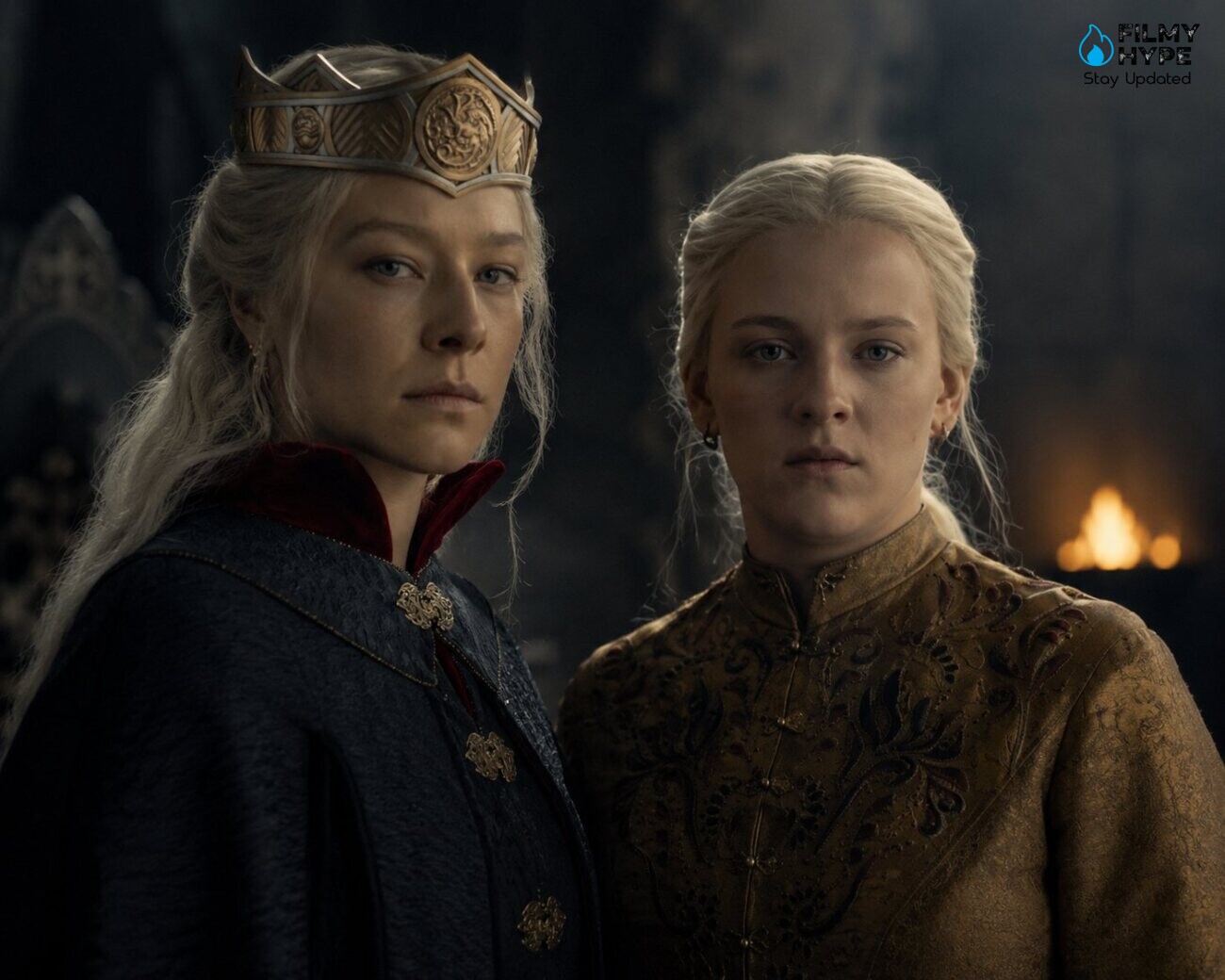
Helaena Targaryen takes her own life. Before she jumps, she finishes an embroidery that has been taking shape all season. It’s not just a piece of art. It’s a prophecy, stitched in thread, and it lays out the future of the Dance of the Dragons with a clarity that Helaena’s earlier, cryptic warnings never possessed. The tragedy is that Rhaenyra, when she finds it, sees only what she wants to see.
The Prophecy Helaena Left for Rhaenyra: What Happened to Helaena?
All season long, Helaena has been a prisoner. Pregnant with what may be Aegon’s child, kept under constant surveillance in the Red Keep, she’s been reduced to a bargaining chip. Rhaenyra’s calculation was cold but logical: a male heir would threaten her claim to the throne. Keeping Helaena and her unborn child in custody meant neutralizing that threat before it could materialize.
In the finale, that logic reaches its brutal conclusion. Mysaria tells Helaena plainly that she will never be released. With Aegon and Sunfyre now confirmed to be alive, the baby she’s carrying will become a permanent hostage—leverage against the Greens, a piece on the board that Rhaenyra will never voluntarily give up. There is no escape. There is no future where Helaena or her child is free.
Before this, Rhaenyra had been pressing her for information from her dragon dreams, treating her like a tool to be used. When Helaena refused to eat, Rhaenyra had her force-fed. The queen who once spoke of justice and rightful inheritance had become someone capable of holding a pregnant woman captive and ordering food shoved down her throat.
Helaena responds with the only sentence she has left. She tells Rhaenyra that King’s Landing is ugly, and that Rhaenyra herself has become ugly too. It’s not a curse. It’s not even particularly angry. It’s just the truth, spoken by someone who has nothing left to lose. Shortly after, she walks to her bedroom window, climbs onto the ledge, and throws herself onto the iron spikes of the dry moat below.
The Tapestry
When Rhaenyra returns to the Red Keep after proclaiming herself queen to the people—after the High Septon’s execution, after the public declaration of the Song of Ice and Fire prophecy—she finds Helaena’s body impaled on the spears. In the bedroom, hanging from the open window, is the finished embroidery.
The tapestry contains two images, stitched side by side. The first shows Helaena herself falling from the tower, exactly as she just did. The second shows Rhaenyra seated on the Iron Throne, crowned, with blood running down her body. Around her, dragons are dying in flames.
This isn’t one of Helaena’s cryptic riddles, the kind she’s been offering since the series began—fragments of truth wrapped in metaphor, easy to dismiss, impossible to parse until it’s too late. This is direct. Brutal. A closed image with no room for interpretation. Rhaenyra will get the throne. She’ll wear the crown. And it will destroy her. The blood, the fire, the dead dragons—all of it is stitched into the same fabric as her victory. The two things are inseparable. You can’t have one without the other.
Why Rhaenyra Doesn’t See It
Here is the most tragic part of the scene, and the most revealing. Rhaenyra looks at the embroidery. Her eyes move across the blood, the flames, the image of her stepsister falling to her death. And then she focuses on one detail: herself, crowned, on the Iron Throne.
This is what Rhaenyra has been asking for all season. She’s been obsessed with whether Helaena’s dreams showed her wearing a crown, as if that would be divine confirmation that she was born to rule the Seven Kingdoms. When the proof finally arrives—stitched into a prophecy that also shows her destruction—she reads the embroidery wrong on purpose. She chooses the one fragment that confirms what she already wanted to believe. Then she discards the tapestry, closes the window, and moves on.
The warning is right there, in one piece, and she only sees the crown. It’s the perfect portrait of her arc this season. She’s become someone who can’t or won’t see clearly. The prophecy isn’t hiding from her. She’s hiding from it.
The Dreams That Led Here
The tapestry didn’t come out of nowhere. In Episode 7, the show gave us Helaena’s dreams for the first time—visions that branched outward from her desperate situation, each one showing a possible future she was powerless to change.
In one dream, she saw a gate open and a grey mare waiting with a cart, ready to take her away from King’s Landing. It was an escape that didn’t actually exist—the gates were locked, and Helaena knew it. The dream was offering her a freedom she’d already accepted she would never have.
In another, her pregnancy progressed, and the baby, a boy, was ripped from her at birth. The vision was clear: any child she bore would never be hers to keep.
And then there was the image of Helaena riding Dreamfyre, dressed as a true dragonrider. This was the most unsettling of all, because it contradicted everything Helaena had chosen for herself. She’d spent the entire series refusing to fly, refusing to become a weapon in her family’s war. The dream suggested that eventually, she would be pulled into the conflict, whether she wanted to be or not—that her refusal wouldn’t matter, that the war would claim her anyway.
All of these visions pointed toward the same destination: the inevitable end. For Helaena, for her family, for Westeros. The only question was whether anyone would recognize the warning in time.
What the Prophecy Means for What Comes Next
Rhaenyra finally has the throne. She’s been crowned. She’s proclaimed herself the Prince Who Was Promised. She’s executed those who refused to bow. But the path to this moment has cost her nearly everything. Corlys has been pushed away. Baela and Rhaena are estranged. Mysaria is dismissed. Ulf has betrayed her. And now Helaena is dead, which means whatever fragile chance remained of reconciliation with Alicent is gone forever.
The embroidery says all of this ends in fire. The dragons die. The blood runs. The crown Rhaenyra wanted so badly becomes indistinguishable from the destruction it brings.
The tragedy is that Helaena gave her exactly what she asked for. Rhaenyra wanted to know if she was destined for the throne. The answer is yes. She’s destined for the throne and the fire and the fall, all at once. The crown and the corpse are stitched together in the same image, and Rhaenyra looked at both of them and only saw the crown.
The fourth season will be the last. The Dance of the Dragons is entering its final, most brutal phase. Aegon is alive. Sunfyre is alive. Daemon is still in the field. The people of King’s Landing, who loved Helaena, will soon learn how she died. And Rhaenyra, sitting on her throne with the prophecy she refuses to read hanging in the room behind her, is running out of time to see what’s coming before it arrives. Helaena tried to warn her. She stitched the future into fabric and left it where Rhaenyra couldn’t miss it. But some people, the show keeps insisting, will only see what they want to see. Even when what they want to see is the thing that’s going to kill them.