
Primetime Movie Trailer: There’s a particular kind of role that Robert Pattinson has been drawn to since he shed the weight of Twilight—men who are chasing something, often at the cost of themselves. His Batman is a detective who can’t stop being a detective even when it’s destroying him. His character in Good Time was a frantic, desperate hustler trying to outrun consequences that were already closing in. In The Lighthouse, he was a man being slowly unmade by isolation and desire. Now, in Primetime, the new thriller from A24, he’s playing Chris Hansen, the journalist who became famous—and then infamous—for a television program that turned the pursuit of sexual predators into prime-time entertainment.
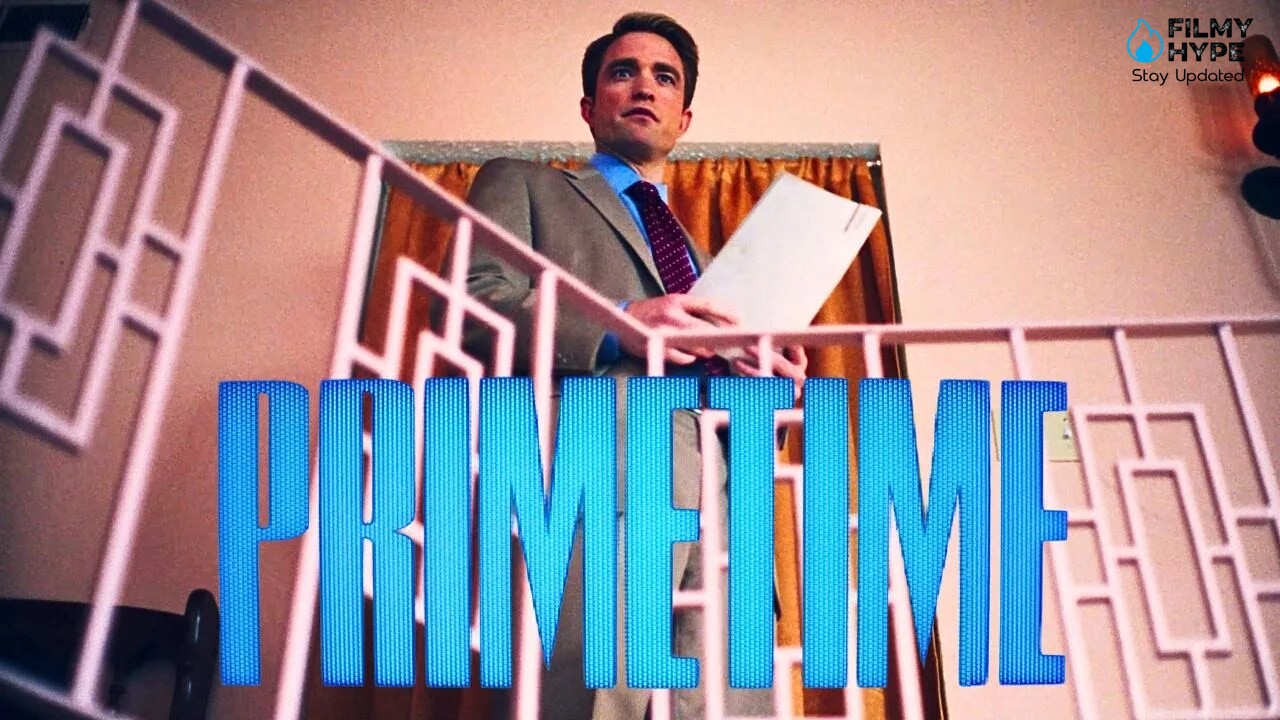
The first trailer has arrived, and it’s immediately clear that this isn’t going to be a straightforward biopic or a hagiography of a crusading journalist. Lance Oppenheim, making his feature-length fiction debut after building a reputation as a documentary filmmaker, seems to be interested in something more complicated: the moment when a format designed to expose predators became a predator itself, consuming not just the men it targeted but the people who made it and the ethical boundaries that were supposed to contain it.
Primetime Movie Trailer: What Primetime Is About
The film is set in 2006, at the height of To Catch a Predator‘s popularity and just before its collapse. Hansen, played by Pattinson with the host’s unmistakable demeanor—the calm, almost theatrical gravity he brought to each confrontation—is trying to make what he believes will be the episode that defines his career. The official synopsis is sparse: “In 2006, ‘To Catch a Predator’ host Chris Hansen attempted to make television history.” But the historical record fills in the gaps.
To Catch a Predator ran from 2004 to 2007 as a recurring segment on Dateline NBC. The format was simple and devastating. Working with the online vigilante group Perverted-Justice, Hansen and a production team would set up a sting operation. Adults who had engaged in sexually explicit online conversations with decoys posing as minors would be lured to a house rigged with cameras. They’d arrive expecting to meet a teenager. Instead, they’d find Hansen, who would calmly read from transcripts of their conversations while cameras rolled. After the confrontation, the men would step outside and be arrested by waiting police.
The show was a ratings juggernaut. It was also, from the beginning, ethically fraught. The partnerships with law enforcement blurred the line between journalism and entrapment. The presence of cameras transformed arrests into spectacle. The men caught in the stings were publicly humiliated before they’d been convicted of anything—their faces broadcast to millions, their lives destroyed before a courtroom had a chance to weigh the evidence. The show’s defenders argued that the public service justified the methods. Its critics saw something closer to a televised witch hunt, where the imperative to produce compelling content had overtaken any concern for due process or proportionality.
The Collapse
The event that broke the format occurred in November 2006. Bill Conradt, an assistant prosecutor in Rockwall County, Texas, had engaged in online conversations with a decoy but had not shown up at the arranged meeting place. Despite this—despite the absence of the confrontation that was the show’s entire dramatic premise—the production team, accompanied by police, showed up at his home with a search and arrest warrant. As officers entered, Conradt shot himself. He died shortly afterward.
The suicide sparked an immediate reckoning. ABC’s 20/20 ran an investigation into the show’s methods. Conradt’s sister filed a lawsuit against NBC, alleging that the network’s actions had directly caused her brother’s death. The case was eventually settled out of court. The show was quietly cancelled in 2008, and Hansen’s career never fully recovered. He became, in the years that followed, a kind of cautionary figure—someone who had been given an enormous platform, who had done something that genuinely exposed dangerous predators, and who had also participated in a system that treated human lives as content.
Oppenheim’s film, based on the trailer, appears to be less interested in adjudicating Hansen’s guilt or innocence than in capturing the specific texture of the moment when the show tipped from investigative journalism into something else. The trailer shows Pattinson’s Hansen as a man who genuinely believes in what he’s doing—the gravity in his voice, the steady gaze, the sense of moral purpose. But it also shows the machinery around him: the camera crews, the police waiting outside, the production meetings where the line between public service and entertainment is being actively negotiated.
The Cast and Director
Pattinson is producing the film as well as starring in it, continuing his post-Batman evolution into one of the most interesting and unpredictable figures in contemporary Hollywood. His choices since Twilight have been almost perversely eclectic—a Safdie brothers heist movie, a Robert Eggers two-hander, a Claire Denis space drama, a Bong Joon-ho sci-fi satire—and Primetime fits the pattern. This is not a movie designed to maximize his commercial appeal. It’s a movie designed to be uncomfortable, to sit in the gray area where most films prefer not to linger.
The supporting cast includes Merritt Wever, one of the most reliably interesting character actors working, and Skyler Gisondo, who’s been building a career out of playing young men whose affability masks something more complicated. Phoebe Bridgers, the singer-songwriter, appears in what the production is describing as a key supporting role—further evidence that Oppenheim is building his world out of people who bring their own associations with them.
Oppenheim himself is the wild card. His documentaries—Some Kind of Heaven, Spermworld—have demonstrated a gift for finding the strangeness inside seemingly ordinary American subcultures. He doesn’t judge his subjects so much as observe them with a clarity that can feel, at times, almost uncomfortable. Applying that sensibility to the story of To Catch a Predator makes intuitive sense. The show was always about performance—the performance of the decoys, the performance of Hansen, the performance of the men who walked through the door believing they were meeting someone they’d only known through a screen. Oppenheim’s background suggests he’ll be attuned to those layers in ways a more conventional filmmaker might not.
Primetime Movie Release
Primetime arrives in theaters on September 25. A24 is distributing, which tells you something about the kind of film this is. The studio has spent the last decade building a brand around work that’s formally ambitious and emotionally complicated—films that don’t offer easy resolutions or comfortable moral positions. Primetime, based on the trailer and the talent involved, looks to be exactly that kind of project.
The film is produced by Range Media, Icki Eneo Arlo, and Square Peg. The involvement of Pattinson as both star and producer suggests a personal investment in the material. He’s not just showing up to play a role. He’s helping to shape a story about a man whose career was defined by the pursuit of predators, and who eventually discovered that the machinery of that pursuit could consume anyone—including the people operating it.
The trailer ends on an image of Hansen, alone in a darkened studio, the cameras off, the show over. The predator hunter, alone. The question the film seems to be asking isn’t whether Hansen was a hero or a villain. It’s what happens to a person who makes his living staring into the abyss, and what the abyss does to him in return. September 25. The cameras are rolling. The house is wired. The door is about to open.