

Coward Film Review and Ratings (Cannes 2026)
Cast: Emmanuel Macchia, Valentin Campagne, Jonas Wertz
Director: Lukas Dhont
Where We Watched: At The Cannes Film Festival 2026
Filmyhype.com Ratings: 4.5/5 (four stars)
“Coward” is one of those films that were born to divide. You may not like it, but it won’t leave you indifferent. Lukas Dhont chooses a particular story to take us into the trenches, to tell us about a youth at the slaughterhouse. There is a forbidden feeling, a struggle against the horror that passes through art, of the impossibility of being oneself, in Competition at Cannes 2026. After Girl and Close, Lukas Dhont continues his journey into emotional fragility and queer identity with Coward, probably his most mature and controlled film. Set during World War I, the film utilizes the war context not so much to tell the story of the war itself, but to explore themes of desire, fear, masculinity, and a desperate need for human connection. The result is a painful and very delicate romantic melodrama, capable of alternating brutality and tenderness with impressive naturalness.
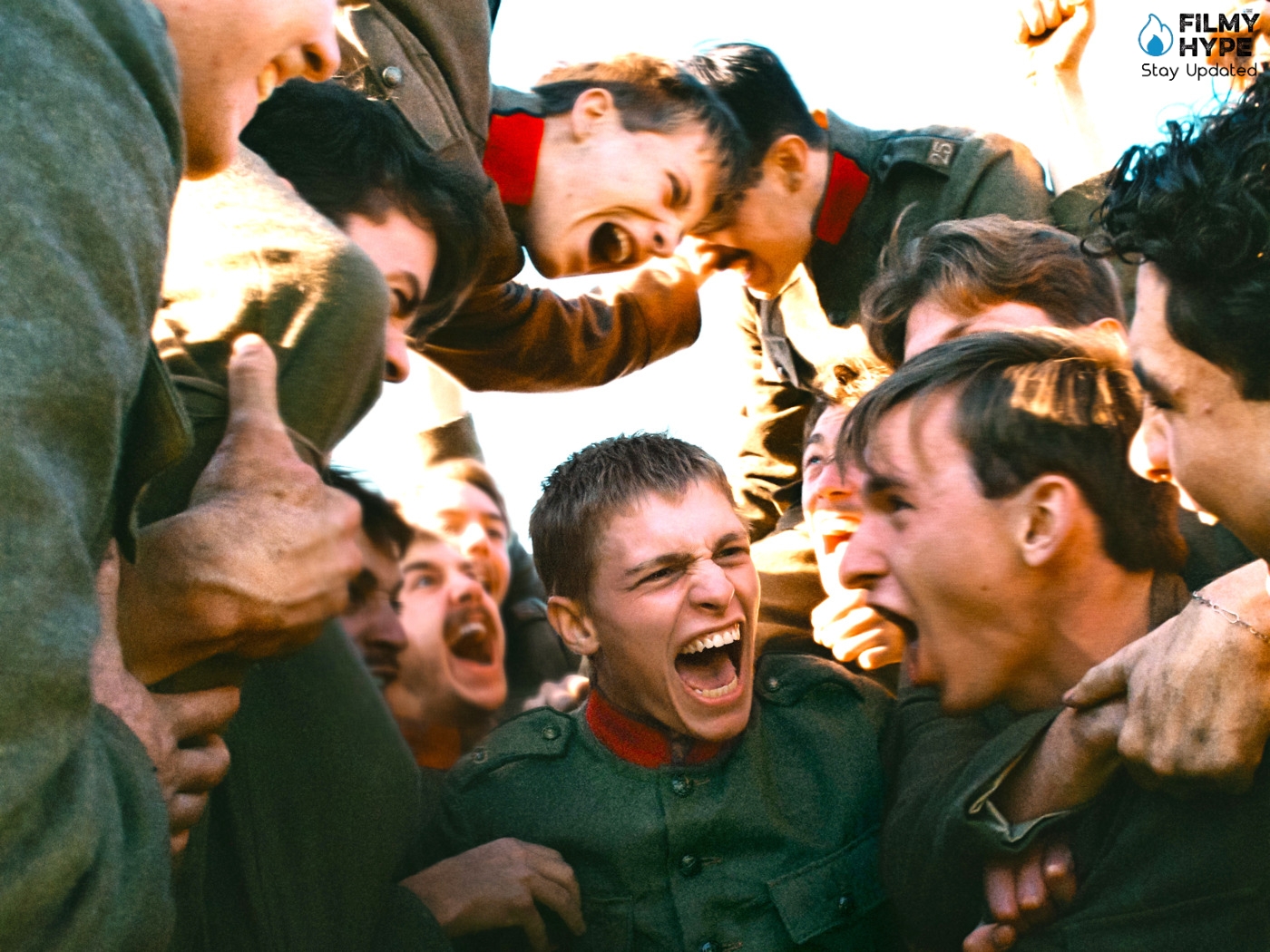
“Cowards die alone.” Lukas Dhont returns to competition at Cannes four years after the Grand Prix obtained with Close. He does it with the third work, Coward, the Belgian director’s first period film, and takes us back to the trenches of the First World War, a conflict as recalled by the sign in the exergue that mobilized 65 million young people throughout Europe. Pierre (Emmanuel Macchia) has just enlisted, eager to prove himself. In the rear, in the team responsible for supplying food and equipment, Francis (Valentine Campagne) organizes shows to keep the soldiers’ morale high. As the fighting rages, everyone tries as much as they can to escape the brutality of war, even if only for a moment.
Coward Film Review (Cannes 2026): The Story Plot
For Pierre (Emmanuel Macchia), the call to arms was an adventure at first. He is part of the Belgian army, with many of his peers, and he arrives singing songs, confident of victory, of country, of the beauty of serving something important. But then the tragedy of that carnage forces him to look reality in the face: death reigns there, looking no one in the face. Moments of camaraderie become increasingly dull, the night brings fear, the enemy is the same as them but invisible, there are bodies to bury, wounded to pull out of the mud.
In all this, a small department was used for theatrical and musical performances to keep the troops’ morale high. Francis (Valentin Campagne) immediately emerges among them as a leader and creative mind. Eclectic, imaginative, impudent, brilliant, he flaunts his homosexuality by disguising it as artistic originality. A very strong bond develops between him and Pierre, but war has its rules, and that traveling show, while on the one hand it saves them from the front lines, on the other, it takes them to the limit of torture.
“Coward”, let’s get this straight, it’s not a queer movie masquerading as a Great War movie. Here, the conflict and its consequences are central. Dhont, thanks to the screenplay he co-wrote with Angelo Tijssens, brings us a sumptuous historical reenactment, in which that small stretch of the front, that slaughterhouse of mud, barbed wire, blood, and trauma, reaches us with a realism as clear as it is visually rich. The photograph of Frank van den Eeden is beautiful, playing with the light, the night, and the colors of that Belgian countryside where Pierre and the others try to overcome fear. Compared to the vast and substantial cinematography that has been dedicated to the First World War for a century now, “Coward” is both canonical and completely different from what has already been seen. Dhont’s direction is mobile, fluid. It gives us a vision that is deliberately partial because it is subjective; the bigger picture is missing because everyone there sees only what is in front of their eyes, and they have no awareness of what tomorrow will be. All this increases the feeling of isolation, alienation, and the combination of truth.
Coward Film Review and Analysis
“Coward” is a film that hits the nail on the head immediately. Those guys are young, very young, they’ve often never even been with a woman. They joke, they hug, they hold each other; there is a clear representation of homoeroticism as linked to male commonality, as obvious, flaunted, and rejected in its most blatant and freest forms. The musical part of “Coward”, of the highest caliber, is very important; it is the moment when Pierre, Francis, and the others try to bring comfort and lightness to men reduced to deformed mannequins, frightened recruits. Dhont creates a perfect contrast between the two protagonists. Pierre is shy, simple, thoughtful, instinctive; Francis is a master of disguise, sharp, cynical in his own way. Homoeroticism is present, gradual, but finally explodes, without diminishing the theme of discovery, of the will to live, as well as of danger. Impressive the choreography and costumes, Dhont’s ability to make us feel inside a private tragedy that is the expression of a lack of absolute freedom for that already dead humanity.
If we have to find a flaw in “Coward,” it’s the usual twenty minutes too long, but otherwise this is an exceptional film as an idea and development, as an ability to make us understand the tragedy of those years, of these two boys who are surrounded by death, by the contempt of a closed and homophobic world, despite the reality inherent in its soul. “Coward” has a different ending than you’d expect; it’s also a coming-of-age film, the kind that knows how to make you understand that sometimes drama, pain, is the thing that makes the difference between growing up and staying the same.
It’s hard to decide which of the two leads is better; they’re like water and fire, but what is certain is that “Coward” is a film that is very modern in terms of semantics, but far from trendy, sensationalistic, wanting to amaze at all costs. Several sequences become a blatant political metaphor of the deception that destroyed an entire generation. Not a perfect film, a few minor script flaws, but at least 4-5 sequences are a powerhouse with few equals, even at this Cannes Film Festival.
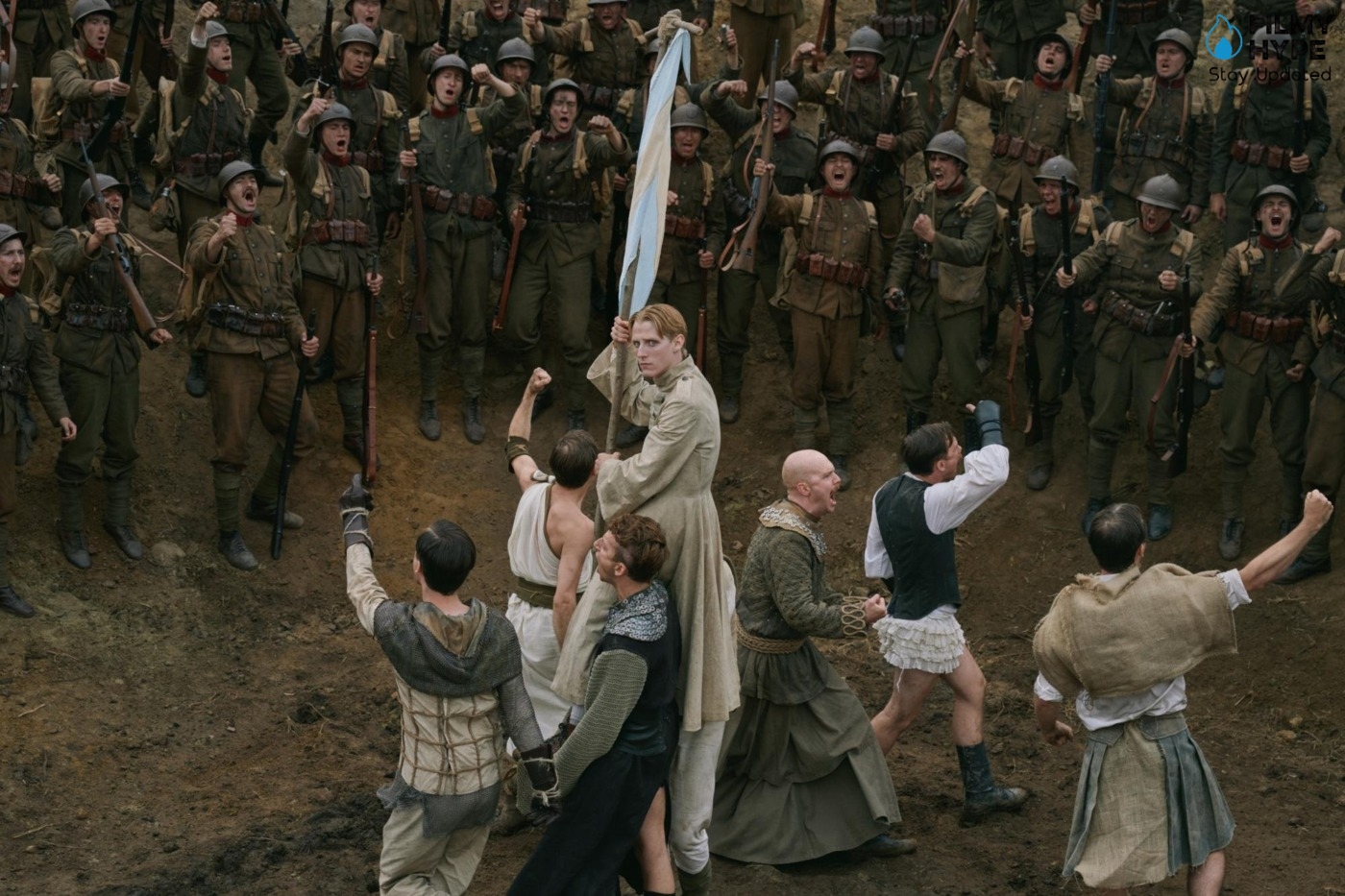
Visually, Coward is probably Dhont’s finest film. Frank van den Eeden’s photography alternates the mud, blood, and greyness of the trenches with almost suspended, soft, luminous moments, especially during the shows organized by Francis. The musical scenes become real, almost unreal spaces of emotional escape, where the film temporarily stops being a war movie and transforms into something profoundly human and romantic. The direction is very elegant but never cold: Dhont films bodies, glances, and desire with rare sensitivity. Even in the hardest moments, the film always maintains an incredible emotional delicacy.
Much of the film’s strength comes from the impressive chemistry between the two leads. Emmanuel Macchia, practically a debutant, is extraordinary in the role of Pierre. He can communicate almost everything through his eyes and body language: fear, desire, confusion, love. It’s a restrained but very powerful performance. Valentin Campagne instead brings energy, sensuality, and vulnerability to the film. His Francis is theatrical, provocative, but also deeply fragile. Behind the confidence of a performer, one continually perceives the fear of losing that one space of freedom that war, paradoxically, is granting him. Together they work perfectly.
There are moments in Coward that really hit home. Dhont manages to create scenes of an almost devastating sweetness precisely because they are placed within a context of continuous death. The moments of intimacy between Pierre and Francis not only serve to tell the story of a queer relationship but also become a form of emotional resistance against the brutality of war. And the film finds its greatest strength right there: in the continuous contrast between the horror of the front and the possibility, even tiny and fragile, of loving someone. Some sequences –especially the first kiss and certain night scenes between the two protagonists – are shot with a sensitivity that we have rarely found on the big screen.
Dhont in Coward is more restrained and controlled than the two films that introduced him to the general public. Coward remains an intensely sentimental film, but it almost avoids melodramatic excess and lets the characters breathe. Some passages remain a bit predictable, and the middle could perhaps have been a little more compact, but overall the film finds a much more mature balance than the director’s previous works. Coward is a film about war, but above all, it is a film about love and the right to exist even in the most hostile places. Dhont takes classic romantic melodrama and places it within one of the most brutal contexts in European history, while always managing to maintain a focus on the emotions and humanity of his characters. It is a delicate, sensitive cinema, full of pain but also of grace. And most of all, it’s one of those movies that really manages to leave something behind even after the credits roll.
With a mastery that seems that of someone who has always handled the war genre, Dhont immediately throws us into the madness and mud of an unbearable routine: the camera does not retreat an inch from the face, from the bodies, from the display (forced in Pierre’s case, as can be seen on more than one small occasion) of a comradely manhood that is a mirror and facade of the only hope of survival in such a context. The trench abandons itself mostly and only for a few minutes to go and collect the bodies of mortally wounded comrades. Avoiding going crazy becomes more complicated every day: someone shoots himself, someone else, Pierre tries the path of self-inflicted wounds to get away from the massacre, and thus be able to take part in Francis’s shows.
The gloomy and deadly tension of the first part of the film – dampened precisely by the moments inhabited by the leader intent on organizing those shows with another handful of soldiers (the gang of outcasts) en travesti – little by little it transforms into homoerotic tension, transporting the war movie to the shores of the tragic world: Pierre (who before enlisting worked as a farmer) and Francis (a tailor in his father’s prestigious shop) begin bringing the shows to military hospitals, thus deluding themselves into thinking they are moving away from war and death. Far from the trench, they can give body to their love, but could that same love ever exist outside of war?
Ultimately, it is another way to object, to desert death, to escape the infernal cycle of a conflict that, in the eyes of those who fight it, makes no sense. Dhont shoots with veteran mastery, traverses spaces, blends glances and bodies, is not pure of blood and mud, and is capable of making the scream and fury of his young protagonists heard, who all take courage together with a camaraderie that does not admit betrayal. Yet, in the face of death, one inevitably rediscovers oneself alone. The continuous tension that runs through the first part transforms into eroticism, conquest, and idyll in the second: for Pierre and Francis, it remains only to survive and face the consequences of what happens next.
Dhont’s film is very bright, bathed in a golden light, almost always shot in broad daylight, full of life, youth, and anger, in a context that continually mortifies them. Only apparently weak from a narrative point of view, it is instead capable of gradually isolating, in the large overall scenes, a small, singular, intimate story, which nevertheless becomes large, emblematic, and common in its identity anxiety. Who are the two blond, ephebic boys really? Will they go back to being the ones from before the war? Will they be able to think about doing it together? If Francis imagines pursuing the family imperative by indulging his father’s wishes and running away from his desires and love, Pierre has no father to return to. For him, life begins all over again, with another name, other clothes, another life, but faithful to itself.
Coward Film Review (Cannes 2026): The Last Words
Coward, Lukas Dhont signs his most mature and poignant film: a queer love story set during World War I that combines brutality and tenderness with great sensitivity. Through the relationship between Pierre and Francis, two young soldiers who fall in love at the front, the director recounts the desire, fear, and human need for connection within the horror of war. Visually magnificent, shot with enormous elegance and beautifully performed by Emmanuel Macchia and Valentin Campagne, the film contains scenes truly capable of touching the heart.
Once again, then, Dhont thinks about cages, the contexts within which people are forced not only to act, but above all to be, the comparison with Brokeback Mountain Secrets – there they were cowboys of the years ‘60, here kids transformed into soldiers by History – it’s not that far-fetched and despite some deviations towards the epilogue (still beautiful for its retained elegance and openness to hope), Coward definitively confirms the great talent of the Belgian director, born in 1991.