

Warning: This article contains major spoilers for Project Hail Mary and Disclosure Day, including some passages from the finale.
The final mission: Project Hail Mary and Disclosure Day are two very different science fiction films, but they have one huge thing in common: aliens are not the enemy to be taken down. In the film starring Ryan Gosling, based on Andy Weir’s novel, contact with Rocky becomes a story of friendship, trust, and survival. In Steven Spielberg’s new film, however, the revelation about extraterrestrials serves not to start a war, but to force humanity to listen to something it has ignored for too long. On one side is Disclosure Day, Steven Spielberg’s return to one of the themes that shaped his career. From the other Project Hail Mary, the adaptation of Andy Weir’s bestseller, directed by Phil Lord and Christopher Miller, and starring Ryan Gosling.
Project Hail Mary Vs Disclosure Day: Which Film Best Chronicled First Contact With Aliens?
They are very different films in tone, setting, and narrative structure. One is an Earth thriller made up of government cover-ups, whistleblowers, and secrets kept for decades. The other is a great space adventure that takes its protagonist to the edge of the solar system to save Earth from an unprecedented catastrophe. Yet they share the same intuition. Aliens are not the problem. The problem is how humans react to what they don’t understand.
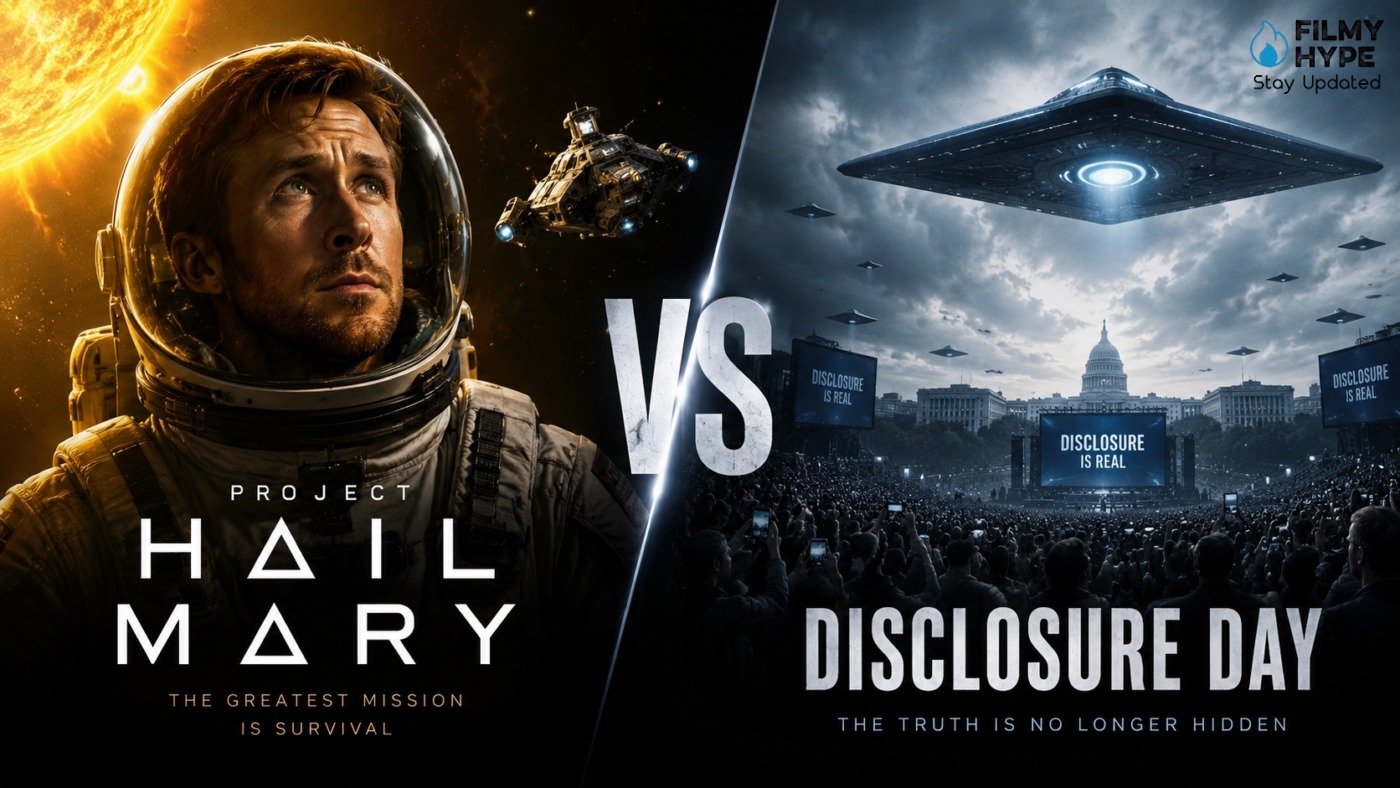
For decades, science fiction cinema has taught us a very simple thing: when aliens arrive, it’s usually trouble. Whether it’s invasions, interplanetary wars, or threats from the stars, much of the modern science fiction imagination has been built on the idea that the unknown must be feared. Yet two of the most popular films of 2026 have chosen a completely different path.
And this choice, in 2026, weighs heavily.
We are used to seeing aliens as a threat. They come from the sky, destroy buildings, erase cities, blow up the White House, occupy the Earth, kidnap people, metaphorically shout “we are superior”, and then someone has to save the day with a missile, a computer virus, or a patriotic speech. That’s fine, huh. Cinema has also given us wonderful films with this setting. But now and then, it’s good to see a science fiction that tries another path.
Project Hail Mary and Disclosure Day do just that. They look at the unknown and do not start from fear. They start from the possibility.
Project Hail Mary Turns an Alien Into a Friend?
The final mission: Project Hail Mary, starts from a very dramatic premise. Ryland Grace, played by Ryan Gosling, wakes up on a spaceship far from Earth, without remembering who he is or why he is there. Little by little, he realizes that his mission is about the survival of the planet. A mysterious life form, called an astrophage, is draining energy from stars, including the Sun. If no solution is found, the Earth risks a climate catastrophe.
On paper, it looks like a classic film about a man alone in space. The protagonist against the universe. Silence, fear, science used as a last hope. Then Rocky comes along.
Rocky is a very different alien than Hollywood has used us to imagine the “first contact”. It’s not elegant, it’s not humanoid in the reassuring sense of the word, it doesn’t speak English after two minutes, and it doesn’t arrive with technology explained in a way that’s convenient for the viewer. It is a rocky creature, intelligent, fragile in its own way, with a biological environment incompatible with the human one.
Ryland is scared at first. Normal. You wake up on a suicide mission, find the crew dead, and then find an alien in front of you. Even the quietest of science teachers would need to sit down for a moment.
The beauty is that the film doesn’t stop at the scare. Ryland and Rocky learn to communicate. They built a translation system. They study each other. They help each other. They understand that they have the same problem, even if they come from very distant worlds. Both want to save their planet. Both are alone. Both need the other.
At that point, Project Hail Mary becomes something more beautiful than just “let’s save the Earth”. Become a space buddy movie. A story of friendship born in the least comfortable place possible: in deep space, with incompatible atmospheres, different languages, and a cosmic threat upon us. In short, not exactly the classic “let’s have a coffee and talk” situation.
Disclosure Day: Tells Aliens As a Truth to Listen To?
Disclosure Day starts in a different territory. We are on Earth, inside a story of secrets, cover-ups, and revelations. The film follows Daniel Kellner, played by Josh O’Connor, Jane Blankenship, played by Eve Hewson, Hugo Wakefield, played by Colman Domingo, and Margaret Fairchild, played by Emily Blunt. At its core is the attempt to show the world that extraterrestrial life exists and that someone, for decades, has kept this truth hidden.
Spielberg doesn’t use aliens as monsters to reveal, though. It doesn’t build history around the question “how do we defeat them?” The question is another: are we capable of accepting what we do not control?
In the film, extraterrestrials are not presented as a destructive force. They are creatures who have sought contact, who have chosen some people, who have also manifested themselves through less frightening forms. As children, Daniel and Margaret come into contact with something they can’t quite understand. Years later, those experiences resurface and become the center of revelation.
The final scene, with the global broadcast and the appearance of the alien In Vivo, takes the film to a very simple word: “Listen”, listen.
And it’s a perfect closing for Spielberg’s speech. After years of secrets, fear, manipulation, and control, the message is not “prepare for war”. It’s not “give up”. It’s not “we know everything, and you know nothing”. It’s an invitation to listen.
I really like this choice, because it’s almost the opposite of screamed science fiction. Spielberg does not extinguish fear, because contact with the unknown is necessarily scary. But try to say that fear doesn’t have to be the only answer.
The Two Films Are About Communication Even Before Aliens?
The thing that unites Project Hail Mary and Disclosure Day is not just the idea of good aliens. It would be too simple. The strongest link is in communication.
In Project Hail Mary, Ryland and Rocky can’t work together until they find a way to understand each other. Their friendship is born of trial, error, observation, sound, symbols, and patience. There is no magic shortcut. It’s not enough to say “hello, alien, let’s become friends”. They must build a common language.
Something similar happens in Disclosure Day, but on a larger scale. Humanity has received signals, traces, clues, and encounters, but has often chosen to bury, militarize, or deny them. The problem isn’t just that aliens are hard to understand. The problem is that humans can’t listen without immediately wanting to check.
This is an important difference. The two films are not naive. They don’t say that every encounter with the different is simple, tender, and full of sweet music. They say the first step shouldn’t always be armed defense. Sometimes, before we decide that something is a threat, we might try to understand it.
It seems like a triviality. In the world we live in, unfortunately, it is not.
2026 Science Fiction Seems Less Interested In Destruction
One thing is striking: two of the most talked-about sci-fi films of 2026 choose a more emotional, more open-minded, less destruction-obsessed science fiction. Project Hail Mary has an enormous danger, because the Earth is at risk of ruin. Disclosure Day has plots, escapes, hidden powers, and a truth kept under lock and key. However, in both cases, the solution does not come from brute force.
Switch from collaboration.
Ryland doesn’t save Earth alone. He needs Rocky. And Rocky needs him. Daniel and Margaret can’t just survive: they have to get a message across to the world. There too, a network of trust is needed, people who believe in each other, gestures made at the right time.
It’s science fiction that doesn’t give up on the show, but puts the heart at the center. And this thing, if done badly, can get sugary. If done well, however, it stays with you. Project Hail Mary works because the friendship between Ryland and Rocky becomes believable. Disclosure Day works because Spielberg uses aliens to talk about our difficulty actually looking at each other, without turning every difference into a war.
Rocky And In Vivo Are Two Different Answers To The Same Question?
Rocky and In Vivo couldn’t be more different. Rocky is a character we spend a lot of time with. We see him making mistakes, learning, collaborating, taking risks, and becoming attached. He almost becomes an emotional co-protagonist, not just a plot-functional alien.
In Vivo, however, it is more mysterious. He appears in the ending of Disclosure Day as a symbolic, almost sacred presence. It doesn’t serve to become “the sympathetic character”. It serves to close the film with an open question. Rocky makes us understand that the other can become friends. In Vivo reminds us that the other can remain mysterious and still deserve a listen.
There are two different ways of saying the same thing: we don’t have to understand everything right away to stop being afraid.
And that’s a very un-Hollywood phrase, if you think about it. Hollywood often wants to explain, solve, and classify. Good, bad. Friend, enemy. Threat, salvation. These two films take a more interesting risk: they leave room for uncertainty.
Why Does This Idea Make Both Films Better?
Project Hail Mary would have been a good film, just as a science adventure in space. Disclosure Day would have been interesting just as a thriller about a UFO revelation. But both become stronger because they choose not to treat aliens as targets.
This choice opens the story. It makes her more human, paradoxically. Because the way we treat the alien says a lot more about us than it does. If in front of an unknown creature we only think about defending ourselves, perhaps we are showing our fear. If we try to communicate, we are telling a hope.
And there’s no need to give the speech from “Let’s love each other among the stars”. Neither film says the encounter with the unknown is easy. Project Hail Mary is about sacrifice, isolation, and painful choices. Disclosure Day is about secrets, power, and institutions that prefer to hide the truth. But both suggest that the only way out is to stop reasoning alone against everyone.
Maybe that’s why they come to the public so well. In a time when we’re filled with divisions, suspicions, anger, and bubbles that don’t communicate with each other, two blockbusters saying “listen” and “cooperate” almost seem strange. Not because they are naive. Because I’m against the grain.
At the end, Project Hail Mary and Disclosure Day talk about aliens, but they look at us. They ask us if we are capable of trusting. Learning a new language. To recognize a friend where we thought we would find an enemy. To stop for a moment before reacting with panic.
And maybe this is true science fiction: don’t imagine creatures light-years away, but imagine humans a little less scared of what they don’t know.
Which of the two films struck you most: The Last Mission: Project Hail Mary or Disclosure Day? Write it in the comments.