


Apple TV’s Neuromancer Teaser: There’s a particular kind of pressure that comes with adapting a book that predicted the future. Not a future of flying cars and ray guns, but the actual, grimy, corporatized, digitally saturated future we’re all living in. William Gibson’s Neuromancer didn’t just imagine cyberspace before the Internet existed. It imagined a world where corporations have more power than governments, where bodies are modified, and memories are hacked, where information is the most valuable currency, and the line between human and machine has become permanently blurred. When the novel was published in 1984, this was speculative fiction. In 2026, it’s just the news.
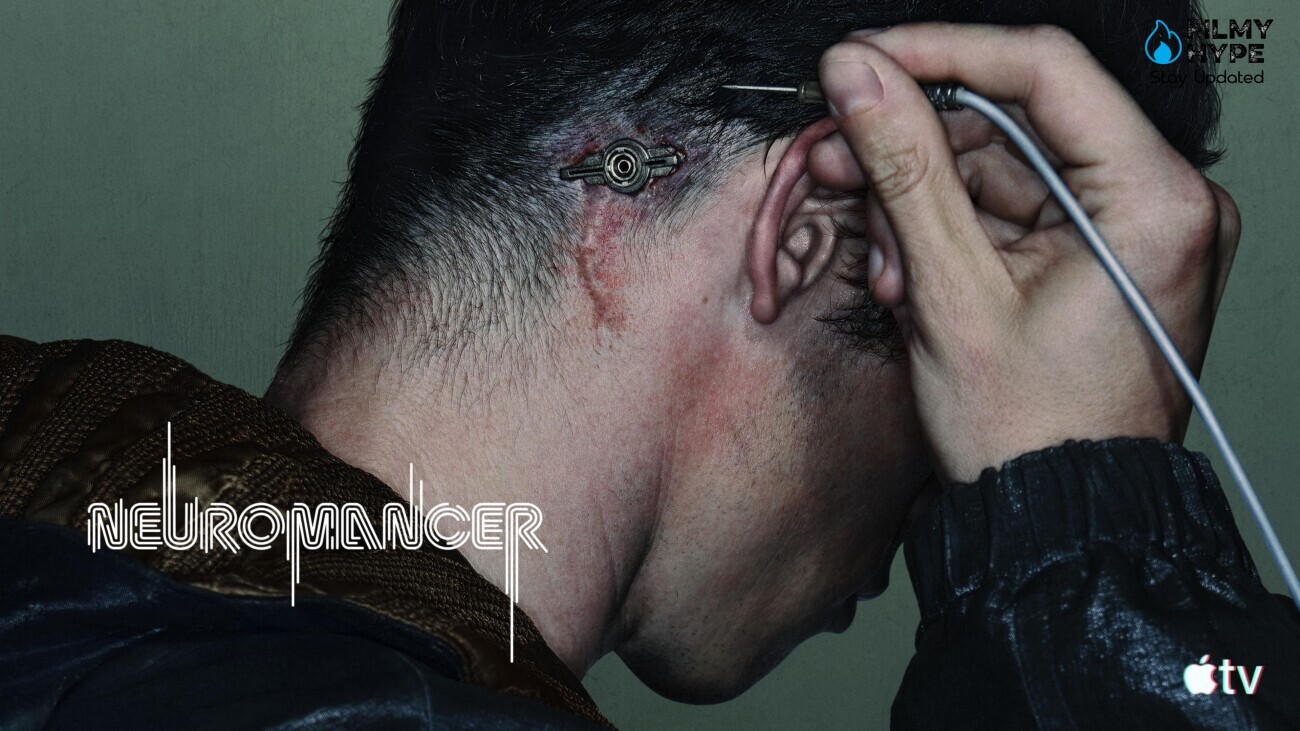
Apple TV’s Neuromancer Teaser: The Adaptation of the Novel That Invented the 21st Century Is Finally Here!
Apple TV has been building toward this moment for years. The platform’s science fiction catalog—Severance, Silo, Dark Matter, Foundation—has carved out a distinct identity, one rooted in the human consequences of technological systems rather than space battles or alien invasions. These are shows about memory, identity, surveillance, and control. Neuromancer is the text that laid the groundwork for all of them. Now, after decades of false starts and abandoned adaptations, Gibson’s novel is finally coming to the screen as a ten-episode series premiering January 22, 2027.
The announcement came at San Diego Comic-Con 2026, alongside a first teaser that suggests the adaptation understands something crucial about its source material. Cyberpunk isn’t about shiny futures. It’s about decay. It’s about what happens when technology advances faster than wisdom, when the people who build the systems lose control of them, and when the only people who can navigate the wreckage are the ones who’ve already been broken by it.
The Story: A Hacker, a Mercenary, and the Heist That Could Change Everything
For those who haven’t spent decades living inside Gibson’s prose, the plot of Neuromancer is both straightforward and deliberately disorienting. Henry Dorsett Case is a console cowboy—a hacker—who was once the best in the business. He could navigate cyberspace with an intuitive grace that made him untouchable. Then he stole from the wrong people. His employers didn’t kill him. They did something worse. They damaged his nervous system so he could no longer jack into the matrix. For a man whose entire identity was built on the digital, it was a fate worse than death.
Case is introduced in Chiba City, Japan, where he’s been slowly killing himself with drugs and desperation, hustling for scraps in a world that’s moved on without him. He’s a burnout, a ghost haunting the edges of the criminal underworld he used to dominate. Then he’s approached by Molly Millions, a “Razorgirl” with mirrored lenses surgically implanted over her eyes and retractable blades under her fingernails. She works for a man named Armitage, who offers Case something no one else can: a cure. His nervous system was repaired. Access to cyberspace restored. In exchange, Case agrees to participate in a heist. The target is an artificial intelligence. The stakes are nothing less than the future of consciousness itself.
What follows is a journey through the Sprawl—the vast urban corridor stretching from Boston to Atlanta—and into orbit, where the Tessier-Ashpool family controls one of the most powerful AIs ever created. The novel weaves together corporate intrigue, body modification, virtual reality, and philosophical questions about the nature of selfhood. It’s a heist story, a love story, and a horror story, often in the same scene.
The Cast: Finding the Faces for Gibson’s World
Callum Turner takes on the central role of Case, and the casting suggests the series understands something essential about the character. Case isn’t a hero. He’s not even particularly likable. He’s brilliant and self-destructive, capable of extraordinary things in cyberspace and almost completely useless in the physical world. Turner, whose work in Masters of the Air and The Boys in the Boat has shown a capacity for playing men who are both competent and haunted, seems equipped to handle the duality.
Briana Middleton plays Molly Millions, and this is arguably the most important casting decision the series had to make. Molly is one of the great characters in science fiction—lethal, pragmatic, and carrying a backstory that’s revealed in fragments. She’s the body to Case’s mind, the person who handles the physical world while he navigates the digital one. The mirrored lenses permanently sealed over her eyes aren’t just a visual signature. They’re a statement. She sees the world differently because she’s chosen to. Middleton, who broke out in The Tender Bar and has been steadily building a reputation for intensity and intelligence, has the chance to define this character for a generation.
Mark Strong plays Armitage, the enigmatic figure who assembles the team and whose true nature becomes one of the novel’s central mysteries. Strong has built a career on men whose surfaces are calm and whose depths are turbulent, and Armitage—a man who may not be entirely a man—fits that mold perfectly.
The supporting cast extends deep into the novel’s mythology. Clémence Poésy plays Marie-France Tessier, the visionary behind the Tessier-Ashpool dynasty. Peter Sarsgaard plays John Ashpool, her husband and partner in building an empire that spans Earth and orbit. Dane DeHaan takes on Peter Riviera, one of the most disturbing characters in the novel—a man who can project holographic illusions directly into other people’s minds and uses that ability in ways that are deeply, deliberately unsettling. Emma Laird plays Linda Lee, Case’s girlfriend from Chiba, whose fate becomes one of the story’s emotional anchors. Joseph Lee, Max Irons, André De Shields, and Isabella Pappas round out the ensemble.
The Creative Team: Translating the Untranslatable
Neuromancer has defeated filmmakers for four decades. At various points, names like Chris Cunningham, Joseph Kahn, and Vincenzo Natali were attached to adaptations that never materialized. The problem was never a lack of interest. It was a lack of a viable approach. Gibson’s prose is dense with invented slang, his narrative jumps between physical and virtual spaces without warning, and his vision of cyberspace is more sensory than visual—a “consensual hallucination” that’s easier to feel than to depict.
Graham Roland, the showrunner, comes to the project with a background that suggests he understands the challenge. He wrote for Fringe, a series that routinely balanced character drama with mind-bending speculative concepts. He ran Tom Clancy’s Jack Ryan, demonstrating an ability to manage large-scale action while keeping the focus on a central, complicated protagonist. He’s also an executive producer on Ghost War, the Jack Ryan film spin-off. Roland has spent years working at the intersection of genre spectacle and character-driven storytelling, which is exactly where Neuromancer needs to live.
J.D. Dillard directs the pilot. His work on The Twilight Zone revival and the Prime Video series Utopia shows a filmmaker comfortable with the uncanny—stories where reality feels slightly off, where the familiar has been invaded by something strange. The pilot of a series like this has to do an enormous amount of work: introduce the world, establish the rules of cyberspace, make the audience care about a protagonist who’s actively difficult to like, and set up a mystery that will sustain ten episodes. Dillard’s experience with genre television that prioritizes atmosphere over exposition is a good sign.
The Aesthetic: Neon, Decay, and the Samurai Connection
The teaser makes clear that the series is leaning into the Japanese influences that run through Gibson’s novel. Chiba City, where Case is introduced, is a Japanese port city that Gibson described with the kind of detail that made readers feel they could smell the street food and the ozone. The series appears to be honoring that specificity rather than sanding it down into generic cyberpunk visuals.
But the broader aesthetic is defined by decay. This isn’t the clean, Apple-store future that some science fiction imagines. The technology in Neuromancer is greasy and improvised, patched together from components that were never meant to work together. Bodies are modified not because modification is glamorous but because survival requires it. The neon is beautiful, but it’s also desperate—a splash of color against a background of rust and concrete and exhaustion.
The visual effects serve the story rather than the other way around. Cyberspace, in the brief glimpses the teaser provides, looks less like a video game and more like a dream—geometric, abstract, constantly shifting. It’s a space made of data and light, and the filmmaking seems to understand that the wonder of it has to be balanced against the danger. In Neuromancer, cyberspace isn’t an escape. It’s just another battlefield.
Why Now?
Gibson wrote Neuromancer in a world where the internet was a niche academic tool and artificial intelligence was pure speculation. The novel’s prescience is so complete that adapting it now risks the opposite problem from when it was published: not that it seems too far-fetched, but that it seems too familiar. We live in a world of corporate surveillance, data brokers, AI systems that make decisions we don’t understand, and a digital economy that has blurred the boundaries between self and technology. The future Gibson warned about isn’t coming. It arrived.
The adaptation’s challenge, then, is to make the material feel urgent rather than redundant. To remind audiences that Neuromancer wasn’t just predicting gadgets. It was predicting a feeling—the sense of living in a world where the systems that control your life are too complex to understand, too powerful to challenge, and too entrenched to escape. That feeling hasn’t aged. It’s intensified.
If the series can capture the paranoia, the exhaustion, the flickering hope that runs beneath Gibson’s cynicism, it won’t just be a successful adaptation. It’ll be a necessary one. The teaser suggests the creative team understands the assignment. The cast suggests the performances will be there. The release strategy—ten episodes, weekly after the two-episode premiere, wrapping up in March 2027—suggests Apple believes in the material enough to let it breathe.
January 22, 2027, is the date. The matrix is waiting. All that’s left is to jack in.