
Carrie TV Series First Trailer: The first teaser trailer for Mike Flanagan‘s Carrie series has arrived, and it’s clear within seconds that this isn’t going to be a simple retread of familiar territory. The imagery is iconic—the prom, the blood, the wide-eyed girl at the center of it all—but the texture of what Flanagan is building feels entirely new. This is Carrie for a generation that lives its worst moments online, where humiliation isn’t just witnessed by a gymnasium full of classmates but preserved, shared, and amplified across platforms that never forget.
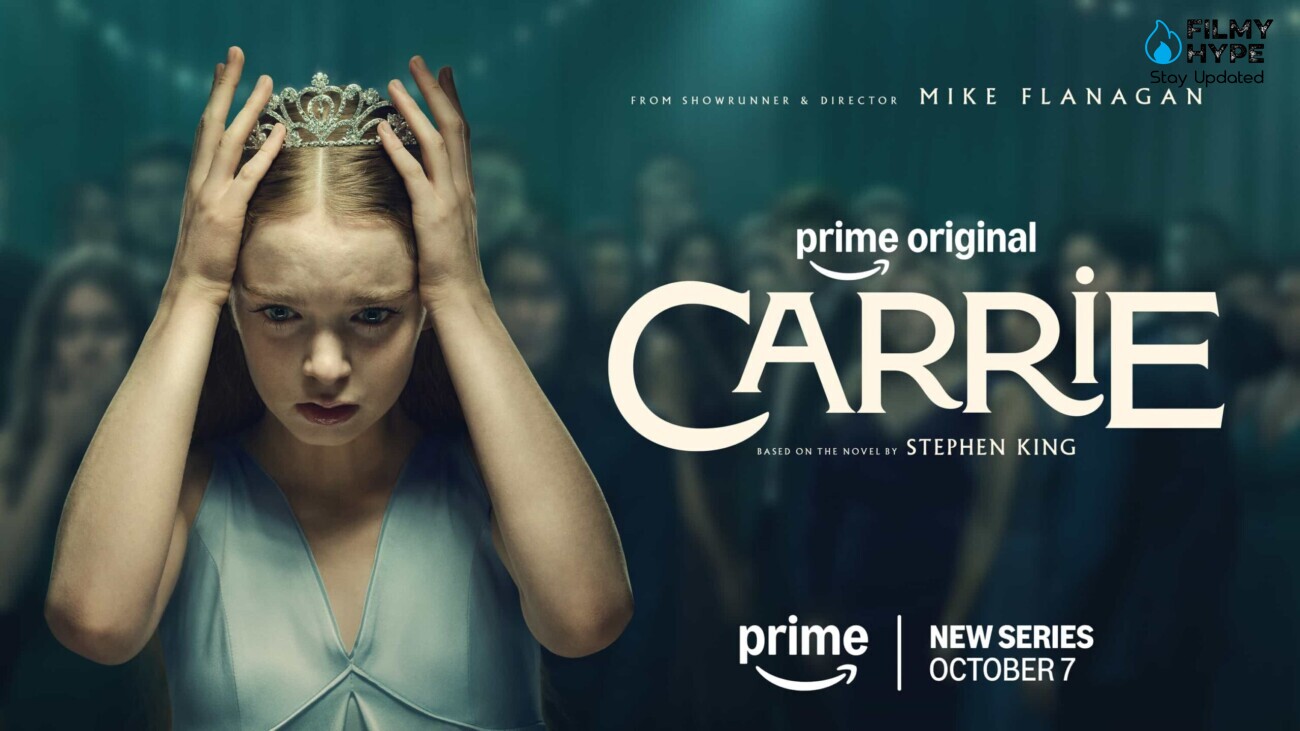
Prime Video will release all eight episodes on October 7, and the teaser makes clear that Flanagan, the mind behind The Haunting of Hill House, Midnight Mass, and Doctor Sleep, is treating King’s first published novel with the gravity it deserves. This is the first television adaptation of Carrie, and the expanded format gives Flanagan room to explore dimensions of the story that a two-hour film—even Brian De Palma’s iconic 1976 version—could only gesture toward.
Carrie TV Series First Trailer: What the Teaser Shows
The teaser is built around the prom sequence, the moment that has defined Carrie in the cultural imagination for nearly five decades. We see the gymnasium, the decorations, the nervous excitement of teenagers dressed up for a night that’s supposed to matter. And then we see Carrie White, played by Summer Howell, standing in the center of it all.
The blood comes. The expression on Carrie’s face shifts from confusion to something far more terrifying—not rage, exactly, but a kind of awful clarity. The telekinetic power that’s been building inside her all her life, suppressed and denied and beaten down by her mother’s religious fanaticism and her classmates’ cruelty, finally releases. The teaser doesn’t show the full destruction, but it shows enough. The lights flicker. The walls tremble. The prom becomes a kill box.
Interspersed with the prom imagery are glimpses of the world that created this moment. Carrie at home, under the oppressive eye of her mother, Margaret, played by Samantha Sloyan. Carrie is at school, navigating hallways full of people who see her as a target. Brief flashes of smartphone screens, social media posts, and the digital architecture of modern bullying. Flanagan isn’t just adapting King’s novel. He’s translating it into a vocabulary that speaks directly to how cruelty operates now.
The Story: King’s Novel Expanded for a New Era
The basic architecture of Carrie remains intact. Carrie White is a teenage girl with telekinetic powers she doesn’t understand and can’t control. Her father is dead. Her mother is a religious fanatic whose love is indistinguishable from abuse. When Carrie is forced to attend public school, she enters an environment where her strangeness makes her a magnet for cruelty. The bullying escalates. The powers grow. The prom becomes the flashpoint where everything explodes.
But Flanagan has been explicit about what makes this adaptation different. In interviews leading up to the release, he described the series as addressing “cruelty in today’s world and how the internet encourages, rewards, and amplifies it.” The bullying Carrie endures isn’t just whispered in hallways or scrawled on notes. It’s viral. It’s permanent. It’s the kind of humiliation that follows a person home, that lives on their phone, that gets replayed and reshared until the original context is obliterated and all that’s left is the pain.
The eight-episode format allows Flanagan to do something the 1976 film and its various sequels and remakes couldn’t: develop Carrie as a person rather than a symbol. The series reportedly spends significant time on her interior life, her attempts to understand her powers, her relationship with her own body, and her own anger. The prom isn’t just a climax. It’s a culmination of episodes of accumulated damage, each one adding weight to the eventual explosion.
Flanagan consulted with actual teenagers while developing the series, a choice that speaks to his interest in getting the texture of contemporary adolescence right. The cast is built around young actors who can carry the specific awkwardness and intensity of being seventeen in a world that’s always watching. Over a thousand auditions were held for the lead role before Summer Howell was cast, suggesting the level of care that went into finding someone who could embody Carrie’s vulnerability and her eventual, terrifying power.
The Cast: Flanagan Regulars and New Faces
Flanagan has built a repertory company of actors across his various projects, and several of them appear here. Samantha Sloyan, who delivered one of the most chilling performances in Midnight Mass as the fanatical Bev Keane, takes on the role of Margaret White. It’s casting that makes almost too much sense. Sloyan has already proven she can play religious conviction as a form of psychological violence, and Margaret White is one of the great monsters of American literature—a woman whose love for her daughter is so twisted by fear and doctrine that it becomes indistinguishable from torture.
Kate Siegel, a Flanagan regular and his wife, appears in an undisclosed role. Rahul Kohli, another Midnight Mass and The Fall of the House of Usher veteran, is also in the cast. Matthew Lillard brings his particular intensity to the ensemble, while Amber Midthunder, fresh off her standout work in Prey, adds another layer of genre credibility.
The younger cast includes Alison Thornton, Siena Agudong, Josie Totah, Arthur Conti, and Joel Oulette, all playing the classmates whose cruelty—and occasional, complicated kindness—shapes Carrie’s world. Heather Graham, Michael Trucco, and Katee Sackhoff round out the adult ensemble.
The Flanagan-King Partnership Deepens
Carrie is the latest collaboration between Flanagan and Stephen King’s work, and it’s part of a growing creative relationship that shows no signs of slowing down. Flanagan previously adapted Gerald’s Game into one of the best King films of the 2010s, a claustrophobic masterpiece that proved King’s supposedly unfilmable novels could be translated with intelligence and care. He followed it with Doctor Sleep, a sequel to The Shining that somehow honored both King’s novel and Stanley Kubrick’s film while carving out its own identity.
His most recent King adaptation, The Life of Chuck, premiered in 2024 to strong reviews. And he’s currently developing a series adaptation of The Dark Tower, King’s sprawling magnum opus that has defeated multiple attempts to bring it to the screen. King has been publicly enthusiastic about Flanagan’s take on Carrie, describing it as a modern vision that captures something essential about the novel while updating it for a world the original author couldn’t have imagined in 1974.
The Legacy of Carrie
When Stephen King wrote Carrie in 1974, he was a struggling teacher living in a trailer, and the novel was his last-ditch attempt to break into publishing. He famously threw the manuscript in the trash, and his wife Tabitha fished it out and convinced him to finish it. The book became his first published novel, launched his career, and established the template for much of what followed: ordinary people in extraordinary circumstances, the horror that grows out of human weakness rather than external monsters, the American small town as a pressure cooker of secrets and cruelties.
Brian De Palma’s 1976 film adaptation became a classic in its own right, earning Sissy Spacek an Oscar nomination and cementing the prom sequence as one of the defining images of horror cinema. There have been sequels, a television movie, a 2013 remake, and countless homages and references across popular culture. The story has proven remarkably durable, in part because its central dynamic—the bullied outsider who finally snaps—remains tragically relevant.
What Flanagan seems to be doing is taking that durability and stress-testing it against the present. The bullying Carrie endures in 2026 isn’t qualitatively different from what King imagined in 1974, but it’s quantitatively different. The scale is different. The permanence is different. A humiliating moment at the prom, in King’s original telling, was witnessed by the people in the room. Today, it’s witnessed by everyone. The trauma doesn’t end when the blood is washed off. It lives on screens, in group chats, in the endless scroll of content that turns other people’s pain into entertainment.
That’s the horror Flanagan seems to be reaching for. Not just the telekinetic destruction, though that will certainly be there. But the quieter, more insidious horror of being a young person in a world that has built an entire infrastructure around amplifying cruelty. Carrie White’s powers may be supernatural. The forces arrayed against her are not. They’re human. They’re everywhere. And in Flanagan’s telling, they’ve never been harder to escape.
October 7 is the date. The blood is already in the bucket. All that’s left is to see what happens when it falls.