

I walked out of Nolan’s The Odyssey feeling something I haven’t felt in a long time at the movies—that specific kind of awe that comes from seeing mythological creatures rendered with enough weight and texture that they feel like they actually exist. Not CGI spectacles floating weightlessly across the screen. Not cartoonish monsters that break the tension. But beings that carry genuine menace, genuine strangeness, and the particular terror that Homer’s original audiences must have felt hearing these stories around a fire.
All the Mythological Creatures Appeared in Christopher Nolan’s The Odyssey: A Complete Guide
Nolan has always been a filmmaker interested in the mechanics of reality, even when he’s dealing with the impossible. Dream-sharing in Inception has rules. Time inversion in Tenet has physics. So what happens when he turns his attention to a poem full of one-eyed giants, sorceresses who transform men into animals, and six-headed monsters lurking in narrow straits? The answer, it turns out, is something remarkable: a film that embraces the fantastic completely while grounding it in a tactile, almost documentary-like physicality.
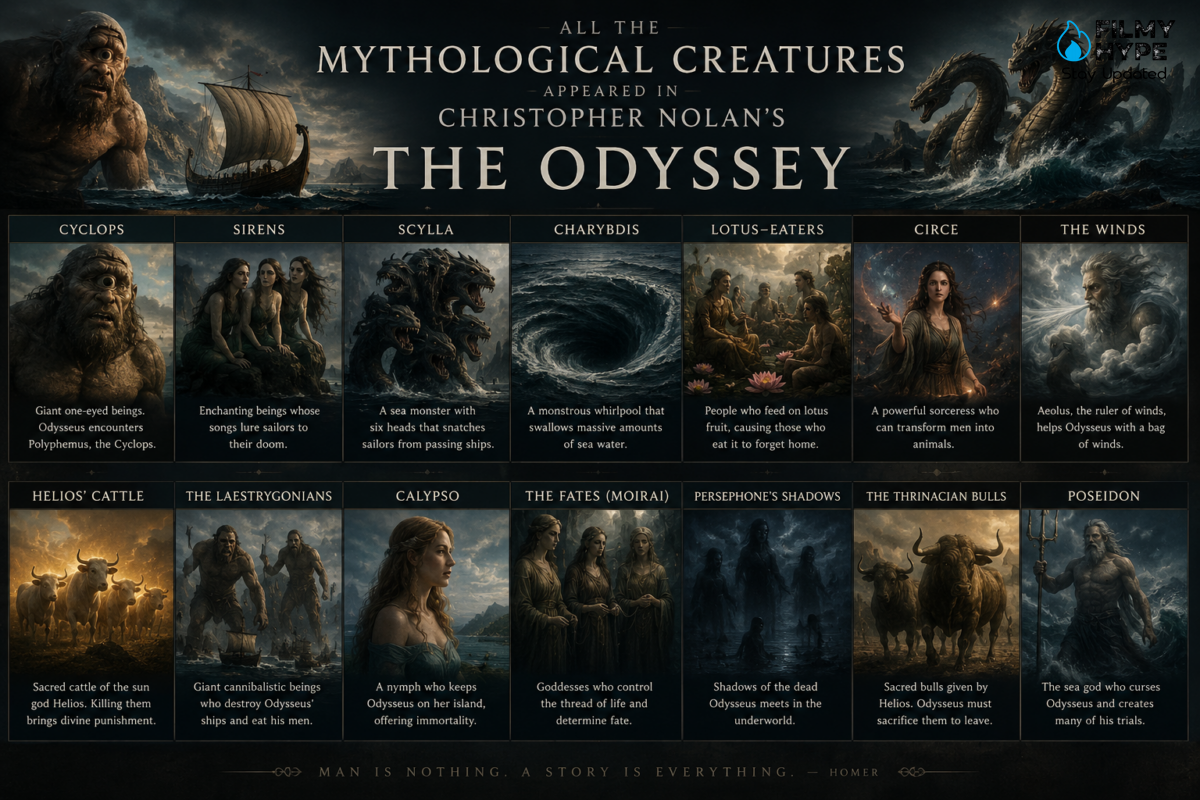
Here’s every mythological creature and divine figure that appears in Nolan’s The Odyssey, how they’re portrayed, and what the film does differently from the poem.
At the center of the story stands Odysseus, a cunning king and reluctant warrior, fresh from a war that was both myth and massacre: the ten-year siege of Troy. Yet, instead of finding rest, Odysseus finds himself condemned to a return journey that seems designed by a higher mind to test a man’s moral standing. For years away from Ithaca, Odysseus has become a liminal entity: no longer a historical figure, not yet a ghost. No one knows whether he is alive or dead, whether his name belongs to the chronicle or to legend. To reunite with his wife and son, he must cross seas that seem designed to swallow men, lands where logic cracks, and a repertoire of obstacles made up of gods, monsters, mermaids, and witches who embody, with astonishing modernity, the fears and seductions of humanity as a whole. The epic nature of the Odyssey is immediately visible in the description of the protagonist’s various adventures, while its deeper dimension, that which speaks of the human being, requires a different attention, almost a reading “in filigree”.
Polyphemus, the Cyclops Son of Poseidon
The Cyclops is Odysseus’s first major mythological obstacle, and in some ways, he’s the most important, because everything that goes wrong afterward traces back to this encounter. Polyphemus is a son of Poseidon, and when Odysseus blinds him and escapes, the Cyclops prays to his father for vengeance. Poseidon listens. The storms, the shipwrecks, the years of wandering—all of it starts here.
Nolan’s Polyphemus is enormous without feeling inflated. The design avoids the typical movie-monster trap of making the Cyclops just a scaled-up human with one eye. There’s something genuinely unsettling about his proportions, the way he moves through his cave, the sheer physicality of a being who can block the entrance with a boulder that a dozen men couldn’t shift. The eye isn’t just a feature—it’s a presence, unblinking, alien, wrong in a way that registers before you can articulate why.
The film keeps the essential beats of the Homeric episode. Odysseus and his men are trapped in the cave. Polyphemus eats several of them—the film doesn’t shy away from the brutality of this, though it also doesn’t linger gratuitously. Odysseus tells the Cyclops his name is “Nobody,” gets him drunk, and drives a sharpened stake into the single eye. The escape beneath the sheep is rendered with genuine tension; you feel the weight of the animals, the heat of their bodies, the blind giant’s hands groping across wool, inches from discovery.
And then the crucial moment: as Odysseus sails away, he can’t resist revealing his true name. It’s an act of pride that has always been the point of the episode. Odysseus is clever enough to escape, but not wise enough to escape quietly. Nolan emphasizes this, letting the audience feel the crew’s horror as their captain dooms them all for the sake of his own legend. Polyphemus’s curse, hurled across the water to his father Poseidon, lands with genuine weight. This isn’t just a monster defeated—it’s the beginning of a longer punishment.
Circe, the Sorceress of Aeaea
If Polyphemus is brute force, Circe is something more insidious. She doesn’t crush her victims; she transforms them. In Homer’s poem, she uses a drugged wine to turn Odysseus’s men into pigs, and it takes divine intervention—Hermes providing Odysseus with the herb moly—for the hero to resist her magic and eventually win her cooperation.
Nolan’s version of Circe leans into body horror. This is the sequence where the film’s PG-13 rating gets pushed to its limits. The transformations aren’t elegant or magical in a sparkling, storybook sense. They’re grotesque. Flesh warps. Limbs reconfigure themselves. Men scream as their bodies betray them, and the sound design doesn’t let you look away from what’s happening. It’s Cronenberg-adjacent, a decision that makes Circe feel less like a fairy-tale witch and more like a genuine threat whose power operates on a visceral, physical level.
The sorceress herself is played with an unsettling calm. She doesn’t cackle or monologue. She’s almost clinical in her detachment, watching the transformations with the dispassionate interest of someone for whom human beings are raw material. When Odysseus resists her—thanks to divine protection—her shift from hostility to alliance doesn’t feel like a sudden change of heart. It feels like a negotiation between two people who recognize each other’s capabilities. The film suggests that Circe respects Odysseus precisely because he’s the first man in a long time who didn’t become an animal at her table.
Calypso, the Nymph of Ogygia
Calypso’s island is a paradise that functions as a prison. In the poem, she keeps Odysseus for seven years, offering him immortality and eternal youth if he stays with her forever. He refuses. What he wants isn’t divine comfort—it’s home, mortality, Penelope, the life he left behind.
Nolan’s Calypso sequence is one of the film’s quieter stretches, and that’s deliberate. After the chaos of the earlier adventures, Ogygia feels almost seductively peaceful. The island is beautiful. The nymph is beautiful. There’s no obvious threat, no monster to fight, no clever escape to engineer. The danger here is internal—the slow erosion of purpose, the temptation to accept paradise and abandon the difficult journey.
The film handles the passage of time on Ogygia elliptically. We see Odysseus at different points across the seven years, and Matt Damon plays the cumulative toll subtly. He’s not aging dramatically, but something behind his eyes dims. Calypso isn’t portrayed as evil; she’s lonely, genuinely fond of him, and unable to understand why he won’t accept what she’s offering. Their final conversation, when Hermes arrives with Zeus’s command that she release him, has a surprising melancholy. She lets him go not because she’s been defeated but because she finally understands that keeping him is a different kind of loss.
The Sirens, Barely Seen and All the More Terrifying for It
This is one of Nolan’s smartest choices. The Sirens in the Odyssey are defined by their song, not their appearance. Their voices are what draw sailors to destruction on the rocks. Their physical forms are almost irrelevant—the danger is auditory.
So Nolan barely shows them.
The Siren sequence in the film is built around sound. The song itself is haunting in a way that’s hard to describe—not just beautiful, but specific, as if it’s singing directly to each listener’s deepest desires. Odysseus, tied to the mast, strains against his ropes with a desperation that feels real. His crew, their ears plugged with wax, row past without hearing anything, and the contrast between their calm and his agony is almost unbearable to watch.
We catch glimpses of the Sirens on the rocks, but they’re fragmentary, half-seen, obscured by mist and distance and the angle of the ship. Some viewers will find this frustrating. I found it perfect. The Sirens work because they’re an absence that feels like a presence, a threat defined by what you can’t quite see. Showing them clearly would demystify them. Nolan understands that the most terrifying monsters are the ones your imagination has to complete.
Scylla and Charybdis
This is the set piece that everyone will be talking about, and for good reason. The strait between Scylla and Charybdis is maybe the most famous geographical nightmare in all of literature, and Nolan turns it into the film’s most harrowing sequence.
Charybdis is depicted as an enormous whirlpool, a churning vortex that opens like a mouth in the sea. The water doesn’t just swirl—it seems to breathe, expanding and contracting, sucking everything in its radius toward a darkness that has no visible bottom. The sound design is crucial here, a deep, subsonic roar that you feel in your chest more than you hear with your ears.
On the opposite side, Scylla waits. The poem gives her six heads on long necks, each snatching a sailor from passing ships. Nolan’s version keeps the multiplicity without making it look absurd. The heads are serpentine, fast, striking from cave openings in the cliff face with a speed that makes evasion impossible. There’s no fighting Scylla. There’s only enduring her, losing the men she takes, and sailing on.
The moral dilemma at the heart of this passage is preserved faithfully. Odysseus knows the strait is coming. He knows what lives on either side. Circe has told him that sailing closer to Scylla means losing six men, while getting too close to Charybdis means losing everyone. He chooses without telling his crew what’s waiting for them, and the film doesn’t let him off the hook for that. The camera lingers on his face as the heads strike, and whatever calculation is happening behind his eyes, it’s not heroic.
The Laestrygonians, Giants Who Destroy the Fleet
I’ve written about the Laestrygonians in more detail elsewhere, but they deserve their place in this overview because they represent the single most devastating loss Odysseus suffers before reaching Ithaca. In the poem, they’re cannibalistic giants who destroy eleven of his twelve ships by hurling boulders from the cliffs surrounding their harbor. Nolan’s version makes them armored warrior-giants rather than explicitly cannibalistic monsters, but the narrative function remains identical.
The harbor sequence is shot like a disaster film. Ships trapped in a narrow inlet, unable to maneuver, while enormous figures appear on the cliffs above. The boulders fall like artillery shells. Men scream. Wood splinters. Odysseus, who moored his own ship outside the harbor, can only watch as his fleet is annihilated.
The Laestrygonians appear only briefly, but their impact on the story is permanent. After this episode, Odysseus commands a single ship. The expedition has become a survival mission. Every subsequent loss will be felt more keenly because there are so few men left to lose.
Tiresias, the Blind Prophet of the Underworld
Not a monster, but a mythological figure too significant to omit. To reach Tiresias, Odysseus must sail to the edge of the world and perform a blood sacrifice that draws the spirits of the dead. Nolan’s Underworld sequence is one of the film’s most visually striking passages—a realm of shadows and whispers, not fire and brimstone, closer to the Homeric conception of Hades as a place of dim, mournful existence.
Tiresias appears as a blind old man whose physical frailty belies his authority. He drinks the blood, gains the ability to speak to the living, and delivers the prophecy that will shape the rest of Odysseus’s journey. The hero will reach home, but only after further trials. The suitors must be dealt with. And even after Ithaca, Odysseus will need to make one final journey to appease Poseidon completely.
The scene is quiet, almost ritualistic. Nolan resists the temptation to make the Underworld a spectacle of horror. It’s sadder than it is frightening—a place where the dead drift like memories, and even prophecy carries the weight of exhaustion.
The Gods: Athena and Poseidon as Opposing Forces
The gods of the Odyssey aren’t creatures, exactly, but they’re mythological presences who shape every event in the story. Athena, played by Zendaya, is Odysseus’s patron and protector—the goddess of wisdom who sees in him a mortal reflection of her own nature. Her interventions are subtle: a disguised appearance to Telemachus, a calming of the winds, strategic guidance offered at critical moments.
Poseidon is her opposite. He doesn’t appear as often, but his presence is felt in every storm, every wave that drives Odysseus off course, every disaster that stretches a journey of weeks into years. Nolan’s Poseidon is a force rather than a character—the embodiment of nature’s indifference to human suffering, the chaos that intelligence and strategy can only temporarily hold at bay.
The tension between these two divine forces gives the film its philosophical backbone. Athena represents the belief that the mind can overcome obstacles. Poseidon represents the reality that some forces are too vast to be outsmarted, only endured. Odysseus lives in the space between them, and his survival depends on knowing when to plan and when to simply hold on.
Nolan’s Approach to Mythological Creatures
What unifies all of these portrayals is Nolan’s insistence on physicality. The Cyclops has weight. Circe’s transformations have texture. Scylla’s heads move with a predatory speed that feels biological rather than fantastical. Even the Sirens, the most ethereal threat, are grounded in the physical experience of hearing their song.
This is consistent with Nolan’s broader approach to adaptation. He doesn’t reproduce Homer’s poem literally; he translates it into a cinematic language that prioritizes immersion and sensory experience. The creatures aren’t illustrations from a mythology textbook. They’re obstacles that Odysseus has to navigate using the tools available to him—intelligence, courage, and occasionally divine assistance. They feel real because the film treats them as real, not as special effects but as genuine dangers with genuine consequences.
The result is an Odyssey that honors the spirit of the original while making it accessible to audiences who might find ancient poetry intimidating. These monsters have been terrifying people for nearly three thousand years. Nolan’s achievement is making them terrifying again, for a new audience, without losing what made them resonate in the first place. They’re not just obstacles in a hero’s journey. They’re embodiments of fears that don’t age—the fear of being consumed, of losing oneself, of facing something so vast that survival is the only victory available.

