


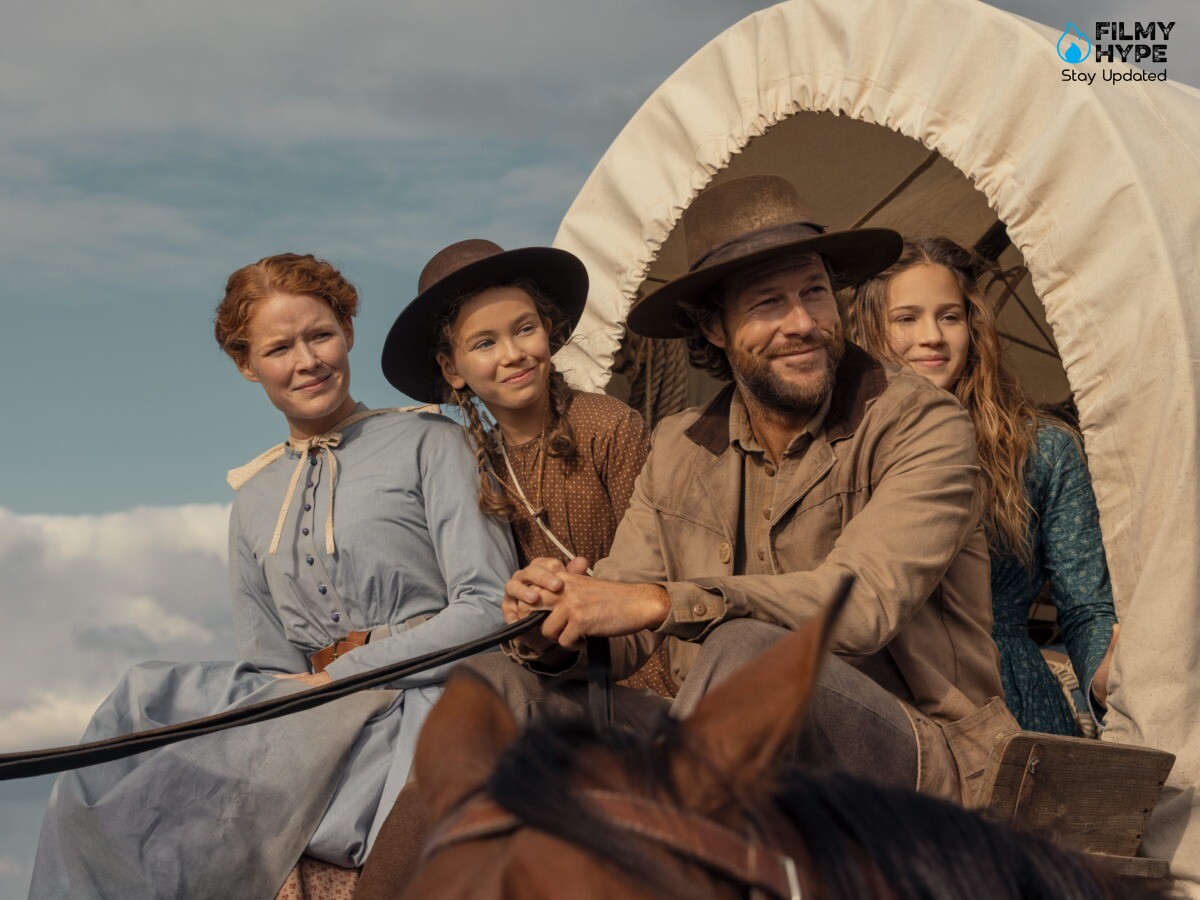
Little House on the Prairie Ending Explained: There’s a particular kind of sadness that comes with watching a family build something from nothing, only to watch it slip through their fingers. The first season of Netflix’s Little House on the Prairie ends exactly there, in that space between hope and departure. Charles and Caroline Ingalls, with Mary, Laura, and baby Carrie in tow, have spent eight episodes hammering together not just a cabin but a life. They’ve made friends. They’ve survived fever and fire and the grinding uncertainty of frontier existence. And then the finale arrives, and they pack up their wagon and leave it all behind.
Little House on the Prairie Ending Explained: Why Do the Ingalls Have to Leave Independence?
It’s not a defeat, exactly. But it’s not a victory either. It’s something more honest, more adult, and ultimately more faithful to the spirit of Laura Ingalls Wilder’s books than any tidy happy ending could have been. The search for home, the series insists, is not a destination. It’s a continuous journey. And sometimes the only way forward is to accept that the place you fought so hard to build isn’t the place you get to keep.

The finale of the first season of Little House on the Prairie surprises viewers with a bitter but hopeful epilogue, perfectly in keeping with the spirit of Laura Ingalls Wilder’s novels, but how does it end? After eight episodes of sacrifice, new beginnings, and big dreams, the Ingalls family finds themselves forced to make a painful decision that will completely change their future. The new Netflix series, developed by Rebecca Sonnenshine, draws directly from the original books and chronicles the family’s time in Independence, Kansas, before moving to what will become their most famous home: Walnut Grove. Below we explain how Little House on the Prairie ends, what happens to the protagonists, and why the final scene already sets the stage for the second season.
The Math That Doesn’t Add Up
The Ingalls don’t leave because they’ve given up. They leave because the economics of Independence, Kansas, have turned against them in ways that no amount of hard work can overcome. The season laid the groundwork for this slowly, episode by episode. First the land dispute with the Osage, which cast a shadow over everything Charles built. Then the fever that swept through the community. Then the debts, the scarcity of reliable work, the growing pressure from the government and the railroad interests circling the territory.
In the finale, all of these pressures converge. Charles and Caroline realize they have almost no money left. The new political arrangement between the government and the Osage, brokered by the town’s founder Eli James, doesn’t free up the land for the settlers who already live on it. It just changes who they have to pay. The cost is impossible. The terms are unsustainable. And then, as if to drive the point home with fire and smoke, the blaze comes and takes what little they had left.
The fire doesn’t just burn ground. It burns the central promise the Ingalls have been holding onto since the first episode: that if you work hard enough, if you’re decent enough, if you pour enough of yourself into a place, the place will hold you in return. The finale says, quietly and without flinching, that this promise is not always kept. Sometimes the context wins. Sometimes the system is stacked in ways that diligence and integrity can’t overturn.
The Fire That Comes During the Celebration
The timing of the fire is brutal, and it’s meant to be. It breaks out during Founders’ Day, the moment when Independence is most wrapped up in its own mythology. The town is celebrating itself, its identity, its vision of progress. Music is playing. People are dancing. Speeches are being made about the future. And while all of that is happening, the flames are spreading through the dry grass, a reminder that nature and material fragility don’t care about civic pride.
The contrast is the point. On one side, the ritual of civilization: the ceremony, the rhetoric, the shared belief that this community is permanent. On the other, the fire that doesn’t distinguish between dreams and kindling. The show captures something essential about frontier life in that juxtaposition. People can build traditions and institutions. They can tell themselves stories about who they are. But the world remains larger and more indifferent than any story can contain.
There’s a small, perfect detail in how the fire sequence is handled. The adults dig into the earth, trying to contain the flames. The children are gathered in the general store, terrified, and find comfort when Mary, Laura, and Good Eagle start singing. It’s a moment that shows both sides of the community’s strength. People can help each other. They can hold together. But they can’t control everything. The fire burns anyway. The damage is done. And after it’s over, the Ingalls have to reckon with the reality that there’s nothing left to stay for.
Why the Happy Moments Feel So Bittersweet
The finale doesn’t withhold joy entirely. Mary and Caleb kiss. Emily and George Tann get married. Laura and Good Eagle promise to write to each other. John Edwards comes back. William Mitchell and Charles part as friends. On paper, these are resolutions. Emotional payoffs for relationships the season has carefully built.
But every single one of them happens in the shadow of departure. Mary finally gets her moment of connection with Caleb, and then she has to get in the wagon and leave him behind. Laura and Good Eagle’s friendship, the most quietly radical relationship in the entire season, is reduced to a promise to write letters across a distance neither of them can control. The wedding is beautiful, but it’s a ceremony that one family is attending on their way out of town. These aren’t endings where people get to stay in the life they’ve built. They’re endings where people have to figure out what they can carry with them and what they have to let go.
The show makes a deliberate choice here. It could have ended with the Ingalls securing their claim and settling into permanence. It chose to end with a house abandoned and a family on the road. That choice tells you what the season has really been about. The frontier is not a place of arrival. It’s a place of passage. There’s no promised land waiting at the end of the trail. There’s just the next horizon.
Charles and Caroline, Still Together
The relationship between Charles and Caroline has been tested all season in ways that felt both period-appropriate and surprisingly modern. Caroline has been oscillating between loyalty to her husband’s vision and genuine fear about the family’s future. Her sister Eliza’s letters, offering a different kind of life back east, have been a constant temptation. The risks of the prairie, the pregnancy, the illness, the debts—all of it has led her to wonder whether staying was actually the right decision.
In the Christmas episode, she made her choice internally. She decided not to abandon Charles, even as she continued to hide the full contents of Eliza’s letter from him. In the finale, that choice becomes action. She gets in the wagon. She doesn’t deliver a big speech about it. She just goes. The decision has been made, and the family moves forward together.
Charles ends the season the way he’s moved through all of it: full of guilt and stubborn affection and a kind of desperate integrity. He couldn’t save the house. But he kept the family together. That distinction matters. His project failed on the material plane, but it held on the human one. Caroline still chose him. The girls still trust him. Even John Edwards, the most broken person in their orbit, decides to throw in with them rather than stay behind. The house is gone. The family isn’t.
Mary and the Kiss That Almost Didn’t Happen
Mary’s arc across the first season has been quieter than Laura’s, but in some ways it’s been more transformative. She started as the daughter most invested in order and belonging and recognition. She felt the comparison with Laura acutely. She worried about losing her place in the family with the new baby. She carried her feelings for Caleb with a kind of intense, awkward longing that she didn’t know how to express.
In the finale, she crosses a threshold. She discovers the true extent of the family’s financial problems and tries to help, which means she’s no longer just a spectator to adult decisions. She’s starting to shoulder some of their weight. And then the kiss with Caleb happens, and it’s not just a romantic beat. It’s the moment her emotional life stops being something she hides and becomes something she can acknowledge, even if only briefly, even if only before saying goodbye.
The relationship may not survive the distance. The show is too honest to pretend otherwise. But Mary leaves Independence knowing what she felt and having finally expressed it. That’s not security. It’s something else. Awareness, maybe. The beginning of growing up.
Laura, Good Eagle, and the Friendship That Transcends the Conflict
The bond between Laura and Good Eagle has been the quiet moral center of the season. Two girls who choose each other before they fully understand the political and historical forces that are supposed to keep them apart. Their friendship isn’t naive. It exists in full knowledge of the conflict between the settlers and the Osage, between the people who are taking the land and the people who have always lived on it. But it exists anyway, because the girls have found something in each other that the adult world can’t account for.
In the finale, they say goodbye with a promise to remain best friends and to write. It’s tender and melancholy and completely inadequate to the depth of what they’ve shared. Laura is not leaving Independence as the same girl who arrived. Good Eagle taught her that the land wasn’t empty, that there were histories here before hers, that friendship can grow even in ground that adults have salted with conflict.
The promise to write is small. But the show treats it with dignity. It matters that they make it. It matters that Laura carries this friendship with her into whatever comes next. Good Eagle is not a passing character in her life. She’s part of the foundation of who Laura is becoming.
The Mitchells Stay, and What That Means
William Mitchell and White Sun have been the characters through whom the season explored its most difficult political and moral questions. Through them, the show examined the trauma of stolen land, the exhaustion of constant compromise, and the weight of maintaining dignity while everything around you changes.
In the finale, the Mitchell family decides to stay. This isn’t presented as a resolution to the larger injustice. It’s a practical choice, made in a context where no option is fully just. William, who has spent the season as a lucid mediator between the Osage and the settlers, makes his farewell to Charles with a kind of mutual recognition. Two men from opposite sides of history, acknowledging each other’s humanity before one of them leaves.
White Sun’s arc is more internal. She arrived on screen guarded and suspicious, and she never fully lets that guard down, which is part of what makes her so compelling. But she softens toward Caroline and Laura without ever betraying her own anger or her own reasons. Her decision to stay isn’t presented as forgiveness. It’s presented as a form of personal resistance. She’s still here. She hasn’t been erased. The compromise is painful, but she’s choosing to endure it on her own terms.
Emily and George, the Love Story That Sticks
In a season defined by impermanence, Emily and George Tann’s wedding is the one story that resolves in stability. Their relationship has been through the wringer: hesitations, emergencies, the revelation that George was still married and had handled that truth badly. He ran. He came back with divorce papers. He stopped running.
The wedding isn’t a fairy tale. It’s a decision. George, a man defined by duty and emotional delay, finally makes a clear, definitive choice. Emily, who has spent much of the season as a sidelined figure, not fully accepted by the town’s social hierarchy, finally gets a place that no one can question.
The timing is deliberate. While one family loads their wagon, another is forming. The house the Ingalls built is emptying. A new one is being created. The cycle continues.
John Edwards Chooses the Road
John Edwards has been the most jagged, painful character in the ensemble. Every appearance he’s made has carried the weight of loss: his family, his sobriety, his ability to stay in one place. He disappears just when people start to rely on him. He comes back ashamed. He’s a man who wants connection and is terrified of what connection will cost him.
In the finale, this pattern repeats. He dances with Lacey Aubert. She wants stability, maybe a family. John, faced with that possibility, does what he always does. He vanishes. Not because he doesn’t want affection, but because accepting it would mean fully acknowledging that his previous family is gone forever, and he’s not ready to do that.
But then he comes back. And here’s the turn that makes his arc land. He doesn’t come back to settle down. He comes back to get on the road with the Ingalls. He chooses a family, but it’s a family in motion, a family that doesn’t require him to be still or fixed or healed. It’s the only form of belonging he can currently tolerate, and the show understands that. John Edwards is no longer just a troubled neighbor. He’s one of them now. He’s in the wagon.
What the Ending Is Really Saying
The title of the final episode translates to “This Is the Present,” and that’s the thesis of the whole finale. After a season of chasing the promise of a home, the Ingalls are forced to look at reality for what it is. The present is not the dream. It’s not the promised land. It’s not security. It’s debt and burned ground and the necessity of starting over.
But the finale isn’t nihilistic. It insists that what mattered hasn’t been erased. The material house is gone, but the transformations endure. Laura has her friendship with Good Eagle. Mary has her moment of emotional honesty and her first real steps toward adulthood. Caroline and Charles are still together, still choosing each other. Emily and George have built something lasting. William Mitchell’s friendship has marked Charles in ways that will outlast the departure. John Edwards is in the wagon with them, no longer alone.
The house on the prairie wasn’t a destination. It was a passage. A temporary place that changed everyone who lived in it, even though it couldn’t last. The Ingalls leave, but they leave carrying everything that mattered. The season closes not with a victory, but with an understanding. Not everything that ends was for nothing. Sometimes a place transforms you precisely because you can’t stay there. And then you take that transformation with you, into the wagon, onto the road, toward whatever comes next.