

I have to admit something—before the buzz around Nolan’s Odyssey started building, I hadn’t thought about the Laestrygonians in years. Maybe ever, really. Everyone remembers Polyphemus the Cyclops. Circe turning men into pigs is practically a cultural shorthand. The Sirens, Scylla and Charybdis, even the suitors back in Ithaca—these episodes have seeped into the collective imagination through countless retellings, paintings, and references. But the Laestrygonians? They’ve always been the deep cut, the chapter that even people who’ve read Homer might struggle to recall in detail.
Which is strange, because in terms of pure devastation, the Laestrygonians represent the single worst catastrophe Odysseus suffers before finally reaching home. This isn’t a close call or a narrow escape. This is annihilation. And Nolan, being Nolan, clearly recognized the dramatic potential in that.
His film adaptation doesn’t just include the Laestrygonians—it reimagines them in a way that’s consistent with his entire approach to mythmaking. What he keeps, what he changes, and what he chooses to leave out all tell us something about how he understands the The Odyssey and what he wants audiences to feel during this crucial turning point.
Who Are the Laestrygonians in Homer’s Poem?
Let’s start with the source material, because the Homeric version is genuinely terrifying in a way that deserves more attention.
Odysseus and his remaining fleet arrive at a place called Telepylus, ruled by a king named Antiphates. The harbor seems almost supernaturally perfect—a narrow inlet with steep cliffs on either side, so enclosed that ships can moor without even needing lines. It looks like shelter. It looks like a blessing after everything they’ve been through.
But the harbor is actually a trap. The inlet is so narrow that once the ships are inside, escape becomes nearly impossible. Odysseus, in one of his rare moments of caution, ties his own ship to a rock outside the harbor entrance rather than entering. This single decision saves his life.
When scouts go inland, they encounter a young woman who directs them to her father’s palace. She turns out to be the daughter of King Antiphates. And Antiphates, like his subjects, is a Laestrygonian—a member of a race of giants. But they’re not just large. Homer describes them as cannibals. The king grabs one of the scouts and devours him on the spot. The other two scouts flee back toward the harbor, but it’s too late.
What follows is pure massacre. The Laestrygonians gather on the cliffs above the trapped ships and begin hurling massive boulders down into the harbor. The ships can’t maneuver. There’s nowhere to hide. The giants spear the drowning men like fish and carry them away to be eaten. Of the twelve ships that entered the harbor, eleven are destroyed. Odysseus escapes with only his own vessel and its crew. Thousands of men, gone in a single episode.
The poet doesn’t linger on this. Homer moves on quickly, as if the scale of the loss is too vast to dwell on. But for anyone paying attention, this is the moment where the Odyssey changes. Before the Laestrygonians, Odysseus commands a small fleet. After them, he commands one ship. Everything that follows—Circe, the Underworld, Scylla and Charybdis, the cattle of the Sun—happens to a diminished man leading a diminished crew.
The Symbolic Weight of Cannibalism in the Greek Worldview
To understand why the Laestrygonians matter, you have to understand what cannibalism meant in the Homeric universe.
Greek civilization was built around certain fundamental values, and hospitality—xenia—was near the top of the list. When strangers arrived at your door, you fed them, sheltered them, and only then asked who they were and where they came from. This wasn’t just politeness. It was a sacred obligation, enforced by Zeus himself in his aspect as Zeus Xenios, protector of guests and strangers.
The Laestrygonians invert this completely. They don’t just refuse hospitality. They don’t just attack their guests. They eat them. Cannibalism represents the absolute negation of civilization, the point where all human codes break down. When Antiphates devours Odysseus’s scout, he’s not just being cruel. He’s declaring that the rules that govern human interaction—the rules that make society possible—don’t apply here.
This is also why the episode hits differently than the Cyclops encounter. Polyphemus eats men too, but he’s a solitary monster living outside any social structure. The Laestrygonians have a city, a king, a harbor, the outward forms of civilization. The horror is that all these familiar structures exist, but they’re built around something fundamentally inhuman. It’s the uncanny valley applied to culture—a society that looks like a society but operates on principles that are the mirror opposite of everything Greek.
The Point of No Return: Why This Episode Changes Everything
The Laestrygonian episode serves a specific structural function in the Odyssey. Before it, Odysseus is still leading a military expedition. He has a fleet. He has manpower. The journey is dangerous, but it’s still recognizably a voyage with resources and options.
After the Laestrygonians, everything is different. Odysseus is no longer a commander of ships but a survivor clinging to whatever he has left. The remaining journey isn’t an adventure; it’s a long, grinding retreat. Every subsequent loss—the men turned to pigs by Circe, the men devoured by Scylla, the men struck down for eating the sacred cattle—happens to a crew that’s already been gutted. The Laestrygonians don’t just kill Odysseus’s men. They kill the idea that this is a journey that can be won through strength or numbers.
The psychological impact on Odysseus is profound, even if Homer doesn’t spend much time on it explicitly. From this point forward, caution becomes his defining trait. He doesn’t trust harbors anymore. He doesn’t trust appearances. The man who sails away from Telepylus is harder, warier, more suspicious. The Laestrygonians taught him that the world contains threats so overwhelming that the only correct response is to survive and keep moving. Courage and cleverness, his two great assets, aren’t always enough. Sometimes the best you can do is be the one who doesn’t die.
How Nolan Reimagined the Laestrygonians
Now let’s talk about what Nolan does with this material, because his choices are fascinating and very much of a piece with his broader approach to adaptation.
First, what he keeps: the Laestrygonians are still giants. They still represent an overwhelming physical threat. The harbor still becomes a trap. The fleet is still destroyed. Odysseus still escapes with a single ship. The narrative function of the episode—the point of no return, the transition from expedition to survival—remains intact.
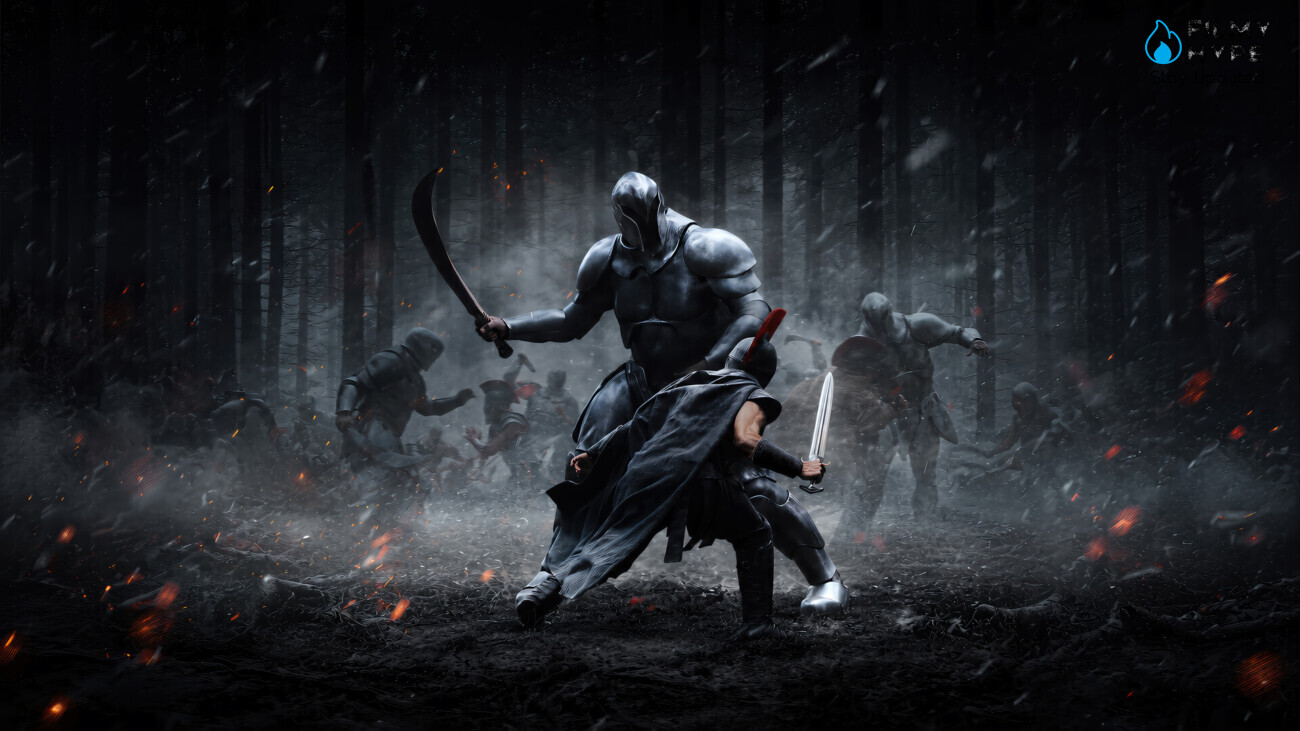
But Nolan makes significant changes to how the Laestrygonians are presented visually and conceptually. In his film, they appear as armored warriors rather than explicitly monstrous creatures. The gigantism is there, but it’s expressed through military grandeur rather than grotesquerie. They’re less like mythical ogres and more like an ancient civilization of warriors who happen to be enormous.
The cannibalism, which is so central to Homer’s depiction, is essentially absent from the film. Nolan doesn’t show the Laestrygonians eating anyone. He doesn’t reference their anthropophagy. The horror of the scene comes instead from pure military superiority—the giants’ discipline, their coordination, their unstoppable force. They function less as monsters and more as an army that cannot be fought.
This is consistent with Nolan’s entire approach to the Odyssey. Throughout his career, he’s shown a preference for grounding fantastic elements in something that feels tangible and credible. Think about how Inception treats dream-sharing less like magic and more like a technology with rules and procedures. Think about how Interstellar builds its cosmic journey on a foundation of real physics. Nolan tends to strip away the explicitly supernatural and replace it with something that feels epic but still believable within the world he’s constructed.
The Laestrygonians follow this pattern. By making them armored giants rather than cannibalistic monsters, Nolan shifts the register from horror to war epic. The fear isn’t that you’ll be eaten—it’s that you’ll be crushed by an enemy so far beyond your scale that resistance is meaningless.
What Nolan’s Changes Do to the Meaning of the Episode
This shift in presentation also shifts the symbolic weight of the scene. In Homer, the Laestrygonians represent the breakdown of civilization itself. Cannibalism is the ultimate taboo, the line that separates human from inhuman. The giants aren’t just powerful; they’re a perversion of everything Greek culture holds sacred.
Nolan’s Laestrygonians represent something different. They’re not inhuman in the same way. They’re hyper-human—a civilization taken to such an extreme of martial capability that individual heroism becomes irrelevant. The dread doesn’t come from watching a man get eaten. It comes from realizing that no amount of courage or cleverness can bridge the gap between what you’re capable of and what you’re facing.
This reframes Odysseus’s escape. In Homer, he survives because he was cautious enough to moor outside the harbor—a tactical decision that paid off. In Nolan’s version, the same decision carries a different weight. It’s not just prudence; it’s the dawning recognition that some forces can only be endured, not defeated. The Laestrygonians become a symbol of cosmic disproportion, the gap between human effort and the scale of the world’s dangers.
This fits into Nolan’s larger thematic interests. His films repeatedly explore characters confronting forces that dwarf them—time in Interstellar, entropy in Tenet, the subconscious in Inception. The Laestrygonians, in his hands, become another expression of this preoccupation. They’re not evil in a personal sense. They’re simply vast, implacable, and utterly indifferent to the human drama unfolding in their harbor.
The Absence of Cannibalism: What’s Lost and What’s Gained
Let me dig into the cannibalism question a bit more, because I think it’s the most telling choice Nolan makes.
Removing the anthropophagy does something interesting: it prevents the audience from othering the Laestrygonians too easily. Homer’s giants are easy to categorize as monsters because they do something that humans find fundamentally repulsive. They eat people. Case closed. They’re the bad guys, and Odysseus is right to flee from them.
Nolan’s giants are harder to judge in such simple terms. They’re warriors defending their territory. They’re not doing anything that human armies haven’t done throughout history—destroying an invading force with overwhelming violence. The moral calculus shifts. Are the Laestrygonians evil, or are they just defending their harbor against an armed fleet that showed up uninvited? Odysseus’s men aren’t innocent travelers in this version; they’re a military force entering foreign territory. The giants’ response, while devastating, isn’t obviously disproportionate to the perceived threat.
This ambiguity is very Nolan. He rarely gives audiences clear villains. His antagonists tend to operate according to their own coherent logic, even when that logic produces terrible consequences for the protagonists. The Laestrygonians, by losing their most monstrous trait, become something more complicated—an enemy that’s terrifying without being simply evil.
What’s lost is the visceral horror of Homer’s version. The image of a giant spearing drowning sailors and carrying them off to be cooked is primally disturbing in a way that military destruction isn’t. Nolan trades that specific, stomach-turning dread for something more abstract but also more epic in scope. Whether this is a good trade depends on what you want from the Odyssey. If you’re looking for the full mythic grotesquerie of the original, you might miss the cannibalism. If you’re looking for a coherent cinematic vision, Nolan’s approach probably works better.
The Laestrygonians and Nolan’s Theory of Myth
Watching Nolan’s take on this episode, you start to see a theory of adaptation at work. He’s not interested in literal faithfulness. He’s interested in functional faithfulness—preserving what an episode does to the story and the protagonist, even if he changes how it looks and what it emphasizes.
The Laestrygonian episode in Homer does three things: it destroys Odysseus’s fleet, it marks the point where the journey turns from expedition to survival, and it teaches Odysseus something about the limits of heroism. Nolan’s version does all three. The details change—armored giants instead of cannibals, military scale instead of taboo horror—but the structural role remains identical.
This is how Nolan has always approached source material. He doesn’t adapt texts; he adapts the experience of those texts. The feeling of reading Homer’s Laestrygonian episode—the shock of sudden, overwhelming loss, the realization that the hero isn’t in control, the sinking understanding that the journey will never be the same—is what he’s trying to recreate. The specific imagery is just the vehicle.
For audiences who know the poem well, this can be disorienting. You’re watching something that feels different while hitting all the same emotional beats. For audiences who don’t know Homer, the approach probably works better—the Laestrygonians make sense within the film’s own logic without requiring footnotes about Greek taboos around cannibalism.
What This Episode Tells Us About Odysseus
The Laestrygonian encounter reveals something about Odysseus that the more famous episodes don’t show as clearly. He’s not just clever. He’s not just brave. He’s capable of recognizing when those qualities won’t help.
The decision to moor outside the harbor seems small on the page. But it’s actually one of the most important choices Odysseus makes in the entire poem. It’s pure instinct—a sense that something about this perfect harbor isn’t right. Homer doesn’t explain the reasoning. Maybe Odysseus doesn’t even fully understand it himself. But that instinct is what separates him from the thousands of men who die in the harbor.
This is a different kind of heroism than outwitting the Cyclops or navigating past the Sirens. It’s quieter. It’s less dramatic. But it’s also more essential. The Laestrygonians teach Odysseus—and the audience—that survival sometimes depends on knowing when not to engage. Some battles can’t be won. Some enemies can’t be outsmarted. The only victory available is to be the one who lives to sail away.
Nolan, whose films are full of characters making impossible choices against overwhelming odds, clearly recognizes the power of this moment. His Odysseus isn’t diminished by running from the Laestrygonians. He’s defined by it. The decision to survive and continue, even when survival means accepting catastrophic loss, becomes central to the character.
Conclusion
The Laestrygonians have always been one of the Odyssey‘s most underrated episodes. They’re responsible for the single greatest loss Odysseus suffers before reaching Ithaca, yet they’ve never achieved the cultural saturation of Polyphemus or Circe. Nolan’s film, whatever its other merits, has done something valuable just by bringing them back into the conversation.
His reinterpretation—armored giants instead of cannibalistic monsters, military scale instead of taboo horror—changes the texture of the episode without changing its narrative function. The fleet still burns. Odysseus still escapes alone. The journey still transforms from adventure into survival. What shifts is the symbolic register, from a story about the breakdown of civilization to a story about the disproportion between human effort and the forces that shape human fate.
Whether you prefer Homer’s grotesque cannibals or Nolan’s implacable warrior-giants probably says more about your taste in mythology than about either version’s quality. The poem’s horror is more visceral, more taboo-breaking. The film’s horror is more existential, more about scale and power than about the violation of sacred codes. Both approaches understand that this is the moment when Odysseus loses everything except himself—and that losing everything except yourself is sometimes what survival looks like.
The Laestrygonians, in any version, are the point of no return. After them, nothing is the same. The hero who sails away from Telepylus is not the hero who arrived. He’s carrying the same name, the same cleverness, the same desperate desire to reach Ithaca. But he’s carrying it alone now, or nearly so, and he knows something he didn’t know before: that the world contains harbors that are traps, cities that eat strangers, and enemies so vast that the only victory is escape.

