

The Polygamist Ending Explained: Most stories about a towering, manipulative figure end the way we secretly hope they will: with a reckoning. After twenty-two episodes of simmering betrayals, buried family secrets, and raw fights for control, the finale of The Polygamist gives us exactly that. Jonasi Gomora, the man whose appetites and schemes set the entire tragedy in motion, watches his kingdom collapse brick by brick. He loses his grip on his family, his money, and finally his life. On a surface level, the moral scales find their balance. The monster is slayed, and the credits can roll.
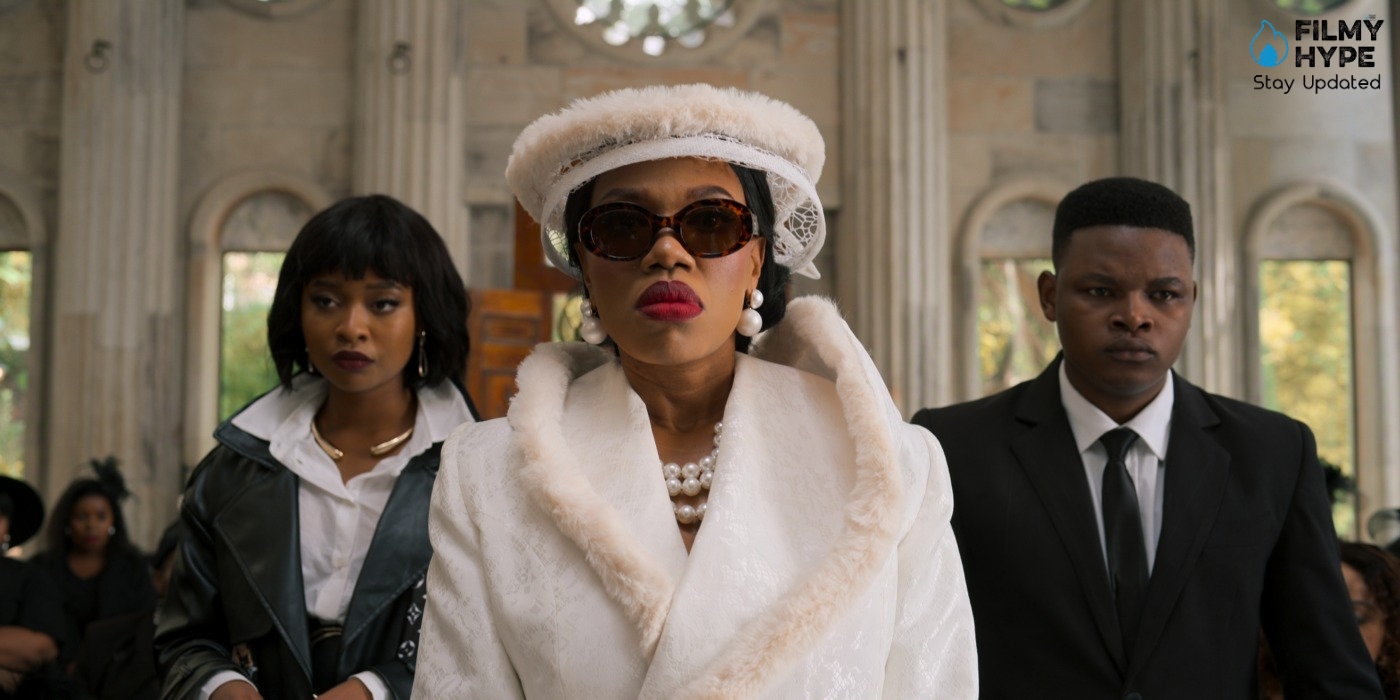
But if you sit with those final minutes for a while, a much more uncomfortable feeling settles in. Jonasi’s death isn’t a clean slate. If anything, the story goes out of its way to whisper that the mess a man like this makes doesn’t die with him. It seeps into the floorboards of the house he built. It lingers in the people who survive him. That’s the real hook of this finale: it’s not satisfied with just punishing a cruel man. It forces us to look at how a specific kind of poison can outlive the one who brewed it.
The Polygamist Ending Explained: How Joyce Finally Got Her Revenge and What it Means?
For the entire run of the show, Jonasi moves through the world like a man who can’t be touched. His money, his status, and his uncanny ability to read what people want allow him to bend nearly every situation to his will. Wives swallow their anger, children twist themselves into knots for a scrap of his approval, and business partners learn to play by his rules. It’s a system of control disguised as a family.
So when the end comes, it’s crucial how the writers choose to deliver it. He isn’t overthrown by a more powerful rival or flattened by a random stroke of bad luck. His death comes through Joyce, and the method is devastatingly precise. She weaponizes his own predictability against him. Jonasi’s single greatest vulnerability was always his absolute certainty that he understood the game better than anyone else. He never imagined someone could use his own script to write his final scene. When the audience realizes that Joyce orchestrated the contagion that kills him, the show pulls off a genuine reversal. For the first time, Jonasi isn’t the puppet master. He’s caught in a trap built from his own lifelong logic: that people are just tools to be used to get what you want.
It’s a form of poetic retaliation that doesn’t feel cheap because the series spent so much time showing us why Joyce would eventually stop being a source of stability and become an agent of chaos in her own right.
The Moment Joyce Stopped Trying to Fix Him
Joyce’s arc is the quiet engine of the entire series. For years, she’s been the one holding the center, absorbing endless humiliations while trying to keep the idea of a family intact. Her patience is often mistaken for weakness, but the show makes it clear it’s something else: a genuine, stubborn belief that the man she married is still in there somewhere.
That belief doesn’t fade slowly. It’s murdered in an instant. The physical assault on Joyce and Matipa is the moment the floor drops out. It’s no longer about infidelity or selfishness or even lies. It’s about a fundamental realization that Jonasi doesn’t see the people around him as human beings. They are instruments. Once Joyce fully absorbs that, her quest for revenge changes shape. It stops being an emotional, reactionary thing. It becomes methodical.
She doesn’t just want to hurt Jonasi. She makes the decision to stop absorbing the pain he radiates and instead reflect it at him, amplified. She knows him so perfectly that she understands exactly how to dangle a new conquest in front of him, knowing he’ll walk right into it. Is it a morally spotless choice? Hardly. It’s a descent into a dark kind of pragmatism, and it fits the tragic tone the show has always carried. Joyce chooses to become the consequence he never thought he’d face.
Ghosts, Lies, and the Inheritance of Nothing Good
Even as death approaches, the show won’t let Jonasi be. The final episodes peel back yet another layer of his lies with the reveal about Essie—not just a hidden wife, but a first love, a foundational part of his history that he buried. It’s almost absurd, but tragically believable: nearly everyone close to him knew only a fraction of who he actually was. His entire life was a curated performance, and death only exposes how much of it was fiction.
The fight over his economic legacy runs alongside this, and Joyce navigates it with a cold clarity. She maneuvers to push the bulk of the empire toward Menzi, convinced that the business belongs not to Jonasi’s memory but to the children he spent years failing. She treats it as a form of reclamation.
And here is where the show makes its smartest, meanest move. It lets Joyce win on paper, and then immediately plants a seed of doubt so deep that it undercuts everything. The victory isn’t clean because the heir she chooses might already be carrying a disease she can’t see.
The Final Scene That Swallows All Hope
After Jonasi is gone, there’s a brief moment where you can almost breathe. The long nightmare seems over. Justice, however messy, has been served. Menzi stands there as the potential for a new chapter, a son who has seen the wreckage of his father’s life and could choose a different path.
Then the last image of the series lands, and it recalculates everything. The silent, quiet development of a connection between Menzi and Lindani—the very woman tangled up in his father’s past—isn’t a twist thrown in for shock value. The writers are doing something far more unsettling. They’re suggesting that Menzi, without even realizing it, is stepping onto the same track his father once walked. It’s not a full-blown affair or a violent act. It’s a subtle, dawning repetition of a pattern.
Joyce spent years fighting a monster, blind to the possibility that some of the traits she despised were quietly taking root in the person she viewed as her ally and her hope. The real tragedy of the finale isn’t that Jonasi died punished and alone. It’s that his death might be almost irrelevant. The way he saw the world—how you hold power, how you treat people, how you take what you want—seems to be humming along quietly in the next generation.
The show closes on a brutal, circular note. Jonasi Gomora is punished, yes, but his most resilient legacy was never the bank accounts or the properties. It was the blueprint he laid for how to live, a blueprint his son may already be unknowingly tracing. That final scene doesn’t explode. It just sits there, still and unnerving, whispering that cycles don’t break just because one man is put in the ground. That’s what makes it sting long after the screen goes dark.