

The Black Cloud in Silo Season 3: For two seasons, Silo kept the apocalypse at arm’s length. We knew something had happened. We knew the outside world was dead, or supposedly dead, or maybe not as dead as the people in charge wanted everyone to believe. We knew there were relics from the before-times—watches, pez dispensers, children’s books—that the silo’s rulers treated like radioactive contraband. But the apocalypse itself was always a story told in fragments. A legend. A warning. A lie, maybe. The show let us wonder.
The Black Cloud in Silo Season 3: The Oldest Secret the Show Has Ever Revealed
Season 3 opens by turning the camera around. Suddenly, we’re not in the silo anymore. We’re not breathing recycled air or walking metal corridors or squinting at a screen that shows the same gray hillside day after day. We’re in the world. The real world. The one that existed 352 years before Juliette Nichols ever picked up a wrench. And in that world, high above the deserts of Iran, something is waiting in the sky that shouldn’t be there.

A black cloud. Fifteen kilometers up. Hanging in the atmosphere like a stain. And the moment a squadron of U.S. Navy jets flies through it, everything changes—not just for the pilots, but for how we understand everything Silo has been building toward since the first episode.
The Mission That Was Never What They Said It Was
Charlotte Keene knows something is wrong before she even takes off. She’s a Navy pilot, sharp and watchful, and she’s been given a mission over Iranian territory that doesn’t add up. The briefing is vague. The objectives feel incomplete. She tells her brother Daniel, a congressman, to accept a seat on Senator Thurman’s committee—a request that seems like a minor political favor until the episode reveals that the committee and the mission are two pieces of the same hidden operation.
Her squadron climbs to fifty thousand feet. And then they see it. A dark formation, massive and unmoving, sits at an altitude where clouds don’t form. Charlotte asks the question aloud: what is a cloud doing up here? No one answers. The planes fly into it, and the cloud turns out not to be a cloud at all. It’s something else. A viscous, metallic substance that coats the cockpit, invades the instruments, kills the systems. Planes start falling. One after another. Charlotte survives, but when she wakes up in a hospital bed, she doesn’t recognize her brother. She doesn’t remember who she is.
The show doesn’t tell you what the cloud is. Not yet. But it gives you enough pieces to start putting the puzzle together, and the picture that emerges is the darkest thing Silo has ever shown us.
What the Cloud Actually Is
Let’s work through what we see. The cloud doesn’t explode. It doesn’t burn. It doesn’t behave like any weapon a pilot would be trained to recognize. It adheres. It coats surfaces. It seems almost active, like it’s reaching for the planes rather than just being flown through. When Charlotte looks at the substance spreading across her cockpit, it’s not like smoke or ash. It’s material. It has texture. It’s doing something.
If you’ve read Hugh Howey’s Shift, the second book in the trilogy, your stomach probably dropped during this scene. In the books, the apocalypse wasn’t caused by nuclear war or climate collapse or any of the conventional doomsdays the silo residents have been taught to fear. It was caused by nanotechnology. Self-replicating nanomachines, designed for military purposes, were released into the atmosphere and spiraled out of control. They didn’t just poison the air. They transformed it. They made the surface of the planet incompatible with human life. And once they were out, there was no calling them back.
The series hasn’t confirmed that it’s following the same path. It’s been careful about that. But the black cloud shares an awful lot of characteristics with the swarm from the books. It’s concentrated. It interacts directly with machinery. It produces immediate physical effects. The metallic substance in Charlotte’s cockpit doesn’t behave like debris. It behaves like something that was designed to do what it’s doing.
The cloud, in other words, might be the earliest version of the technology that eventually ended the world. A prototype. A weapon test that went wrong. Or right, depending on whose side you were on.
The Memory Loss Isn’t a Side Effect. It’s the Point.
Here’s where the show does something characteristically smart. It connects the cloud to memory.
Charlotte survives the crash but loses her identity. She doesn’t recognize Daniel. She doesn’t remember the mission. She doesn’t remember anything about her life before she woke up in that hospital bed. The official explanation is a traumatic brain injury, but the show frames the memory loss as something more specific. It happens after contact with the cloud. The cloud did something to her mind.
Now jump forward three and a half centuries. Juliette Nichols wakes up in Silo 18 with no memory of how she got there. She’s been drugged. Her memories have been chemically suppressed. The system she’s fighting against can edit what people remember, to take away the parts of their experience that don’t serve the larger project of keeping the silos stable.
Two women. Two timelines. The same fundamental violation. Charlotte’s amnesia is the earliest point on a long continuum of memory manipulation that eventually becomes the foundation of the silo system. The technology that was in its infancy over Iran in the pre-apocalyptic world is, by Juliette’s time, a refined tool of social control. The silos don’t just keep people underground. They keep people’s minds in cages.
Senator Thurman and the Real Mission
After the crash, Senator Thurman reveals to Daniel that the mission over Iran was never about Iran. The real target was a facility in the mountains of Turkmenistan. All the publicly released information about the operation had been altered. The squadron wasn’t flying a conventional military strike. They were flying toward something that someone wanted very badly to keep secret.
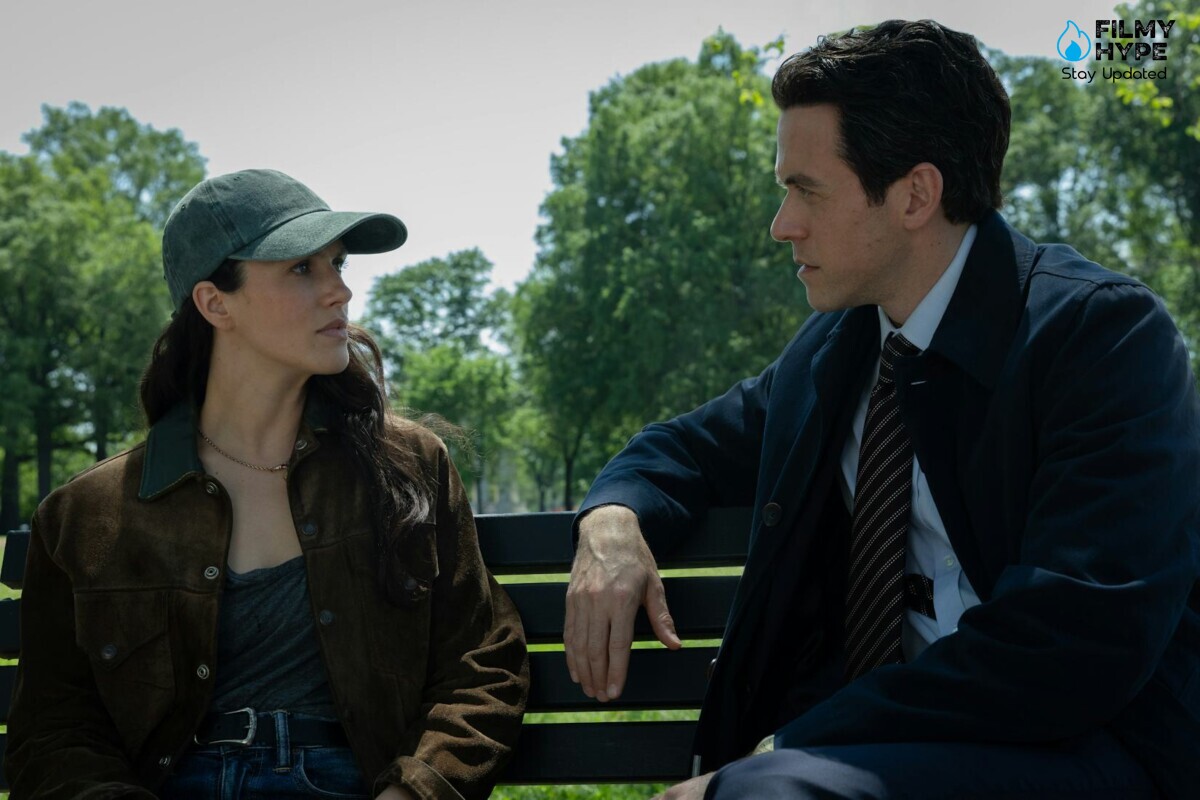
The cloud appears around a classified facility. That’s not a coincidence. The implication is that whatever was being developed in those mountains, the black cloud was part of it—a defense system, a weapons test, an experiment that was never supposed to be seen by the outside world. Charlotte and her squadron flew into something that was never meant to be encountered by anyone who wasn’t supposed to know it existed.
Thurman, in the books, is one of the architects of the silo project. He’s not a savior. He’s not a well-meaning bureaucrat trying to preserve humanity. He’s someone who knew what was coming and built a system designed to survive it, but also designed to control every aspect of human life inside it. The fact that he’s connected to both the committee Daniel is joining and the mission Charlotte flew is the show’s way of telling you that the conspiracy didn’t start with the silos. It started before them. The silos are just the most visible part of a project that was already in motion while the sky was still blue.
What This Changes About Everything
Up until now, the apocalypse in Silo has been a distant event. A thing that happened. A reason for the silos to exist. The Season 3 premiere changes that by making the apocalypse immediate. We’re not hearing about it in fragments and legends. We’re watching it begin. The black cloud is the first visible manifestation of the technology that will eventually remake the world into something humans can’t live in.
But it’s also something more than that. The cloud is the show’s first real statement about what kind of apocalypse this was. Not an accident. Not a natural disaster. Not even a war, in the conventional sense. It was an experiment. A weapon. Something that was built, tested, and then lost control of. The people who built it knew what they were doing. They just didn’t know how to stop it.
And Charlotte Keene, flying through a sky that was supposed to be empty, became the first person in the show’s timeline to encounter the thing that would eventually force humanity underground. She didn’t know what she was seeing. She didn’t have a name for it. But the black cloud that took her memory and killed her squadron is the same technology—or the ancestor of the same technology—that Juliette is fighting against three hundred and fifty years later.
The Thread That Runs Through Everything
Silo has always been a show about control. Who has it? Who doesn’t? Who gets to decide what’s true and what’s forbidden and what’s worth remembering? The black cloud is where that fight began. Before the silos. Before the pact. Before the rebellion and the cleaning and the screens that show a dead world. There was a moment when someone built something they couldn’t contain, and that something got loose, and the people in power decided that the only way forward was to bury the truth along with everyone who might have told it.
Charlotte Keene flew into that secret and lost herself. Juliette Nichols is living inside the system that eventually became secret. The black cloud connects them across centuries, two women whose memories were taken by forces that don’t want anyone to know what really happened. The question Season 3 is asking isn’t just what the cloud was. It’s who knew about it, who tried to cover it up, and whether the silos were ever really about saving humanity—or just about making sure no one ever found out what humanity had done.