Black Panther 3 Release Date: The kingdom of Wakanda is opening its gates again. At San Diego Comic-Con 2026, Marvel Studios made official what fans have been hoping for since the credits rolled on Black Panther 3 is happening. The announcement ended years of careful silence from Kevin Feige and Ryan Coogler, who had always insisted that a third film would only move forward when the right story presented itself. That story has apparently arrived.
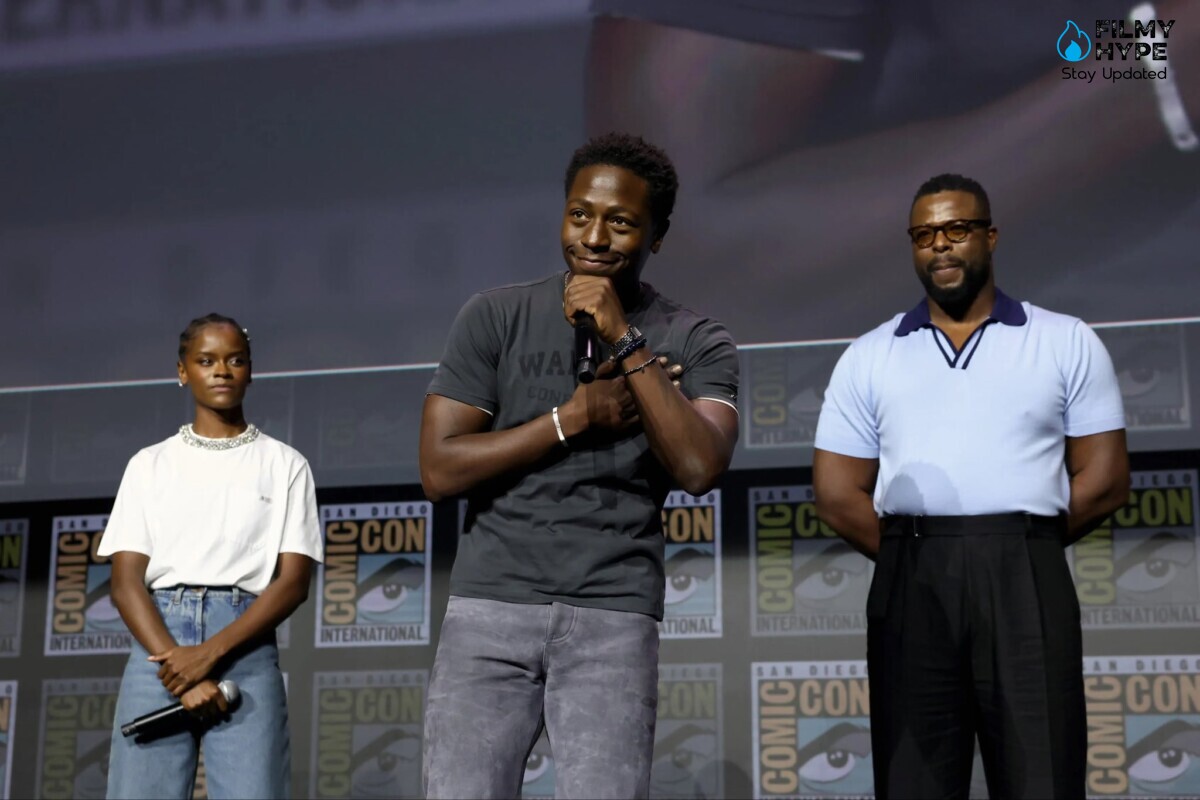
The details unveiled at Comic-Con paint a picture of a franchise in transition. This isn’t a direct sequel in the conventional sense. It’s a passing of the torch, a generational shift that honors the legacy of Chadwick Boseman’s T’Challa while moving the story into new territory. Here’s everything we know so far.
Black Panther 3: Release Date, A Longer Wait for a New Era
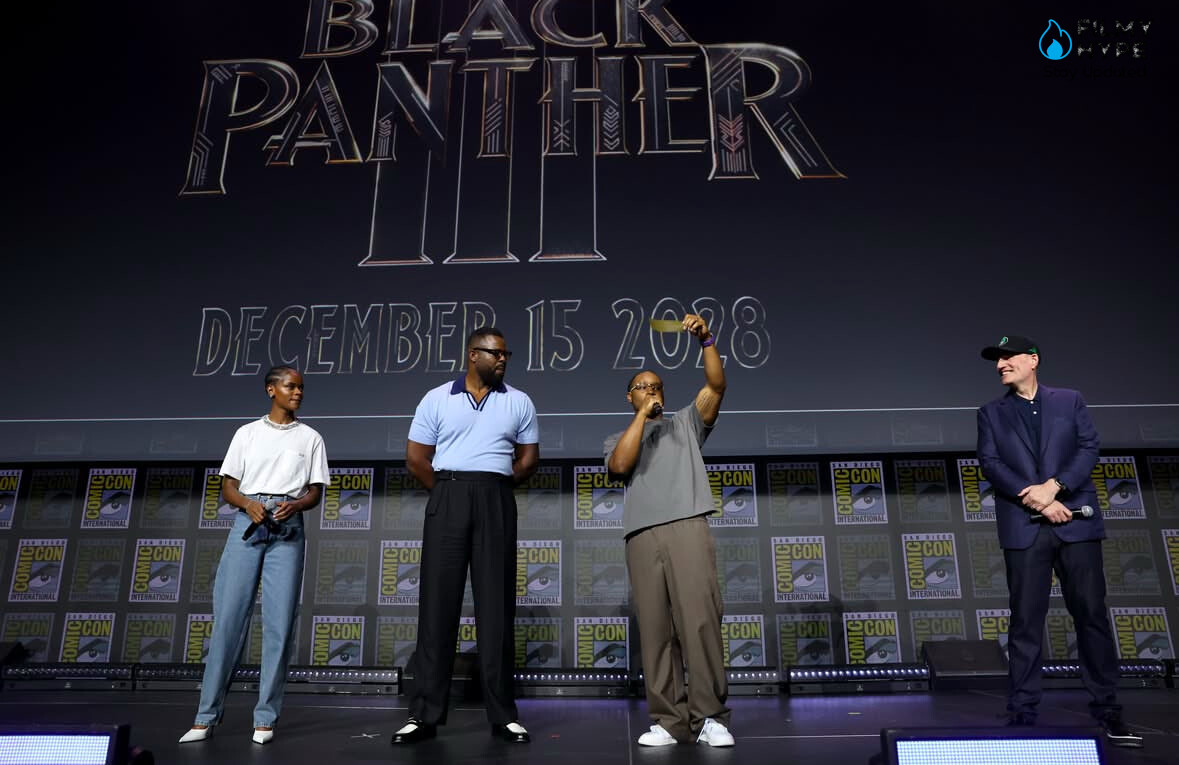
Marvel Studios confirmed that Black Panther 3 will arrive in theaters on December 15, 2028. That puts nearly six years between Wakanda Forever and the new installment—a significant gap, and one that reflects the careful deliberation behind the project.
The date also positions the film as a major holiday release, the kind of slot Marvel reserves for titles it believes can dominate the box office through the end of the year and into the new one. The original Black Panther opened in February 2018 and became a cultural phenomenon. Its sequel weathered the challenges of a pandemic-altered marketplace and the impossible task of continuing without its lead actor. The third film, arriving nearly a decade after the first, is being positioned as an event.
The Plot: T’Challa II Takes Center Stage
The most significant revelation from Comic-Con is the identity of the new Black Panther. The film will follow T’Challa II, the son of T’Challa and Nakia, who was introduced as a young child in the post-credits scene of Wakanda Forever. In that scene, Shuri met her nephew for the first time on a beach in Haiti, where Nakia had been raising him away from the pressures of the throne. The boy’s name, revealed in that moment, was a quiet declaration of legacy: T’Challa, son of T’Challa.
Black Panther 3 will pick up years later. The young prince, now grown, will begin his journey toward the mantle his father once held. The film will follow his training, his struggles with the weight of his inheritance, and his emergence as Wakanda’s new protector. It’s a narrative that allows the franchise to move forward without recasting the original T’Challa—a line Marvel has been adamant about not crossing since Boseman’s death.
The choice is both practical and poetic. The son of T’Challa was always going to be part of the story. Wakanda Forever planted that seed deliberately, giving the franchise a path forward that wouldn’t require erasing or replacing the character Boseman built. Now that the seed is ready to grow.
The New Black Panther: David Jonsson
The actor chosen to carry that weight is David Jonsson, the British performer whose star has been rising rapidly. Jonsson broke through with his work in Industry, the HBO finance drama where he played a young graduate navigating a world of ambition and moral compromise. He’s since appeared in Alien: Romulus and the film adaptation of Stephen King’s The Long Walk, building a reputation for intensity and emotional transparency.
Casting a relative newcomer as the face of one of Marvel’s most important franchises is a gamble, but it’s one the studio has made before. Tom Holland was a young actor with a handful of credits when he was cast as Spider-Man. Chadwick Boseman himself had only a few major film roles before Black Panther. Marvel’s track record with these choices suggests they know what they’re looking for: not just star power, but the ability to grow into a role over multiple appearances.
Jonsson’s T’Challa II won’t be a direct replacement for his father. He’s a different character, raised in a different context, carrying different burdens. His journey to becoming the Black Panther will be his own, and the film seems designed to give him space to figure out what that means.
The Returning Cast
Marvel confirmed that Letitia Wright will return as Shuri, and Winston Duke will be back as M’Baku. Both characters were central to Wakanda Forever, with Shuri taking on the Black Panther mantle in the wake of her brother’s death and M’Baku emerging as a key political figure in Wakanda’s leadership.
Shuri’s role in the new film is particularly intriguing. She’s been the Black Panther. She’s carried the weight of the suit and the mantle and the expectations that come with both. Watching her pass that legacy to her nephew—the son of the brother she lost—will likely be one of the emotional anchors of the story. Wright has grown into one of the MCU’s most compelling performers, and her Shuri has evolved from the quippy tech genius of the first film into someone marked by grief and responsibility. The third film gives her a new dynamic to explore.
Duke’s M’Baku has similarly transformed. Introduced as an antagonist in the first Black Panther, he became an ally, then a trusted leader. By the end of Wakanda Forever, he was positioned as a potential king. How he navigates the emergence of a new heir to the throne will test the alliances that have defined the franchise.
While not officially confirmed at Comic-Con, several other cast members are widely expected to return. Lupita Nyong’o’s Nakia is essential—she’s T’Challa II’s mother, the woman who raised him in Haiti, and her perspective on whether her son should take up his father’s mantle will be central to the story. Danai Gurira’s Okoye and Florence Kasumba’s Ayo represent the Dora Milaje, whose loyalty to the throne will be tested by a succession that hasn’t been straightforward in years. Dominique Thorne’s Riri Williams, introduced in Wakanda Forever, could return if the film maintains connections to the broader MCU.
Ryan Coogler Returns
Coogler’s return as director was never seriously in doubt, but the confirmation still matters. He’s been the primary creative force behind the Black Panther franchise, shaping its visual language, its emotional register, and its thematic preoccupations. Under his direction, Wakanda became more than a setting. It became a culture—fully imagined, textured, and alive.
Coogler has spoken openly about how difficult Wakanda Forever was to make. The loss of Boseman reshaped the film entirely, turning what might have been a conventional sequel into a meditation on grief. The film that emerged was messier than its predecessor but also more emotionally ambitious. It honored Boseman’s memory while moving the story forward, and it ended with a gesture toward the future: a child on a beach, carrying his father’s name.
Black Panther 3 is Coogler’s chance to explore that future. The pressure is different this time. The loss has been processed. The groundwork has been laid. The task now is to build something new on the foundation that the first two films established.
Chadwick Boseman’s Legacy
Any discussion of Black Panther 3 has to acknowledge the absence that defines it. Chadwick Boseman’s T’Challa was the center of gravity for the first film and the ghost haunting the second. His death in 2020, at the age of 43, was a shock that reverberated far beyond the MCU. He had become, in a few short years, one of the most significant actors of his generation, and his portrayal of T’Challa had transformed the character into a global icon.
Marvel’s decision not to recast T’Challa was controversial. Some argued that the character was bigger than any single actor, that the role should continue with a new performer. Others felt that Boseman’s portrayal was too definitive, that any recasting would feel like an erasure. Coogler and Feige chose the latter path, building Wakanda Forever around the absence rather than trying to fill it.
The introduction of T’Challa II is the resolution of that choice. It allows the franchise to have a Black Panther named T’Challa without replacing the man who made the name mean something. The son inherits the mantle, but he’ll have to earn it. The legacy isn’t automatic. It’s something he’ll have to grow into, struggle with, and ultimately define on his own terms.
The Franchise’s Place in the MCU
Black Panther 3 arrives at an interesting moment for Marvel. The Multiverse Saga will have concluded by 2028, and the studio will be charting a new course. The Black Panther franchise has always existed somewhat apart from the larger MCU machinery—its concerns are more political, its tone more grounded, its stakes more personal. That independence has served it well. The first two films felt like complete artistic statements rather than episodes in a larger serial.
Whether the third film maintains that independence or integrates more fully into whatever the MCU becomes post-Secret Wars remains to be seen. But the December 2028 release date suggests Marvel sees Black Panther 3 as a pillar of whatever comes next. The franchise has earned that status. The first film grossed over $1.3 billion worldwide and earned a Best Picture nomination—a first for a superhero film. The sequel, despite impossible circumstances, earned $859 million and five Oscar nominations, including Angela Bassett’s historic acting nomination. The audience is there. The goodwill is there. The story is ready to continue.
What Comes Next
The film is still in early development, which means much of what we think we know could change. Casting announcements will continue. Plot details will emerge. The marketing machine will ramp up as the release date approaches. But the broad strokes are in place. A new Black Panther. A generational transition. A kingdom looking toward its future.
T’Challa II will have to decide what kind of king he wants to be. Shuri will have to decide what kind of mentor. Wakanda will have to decide what kind of nation. These are questions the franchise has been asking since the beginning. The third film is the chance to answer them—not with an ending, but with a new beginning. December 15, 2028. Wakanda forever, and forever just got a little longer.