

Clayface Terrifying Origin Explained: There’s a moment in the new Clayface trailer where Tom Rhys Harries, playing actor Matt Hagen, looks in a mirror and doesn’t recognize what’s staring back. His face is shifting. Melting. Becoming something that no longer obeys the rules of human anatomy. It’s a horror image in the most literal sense—not just because of what we’re seeing, but because of what it means. This is a man who traded his identity for his appearance, and now both are slipping away from him.
Clayface Terrifying Origin of DC’s Most Tragic Monster Explained
DC Studios has been making a lot of noise about expanding the Batman universe in unexpected directions, but Clayface might be the most unexpected of all. This isn’t a superhero movie with a villain problem. It’s a body horror film, shepherded by two of the most respected names in modern horror—director James Watkins, who brought us The Woman in Black and Speak No Evil, and writer Mike Flanagan, the mind behind The Haunting of Hill House and Midnight Mass. The pairing suggests something genuinely disturbing, a film that treats its central character not as a monster to be defeated but as a tragedy to be witnessed.
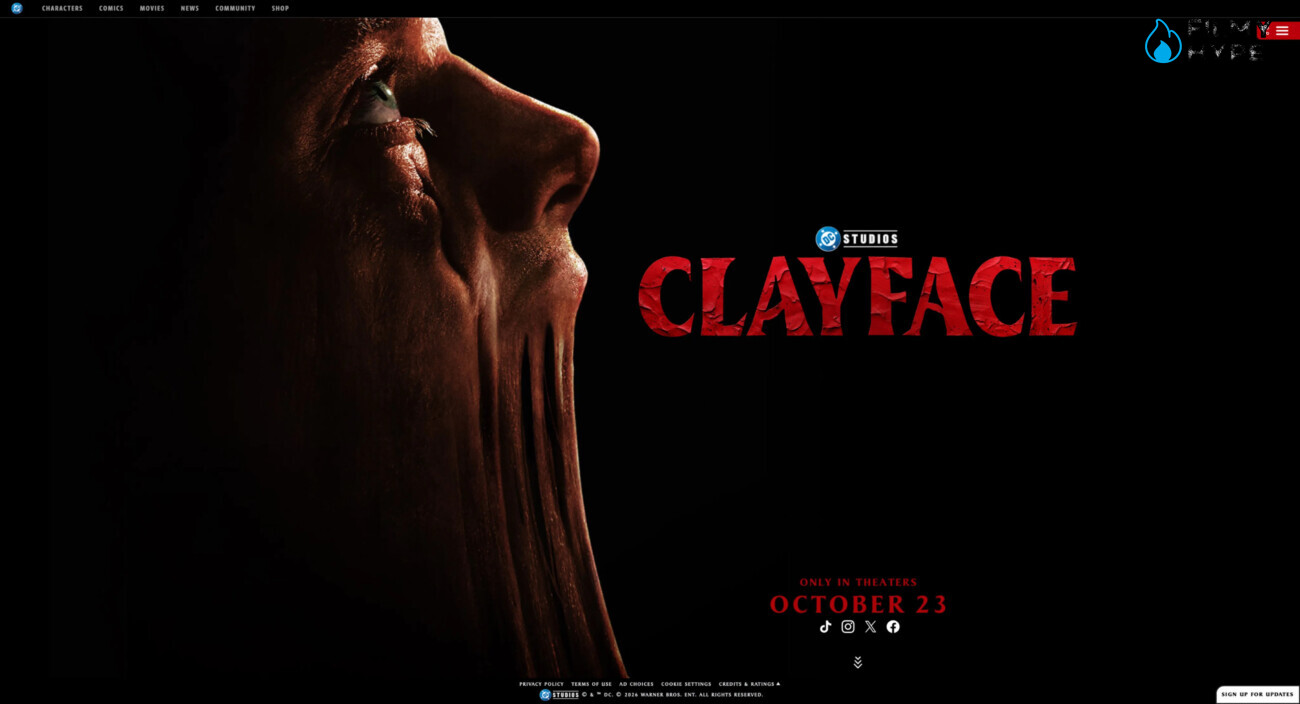
The film arrives in October 2026, and it’s drawing from a character whose comic book history is darker and more psychologically complex than most casual fans realize. Clayface has been around since the 1940s, but unlike the Joker or the Riddler, he’s rarely been given the spotlight in live action. Watkins and Flanagan seem determined to change that.
What the Trailer Reveals
The trailer opens with Matt Hagen at the peak of his career. He’s a successful film actor, the kind of face that belongs on magazine covers and red carpets. His identity is tied up in how he looks. How the camera catches him. How the world sees him.
Then the attack happens. The details are brutal and deliberately obscured—flashes of violence, the suggestion of acid or some other corrosive substance, and then the aftermath. Hagen’s face is destroyed. The thing that defined him, that gave him his career and his status and his sense of self, is gone.
What follows is the descent. Desperate and broken, Hagen turns to an experimental aesthetic treatment. The trailer doesn’t explain exactly what it is, but the implications are clear. This is not medicine. This is not healing. This is something that promises to restore what was lost and delivers something else entirely. Hagen’s skin begins to behave like a non-Newtonian fluid, shifting and flowing, losing its fixed shape. He becomes, in the most literal sense, a person without a stable form.
The horror is both physical and psychological. Hagen can reshape himself, but the reshaping is never permanent. He’s trapped in a body that no longer obeys him, driven by needs he doesn’t fully understand. The trailer suggests a man who is being erased from the inside out, replaced by something that used to be human and no longer is.
The Comic Book Origins: Three Men, One Monster
Clayface isn’t one character. He’s an identity that’s been passed between multiple people across decades of Batman comics, each version adding another layer of tragedy to the myth. The film, based on what we know, is combining elements from all of them to create something new.
Basil Karlo: The First Clayface
The original Clayface debuted in 1940, and he didn’t have superpowers. Basil Karlo was an actor—not a failed one, exactly, but one whose career never reached the heights he believed he deserved. His big break came when he was cast as the villain Clayface in a horror film called Dread Castle. It was a role that should have defined him.
Years later, when a remake of Dread Castle was announced, Karlo expected to be involved. He wasn’t. The studio moved on without him. The rejection shattered something already fragile. Karlo, in a breakdown that blurred the line between performance and reality, adopted the Clayface persona as an alter ego and began killing the cast and crew of the new film. He murdered them in the order their characters died in the original movie, turning his obsession with the role into a literal death sentence for everyone involved.
What makes Karlo so unsettling is that he’s not a monster in the physical sense. He’s just a man. A man whose need for recognition curdled into homicidal rage. In a world of costumed supervillains with elaborate schemes, Karlo stands out because he’s terrifyingly plausible. The recent Batman films have leaned into this kind of grounded villainy—the Joker as an agent of chaos, the Riddler as a radicalized loner—and Karlo fits that mold perfectly. He’s what happens when the hunger for fame consumes everything else.
Matt Hagen: The Second Clayface
Matt Hagen arrived in the early 1960s, and he’s the version the film is primarily adapting. In the comics, Hagen was a treasure hunter. While exploring a cave, he stumbled across a pool of radioactive protoplasm. He fell in. When he emerged, his body had been transformed.
Hagen’s skin became clay-like, malleable, capable of being shaped into any form he could imagine. He could mimic other people’s appearances, duplicate their voices, become anyone he needed to be. But the power came with a cost. To maintain his abilities, Hagen had to regularly immerse himself in the same protoplasm that created him. He was addicted to the very substance that made him a monster.
Unlike Karlo, Hagen wasn’t a killer by nature. He used his powers for crime—robbery, impersonation, the kind of schemes that required a shape-shifter’s touch—but his story was always more melancholy than malevolent. He was a man who had been given an extraordinary ability at the cost of his own identity. Every transformation pulled him further from who he used to be. Eventually, there was almost nothing left of Matt Hagen except the shapes he could take.
Preston Payne: The Third Clayface
Preston Payne, introduced in the late 1970s, is arguably the most tragic version of all. He was a scientist suffering from acromegaly, a hormonal disorder that causes abnormal growth and disfigurement. His body was betraying him in slow motion, and he was desperate for a cure.
Payne became obsessed with Matt Hagen’s case, convinced that the protoplasm that transformed Hagen could be reverse-engineered to help him. He experimented with samples of Hagen’s blood. The results were catastrophic. Payne’s body was transformed, but not in the way he hoped. He became a monster whose touch melted other people—dissolving them on contact. And here’s the cruellest irony: Payne had to keep doing it. The act of melting others was the only thing that kept his own body from destroying itself. He had to kill to survive.
Payne is the version of Clayface where the body horror becomes inescapable. He didn’t ask for power. He didn’t want to hurt anyone. He was a sick man looking for a cure, and what he found was a nightmare that forced him to become the thing he most feared. His story is about the body as prison, about disease and desperation, and the impossible choices that suffering creates.
How the Film Combines All Three
What Watkins and Flanagan seem to be doing is taking the psychological realism of Karlo, the body horror of Hagen, and the medical tragedy of Payne, and fusing them into a single character.
The film’s Matt Hagen is an actor, like Karlo, whose entire identity is bound up in his appearance. He’s attacked and disfigured, his face ruined, his career destroyed. The experimental treatment he seeks out echoes both Hagen’s protoplasm and Payne’s desperate search for a cure. The transformation that follows—the shifting skin, the unstable form, the gradual loss of control—draws from all three comic book versions.
But the film also adds a contemporary layer. The treatment Hagen undergoes is described as an experimental aesthetic procedure, which connects the story directly to modern anxieties about cosmetic surgery, appearance, and the lengths people will go to preserve or reclaim their looks. In a world where aesthetic treatments are increasingly normalized and increasingly extreme, Clayface becomes something more than a comic book villain. He’s a cautionary tale about what happens when the self becomes inseparable from the surface.
The Horror of Identity Loss
The most frightening thing about Clayface has never been his ability to shape-shift or his capacity for violence. It’s the erosion of identity. Every version of the character is about someone losing themselves—Karlo to obsession, Hagen to his powers, Payne to his disease. The monster isn’t just what they become. It’s what they leave behind.
The film seems to understand this. The trailer doesn’t frame Hagen’s transformation as empowerment. It frames it as dissolution. He’s not gaining control. He’s losing it. The mirror scene, the melting face, the glimpses of a man who can’t hold himself together—these are horror images because they’re about annihilation. Not death, exactly, but the slow, awful process of becoming something that used to be you.
Flanagan’s involvement is particularly encouraging here. His work has always been interested in the intersection of horror and grief, in the monsters that grow out of human pain rather than external threats. Clayface, in his hands, could be one of the great tragic figures of modern superhero cinema—not a villain to be punched into submission, but a person to be mourned.
October 2026 is when we find out if they pulled it off. The trailer suggests they might have. The talent involved suggests they probably did. And the character’s long, dark history in the comics provides more than enough material to build something that haunts you long after the credits roll.

