

Oasis Season 1 Ending Explained: If you’ve already done your eight-episode marathon of “Oasis”, the new Spanish series of Netflix that arrived on the platform June 19, you probably have a head full of questions. And between unexpected revelations, suspicious characters, and details that take on new meaning, the outcome of this story offers us more than one reading. Let’s be honest about what Oasis Resort actually is. It presents itself as a glossy summer series, all sun-drenched pool decks, tangled flirtations, and the kind of luxurious backdrop that makes you want to book a vacation you can’t afford.
Oasis Season 1 Ending Explained: Who Kidnapped Celia and What Was the Resort Hiding?
But somewhere around the midpoint, the show pulls a quiet bait-and-switch. The betrayals stop feeling like teen drama and start feeling like evidence. The resort itself, with its endless corridors, locked storage rooms, and hidden technical passages, transforms from a setting into something more ominous. It becomes a mystery. By the time the finale arrives, nearly every character is hiding something, and the real question isn’t who kissed whom at the party. It’s who built this place, what they built it for, and how many people have been swallowed up trying to find out.

The ending pulls all of these threads together with a surprising amount of coherence for a series that spent so much time keeping you guessing. Celia’s kidnapping, the truth about Helena’s assault, Luis’s complicity, the drug operation running through Oasis Infinity, and the unmasking of Inspector Ortega all snap into place. But to feel the full weight of it, you have to look at the whole series as a system of interconnected lies, where the most dangerous people were never the obvious suspects.
Who Actually Took Celia?
The answer lands with a gut punch: Inspector Ortega. For episode after episode, the show works hard to make you look elsewhere. Jaén acts guilty. Pablo can’t seem to tell a straight story. Armando hovers with an unsettling ambiguity. Ginés practically sweats suspicion every time he appears on screen. Everyone has something to hide, and the series uses that to scatter your attention.
Ortega, meanwhile, wears a badge and carries the implicit trust of his position. He’s not just a detective following a flawed lead. He’s a man embedded in the corrupt structure that Oasis Infinity has been protecting. Celia doesn’t become a target because she stumbles into romantic drama or hears a stray piece of gossip. She gets taken because she gets too close. She starts connecting pieces that were never meant to touch, and at that point, she stops being the director’s curious daughter and becomes a liability.
The confirmation is methodical, not theatrical. Daniel and Helena trace the cigarette butts. They connect Ortega’s presence to moments that never quite added up. And suddenly the show isn’t asking you to suspect a shadowy outsider anymore. The threat was inside the investigation the whole time, wearing the one uniform no one thought to question.
What Oasis Infinity Was Really Hiding?
The resort wasn’t just a venue for romantic chaos. It was a front for cocaine trafficking, and the operation ran through the very architecture of the place. This is where the series makes its harshest turn, because the man at the center of it isn’t a cartel outsider or a corrupt guest. It’s Luis, Celia’s father, and the director of Oasis Infinity.
For most of the series, Luis reads as an authoritarian figure, the kind of man who controls everything not out of malice, necessarily, but because control is how he understands the world. The finale strips that reading away. He wasn’t just a tough father trying to protect the resort’s image. He was using the resort to move drugs and generate money. Every seemingly minor detail the series scattered throughout the episodes—the secret room, the equipment in the warehouse, the moved planters, the walkie-talkies, the way certain spaces never quite made sense—finds its explanation here.
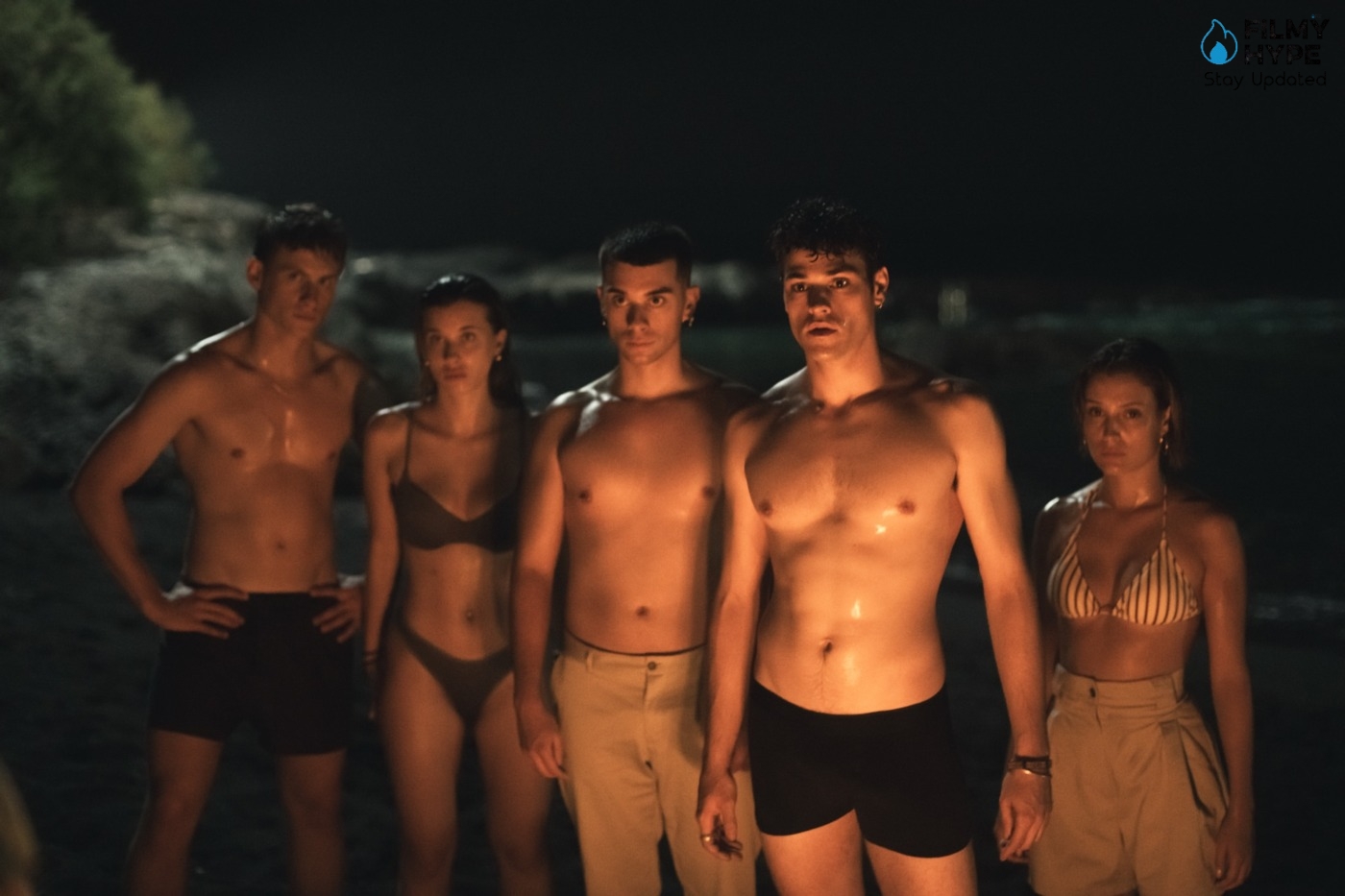
The emotional detonation comes when Celia finds a necklace in the secret room and recognizes it as her father’s. That’s the moment the ground gives way beneath her. It’s no longer a vague, creeping suspicion. It’s physical proof that her father is connected to the hidden machinery of the resort. When Luis tries to explain himself, he only buries himself deeper. He admits that Helena had stumbled into that area. He acknowledges there was cocaine. He even says they had to clean it up. He’s not protecting anyone. He’s managing damage control, and he’s been doing it long before the current crisis began.
The resort, in other words, isn’t the backdrop for the mystery. It’s the engine that drives it.
What Really Happened to Helena?
Helena’s storyline functions as the early warning system that the other characters didn’t recognize in time. When she first appears, she’s easy to misread: the grumpy girl, the isolated one, freshly rejected from a medical scholarship and simmering with resentment. Then she becomes a victim, assaulted and left with fragments of memory she can’t fully assemble. She remembers being taken. She remembers a light. The rest is darkness.
The series eventually clarifies that Helena wasn’t chosen randomly. She saw something she wasn’t supposed to see. She intercepted the drug operation at the wrong moment and found herself inside a mechanism that needed to be silenced immediately, before she could understand what she had witnessed.
Jaén’s role in this becomes clearer in the finale and the accompanying flashbacks. He’s involved in the trafficking. He drugged Helena to keep her from remembering and talking. But he’s not the architect of the whole operation. He’s a link in a chain, the one who does the dirty work while people with more power and cleaner hands stay protected. This distinction matters because it reflects what the series seems most interested in: the way systems of corruption distribute responsibility unevenly, with the most vulnerable people taking the heaviest risks.
The detail about the resort shampoo found on Helena’s hair also lands here with full meaning. It wasn’t a random clue. It was evidence that after she was caught in the trafficking area, she was moved through a controlled indoor space where someone tried to clean her up, physically scrub away what had happened before she could become a coherent witness.
Why Celia Became the Target?
Celia stops being safe the moment she stops being passive. Her mistake, if you can call it that, is wanting to understand. She helps Daniel. She gets close to the truth about Helena. She finds her father’s necklace. She confronts Luis directly. At each step, she moves closer to a secret that the resort’s infrastructure has been designed to protect, and by the time she realizes what she’s stepping into, the trap is already closing.
What makes her story particularly bruising is the nature of the betrayal. She doesn’t just discover that the resort hides drugs and violence. She discovers that her father is part of the problem. The miniseries doesn’t just wrap up a thriller plot in its final act. It forces a family rupture into the open. Celia isn’t taken by a stranger operating far from her life. She’s consumed by a system where the first betrayal came from home.
Ortega’s involvement isn’t disconnected from Luis, though the inspector proves willing to escalate further than anyone else. By the time he takes Celia, the logic has shifted from covering up crimes to ensuring survival. The series crosses a line here, moving from moral compromise into something more primal. Celia knows too much, and Ortega is prepared to close the file permanently.
Daniel and Helena, the Accidental Detectives?
The police investigate, but they’re consistently late, misdirected, or compromised. It’s Daniel and Helena who actually carry the truth forward, not because they’re brilliant strategists, but because they’re stubborn and unable to accept the comfortable version of events. They follow the phone, the cameras, the secret room, the planters, the roof, the transmitter, the cigarette butts, and the technical layout of the resort. Piece by piece, they assemble a picture that the authorities either couldn’t see or chose not to.

Their dynamic shifts meaningfully across the series. Daniel starts drawn to Celia, while Helena occupies a lateral, almost hostile position, closed off from the people around her. Investigating together changes that. They go through Helena’s assault, Celia’s disappearance, and a desperate escape through the resort’s ductwork. By the time Daniel records what he believes might be his final message, thinking the gas is about to kill him, the relationship between them has solidified into something the show no longer needs to explain.
In the finale, they chase the last leads, corner Luis, locate the exchange point with Ortega, and free Celia. They’re the ones who solve the case, not through abstract deduction but through persistence, personal risk, and a refusal to look away. Their story closes on a note that feels earned: they’ve seen the worst of what the resort conceals, and they’ll never be able to look at it the same way again.
Luis, the Architect Who Lost Everything?
Luis is one of the better-drawn figures in the miniseries because the show plays fair with his ambiguity for a long stretch. He seems like a strict father, a man whose need for control borders on pathological but who might still be operating from some recognizable version of paternal concern. Then the finale methodically removes every alibi.
Without Luis, there is no central secret. He’s the one using the resort as a front. He knows what happened to Helena. He’s tied to the secret room. He lies to Celia right up to the breaking point, even as he watches his daughter unravel under the weight of what she’s discovering.
The ending doesn’t give him a clean punishment. He survives, almost miraculously, but he loses the only things that gave his life structure: his credibility, his authority, and his relationship with his daughter. The show leaves him alive to witness what he destroyed, which is a more interesting and arguably crueler sentence than simply killing him off.
Sorting the Guilty from the Merely Suspicious?
One of the more satisfying elements of the finale is how it distributes blame across different levels. Jaén is guilty of real crimes. He traffics, he covers up, he manipulates Helena, he lies. But he’s not the final architect of Celia’s kidnapping. He’s a cog, dangerous but replaceable.
Ginés gets built up as a major suspect, especially when compromising items appear in his car. But the series uses him largely as misdirection, the person you’re meant to fixate on while the real threat moves undetected. He’s inside a murky system, but the true twist sits elsewhere.
Ortega is the face of institutional betrayal. He was supposed to protect, to listen, to piece the truth together. Instead, he controls, pursues, kidnaps, and attempts to eliminate every trace of what he’s done. His unmasking works precisely because it comes after such a long parade of more obvious suspects. The series spreads culpability across a hierarchy: Jaén does the dirty work, Luis organizes and covers, and Ortega ensures the entire structure can withstand scrutiny from the inside.
The Other Lives the Resort Touched?
The choral side of the series also reaches its various conclusions, and while some land more gracefully than others, they all reinforce the same underlying theme. The resort has contaminated everyone who passed through it.
Sofía, Maca, and Pablo cycle through attraction, betrayal, jealousy, and revenge until Pablo is left broken by his own ambiguities. Sofía and Maca, initially positioned as rivals, end up drawing closer, a reversal that quietly subverts the competitive logic the early episodes established.
Leo and Felipe collapse under the weight of a denied pregnancy, blackmail, secret gifts, and the unsustainable double life Felipe tried to maintain. Felipe loses control of everything. Leo, at least, reaches a form of clarity about herself.
Yon remains one of the series’ most straightforward collateral victims. He discovers his father’s hypocrisy through no fault of his own, and the show doesn’t offer him an easy resolution. He just has to live with what he now knows.
Laura and Oliver’s subplot, with its focus on inheritance, family control, and Grandmother Esperanza’s hidden illness, is more melodramatic than thriller-driven. But it echoes the central preoccupation of the miniseries: adults decide, hide, and manipulate, while the younger generation absorbs the consequences of unspoken truths.
The Real Meaning of the Finale?
Oasis Resort ends where it always had to end: not in the luxurious interior spaces that defined its early episodes, but at the lighthouse. It’s an exposed, extreme location where nothing can be hidden anymore. The contrast is deliberate. The resort sells itself as paradise, a place of freedom and desire and endless summer. The truth, slowly and then all at once, is that it’s a structure built on surveillance, cover-up, privilege, and silence.
Celia’s kidnapping is the event that finally forces the real Oasis Infinity into view. Every narrative line, even the ones that seemed like pure teen melodrama, contributes to this unveiling. The clandestine relationships, the videos, the drugs, the blackmail, the carefully planted false leads—they all point to an environment where honesty is punished, and those who try to speak are isolated or worse.
The finale doesn’t pretend that the truth fixes everything. The resort’s secrets are exposed, but the damage is already done. Relationships are shattered. Trust is gone. The people who survived will carry what they saw into whatever comes next. The lighthouse offers clarity, but clarity isn’t the same thing as healing, and the show is smart enough not to conflate the two. It simply brings everything into the light, finally, and lets the characters stand there, exposed and irrevocably changed.