The Odyssey Movie Review and Ratings
Cast: Zendaya, Anne Hathaway, Tom Holland, Matt Damon, Robert Pattinson, Charlize Theron, Lupita Nyong’o
Director: Christopher Nolan
Filmyhype.com Ratings: 4/5 (four stars)
“The Odyssey” by Christopher Nolan is a very interesting film, it is because it allows us to understand what makes today’s film industry so unbearable, self-praising, incapable of going beyond the obsession of giving moral lessons and judging man, his past, his myths, and his narrative. After “Tenet,” another misstep by a great director, who begins to show an overconfidence that is worth reflecting on. Confronting The Odyssey means confronting a story that has been part of the collective memory for nearly three thousand years. The journey of Ulysses, the Trojan horse, Polyphemus, Circe, the mermaids, and the wait for Penelope are images so ingrained in Western culture that it would seem impossible to show them in any surprising way yet.
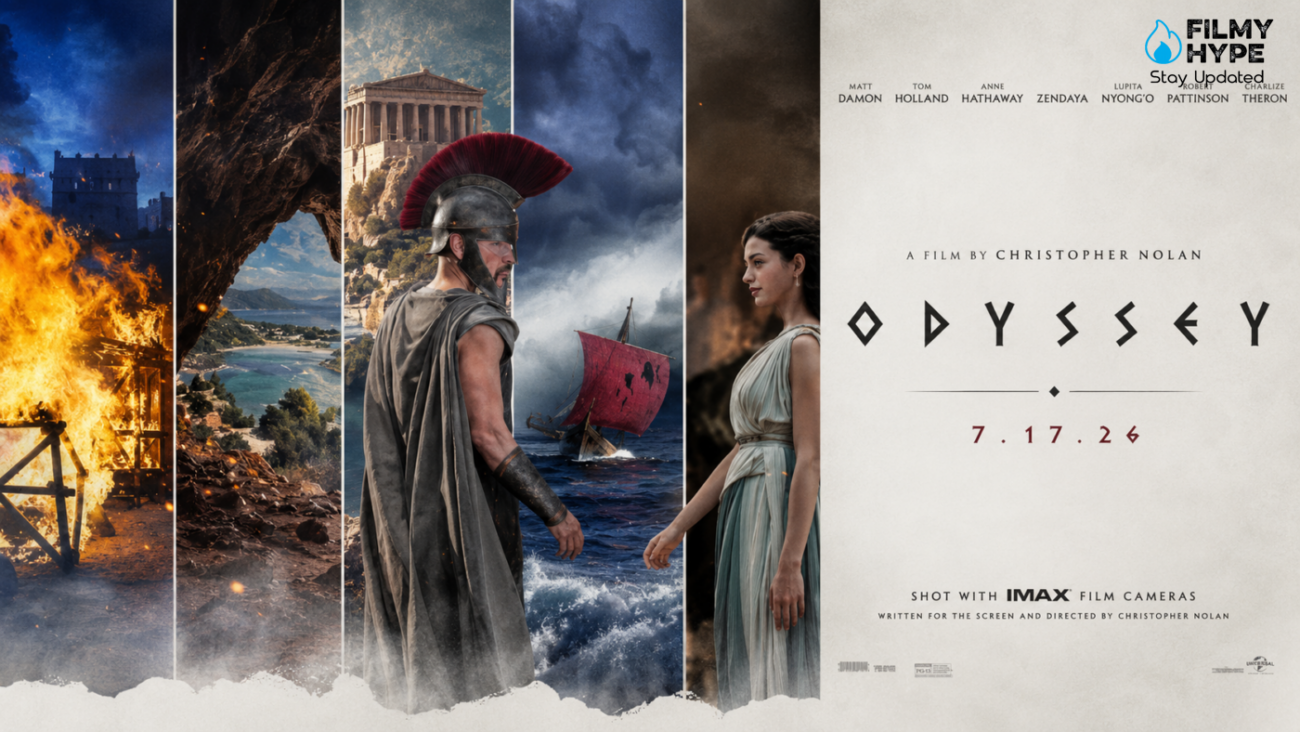
Christopher Nolan, on the other hand, succeeds in the most difficult undertaking: he does not limit himself to staging Homer’s poem, but passes through it with all the obsessions that have defined his cinema, transforming it into a story built on time, memory, guilt, and the inability to truly return home after experiencing war. His The Odyssey is a spectacular and profoundly dark work, capable of alternating images of almost unreal beauty with distressing and brutal moments. Nolan doesn’t just tell the misadventures of a hero forced to fight against men, monsters, and deities. Above all, it tells the story of a man consumed by remorse, by his own presumption, and by the consequences of the choices made during the conflict. The journey to Ithaca thus becomes a path of atonement, in which Odysseus must lose all certainty before he can understand who he has become.
The Odyssey Movie Review: The Story Plot
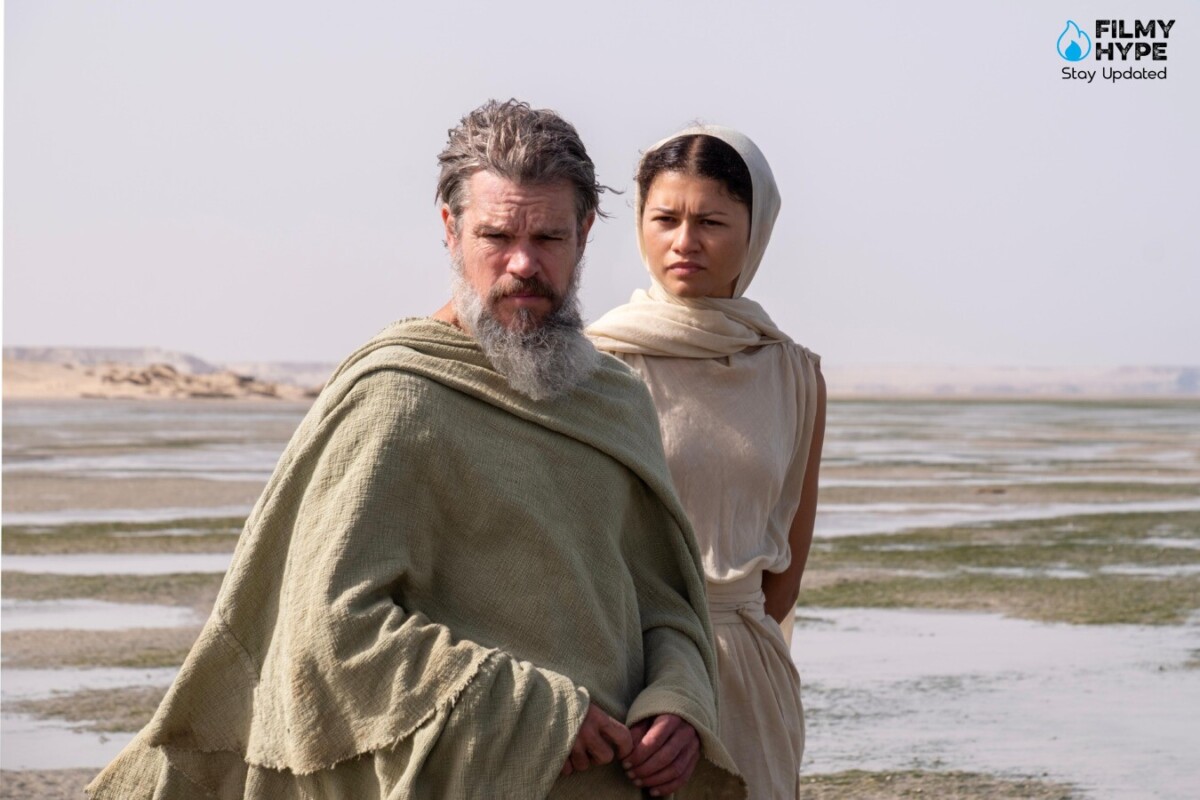
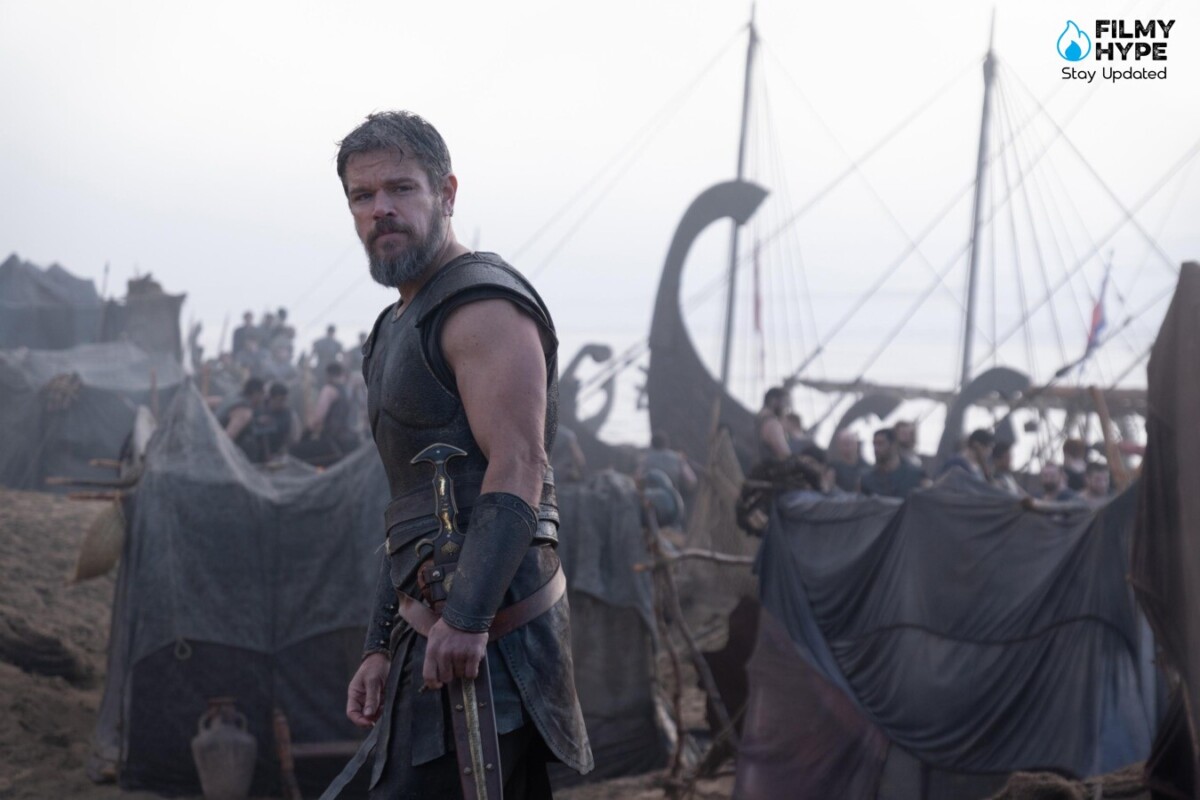
And finally, we come to discuss Christopher Nolan’s “The Odyssey“—a film that was heavily announced, hyped, and eagerly awaited. It differs greatly from Homer’s original tale—though, to be fair, that is not a problem in itself; cinematic necessities had already compelled directors like Camerini in 1954 to present a more condensed version, so to speak. Christopher Nolan takes three hours to guide us through his own take on the exploits of the quintessential Greek hero, bending a great deal—indeed, perhaps too much—to his personal will and vision. The story opens with Ulysses (Matt Damon) on a golden beach, in the grip of a lotus addiction induced by Calypso (Charlize Theron); he struggles to recall the fate of his ships and warriors, and why, after conquering Troy, he has yet to return to Ithaca.
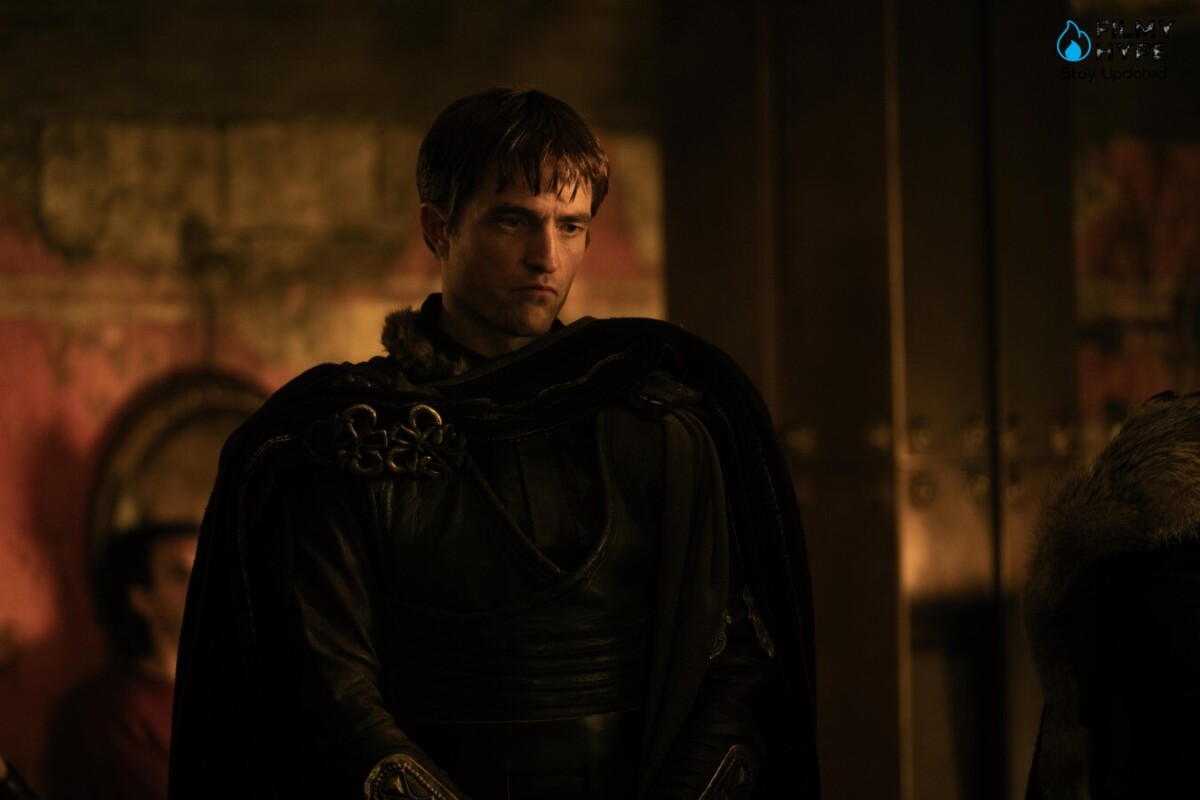
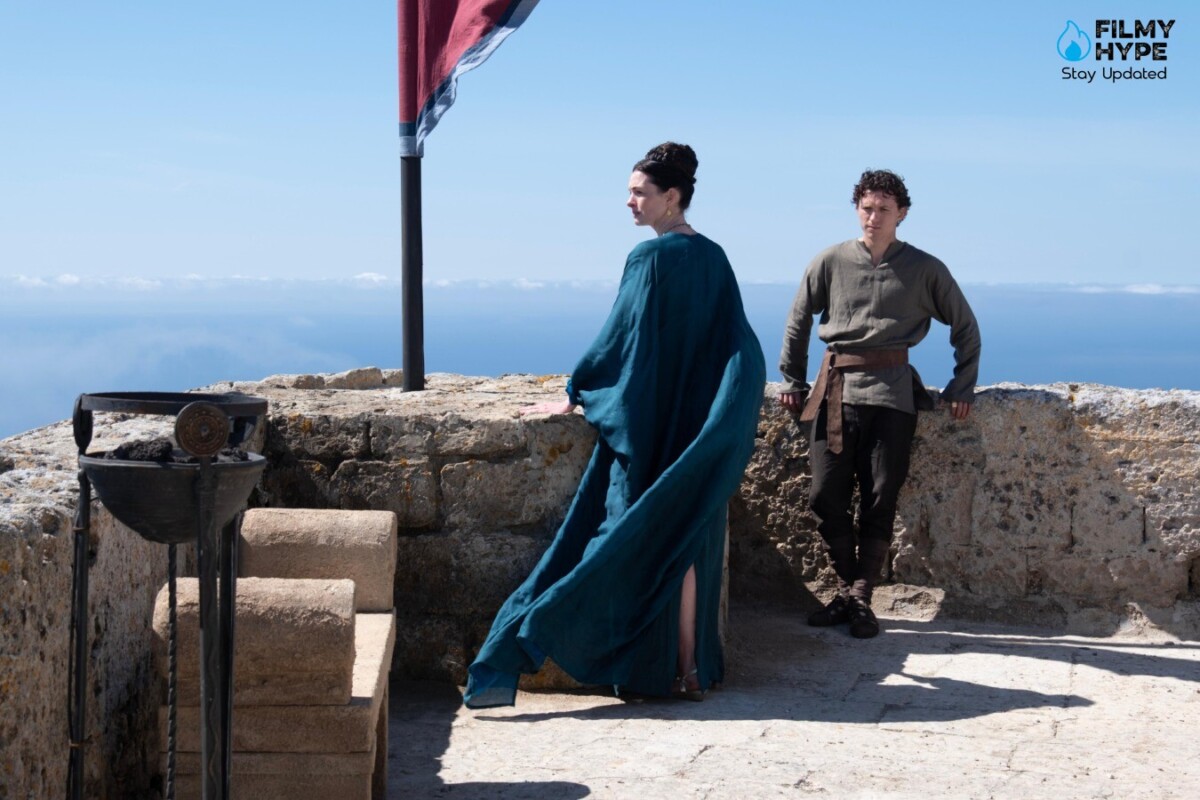
Meanwhile, back in Ithaca, Penelope (Anne Hathaway) faces mounting pressure from the Suitors—particularly the slimy, cunning Antinous (Robert Pattinson)—to remarry after all these years. Her son, Telemachus (Tom Holland), desperate over his father’s absence, travels to Sparta and the court of King Menelaus (Jon Bernthal) in search of news, fully aware that the Suitors will attempt to kill him. All the while, Ulysses finally remembers—with fear and dread—the war and a journey that took him to the ends of the earth, a realm where reality and magic intertwine.
Put that way, it sounds like the story we all know, right? So why complain? Yet, it isn’t the *what* that makes *The Odyssey* a mediocre, arrogant film; it is the *how* and, above all, the *why*. There has been much debate regarding inclusive casting (which, let’s be honest, borders on the ridiculous here), but the real issue lies elsewhere. Nolan’s vision is more British than American. Americans love myths; when they alter or modify them, it is often because they fail to grasp the concept of the sacred—it is, in a sense, unintentional, making it hard to get truly angry. The British, on the other hand, alter history and myth out of a desire for absolution—a response to the guilt stemming from their past as colonizers and cultural appropriators.
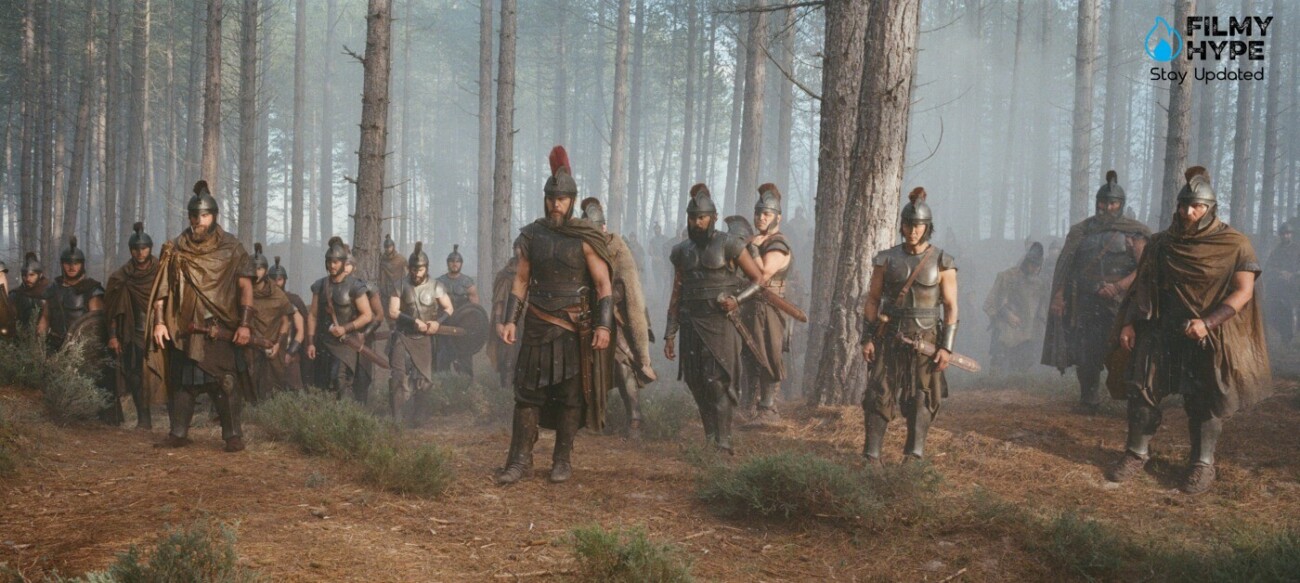
The influence of English theater also plays a role, a tradition where experimentation, rewriting, reinterpretation, and variation are the norm. Yet, there is a world of difference between doing this with Shakespeare and doing it with Homer—taking Odysseus, not merely a character but *the* Character by definition, the very foundation of storytelling, and thinking it needs “improving.” For Nolan and others like him, only the present matters; everything must be bent to serve it. This explains the absence of Greek deities in favor of a dark magic—embodied by the Circe of a brilliant Samantha Morton and the Tiresias of James Remar—which offers powerful symbols but remains untethered to Homer’s original conception. Ultimately, the result is an arrogant and at times even superficial film.
The Odyssey Movie Review and Analysis
In *The Odyssey*, Christopher Nolan glosses over key passages, characters, locations, and meanings. While the Scylla and Charybdis sequences evoke horror movies and Nolan’s visual mastery remains undeniable, the real issue lies in how he strips the Myth of its identity. A prime example is the encounter with Polyphemus—rendered here as a hairless specter—and the omission of the wine ruse, those magnificent dialogues, and the “My name is Nobody” line; these elements have for centuries defined the essence of Ulysses: the man capable of overcoming any obstacle through sheer intellect. Instead, Matt Damon—understated and cold—merely endures events; he lacks both wit and charisma because Nolan casts him as a victim of circumstance, a puppet devoid of agency.
There is no trace of the significant Phaeacian episode or the Lotus-eaters—only heavy theatricality, such as the gigantic Laestrygonians who look like they stepped straight out of *Excalibur*. These are not merely narrative alterations but a fundamental shift in semantics; there is no courage in this, only the arrogance of a director who feels untouchable—someone who labels the wholesale rewriting of the material as “fidelity.” Fidelity to himself, of course, not to Homer’s original vision or what the story represents. Yet, one need only look to the past to find numerous examples that strip away the veneer of the “courage” so many have attributed to him.
“The Odyssey” comes off poorly not only when compared to Camerini’s film or Pasolini’s “Itaca – Il ritorno,” but even against the American miniseries from the 90s, which at least possessed a spirit of adventure and light. Nolan, by contrast, envelops everything in the cold, leaden hues of cinematographer Hoyte van Hoytema. Out of mercy, I will refrain from comparing it to the work Franco Rossi created in 1968. As for the much-touted feminist reinterpretation—well, as often happens in contemporary cinema, it is merely superficial window dressing: crude and graceless. Had the filmmakers watched Michael Cacoyannis’s “The Trojan Women,” they might have learned something useful.
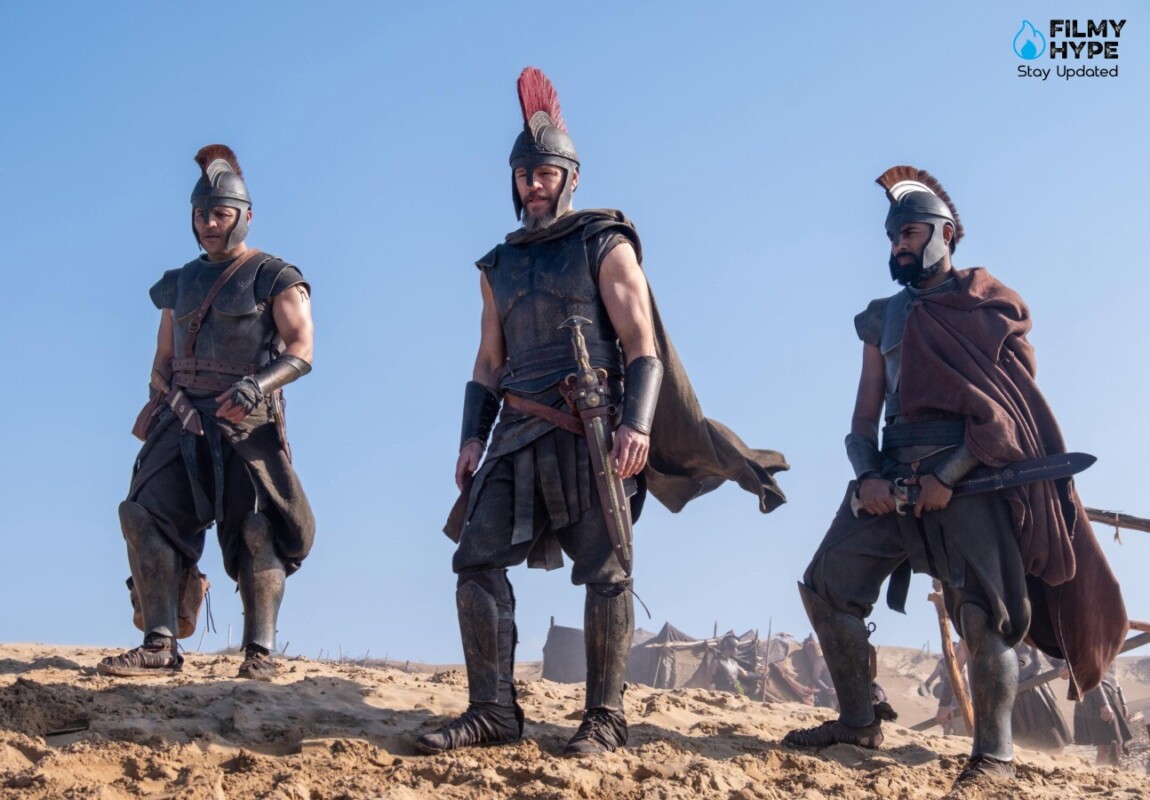
Instead, they chop, stitch, and destroy moments, emotions, characters, and the wide variety of a magnificent world. The characters are all identical; they all act in the same way. There are a few flashes of insight here and there—notably regarding the dreaded Sea Peoples (who turn out to be the Greeks themselves—destroyers of Troy and the rule of law) and the reflection on civilizations that self-destruct. Perhaps this is the one moment where the film remains faithful to Homer, yet it fails to effectively convey the transition from Myth to History, distracted as it is by its own sleight-of-hand tricks. It is a case of arrogance—what the Greeks called *hubris*, a trait the Gods invariably punished. Christopher Nolan, however, will likely walk away with a few Oscars for this three-hour slog, devoid of any real originality.
The center of Nolan’s The Odyssey is not the glorification of the hero, but the destruction wrought by war. The director looks at the fall of Troy with the same moral clarity with which he observed the birth of the atomic bomb in Oppenheimer. Once again, at the center of the story is a man celebrated for his intelligence, but haunted by the consequences of what that same intelligence helped create. The sequences set in Troy are among the most terrible in the film. Nolan does not turn the battle into an occasion to exalt the courage of the warriors, but into a suffocating, dirty experience devoid of any nobility. Buildings collapse, flames engulf the streets, and civilians are overwhelmed by the violence of men who have now forgotten why they are fighting. War appears as a disease that spreads among people, destroys communities, and continues to live within those who survived even after the fighting ends.
Ulysses brings with him every death, every deception, and every sacrifice. Remorse is not a secondary element, but the force that structures the entire film. Like J. Robert Oppenheimer, he too is a man forced to live with the weight of a victory achieved through an act of genius that has caused immense devastation. The journey to Ithaca, therefore, serves not only to reunite him with Penelope and Telemachus but to force him to look at what he has done and to understand that there is no return to the person he was before the war. Nolan retains one of the most important cores of the Homeric poem: the presumption of the human being in the face of forces he cannot control. Ulysses is intelligent, cunning, and capable of finding a solution when everyone else sees only death. It is precisely this awareness, however, that fuels his arrogance.
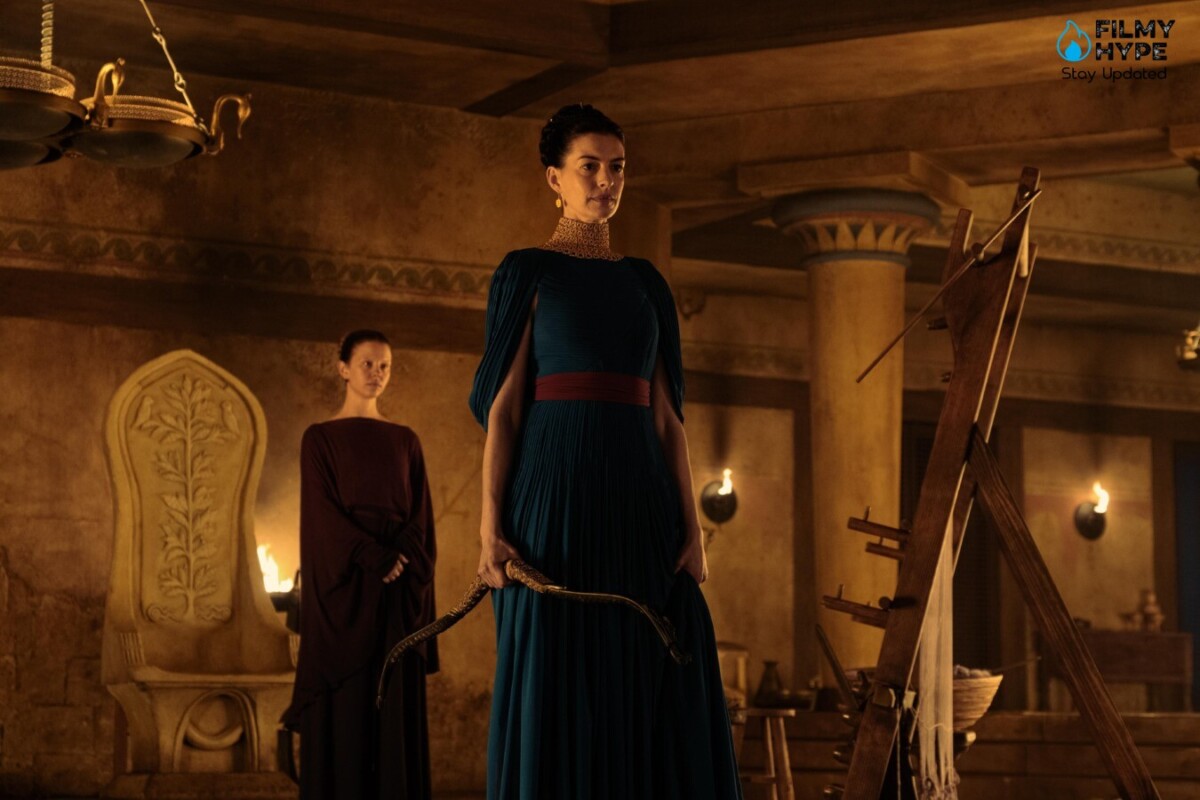
The protagonist challenges the gods, violates his own rules when it suits him, and believes that ingenuity can allow him to dominate any situation. The film does not absolve him or turn him into a pure hero. Instead, he shows how his suffering is also linked to the need to overcome this presumption, understanding that the world cannot always be bent to its own will. Even the encounter with Polyphemus takes on a less reassuring nuance than more traditional versions. The Cyclops is not only the monster to be defeated, but a creature into whose house Odysseus and his men break in, behaving like invaders. The way Nolan flips perspective does not erase the danger, but it makes the confrontation morally more complex and forces the viewer to continually question who is truly committing violence against whom.
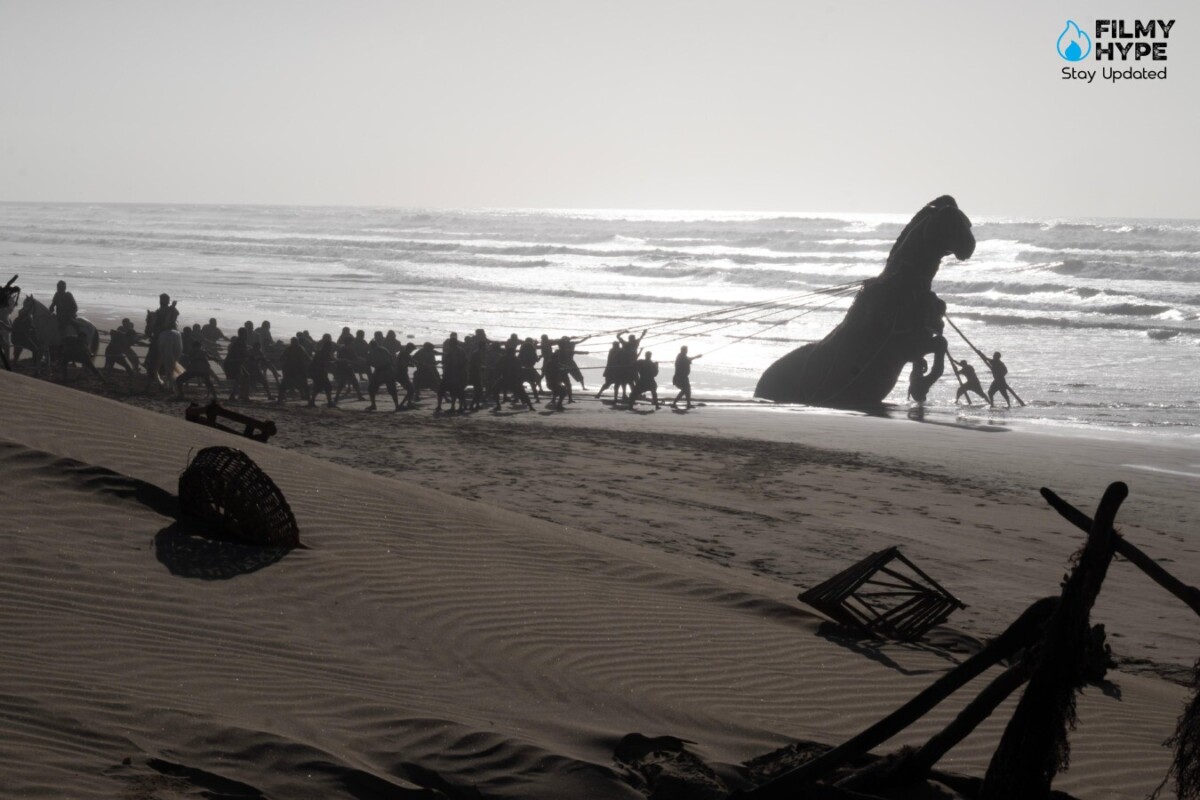
Visually, The Odyssey is one of the most impressive films Christopher Nolan has ever made. The massive use of practical effects gives environments, creatures, and battles a physical weight that digital effects rarely achieve. The ships really do seem to be swept away by the sea, the Trojan horse appears as a huge construction dragged with difficulty by dozens of men, and each collapse produces a concrete feeling of danger. There are absolutely extraordinary moments, shot with a visual and narrative intelligence that shows how well Nolan can tell already known images as if we were seeing them for the first time. Polyphemus’ sequence is a nightmare built on proportions, noises, and the perception of space. The physical presence of the cyclops, achieved through a gigantic practical effect, makes every movement unpredictable and every escape attempt desperate.
The part dedicated to Circe is perhaps the one in which the film reaches its most disturbing form. Samantha Morton constructs a magnetic and frightening figure, while Nolan avoids any predictable depiction of the transformation of humans into animals, finding a much more disturbing solution consistent with the psychological atmosphere of the work. Even mermaids are told through a surprising visual and sound idea. Nolan does not rely on simple seduction but transforms their singing into something that invades the sailors’ memories and weaknesses. The threat comes not only from outside, but from the images that each person carries within themselves and from the desire to surrender to a reality more reassuring than that which awaits them.
The choice to build the film through continuous time jumps completely elevates the story. Nolan does not follow Ulysses’ journey linearly, but he reassembles it through testimonies, fragmentary memories, and stories inserted within other stories. The film can begin in the present, return to the fall of Troy, move to Ithaca, and then enter into the memory of a character narrating an event already transformed into legend. It is a fitting structure typical of Nolan cinema, but here it finds a particularly profound justification. The Odyssey is, in fact, a story that has survived for centuries thanks to oral tradition, continually told, modified, and reinterpreted.
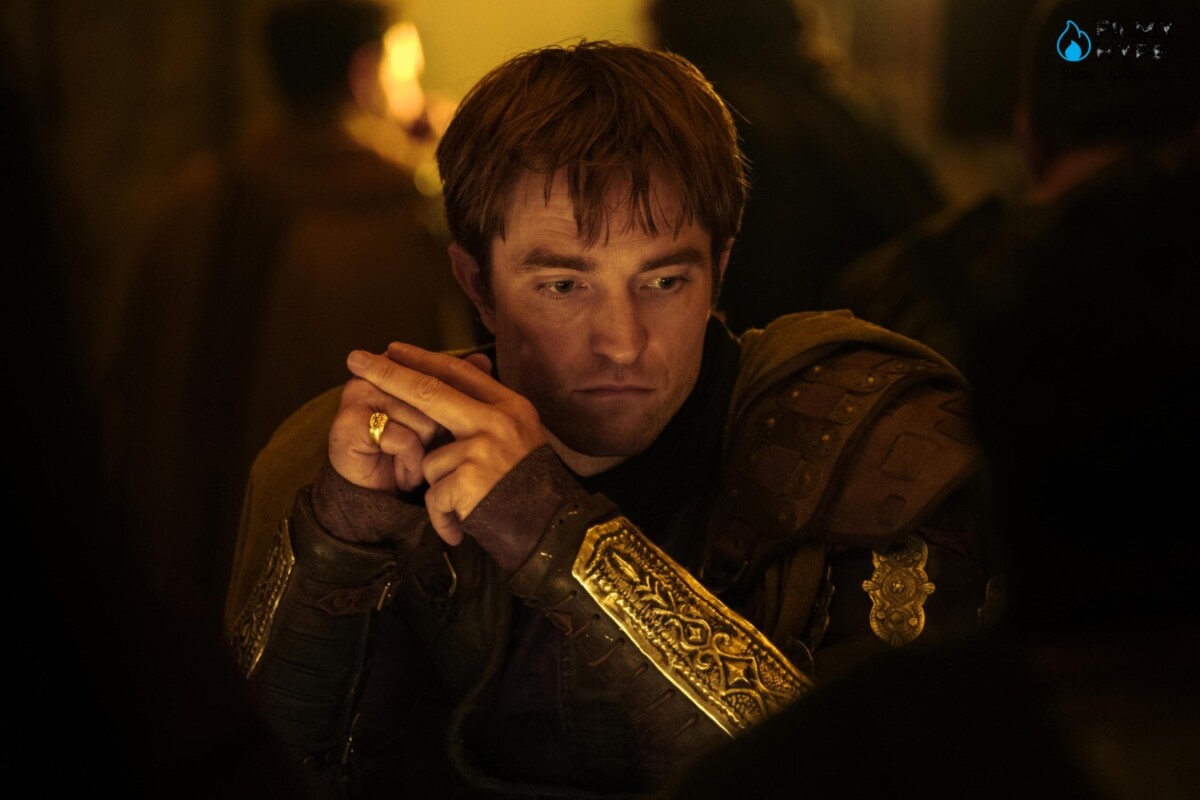
Events are never entirely in the past. They return to Odysseus’ dreams, Telemachus’ fears, and Penelope’s long wait. Memory does not follow a chronological order, especially when it is traversed by trauma. Nolan thus manages to make time a mental space in which the protagonist continues to relive what he has done, trying in vain to separate the truth from the version he has told himself in order to continue living. The film boasts a massive cast, in which even the shortest appearances leave their mark. Matt Damon portrays Ulysses as a man consumed by weariness and guilt, able to be authoritative in front of his own men and completely lost when left alone. He is not a heroic figure in the traditional sense, but a contradictory, intelligent, and often cruel human being, forced to progressively recognize his own responsibility.
Anne Hathaway is in top form and builds a Penelope with an impressive stage presence. The film does not reduce her to the wife patiently awaiting her husband’s return, but shows her attempting to protect Ithaca, Telemachus, and herself from men who believe that power and her body are already at their disposal. Some of the most beautiful and emotional moments of the entire work belong to her. Tom Holland does a good job of conveying the insecurity of a son raised in the myth of an absent father, while Robert Pattinson makes Antinous elegant, contemptuous, and deeply threatening. Charlize Theron, Samantha Morton, John Leguizamo, Jon Bernthal, Benny Safdie, and Elliot Page manage to assert themselves even within such a crowded story.
The cameos are also extraordinary. Zendaya appears for a few minutes as Athena, but her presence possesses something solemn and painful that remains imprinted. Lupita Nyong’o has an equally small space, yet she makes both the figures she plays unforgettable, confirming that in such a film, there really are no minor roles when the stage presence is so powerful. The Odyssey is a huge film, but its greatness depends not only on the size of the sets, the battles, or the practical effects. The real strength of the play lies in the way Nolan uses the show to question the war, remorse, memory, and arrogance of the human being.
Some dialogue can be more explicit than necessary, and the sheer number of characters and episodes demands attention, but the nearly three hours flow with surprising fluidity. Each fragment progressively finds its place within the structure and contributes to building the portrait of a man trying to return home without knowing whether there is still a house capable of welcoming him. Nolan does not tell the story of the hero who defeats monsters, but of the man who must survive what war has transformed within him. In his cinema, time does not heal wounds; it preserves them and resumes them until the characters are forced to face them. For Ulysses, Ithaca represents not only the end of the journey, but the place where he will finally have to discover if anything can still exist after remorse.
Beyond the narrative approach, however, there is the aesthetic one, through which Christopher Nolan once again gives us an immense, challenging, and in some ways even atypical and fluctuating blockbuster. If The Odyssey is, as mentioned before, anti-epic and intimate in the tone of the script, it is instead gigantic in terms of visual scale. It is a film that literally “fills” the screen, and also the eyes, restoring a fullness and visual grandeur in relating the smallness of man to the immensity of his journey, and to the panoramas of a mysterious and unexplored world, straddling real historical landscapes and non-places, the fruit of dreamlike and the suggestions of myth.
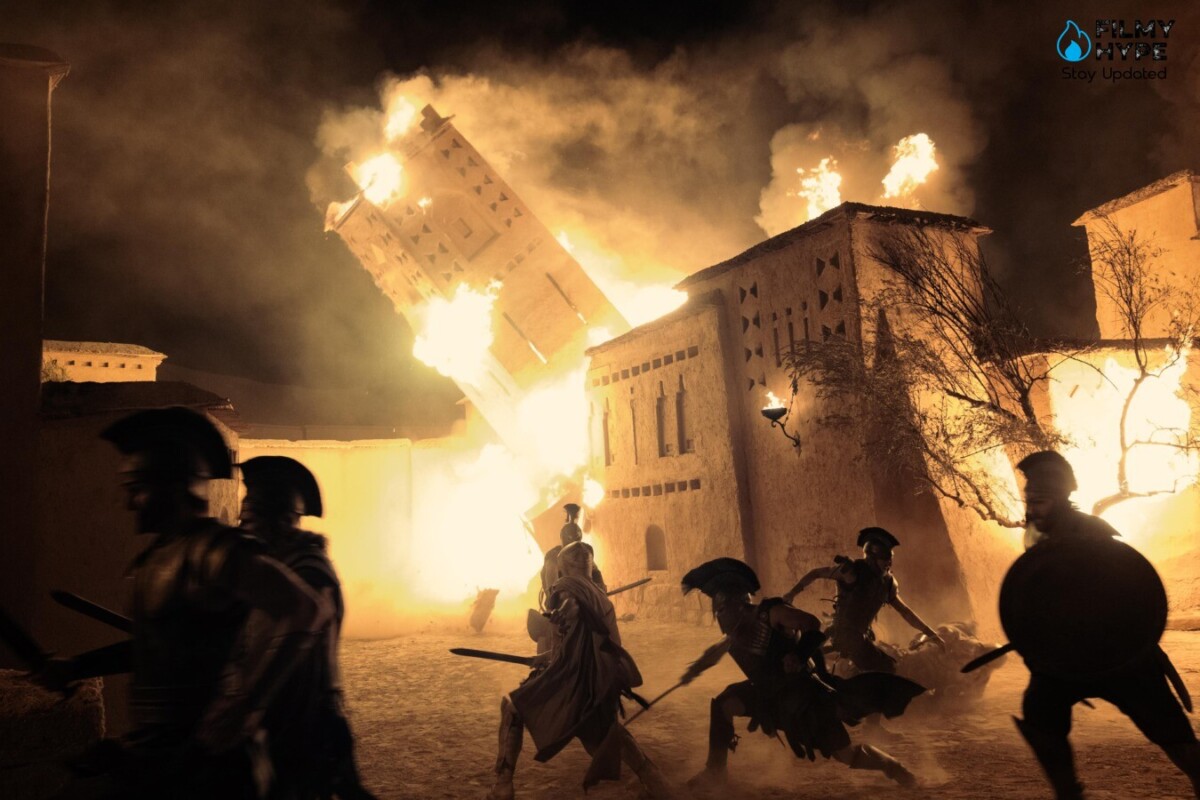
So, if I’m “Nolan-style” in my view of the story and the characters, the eye through which we follow the epic of Ulysses is instead anti-Nolan. Because the director of Inception, deep down, knows very well how to move between dream and reality, and he does it in his own way, while also embarking on the unknown in exploring new genres. The Odyssey is, in fact, a very “dirty” film, deliberately desaturated in color, and even horror in some places. This is the most intriguing and convincing aspect of The Odyssey, according to Nolan: the fact that it is different from everything we have seen so far about the Homeric poem, and is different even from Nolan himself.
Because the author managed to venerate the original material, and in a certain sense even betray it, in the most positive sense of the word. Again, it’s not all perfectly set up, and in trying to experiment, Nolan makes a few small stumbles, especially in the final act. The idea of following a path halfway between realism and fantasy results in a somewhat chaotic and hasty final resolution, though understandable in terms of language. And it is precisely these aspects that make The Odyssey a wonderfully imperfect work, an “almost masterpiece” that proves magnificent precisely because of its at times alienating sense. And that allows Christopher Nolan to delve into the origins of man himself, re-signing an important page in contemporary cinema.
The Odyssey Movie Review: The Last Words
The Odyssey is a gigantic, imposing, and at the same time intimate film. A film “Nolan-style” and also “anti-Nolan”, which marks the full artistic maturity of the British filmmaker, who manages to respect the Homeric poem with religious fidelity while also remaining faithful to his cinematic language. At the same time, Nolan also manages to betray himself, crafting a story that intriguingly blends realism and fantasy, with previously unseen horrifying grafts and reflections that, albeit tied to a two-thousand-year-old narrative context, manage to connect with current events with a frighteningly lucid gaze. A few small smudges and a couple of moments not too in focus separate a huge blockbuster from a total masterpiece. But that’s okay.