


The first thing to understand about Teenage Sex and Death at Camp Miasma is that it’s not really a horror movie. Not in the way most audiences use that term. Jane Schoenbrun, the director behind I Saw the TV Glow and We’re All Going to the World’s Fair, has spent their career making films about the porous boundary between fiction and identity, about the ways the stories we consume shape who we become. Camp Miasma is the culmination of that project: a slasher film that uses the language of 1980s horror to tell a story about queer desire, sexual shame, and the strange, painful process of learning to inhabit your own body.
The film won the Queer Palm at Cannes, which tells you something about its ambitions. It’s not content to simply reference Friday the 13th or A Nightmare on Elm Street. It wants to dismantle the assumptions those films were built on—the idea that sex equals death, that the “final girl” survives because she’s pure, that queer and trans bodies are monstrous by definition. Schoenbrun inverts all of it. The killer isn’t a punishment for desire. The killer is desire itself.
Teenage Sex and Death at Camp Miasma Ending Explained: What Does the Camp and the Movie Kris Wants to Make Represent?
He Miasma Camp and his Final Girl original are also concepts. In Slasher cinema, camps represent freedom, the possibility of living a summer without parental rules or surveillance, and a place where a teenager can begin to become an adult. The Final Girls represent survival and resilience, and they become figures that guide the audience from their own perspective and perception of what is happening. But they also talk about stereotypes and gender roles, because, to survive, you have to be innocent, pure, and “good”.
Here, the meaning is a little different, since Schoenbrun talks about nostalgia, about how certain films mark us, films in which we find a refuge, a tribe, and in which we learn to look at ourselves and understand ourselves, and that help us feel seen, understood, and less alone. Here, the meaning is a little different, since Schoenbrun talks about nostalgia, about how certain films mark us, films in which we find a refuge, a tribe, and in which we learn to look at ourselves and understand ourselves, and that help us feel seen, understood, and less alone.
Kris’ connection to that camp, to that movie, and to that character is deep, and it’s something that all of us who grew up watching movies can feel connected to. Some films are not simple films; they are part of our history, or they helped us build our own history, and that is what makes them survive the passage of time and become more transcendent. Schoenbrun shows cinema as a refuge, as a way of understanding ourselves and being less alone.
Why Does Little Death Watch From a Hole in the Lake?
Little Death: he is the “villain” of the original version of Camp Miasma, but what Schoenbrun does is remind us that, sometimes, history does not tell things as they are, because the perspective, opinion, and position of the person telling it always intervenes. Little Death: yes, he is a murderer, but he was also a victim before becoming that “monster” (which is a bit reminiscent of the witch’s ghost in 13 Ghosts), and what he is doing is seeking revenge.
But why do you watch from a hole at the bottom of the lake? Throughout the film, Kris begins to get lost in the fantasy of cinema; he comes to doubt if Little Death exists only in fiction, and if the story that Billy tells him (where Little Death lives in a hole at the bottom of the lake, where he watches and waits to return) may be true.
And this can also be interpreted in many ways. Little Death doesn’t go away completely because the trauma doesn’t go away either, neither from people nor from certain places. Some facts and experiences accompany us all our lives, and reappear when we least expect it. Little Death is always present because the world won’t let him “die”, and because, in this context, the villain is an icon that reappears every time someone wants to add a new movie to the saga.
That’s how the real world works and memory too. There are many things that we forget, that we keep in a mental drawer or that we put aside, until something wakes it up and brings it to the surface.
What Does The Film Say About Hollywood’s Obsession With Remakes, Sequels And Remakes?
One of the most interesting elements of Miasma Camp is what it says about the obsession with remakes, sequels, prequels, and new versions. On the one hand, it’s playing it safe, looking for guarantees, and an “easy” way for studios to make money, but if we look at it from Kris’s perspective, it’s also nostalgia and a way to bring back a movie or story that was very loved, and even to pay tribute to her and help her grow.
Originality exists; we see it with this film, but cinema is still a business and wants to look for projects that have a high chance of being successful, and that is why there are stories, characters, and old films that will continue to receive the remake treatment.
A Final Girl Who is No Longer a Teenager (and the connection to Sunset Boulevard)
Gillian Anderson does an extraordinary job in this film, as a peculiar character, strange, eccentric, and magnetic at the same time. Billy was the Final Girl in the original film, but then she stopped acting, distanced herself from the world, and became a symbol.
Kris wants her back, but she’s not the teenager anymore at Camp Miasma, and the producers even tell him that no one wants to see a 60-year-old woman in a movie like this. In short, this makes a point about the ageism that exists in the industry, about the obsession with youth and the fear of growing up.
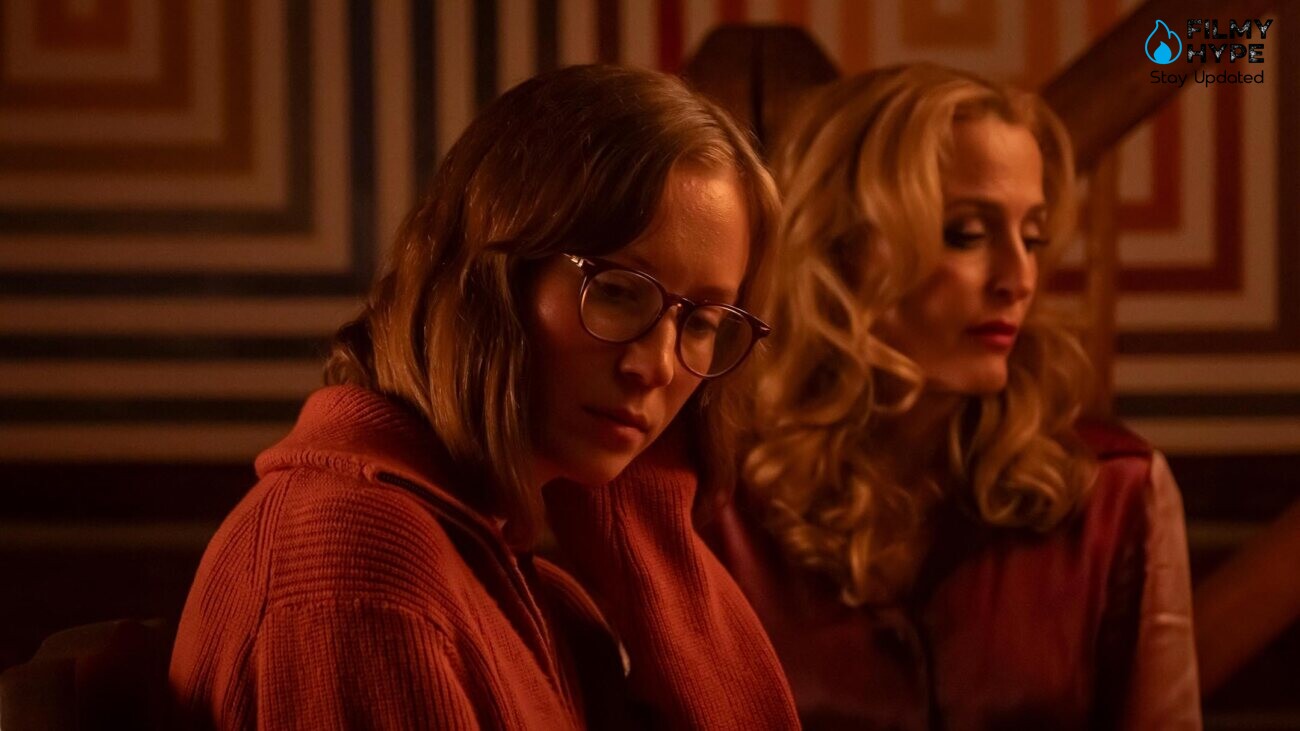
One Final Girl adult forces us to accept that time passes, that people change, and that the world does too. It tells us that, after surviving, we must continue moving forward, because time does not stop for anyone. And it reminds us that life is short.
Also, here they connect it with the movie Sunset Boulevard, where a silent film actress lives isolated and far from the world, because it is a world that she no longer understands and in which she feels that she does not fit. Here, as in Camp Miasma, a writer appears who begins a romance with this actress and who offers her the possibility of being part of the world, but there is a resistance: something within Norma Desmond (the protagonist of Sunset Boulevard) resists, and that resistance leads to chaos and tragedy.
Luckily, at Camp Miasma the result is a little different (or not?).
Does Little Death kill Kris and Billy?
In the final moments of the film, after Kris begins to let go of her insecurities and fears, and completely loses herself in Billy’s world and the idea of being one Final Girl (which was also her fantasy, although not even she herself knew it at first), Little Death shows up and starts chasing Kris, as he did with Billy in the past.
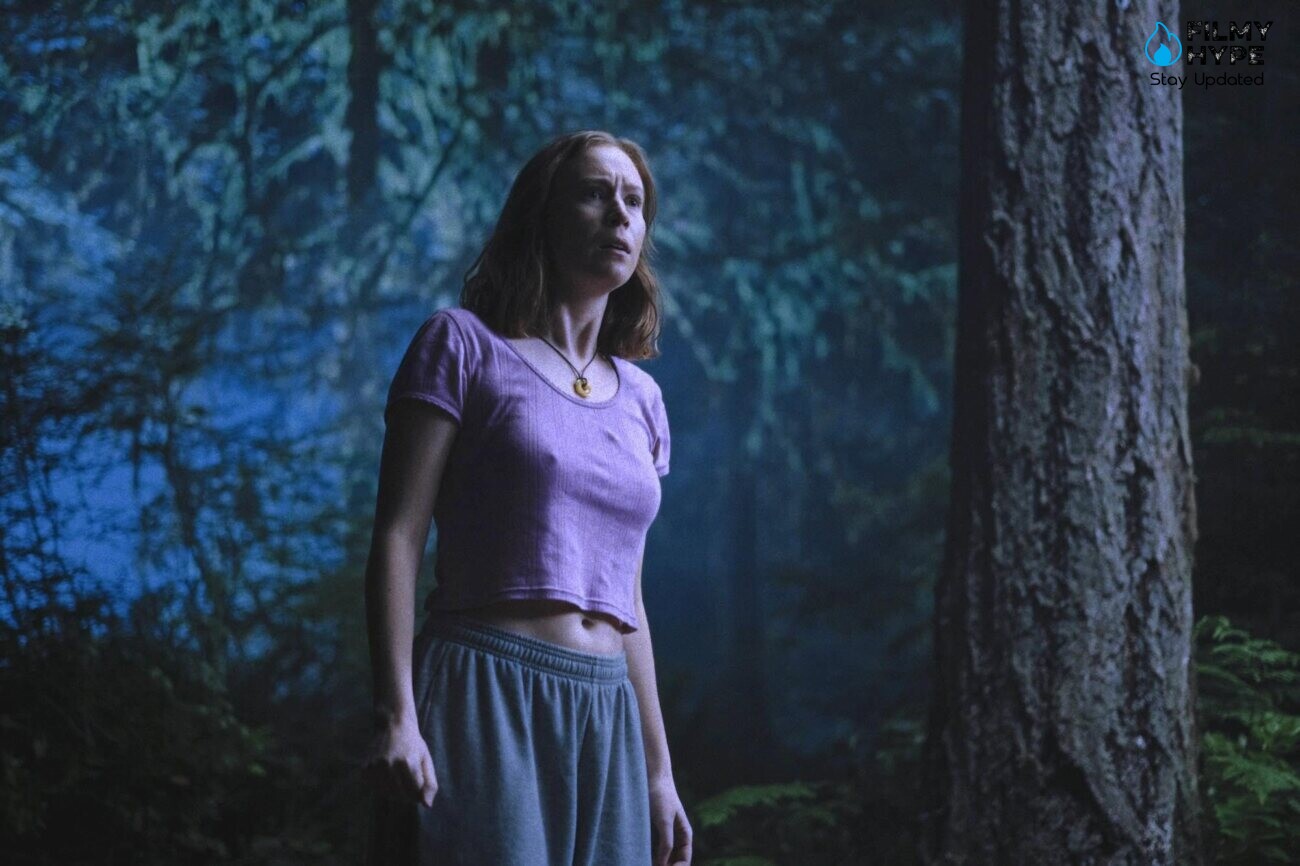
Kris runs through the woods (half-naked, because that’s how it is in the Slasher movie theater), manages to escape and reunite with Billy, but Little Death follows closely and eventually finds the two women in bed, killing them by impaling them with his spear.
But this is not a literal death, because we see them wake up the next day, covered in blood, and go shopping for candy at a nearby store. Billy herself explains it before: it is not a death; it is a “giving in”; it is letting go of prejudices that we carry and the insecurities that we let dominate us.
Little Death is also a poetic way of referring to an orgasm and the state of total relaxation that happens afterwards, for a few minutes. That’s what Kris has: a little death where she finally lets go and is at peace, nothing is after her, and she doesn’t need to prove anything to anyone.
The Setup
Kris Williams, played by Hannah Einbinder, is an up-and-coming queer filmmaker who’s been hired to direct a reboot of Camp Miasma, a fictional slasher franchise that was big in the 1980s and has been decaying ever since. The original premise is deeply problematic: the killer, known as Little Death, is the ghost of a child raised half as a boy and half as a girl, who was drowned in a lake by prejudiced campers. The studio wants to “rehabilitate” the franchise, to make it palatable for modern audiences. Kris is cynical about the whole thing.
To develop her vision, she travels to the Pacific Northwest to meet Billy Presley, played by Gillian Anderson. Billy was the original film’s final girl—the one who survived when everyone else died. She retired from acting abruptly and now lives as a recluse in the abandoned camp where the original was shot. Kris expects intellectual advice. Instead, Billy tells her that to understand terror, you have to experience it in “flesh and fluids.” From that moment, the boundaries between reality and fiction begin to blur.
What “Little Death” Means
The killer’s name is a literal translation of “la petite mort,” the French expression for orgasm. Georges Bataille used the term to describe the brief dissolution of self that follows maximum pleasure—a moment of ego death that’s both terrifying and transcendent. In Camp Miasma, the connection between the killer and sex is explicit. Traditional slasher films punish sexual activity with death. The teenagers who have sex are the ones who get murdered. Purity is survival. Schoenbrun flips this completely. Little Death isn’t a punishment for desire. Little Death is desire itself, untamed and unashamed.
This reframes the entire film. Kris isn’t running from a monster. She’s running from her own inability to feel pleasure, from the shame that’s kept her locked inside herself for years. The killer doesn’t represent what she’s afraid of. The killer represents what she’s been denying.
The Healing Game
The emotional core of the film comes when Kris confesses something deeply personal. She’s been struggling with writer’s block, with the disintegration of her open relationship with Mari, and with a chronic inability to feel pleasure with other people. She reveals that she can only approach sexual satisfaction when she imagines herself inside a 1980s slasher film—as the helpless young woman running through the forest, about to be captured. She’s ashamed of this fantasy. She thinks it’s stupid and misogynistic.
Billy doesn’t judge her. She tells Kris that it’s just a game. She points to an old promotional poster for the original franchise, which carries the tagline: “If it gets too real, you can always turn it off.” That line becomes the film’s operating principle. Kris and Billy decide to “make a movie” together—a structured experience that functions like queer sex itself, with consent, laughter, vulnerability, and aftercare. Billy helps Kris use the language of horror to finally connect with her own body.
Schoenbrun has described this process in interviews as being about “experiencing for the first time, already in your 30s, what most people experience in adolescence: discovering a body, a sexuality and an identity that seem right.” The horror framework isn’t the problem. The horror framework is the tool. It gives Kris a way to approach her own desire that feels safe precisely because it’s scary.
The Climax
The third act dives fully into the fiction of Camp Miasma. The harsh winter around Billy’s cottage—symbolizing Kris’s emotional rigidity—gives way to a scorching summer. Kris strips to her underwear and runs through the woods in slow motion, becoming the final girl. Along the way, Little Death murders everyone who represents the weight of the real world in her life: her other partner, Thor. Her girlfriend, Mari. Her impatient agent. The Hollywood executives who’ve been suffocating her with commercial notes. The deaths are exaggerated, almost cartoonish, the artificial blood looking like candy filling. The Counting Crows song “A Long December” plays over the carnage, undercutting the violence with something wistful and sad.
Kris arrives at Cabin 5, where Billy has set the stage: rose petals, candles, Sade’s “No Ordinary Love” playing. Billy lies beneath her and tells her to do what she did on the set of the original film decades ago—to step outside herself and see through the killer’s eyes. The camera shifts to Little Death’s POV as the killer enters the cabin, spear raised.
The spear pierces them both. And in that moment, Kris has her first orgasm with another person. Pleasure and death happen simultaneously. The ego dissolves. The shame dies. What remains is something new.
Afterward, the pink portal at the bottom of Lake Miasma opens and expels a new VHS tape, its case printed with Kris and Billy’s faces. The tape joins the shelf of Camp Miasma films. The mythology has come full circle. They’ve become part of the story.
The Morning After
When dawn breaks, the camera pans past the lifeless bodies of Kris’s executives and friends. But in Cabin 5, Billy lifts her head and whispers, “Good morning, sleeper.” They both get up, still bloodied, still in their underwear, and walk hand in hand through the forest.
There’s a crucial visual detail here. The mountains and sky in the background are now clearly hand-painted canvases. The artificiality of the setting is visible. Kris and Billy haven’t returned to the “gray reality” of the film’s opening. They’ve chosen to remain inside the fantasy they created together. The game allowed them to shed the shame that was suffocating them, and they’re not going back.
Schoenbrun has explained this as a metaphorical survival. “They die, but it is not a permanent death,” the director said. “It’s fictional in a way. It’s in the land of metaphor, of poetry. It’s a ‘little death’ [orgasm]. It’s not the same thing as ‘great death,’ and it allows them to discard something, probably shame. This is quite healthy.”
The Gas Station
The walk ends at a convenience store. Kris and Billy, still in their bloody outfits, browse the candy aisle while discussing whether we’re living in the “golden age of gummy bears.” A customer at the coffee counter stares at them with open hostility—the kind of look that queer and trans people know all too well, the daily prejudice of existing in public space. But the cashier, Flo, reacts with warmth, complimenting their “visuals.” The stranger can be embraced. The world isn’t entirely hostile.
In the final scene, Kris looks toward the horizon and repeats the franchise line that once haunted her: “He’s still down there, you know, at the bottom of the lake. He’s still hungry.” But her expression isn’t fear anymore. It’s wonder. She smiles. Billy smiles back. Terror is no longer something to avoid. It’s become an ally.
Do Kris and Billy Actually Die?
No. Not literally. The death in the cabin is a “little death”—an orgasm, a surrender of the self. Kris and Billy survive. What dies is the repression, the shame, the trauma that kept them disconnected from their own bodies. The film is explicit about this. The painted mountains aren’t a clue that they’re dead. They’re a clue that Kris and Billy now live inside their own creation, inside a reality they’ve shaped together. They’ve stopped being victims of the story and become its authors.
What the Film Is Really About
Schoenbrun has said that the film is about the strange, delicate process of discovering—late in life—what most people find in adolescence: a body, a sexuality, an identity that feels right. It’s about undoing the damage that’s been done by a culture that treats queer and trans desire as monstrous. The slasher framework isn’t a gimmick. It’s the perfect vehicle for this story, because horror has always been the genre that explores what we’re afraid to name.
The film doesn’t offer easy answers. It doesn’t pretend that shame can be erased overnight, or that the scars of trauma disappear once you’ve had a breakthrough. But it does insist on the possibility of joy. Kris ends the film smiling. Billy ends the film holding her hand. They’ve survived something—not a killer, but the weight of everything the killer represented. The hunger at the bottom of the lake is still there. But now it’s a hunger they understand. And understanding, the film suggests, is the first step toward freedom.