What are Infinity Vision Screens? At the end of the first trailer for Avengers: Doomsday, right after the money shots and the title card and the December 18, 2026, release date, there’s a logo that most viewers probably didn’t recognize. Two words: Infinity Vision. It sounds like something a Marvel character would wield, or maybe a rejected name for a phase four MacGuffin. But it’s not. Disney attempts to solve a very specific, very expensive problem, and the story of why it exists is a window into how the battle for your movie ticket is changing.
What are Infinity Vision Screens?: A New Movie Format for Avengers: Doomsday, and It’s All Because of Dune
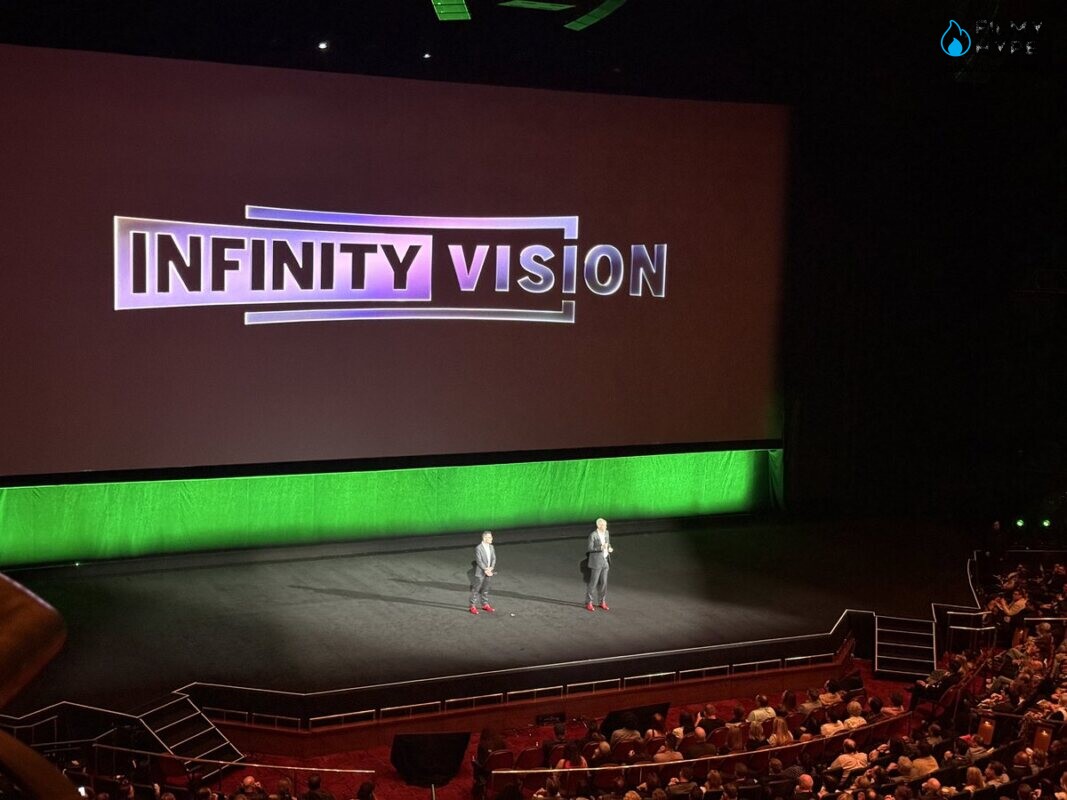
Disney unveiled Infinity Vision at CinemaCon in April 2026, and the pitch was straightforward enough. This isn’t a new camera system. It’s not a proprietary projector that theaters have to buy. It’s a certification, a seal of approval that Disney stamps on theaters that meet certain technical standards. Think of it like the nutrition label on food packaging, except instead of telling you how much sodium you’re about to consume, it’s telling you that this particular screen is going to make Avengers: Doomsday look and sound as good as the filmmakers intended.
The timing of the announcement and the film it’s attached to isn’t a coincidence. Infinity Vision exists because of Dune: Part Three, and the story of how a sandworm epic forced Marvel to invent a new format is genuinely worth understanding.
What Infinity Vision Actually Means
The requirements for Infinity Vision certification are built on three pillars. The first is scale. Screens have to be the largest available in a given location. There’s no fixed size requirement, no minimum diagonal measurement, but the principle is that the certified screen should be the biggest, most visually commanding option in that particular theater. If you’re walking into a multiplex and you see the Infinity Vision logo next to one auditorium and not the others, that’s the one with the screen that fills your field of view.
The second pillar is laser projection. This matters more than most people realize. Standard digital projectors, the ones that have been in theaters for decades, use xenon bulbs that dim over time and can’t hit the same brightness levels or color accuracy as laser systems. Laser projection means deeper blacks, more vibrant colors, and an image that holds its integrity even in dark scenes where standard projectors tend to turn everything into muddy gray soup. For a movie like Avengers: Doomsday, which will almost certainly feature a climactic battle in dimly lit conditions with dozens of characters throwing energy blasts at each other, the difference between laser and standard projection is the difference between seeing what’s happening and squinting at shadows.
The third pillar is immersive audio. Disney-certified multi-channel systems that surround the viewer with sound from multiple directions. This is less about volume and more about precision. When a character flies in from off-screen, you should hear them coming from the correct direction. When something explodes in the distance, the sound should feel like it’s actually in the distance. The audio component of Infinity Vision is designed to ensure that the sonic experience matches the visual one.
Andrew Cripps, Disney’s Head of Theatrical Distribution, framed the initiative as an extension of the studio’s production standards. The idea is that Disney spends years fine-tuning every detail of a film, and Infinity Vision is a way to ensure that the theaters showing those films are matching that commitment. At launch, the certification covered 75 theaters in the United States and around 300 screens internationally. The first film to carry the label will be the special re-release of Avengers: Endgame in September 2026, followed by Avengers: Doomsday in December.
How This Is Different From IMAX
To understand Infinity Vision, you have to understand IMAX, and you have to understand that not all IMAX is the same thing. This is where a lot of the confusion comes from, because movie theaters have spent years blurring the distinction between real IMAX and IMAX-branded screens that are essentially just slightly bigger standard auditoriums.
True IMAX is a proprietary ecosystem. It includes special cameras, dedicated projectors, and a native aspect ratio of 1.43:1. That’s a much taller image than the standard widescreen 2.39:1 format. When you watch a film shot in native IMAX on a real IMAX screen, you’re seeing significantly more vertical image. Not black bars cropped off the top and bottom, but an actual picture, conceived and captured with that specific frame in mind. Directors like Christopher Nolan and Denis Villeneuve build entire sequences around that expanded vertical space. They’re thinking about it when they block scenes, when they choose lenses, when they decide where to put the camera.
But most IMAX screens in multiplex chains aren’t that. They use an aspect ratio of 1.90:1, which is closer to the 16:9 shape of a television. Some of them are smaller screens with digital projectors that don’t match the quality of the original IMAX film systems. The IMAX branding has been stretched to cover a wide range of experiences, and the difference between a true IMAX presentation and an IMAX-branded one can be significant.
Infinity Vision doesn’t compete with IMAX on hardware. Disney isn’t manufacturing projectors or requiring theaters to install proprietary systems. The certification applies to existing PLF, or Premium Large Format, screens. These are the premium auditoriums that individual theater chains have developed under their own brand names, the ones with the bigger screens and better sound systems that cost a few extra dollars per ticket. Infinity Vision is Disney saying that certain of those screens meet a standard, and slapping a label on them so audiences can find them.
On the production side, Marvel films aren’t shot for native IMAX capture. The Marvel pipeline is built for scale, flexibility, and massive visual effects integration. That requires a multi-camera digital ecosystem that prioritizes adaptability over format specificity. When a Marvel movie ends up in IMAX, it’s technically “IMAX Adapted.” The image is optimized for that screen in post-production, with an expanded aspect ratio that fills more of the frame, but it wasn’t conceived from the first shot with native IMAX cameras. The result can still be impressive, but it’s a different process than what Nolan or Villeneuve does.
Infinity Vision, then, isn’t a replacement for IMAX. It’s a parallel track. A quality assurance label that works across different premium formats without requiring theaters to install anything new. It’s less exclusive than IMAX, more widely available, and entirely under Disney’s control.
The Dune Problem That Started All of This
This is the part of the story that explains the timing. Avengers: Doomsday is scheduled for December 18, 2026. So is Dune: Part Three. Denis Villeneuve’s film, shot in native IMAX with custom optics and a production philosophy built entirely around the format, secured a three-week exclusivity window on all global IMAX screens coinciding with its release. That means when Avengers: Doomsday opens, the IMAX screens will be showing Dune. All of them. For three weeks.
Disney found itself facing a situation where one of its most anticipated films, the culmination of years of Marvel storytelling, would open without access to the premium format that audiences have been trained to associate with event movies. You can’t put Avengers on standard screens while Dune occupies all the IMAX real estate and expect audiences not to notice. The solution was to create a premium alternative that could compete on quality without competing for the same hardware.
Infinity Vision is that alternative. It’s a declaration of independence from the IMAX ecosystem, a way for Disney to ensure that its biggest films can still offer a premium theatrical experience even when IMAX screens are unavailable. The fact that it launched specifically to counterprogram Dune: Part Three is the kind of behind-the-scenes maneuvering that audiences rarely see, but it shapes the options available when you buy your ticket.
Is This a Real Format or Just Marketing?
The honest answer is that it’s both. The cynical reading, which has been voiced by some industry commentators and a fair number of fans online, is that Infinity Vision is a smokescreen. Disney lost access to IMAX for its biggest film of the year, needed to justify premium ticket prices anyway, and invented a certification that can be applied to theaters that already exist and already use premium technology. The label doesn’t create a new format. It rebrands existing ones under Disney’s logo.
There’s truth in that reading. Infinity Vision isn’t introducing new hardware to theaters. It’s not changing the way movies are shot or projected in any fundamental sense. It’s a quality standard, and quality standards can be genuinely useful or they can be elaborate marketing, depending on how rigorously they’re enforced.
But the technical requirements aren’t nothing. Mandating laser projection and immersive audio across all certified screens means theaters that want the Infinity Vision label have to actually meet those standards. A theater with a dim xenon bulb projector and a muddy sound system isn’t getting certified just because it has a big screen. The certification, if Disney maintains it seriously, could function as a genuine signal of quality. When you see the Infinity Vision logo, you’ll know that the screen is large, the projection is laser, and the audio is immersive. That’s more information than most premium format branding currently provides.
The test will be whether Disney maintains those standards over time, or whether the certification becomes diluted the way IMAX branding has been diluted. If every multiplex with a slightly larger screen eventually gets an Infinity Vision sticker, the label won’t mean anything. If Disney is selective, and if audiences learn to trust that the logo genuinely indicates a superior experience, Infinity Vision could become a meaningful part of how people choose where to see big movies.
What This Means for Avengers: Doomsday
When you buy a ticket for Avengers: Doomsday in December 2026, you’ll have options. IMAX won’t be one of them, not for the first three weeks. But you’ll see Infinity Vision screens in theaters across the country and internationally, and the experience on those screens should be genuinely good. Laser projection. Immersive audio. The biggest screen in the building. The film was always going to be an event. Disney has made sure the theatrical presentation can match the scale of the story, even without IMAX.
The special re-release of Avengers: Endgame in September will serve as a test run. Audiences who see it in Infinity Vision will get a preview of what the format can do, and Disney will get a chance to work out any kinks in the certification process before Doomsday arrives.
Infinity Vision was born from a tactical problem. A rival studio’s film claimed the IMAX screens. Disney needed a countermove. But the infrastructure being built, the quality standards being established, and the branding being introduced could outlast the specific circumstances that created it. If Infinity Vision works, Disney will have built a premium distribution channel that doesn’t depend on any single technology provider. That’s strategically valuable in an industry where control over the theatrical experience is increasingly contested.
For now, it’s the logo at the end of the Avengers: Doomsday trailer. By December, it might be the reason you choose one theater over another. And somewhere, Denis Villeneuve and his sandworms can take partial credit for making the whole thing necessary.