


House of the Dragon Season 3 Episode 5 Ending Explained: I’ve been sitting with that final scene for a solid day now, and I still can’t quite shake the image. Daemon Targaryen walking into a room and finding Ser Luthor Largent and his Gold Cloaks arranged around a table like some grotesque dinner party—bodies posed, viscera on display, and a message scrawled for Rhaenyra that reads “A Feast for Traitors.” It’s the kind of sequence that reminds you House of the Dragon is, at its core, a horror story wearing the armor of a political drama.
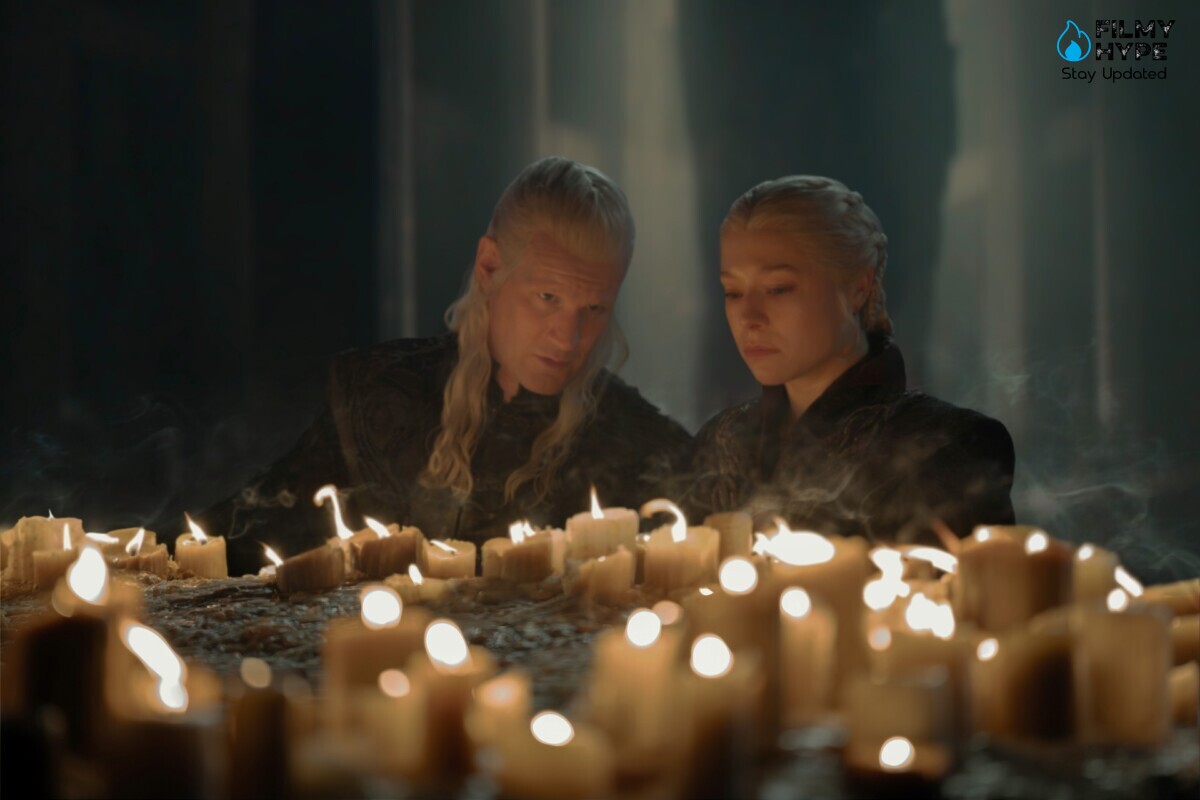
House of the Dragon Season 3 Episode 5 Ending Explained: Who Killed the Gold Cloaks and What “A Feast for Traitors” Really Means
Episode 5, officially titled “Unbowed and Unbent,” aired on July 19, 2026, and it marks a significant shift in how the Dance of the Dragons is being fought. The dragons are still there. The armies are still marching. But something new has entered the war, something quieter and in some ways more terrifying: a propaganda campaign backed by coins, rumors, and assassinations that can reach inside the capital itself.
Let’s break down what happened, who’s responsible, and what it all means for the episodes to come.
Five episodes into Season 3, House of the Dragon has crossed its midpoint, and the darkness is only deepening. Rhaenyra Targaryen sits on the Iron Throne, but sitting on it and holding it are proving to be very different things. King’s Landing is rotting around her. Her allies are pushing for violence she refuses to unleash. Her enemies are multiplying in the shadows. And somewhere beneath the Red Keep, two women who were once the heart of the Green faction are trapped in a tunnel with no way out. The episode doesn’t end with a dragon battle or a beheading. It ends with darkness closing in.
What Actually Happens in the Final Sequence?
Daemon discovers the bodies. That’s the simple version. But the staging matters enormously. Ser Luthor Largent, the commander of the City Watch, and several of his Gold Cloaks have been murdered and arranged around a table. Their bodies are positioned as though they’re participating in some kind of feast—a deliberate, theatrical presentation designed to be discovered and to communicate something specific.
The phrase “A Feast for Traitors” is left as a message addressed to Queen Rhaenyra. It’s not hidden. It’s not subtle. It’s a declaration, and the person who orchestrated it wanted Daemon—and through him, Rhaenyra—to understand exactly what they were looking at.
This isn’t a random act of violence. It’s not even just an assassination. It’s a performance. The killers took the time to arrange the scene, to craft a specific image, to leave a signature. That takes planning, confidence, and a chilling understanding of psychological warfare.
Who Killed the Gold Cloaks?
The episode doesn’t show us the faces of the killers. We don’t get a name or a clear shot of whoever actually wielded the blades. But the series leaves no doubt about who’s behind the operation: Ormund Hightower.
Ormund is running a different kind of war from Tumbleton. He’s not just massing troops and waiting for the next dragon battle. He’s building a network inside King’s Landing—agents who can move through the city, gather information, spread rumors, distribute coins, and, when necessary, eliminate targets. The assassination of Luthor Largent and his men is the most visible demonstration yet of what that network can accomplish.
Before Daemon finds the bodies, he’s already investigating. He interrogates suspects, follows leads, and discovers a coin stamped with Daeron Targaryen’s face. That coin is the thread that connects the unrest in the city to Ormund’s broader campaign. Daeron, the gentle son raised in Oldtown, is being positioned as a legitimate alternative to Rhaenyra—a prince the people can rally behind, a figurehead for the Green cause who hasn’t been tainted by the brutality in King’s Landing.
Ormund receives confirmation that the operation succeeded. The episode makes this clear. He knows what happened, and he’s satisfied with the result. The killers themselves remain faceless, which is almost more disturbing—they could be anyone, anywhere in the city, waiting for their next orders.
Why Was Ser Luthor Largent Considered a Traitor?
To understand the message, you have to understand who Luthor Largent was and why the Greens would want him dead.
Luthor commanded the City Watch of King’s Landing, the Gold Cloaks. Years earlier, Daemon Targaryen had reorganized the Watch during his time as Commander, turning it into an effective force and building loyalty among its officers. Those connections didn’t disappear when Daemon left the position. When Rhaenyra took the capital, Luthor and his men made a choice: they acknowledged her as queen and served her government.
From the Green perspective, that choice made them traitors to Aegon II and the Hightower cause. Luthor had sworn oaths to the previous regime, and by switching allegiance to Rhaenyra, he became—in their eyes—a legitimate target. “A Feast for Traitors” is the Greens’ judgment rendered in blood. It’s a public punishment, even if the bodies are hidden when Daemon discovers them. The message is meant to spread.
But there’s another layer here. The people of King’s Landing, particularly in Flea Bottom, have no love for the Gold Cloaks. The City Watch has been used to put down protests, enforce order, and maintain Rhaenyra’s hold on a population that’s hungry, angry, and increasingly desperate. By eliminating Luthor and his men, Ormund isn’t just punishing traitors—he’s stoking resentment between the Watch and the people. He’s creating chaos, eroding Rhaenyra’s ability to govern, and positioning the Greens as the ones who can restore order once she falls.
The Riverlands and the Butcher’s Work
The episode opens far from the capital, in the Riverlands, where Criston Cole is fighting a losing war. The army of the Trident, led by the improbably young Oscar Tully, has joined forces with Roderick Dustin’s Winter Wolves, those gray-bearded Northmen who came south to die. Cole knows he can’t match them in open battle. His forces are outnumbered, undersupplied, and cut off from reinforcement.
So Cole does what desperate commanders do. He goes guerrilla. Night raids. Burning camps. The kind of ugly, grinding warfare designed to bleed an enemy slowly rather than break them all at once. But Tully, despite his age, refuses to play along. He won’t be drawn into the ambushes Cole sets. Instead, he orchestrates a methodical encirclement—destroying bridges, laying traps, and deploying iron caltrops known as crow’s feet across strategic ground. The devices are simple and brutal. Buried in the earth, they cripple horses and men alike, funneling Cole’s army into killing zones where the Winter Wolves are waiting. By the time the episode cuts away from the Riverlands, Cole’s forces are decimated and cornered, and the Lord Commander of the Kingsguard is running out of road.
What Does “A Feast for Traitors” Mean?
The phrase operates on multiple levels, which is what makes it such effective propaganda.
On the literal level, the scene speaks for itself. The corpses are arranged around a table as though at a banquet. The arrangement of the bodies, the display of viscera, and the entire composition transform a murder scene into something ritualistic. It’s designed to be seen, to be remembered, to haunt whoever walks into that room.
The political meaning is sharper. A “feast” is a celebration. The killers are celebrating the elimination of men who changed their loyalties. The message to Rhaenyra is clear: your servants are not safe. Your hold on the city is not secure. We can reach anyone, anywhere, and there’s nothing you can do to stop us.
There’s also a symbolic resonance that’s hard to ignore. The composition deliberately evokes a dark inversion of a last supper or a banquet of the damned. It’s not meant to hide the crime. It’s meant to produce fear and leave an image that burns itself into the memory of everyone who sees it. Daemon receives a direct response to everything the Blacks have done. The enemy isn’t just outside the walls anymore. The enemy is already inside.
The Propaganda War Has Begun
This episode marks a turning point in how the Dance of the Dragons is being fought. Up until now, the conflict has largely been military—armies marching, dragons clashing, castles changing hands. But Ormund Hightower understands something that purely military commanders often miss: wars are won in the mind before they’re won on the battlefield.
His strategy from Tumbleton combines multiple tactics. He uses agents to spread rumors that undermine Rhaenyra’s legitimacy. He distributes coins bearing Daeron’s face to suggest that an alternative exists, that the young prince is ready to rule, that the Greens have a future worth fighting for. He targets specific figures like Luthor Largent for assassination, not just to remove them from the board but to send a message about what happens to those who serve the Black Queen.
And he does all of this while keeping his own hands technically clean. The faces of the killers remain unknown. The network stays hidden. Rhaenyra and Daemon know who’s responsible, but knowing and proving are different things. They can’t strike back at an enemy they can’t find.
This is the shape of the war going forward. Dragons remain decisive in open battle, but the fight for King’s Landing will be fought in shadows—with coins, with whispers, with bodies arranged around tables.
The Other Threads: Alicent, Helaena, Criston Cole, and Tyland Lannister
While Daemon is discovering bodies in the capital, several other storylines are reaching critical pressure points.
Alicent and Helaena attempt to escape through a secret passage in the Red Keep, but the plan goes wrong. They end up trapped, their situation made even more precarious by the confirmation that Helaena is pregnant. Alicent offers her moon tea—a way to end the pregnancy and potentially simplify their escape—but Helaena refuses. That refusal is loaded with meaning. Helaena has been passive for much of the series, a figure buffeted by forces she can’t control. This moment of active choice, even if it complicates everything, suggests something shifting in her character.
In the Riverlands, Criston Cole is running out of options. Oscar Tully’s tactics are tightening around him, and the episode builds toward the confrontation that book readers know as the Battle of the Butcher’s Ball. The adaptation may change details, but the trajectory is clear: Cole is being drawn into a fight he may not survive.
And Tyland Lannister reappears alive after the Battle of the Gullet, reuniting with Aegon II and Larys Strong. His return isn’t just a reunion—it’s a strategic development. Tyland knows where some of the Crown’s gold was hidden, and that knowledge could finance the Green war effort at a moment when resources are running thin. In a conflict increasingly defined by who can pay for what, Tyland’s information is a weapon.
Alicent’s Desperate Gambit
Back in King’s Landing, the episode’s most emotionally jagged storyline unfolds in the chambers of the dowager queen. Helaena is pregnant. The revelation from earlier episodes—that she’s carrying another child, likely Aegon’s—has become a crisis that can’t be contained. Alicent, ever the pragmatist, sees the situation with brutal clarity. If the baby is a boy, Rhaenyra will view him as a threat to her claim. The infant will be a target from the moment he draws breath. So Alicent presses her daughter to drink an herbal preparation, concocted by Grand Maester Orwyle, that will end the pregnancy before it becomes visible.
Helaena refuses. The show has always positioned her as someone who moves through the world differently than the politicians around her—dreamier, more attuned to the strange and the sorrowful, less capable of the cold calculations her mother excels at. She won’t terminate the pregnancy. And Alicent, left with no good options, lies to Mysaria about the tonic’s purpose, claiming it was for herself, a remedy for a fall she took after Viserys died. The lie buys time, but not much. By the end of the episode, the truth is out, and the consequences are closing in.
Aemond in the Ruins
At Harrenhal, Aemond Targaryen is coming apart. The fortress that was supposed to be a strategic anchor has become a prison. Vhagar is missing. Assassins and bounty hunters stalk the perimeter. And Aemond, the prince who once believed fear was strategy enough, has retreated so far into himself that he’s barely functioning as a commander.
Into that vacuum steps Alys Rivers. As she did with Daemon in Season 2, she feeds Aemond visions—of his brother Aegon, of his own legitimacy, of the choices that brought him here. The difference is that Daemon eventually fought his way out of her influence. Aemond is sinking deeper. Harrenhal’s curse, the weight of its history, the isolation of its endless corridors—all of it is consuming him, and the Green side’s central front is leaderless at the moment it most needs direction.
Tyland Lannister’s Impossible Survival
The episode delivers one genuine shock that’s less about tragedy and more about sheer, improbable survival. Tyland Lannister, presumed dead after being thrown overboard in full armor during the naval disaster at the season’s start, is alive. He dragged himself from the water. He made his way to safety. And now he’s found Aegon II and Larys Strong at Recess of the Grajo.
The reunion is tense and quickly turns ugly. Tyland wants to march for Casterly Rock, rally the Lannister forces, and keep fighting. Larys wants to sail across the sea and put as much distance between himself and the war as possible. Aegon, still nursing the humiliation Tyland dealt him in a previous encounter, takes the opportunity to settle scores. The execution is swift and personal. Whatever political calculus Tyland brought to the table dies with him.
The Hunt for the Gold Cloaks
One of the episode’s most unsettling threads is the systematic slaughter of the City Watch. For weeks, Gold Cloaks have been picked off in Flea Bottom, isolated ambushes that felt like street crime. But the violence escalates until it reaches a horrifying crescendo: Ser Luthor Largent and his officers are found massacred, arranged in a grotesque parody of a Last Supper, with a message painted in blood. “A banquet for traitors.”
Daemon initially suspects local gangs or a popular uprising. He’s wrong. The campaign is being orchestrated from more than sixty leagues away. Ormund Hightower, using Oldtown’s financial resources, has been funding rogue cells inside the capital. His goal isn’t to take the city by direct assault. It’s to rot it from within, to strip Rhaenyra of her most essential tool of control, and to make her authority look hollow. With the Gold Cloaks decimated, the queen’s grip on King’s Landing has never been weaker.
Rhaenyra’s Reluctance
All of this is happening while Rhaenyra hesitates. The episode paints her as a queen caught between her instincts and her circumstances. She doesn’t want to be a tyrant. She doesn’t want to burn cities full of civilians. When Daemon urged her to destroy Tumbleton with dragonfire after Ormund took it, she refused. The cost in innocent lives was too high.
But Ormund is still advancing. Daeron Targaryen is still being positioned as a rival king. The threats Rhaenyra declined to eliminate are growing stronger, and the episode doesn’t shy away from the implication: her mercy is starting to look like a mistake. Daemon’s brutal proposal, the one she rejected as an atrocity, is beginning to seem tragically necessary. The queen who wanted to rule differently is being forced to confront the possibility that ruling differently means losing.
The Trap Beneath the Red Keep
The episode’s final act is pure claustrophobic dread. Mysaria has discovered the truth about Helaena’s pregnancy. Alicent tries to buy her silence with a promise of “eternal gratitude from House Hightower.” Mysaria leaves without a word, her silence more threatening than any explicit threat.
Desperate and cornered, Alicent decides to flee the capital with her daughter. But Helaena, in the course of their preparations, accidentally discovers a secret passage hidden in the walls of the royal chambers. It’s a way out—or it should be. They enter the tunnel, navigating its darkness toward what they hope is freedom. When they reach the end, the passage is boarded up. Completely sealed. And when they turn back, the entrance they came through has been blocked as well.
They’re trapped. Two women who were once at the center of the Green cause, now sealed inside the walls of the Red Keep, with no obvious way out and no one who knows where they are. The episode doesn’t resolve this. It just leaves them there, in the dark, while the city above them slides further into chaos.
What the Episode Is Really About
Episode 5 is about the limits of different kinds of power. Criston Cole’s military skill can’t overcome a boy lord who refuses to fight the way he’s supposed to. Aemond’s dragon and his fury can’t protect him from his own unraveling mind. Rhaenyra’s mercy can’t stop her enemies from advancing. Alicent’s cunning can’t open a sealed door. The episode keeps putting characters in situations where the thing they’ve always relied on stops working, and watching them flail.
The trap beneath the Red Keep is the perfect image for where the season stands at its midpoint. Everyone is stuck. The Greens are scattered, their commanders isolated or dead, their queen dowager literally buried in the walls. The Blacks hold the capital but can’t control it, can’t feed it, can’t protect their own Gold Cloaks from a shadow campaign they didn’t see coming. The war is being fought on multiple fronts, and on every single one, the people fighting it are discovering that the old rules don’t apply.
The second half of Season 3 is going to be about who adapts and who breaks. The episode ends in darkness, literal and metaphorical. The only question is who finds a way out before the walls close in completely.
What This Sets Up for Episode 6
The death of Luthor Largent leaves Rhaenyra without one of the men who maintained order in King’s Landing. The City Watch is leaderless at a moment when the city is boiling with resentment. Daemon knows that Ormund and Daeron have a network operating inside the capital, but he doesn’t know its size, its reach, or its next target.
The episode closes on a note of profound uncertainty. Rhaenyra holds the throne, but her grip is slipping in ways that dragons can’t fix. She can burn armies. She can’t burn rumors. She can’t burn the slow erosion of trust that Ormund is engineering.
The war has entered a new stage, one where the weapons are information and fear as much as steel and fire. “A Feast for Traitors” is the opening salvo of this phase, a promise that more is coming, that no one who serves Rhaenyra is safe, that the Greens can reach into the heart of her power and pull out anyone they choose.
For Daemon, the discovery is personal. The Gold Cloaks were his men once. He built them, shaped them, commanded them. Seeing them slaughtered and displayed is a message aimed directly at him as much as at Rhaenyra. And if there’s one thing we know about Daemon Targaryen, it’s that he doesn’t respond to messages like this with restraint. The question isn’t whether he’ll retaliate. It’s how much of the city will burn when he does.