
Gandhari is a Hindi-language action thriller now streaming on Netflix, built around raising awareness of India’s ongoing crisis of child kidnapping. The story follows Bani, a woman who loses her vision immediately after her young daughter is kidnapped off a train — and who, rather strangely, ends up using that impairment as an asset while she digs into the disturbing web of criminal activity running through the town of Joypurra to find her daughter, Mishty, before it’s too late. The title Gandhari directly recalls the Gandhari of the Mahabharata, but the Netflix film reverses its meaning.
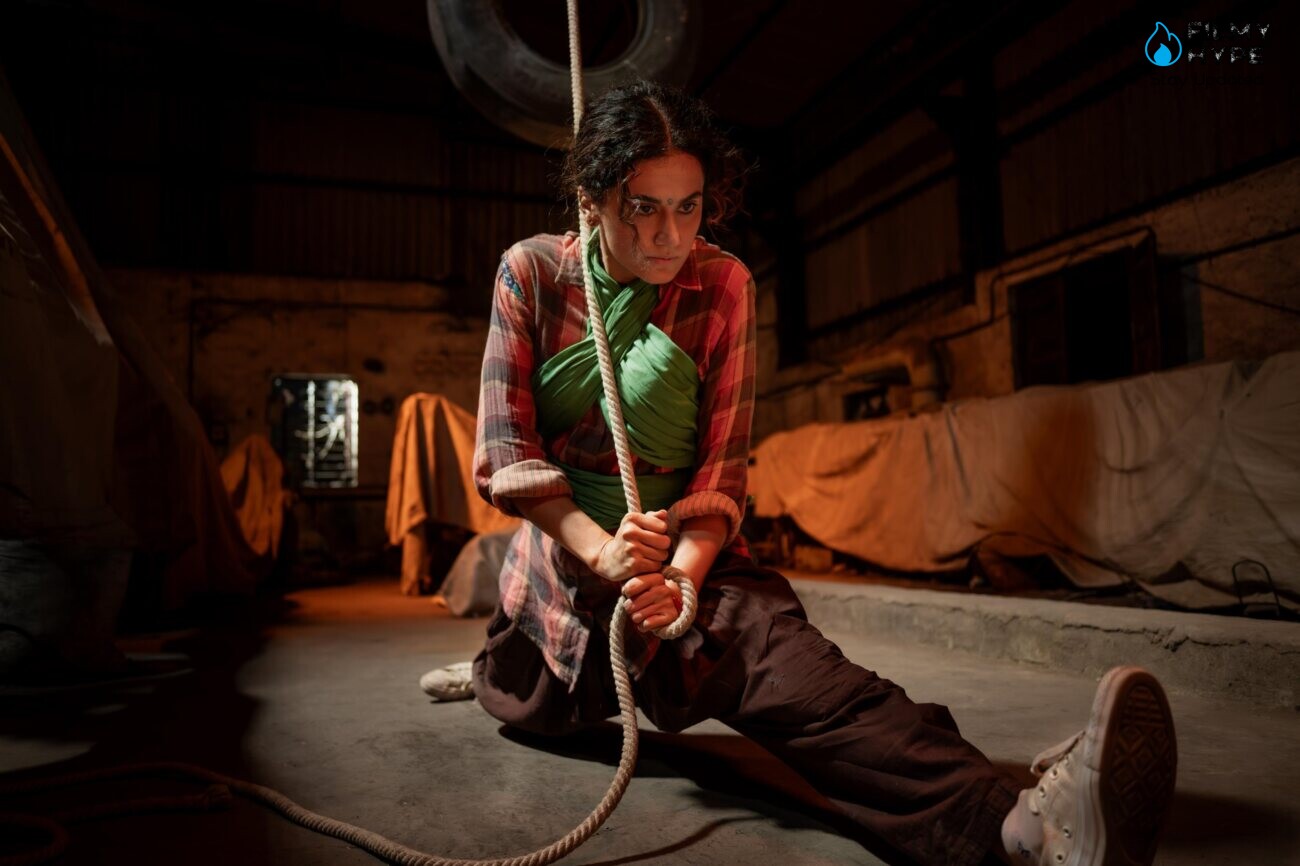
In the Indian epic, Gandhari chooses to live blindfolded after marrying the blind king Dhritarashtra; in the 2026 thriller, however, Bani loses her sight after a brutal attack while her daughter is kidnapped, turning the condition into a tool for fighting back and fighting back. The name is not random. Gandhari is one of the best-known figures of the Mahabharata, wife of Dhritarashtra and mother of the Kauravas. In epic tradition, she is also remembered for choosing to blindfold herself after marrying a blind man. The film, written and produced by Kanika Dhillon and directed by Devashish Makhija, starts from that image, but transports it to the present and overturns it. Taapsee Pannu explained during the promotion that the question behind the character was, essentially: What would Gandhari do if he lived today and decided to enter the battlefield directly?
Gandhari Movie Ending Explained: What Actually Happens?
The film opens with young Mishty excitedly preparing for a summer vacation with her parents, Bani and Gokul, headed to Gomati. The family boards a train and shares a warm, ordinary moment — until everything changes at a stop in Joypurra. Gokul steps off briefly to buy fruit, and Mishty asks her mother to take her to the washroom. When Bani needs to use it herself, she leaves her daughter waiting just outside, keeping track of her by having Mishty recite her favorite rhyme aloud. The moment that recitation stops, Bani knows something’s wrong. Rushing back, expecting to find Mishty back at their seat, she instead spots a woman forcibly dragging the girl away across the platform.
Bani leaps off the train and tries to chase the kidnapper through the crowded platform, but slams her head into a metal bar someone happens to be carrying. She collapses, her vision blurring, and loses sight of her daughter entirely as bystanders rush to help her up. Realizing their child has been taken at an unfamiliar station, Bani and Gokul rush to file a police report — only to find the police largely indifferent, offering no real urgency or help. The desperate parents are left waiting for any scrap of information, hours stretching into days.
It turns out this isn’t an isolated case. Joypurra, a small border town in West Bengal, has quietly become a hub for criminal activity, particularly child trafficking — three children reported missing in just the past month alone. That pattern is enough to draw the attention of central police, who send investigator Kabir to look into it. Almost as soon as he arrives, Kabir senses something is deeply wrong, suspecting that corrupt local police officers are tied into whatever criminal network is operating there. Adding to the town’s unsettling atmosphere are groups of Bahurupis — traditional impersonators who paint their bodies to resemble animals or deities as they move through the streets. Meanwhile, doctors inform Bani that her injury caused internal bleeding, leaving her temporarily blind. They assure her the condition should reverse with time and rest, but with her daughter still missing and the kidnappers still out there, Bani has no intention of simply waiting it out.
Who is the Gandhari of the Mahabharata?
In the Mahabharata, Gandhari is the princess who marries Dhritarashtra, who was born blind and destined to become king of Hastinapura. The woman decides to cover her eyes with a bandage and thus symbolically share her husband’s condition. She is also the mother of the Kauravas, the family that opposes the Pandavas in the great Kurukshetra conflict.
For this reason, her figure is linked not only to blindness, but also to motherhood, responsibility, pain for her children, and the consequences of a war she is unable to prevent. The Netflix film does not adapt the Mahabharata and does not tell a literal modern version of the epic. Instead, it uses Gandhari as an archetype and builds a parallel with Bani.
Who Is Bani, Really?
Throughout the film, several subplots gradually connect back to Mishty’s kidnapping — starting with Bani’s own hidden history. Though she’s introduced as an ordinary lower-middle-class woman, her past is far more complicated. Originally named Liliya, she was raised by her adoptive mother, Jhunu Amba, who trained her from childhood to perform circus tricks — including routines done blindfolded, which is part of why adjusting to her current blindness comes more naturally to her than it might to most people.
As a young woman, Liliya was suddenly sent to the city along with three other girls her age, and she sensed immediately that something terrible was about to happen to her. Using everything she had — strength, instinct, and sheer intelligence — she managed to escape, with help from a kind stranger who becomes significant later in the story. She resettled in a different town under a new name, Bani, and built a quiet, peaceful life for herself, until trouble eventually found her again.
Given how dark the film’s world is, betrayal is inevitable, and Bani eventually learns that Jhunu Amba played an unwitting role in Mishty’s kidnapping. The truth is that Jhunu Amba’s own brother had originally sold Liliya and the other three girls to a criminal gang. When Liliya managed to escape, the furious gang retaliated by kidnapping Jhunu Amba’s own granddaughter, Dulari, as revenge — and Dulari was never found. Jhunu Amba spent years consumed by grief and anger over that loss. Eventually, while trying to investigate the gang responsible on her own, she was manipulated into a deal — falsely promised Dulari’s return in exchange for revealing Liliya’s current location. Believing the gang was actually after Bani’s husband rather than Bani herself, Jhunu Amba handed over the address she’d somehow tracked down. That single decision is exactly what allowed the gang to locate the family and abduct Mishty. Jhunu Amba never wanted harm to come to the little girl — but she did, unknowingly, hand over the information that made it possible, and Bani understandably feels betrayed by that.
Does Joypurra Really Exist?
No. Joypurra is a fictional city created for Gandhari. Netflix describes it as a place traversed by fear, silence, and the presence of the Behrupiyas, figures linked to local culture and the world of transformation and identity on which the thriller builds part of its mystery. This avoids another possible misunderstanding: Search: Joypurra is not an Indian location to look for on the map, but a narrative construction of the film. Director Devashish Makhija explained that he wanted to create a layered and visually recognizable world, while maintaining a universal story of choices and consequences at its core.
Who’s Actually Behind the Kidnappings?
The kidnappings are the work of a criminal organization called Blackhole, which runs a sprawling child trafficking operation stretching across border towns in eastern India, shipping abducted children off to buyers overseas. Inspector Kabir and his team had actually gotten close to exposing the gang once before, using digital evidence tied to the group’s online activity — but ultimately failed to bring them down. That near-miss taught Blackhole an important lesson: they scrubbed their digital footprint entirely and overhauled how they operate.
Since then, they’ve based their operations in Joypurra for a few deliberate reasons. The town sits directly on the national border, and while roads can be blocked by police, as shown early in the film, Joypurra also has a port the gang can use to move shipments out. Beneath the town lies an extensive network of underground tunnels, originally built by nationalist revolutionaries fighting British colonial rule, later repurposed by drug smugglers before most entrances were sealed off — though a handful, including ones near the railway station and the beach, remain accessible.
Joypurra is also home to a significant population of Bahurupi performers, and on the surface, it might look like the gang uses them to help move children unnoticed. In reality, that’s a deliberate misdirection — Blackhole set up shop in a town full of Bahurupis specifically to make them convenient scapegoats, ensuring police suspicion lands on the impersonators rather than the actual operation, even though the Bahurupis have no real connection to the trafficking at all.
Just How Deep Does the Network Go?
Blackhole’s success in Joypurra comes down to how thoroughly they’ve infiltrated local institutions. Their process starts with identifying vulnerable children, then using paid operatives on the street to abduct them the moment a parent is careless or distracted — exactly what happens to Mishty and Bani. When a straightforward abduction isn’t possible, the gang resorts to poisoned candy, deliberately making a child sick enough to be rushed to the town’s general hospital pediatric ward. That hospital, along with its doctors, nurses, and staff, is entirely on Blackhole’s payroll.
Once a targeted child is admitted, hospital staff falsely declare them dead within a few days, claiming a sudden, unexplained decline. In reality, the children are quietly smuggled out and handed off to gang members to be prepared for transport out of the country. To maintain the illusion, the gang kidnaps other children of similar height and build from the streets, kills them, and presents their bodies to the grieving families as their own children — deliberately disfiguring the faces beforehand so the switch can’t be detected, with hospital staff attributing the damage to illness.
The corruption doesn’t stop at the hospital. Officer Saha, one of the investigators working directly alongside Kabir, is secretly on Blackhole’s payroll, and later tries to stop Kabir from reaching the port at a critical moment. A local orphanage run by a seemingly warm, trustworthy woman named Churni is also deeply embedded in the operation — functioning as a safe house where kidnapped children are given falsified identities, sometimes with their physical appearance altered to match. Churni personally oversees several aspects of the trafficking herself.
The network extends into ordinary, everyday life too. Somesh, one of Bani’s friendly neighbors, works as a driver — and is secretly the one transporting kidnapped children to the gang’s safehouse. Another neighbor, Uma, who works for a water purifier company, uses her access to keep tabs on vulnerable children and plays a role in helping select targets.
Why Does Bani Have to Fight Her Own Husband?
Given how thoroughly betrayal runs through this story, it’s almost expected that Bani would eventually be let down by someone close to her — but it still lands as a genuine shock when her own husband, Gokul, ends up standing in her way near the film’s climax. Gokul isn’t malicious, but he’s been hiding something significant: years earlier, he unknowingly worked for Blackhole himself. Running his own printing and photocopy shop, his job had simply been to produce fake IDs — without realizing those documents were being used to traffic children.
Everything changed the day he was sent to deliver a batch of IDs and witnessed four gang members trying to abduct a young woman. That’s the moment he understood exactly what he’d been part of, and he immediately switched sides, helping her escape. That woman was Liliya — the same woman who would go on to become Bani, and who would eventually marry the man who saved her. That history is also why Jhunu Amba gave the gang Gokul’s location in the first place — she blamed him specifically for interfering with the trafficking operation years earlier, an act she believed had directly led to her granddaughter’s kidnapping.
After Mishty’s abduction, Gokul launches his own investigation into the trafficking ring and its tunnel network, until he’s eventually captured by his former boss. That boss offers him a deal: cooperate, convince his wife to back off, and let the rest of the children be shipped out through the port — and in exchange, Mishty would be spared. Desperate to get his daughter back by any means necessary, Gokul accepts, unaware the gang leader is lying and has every intention of trafficking Mishty along with the others. That’s what drives Gokul to try to talk Bani out of continuing her investigation — and when she refuses to back down, he ultimately fights her directly, trying to physically stop her from bringing down the operation.
Are the Children Actually Saved?
By the film’s climax, Bani essentially transforms into a living embodiment of the local goddess worshipped in Joypurra — a figure who, according to the town’s mythology (invented for the film), once descended into the underworld to kill a demon responsible for stealing children. That mythic framing plays out literally: Bani fights and kills the gang’s enforcers one by one, including Somesh and Churni, before finally confronting the organization’s leader directly. After a brutal final confrontation, she manages to take him down as well, effectively dismantling the entire trafficking operation.
Bani is reunited with Mishty, and the rest of the kidnapped children are rescued by police. Gokul survives the film’s events, leaving the door open for eventual reconciliation with his family once he’s had the chance to atone for his role in everything. Whether the corrupt police officers ultimately face consequences is left somewhat unresolved, but with the entire trafficking operation exposed and shut down, it seems likely that Kabir and his team go on to arrest Saha and the others who’d been secretly working for the gang.