

Netflix and AMC $500 Million Deal: There was a time, not that long ago, when the biggest question in the streaming business was whether platforms would keep licensing their shows to each other or hoard everything for themselves. The era of exclusivity, of walled gardens and fractured libraries, seemed like the inevitable future. Every studio wanted its own Netflix. Every network pulled its shows back from competitors. The dream was total control.
Thursday’s announcement that Netflix and AMC have signed a $500 million deal to share the entire Walking Dead universe suggests that dream has evolved into something more pragmatic. Starting in 2027, all 371 episodes of the franchise will be available on both Netflix and AMC+. Not one or the other. Both. It’s a co-exclusive arrangement that acknowledges something the streaming industry has been learning the hard way. Sometimes it’s better to share a big pie than to own a small one.
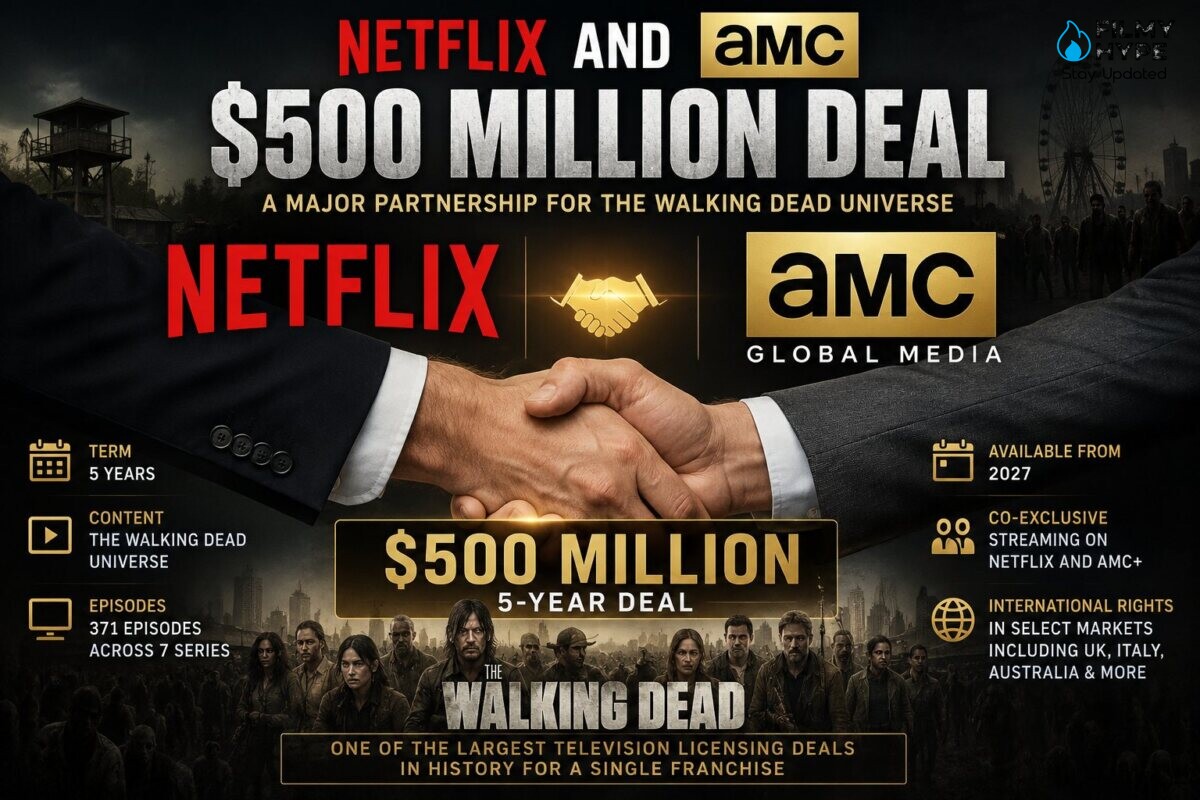
Netflix and AMC Global Media have signed off on a licensing agreement worth a reported $500 million, and it’s a big one — the kind of deal that reshapes where an entire franchise actually lives. Starting in 2027, the whole Walking Dead universe, all 371 episodes of it, will be available across both Netflix and AMC+, turning the two services into shared, co-exclusive homes for one of TV’s longest-running survival sagas.
Netflix and AMC $500 Million Deal: The Full Story, With the Executives Weighing In
When Netflix and AMC Global Media confirmed their new licensing agreement on Thursday, July 30, they didn’t just drop a headline number and move on. Both companies put executives on record to explain why they think this deal matters — and reading between the lines, it’s less about nostalgia and more about a very deliberate strategy to consolidate one of TV’s biggest franchises under one roof.
What’s Actually Changing
The agreement gives Netflix and AMC+ co-exclusive streaming rights to the original The Walking Dead series and all six of its spin-offs, spanning 371 episodes in total. It’s a multi-year deal, and it formally ends an era: Netflix has held exclusive U.S. streaming rights to the flagship show since 2011, and that sole-ownership arrangement is now giving way to something shared.
The international side of the deal is arguably the bigger shift for fans outside the U.S. Netflix’s availability of the franchise is expanding into new territories — the UK, Italy, Australia, and New Zealand, among them. Starting in 2027, the full spin-off lineup — Fear the Walking Dead, The Walking Dead: Daryl Dixon, The Walking Dead: Dead City, The Walking Dead: The Ones Who Live, The Walking Dead: World Beyond, and Tales of The Walking Dead — will roll out globally on Netflix, and on AMC+ wherever that service operates.
One detail worth flagging for anyone expecting an instant switch-over: the rollout won’t happen on a single date everywhere. Each series in the franchise has its own existing licensing arrangements in different countries, so the new deal kicks in region by region as those older agreements expire, rather than all at once.
Straight From the People Who Signed Off On It
Netflix’s Vice President of Licensing, Lori Conkling, framed the deal around the show’s staying power, pointing out that the series has been pulling in devoted viewers on the platform for close to fifteen years now and still manages to bring in new fans. That’s the core logic behind Netflix’s approach here: this isn’t a franchise Netflix is betting on for the first time — it’s one that’s already proven it can hold an audience for a decade and a half, which counts for a lot in a market where new shows are a genuine gamble.
AMC Global Media’s CEO, Kristin Dolan, was even more direct about the ambition behind the deal, describing the goal as turning the franchise into one single global home where every show and every episode lives in the same place. She also confirmed the milestone that’s arguably the most surprising part of this whole arrangement: the original series is coming to AMC+ for the very first time early next year — a show that, until now, had never actually streamed on its own network’s streaming service outside of linear reruns and cable syndication. Dolan credited the long partnership with Netflix for helping turn the franchise into one of the biggest in entertainment history, and called the new agreement a strong outcome for both companies, for fans, and for what she referred to as a lasting piece of intellectual property.
Where It All Started
It’s easy to forget, given how sprawling the franchise has become, that The Walking Dead began as a single show with a single premiere date: October 31, 2010, on AMC. Over the course of 11 seasons and 177 episodes, that original series grew from a well-reviewed genre drama into something much bigger — a defining title for both AMC as a network and AMC Studios as a production house, and one of the shows credited with proving that serialized, fan-driven storytelling could sustain a franchise for over a decade. The spin-offs that followed weren’t an afterthought; they were the direct result of a fanbase invested enough in the world and characters to support multiple concurrent series.
The Companies Behind the Deal
AMC Global Media, which trades on Nasdaq under AMCX, is the parent company behind a wide range of streaming and cable properties — AMC+, Acorn TV, Shudder, Sundance Now, ALLBLK, HIDIVE, and All Reality on the streaming side, along with cable networks like AMC, BBC America, IFC, SundanceTV, and We TV. Its in-house studio arm, AMC Studios, is responsible for producing the entire Walking Dead universe, along with other franchises like the Anne Rice Immortal Universe. The company operates internationally as well, with a presence in Iberia, Latin America, Central Europe, the UK, Australia, and New Zealand — which lines up neatly with several of the new territories this Netflix deal is expanding into.
Netflix, for its part, needs less introduction at this point — a global entertainment platform spanning series, film, games, and live programming, built around flexible, on-demand viewing.
Why This Deal Is Bigger Than It Looks
Put the pieces together, and the picture becomes pretty clear: this isn’t just a licensing renewal, it’s a consolidation play. Instead of the franchise being split across platforms and regions with different availability windows, Netflix and AMC are moving toward a single, unified answer to “where can I watch The Walking Dead” — nearly anywhere, all 371 episodes, under one umbrella. For a franchise built almost entirely on binge-friendly, character-driven storytelling, that kind of consolidation is exactly the setup both companies are betting will keep fans watching, and keep new viewers discovering the show for years to come.
What’s Actually in the Deal?
The agreement covers everything. The original Walking Dead series ran for eleven seasons and became one of the defining cable dramas of the 2010s. The spin-offs that followed as the franchise expanded into a full universe. Fear the Walking Dead, which started as a prequel and evolved into its own sprawling narrative. The Walking Dead: World Beyond is a limited series that explores the larger mythology. Tales of the Walking Dead, the anthology experiment. And the more recent entries that have kept the franchise alive in the post-main-series era: Daryl Dixon, Dead City, and The Ones Who Live, which brought back Rick and Michonne for the reunion fans had been waiting years to see.
For U.S. viewers, Netflix has actually held streaming rights to the original series since 2011. That relationship helped introduce the show to millions of people who discovered it between seasons, binged it during hiatuses, or caught up years after the initial buzz had faded. The new deal preserves that access while adding something Netflix hasn’t had before: the spin-offs. Starting in 2027, subscribers will be able to watch the entire franchise in one place if they choose, or on AMC+ if they prefer. The exclusivity wall is coming down.
Internationally, the deal is even more significant. Territories including the United Kingdom, Italy, Australia, and New Zealand will gain access to the franchise through Netflix in ways they haven’t had before. The global expansion is a major component of the agreement’s value. Netflix operates in over 190 countries. AMC+ doesn’t have that reach. The deal effectively uses Netflix’s distribution network to put The Walking Dead in front of audiences who might never have subscribed to AMC’s platform.
Everything, All Together, for the First Time
Up until now, the Walking Dead franchise has been scattered across different corners of the streaming world, depending on the show and the region. This agreement changes that. It covers not just the original series but all six of its spin-offs: Fear the Walking Dead, The Walking Dead: World Beyond, Tales of the Walking Dead, The Walking Dead: Daryl Dixon, The Walking Dead: Dead City, and The Walking Dead: The Ones Who Live.
There’s a genuinely notable first buried in there too — this will be the first time the original flagship series is available on AMC+ at all. Meanwhile, Netflix is using the deal to push the franchise into new international territory, including the United Kingdom, Italy, Australia, and New Zealand, while keeping its footing in the markets where the show has already thrived for years.
A Long Exclusive Run Comes to an End
Context matters here. Netflix has held onto U.S. streaming exclusivity for The Walking Dead since 2011 — close to fifteen years of being the one place American fans could reliably find it. That run of sole ownership is effectively over now. Under the new structure, Netflix keeps a meaningful presence, but it’s no longer the only game in town; AMC+ gets a seat at the table too, and both platforms will carry the content simultaneously in the markets the deal covers.
It’s worth being precise about what that means: this isn’t full exclusivity for either side. It’s a co-exclusive setup, something noticeably different from the arrangement Netflix has operated under for the past decade-plus.
Why an Old Franchise Is Suddenly Worth So Much?
Half a billion dollars is a serious number, and it puts this deal in rare company. For comparison, HBO Max spent $425 million back in 2020 just to pull Friends away from Netflix and onto its own service. Different shows, different circumstances — but both cases point to the same underlying truth: streamers are willing to pay enormous sums for content people already know and trust.
There’s a strategic logic behind that willingness, and it’s tied to a pattern that’s been showing up in Netflix’s own viewership data. Reporting from TechCrunch points to a trend where a meaningful share of Netflix subscribers simply doesn’t stick around for the second season of newer original shows. New series are a gamble every single time. A franchise like The Walking Dead, on the other hand, arrives with hundreds of episodes already made, a built-in audience, and years of proven staying power — the kind of library that’s practically engineered for binge-watching and long viewing sessions, without needing a splashy new premiere to drive people in.
In other words, it’s a hedge against uncertainty. A brand-new show might be great. It might also flop. A franchise with 371 existing episodes and over a decade of fan loyalty already comes with the hard part solved.
Why Half a Billion Dollars?
Five hundred million is a number that demands context. HBO Max paid $425 million to bring Friends back from Netflix for its own platform in 2020. That was for a sitcom that had been off the air for sixteen years. The Walking Dead deal is bigger, and it covers a franchise that is still actively producing new content. Dead City is coming back for a third season. Daryl Dixon is heading into its final season in 2027. The universe isn’t a nostalgia play, though nostalgia is certainly part of the appeal. It’s a living, breathing franchise with new episodes arriving while the old ones are being discovered.
The price tag also reflects a broader shift in how streaming platforms think about value. Acquiring a massive library of familiar content is, in some ways, safer than betting on new shows. Viewers who start a new series might not finish it. Data suggests that many Netflix subscribers don’t return for second seasons of newer productions. But a show with 371 episodes and a recognizable brand offers something different. It’s bingeable in a way that can sustain viewing hours for weeks or months. It has characters people already care about. It has moments that have already entered the cultural conversation. The risk is lower. The engagement is more predictable.
For AMC, the deal is a financial lifeline wrapped in a strategic partnership. The company announced the agreement alongside its quarterly earnings report and linked it directly to an improved financial outlook. AMC+ retains access to the content, so the deal doesn’t strip the platform of its flagship franchise. Instead, it monetizes that franchise on a global scale while keeping it available for AMC’s own subscribers. It’s the best of both worlds: a massive licensing fee and continued relevance for the company’s direct-to-consumer service.
Good Timing for AMC, Too
The announcement landed on the same Thursday that AMC Networks released its latest quarterly earnings, and the company was quick to tie the Netflix agreement to an improved financial outlook going forward. For AMC, this is really about monetizing a franchise with genuine global reach while still keeping AMC+ relevant in how that content actually gets distributed — rather than watching the property live exclusively somewhere else.
For Netflix, the move fits a pattern that’s become increasingly familiar. The company has poured serious money into licensing deals for shows with built-in audiences — The Office being one well-known example — and earlier this year it also picked up streaming rights to Sesame Street. Between a beloved kids’ franchise and a zombie-apocalypse saga with fifteen years of history, the throughline is the same: Netflix is chasing proven, durable engagement, not just swinging for viral premieres.
What This Actually Means for Viewers?
If you’re in the United States, not much changes on the surface — Netflix keeps the original series available, even with AMC+ now sharing those rights. The bigger shift is international. Viewers in the UK, Italy, Australia, and New Zealand are getting access to a franchise that, in some cases, wasn’t available in the same way before.
One caveat worth flagging: this isn’t an instant, everything-unlocks-tomorrow situation. The broader rollout of the spin-offs across new territories is tied to that 2027 timeline, so the full expansion won’t happen all at once.
There’s also fresh material to look forward to. Dead City is set to return for a third season, and Daryl Dixon is heading into its final season, expected sometime in 2027 — timing that lines up neatly with the wider rollout and should give fans plenty to talk about as the deal actually takes effect.
The Bigger Picture
Strip away the zombies and the walkers, and this is really a story about the economics of streaming in 2026. Platforms are constantly weighing how much to invest in original productions versus how much to spend chasing established, dependable properties — brands that already have an audience baked in. This deal is a pretty clear signal about which side of that equation The Walking Dead now sits on.
Netflix gets more hours of proven, low-risk viewing to keep subscribers engaged. AMC gets a way to turn a legacy franchise into fresh revenue and a stronger financial story to tell investors. And fans, for their part, get something they haven’t really had before: one increasingly unified place to actually watch the whole saga, start to finish, without hunting across half a dozen different platforms to do it.
What This Means for the Streaming Landscape?
The co-exclusive model is the most interesting structural element of the deal. This isn’t Netflix buying the rights and AMC losing them. It’s both platforms sharing access, which means viewers will have a choice. If you already subscribe to Netflix, you can watch the entire Walking Dead universe there. If you prefer AMC+, perhaps because you want access to other AMC content or because the service offers something Netflix doesn’t, you can watch it there instead. The competition shifts from platform versus platform to platform alongside platform, and the winner, in theory, is the viewer who now has more options.
This model could become more common as the streaming industry matures. The walled-garden approach made sense when every company was trying to build a subscriber base from scratch. But now that the major platforms have reached scale, the calculus has changed. Licensing content to competitors generates revenue. Keeping content exclusive generates subscriptions. The balance between those two strategies is constantly shifting, and deals like this one suggest that the pendulum may be swinging back toward shared access, at least for certain kinds of content.
The Walking Dead franchise is particularly well-suited to this arrangement. It’s a known quantity. It has a massive episode count that rewards binge-watching. It has international recognition that makes it valuable across territories. And it has new content in the pipeline that can sustain interest even as viewers work through the back catalog. For Netflix, which has spent billions on licensed content over the years, from The Office to Sesame Street, adding The Walking Dead to the library is a continuation of a proven strategy. Familiar shows keep subscribers engaged. Engaged subscribers keep paying.
What Changes for Viewers
For most people watching, the practical implications are straightforward. If you’re in the United States and you already watch The Walking Dead on Netflix, you’ll continue to have access to the original series. The spin-offs, which were previously unavailable on the platform, will start arriving in 2027. If you’re in the UK, Italy, Australia, or New Zealand, you’ll gain access to content that may not have been available to you before, or that required a separate subscription to a service you didn’t have.
The deal doesn’t change the shows themselves. The episodes are the same. The zombies are the same. Rick Grimes is still Rick Grimes. Daryl Dixon is still Daryl Dixon. What changes is how easy it is to find them, to watch them in order, to follow the franchise from its origins in a Georgia quarry to its various apocalyptic destinations around the world. For fans who have been following the series across multiple platforms and services, the consolidation is long overdue. For new viewers who have never taken the plunge, the 371-episode library represents either an exciting opportunity or a daunting commitment, depending on your tolerance for fictional apocalypses.
The Walking Dead universe has survived the death of its main series, the departure of its central characters, and the general fragmentation of the television landscape. It’s still here. It’s still producing new stories. And now, thanks to a deal that values it at half a billion dollars, it’s about to become more accessible than it’s ever been. Not bad for a show about zombies.