


Silo Season 3 Episode 4 doesn’t just advance the plot. It detonates it. Revelations that have been simmering since the premiere finally surface, and by the time the credits roll, you’re left questioning the loyalties of characters you thought you understood. Let’s walk through the major questions this episode raises and the answers it provides, because there’s a lot to unpack. Graham Yost’s adaptation of Hugh Howey’s novels has always been good at pacing its secrets. The show doles out information carefully, making you wait, making you earn it. But this episode felt different. It wasn’t just moving pieces around the board. It was flipping the board over and showing you that the game you thought you were watching wasn’t the game at all.

Before the premiere of its new chapter, Silo has taken a huge turn in episode 4 of season 3, offering an unthinkable outcome as seen in previous installments. It is a script twist that leaves the viewer with their mouths open and reflecting, completely changing the setting of the timeline set in the future, while very alarming developments are also revealed in the past. When a production earns the nickname of one of the best science fiction series on television, it’s not trivial at all. Responds to a fascinating story adapted for Apple TV+ by Graham Yost, based on the writer’s acclaimed literary saga, Hugh Howey. After two very high-level first seasons, this third installment is being surpassed as it approaches the peak of its plot.
Silo Season 3 Episode 4 Ending Explained: Is Bernard Really Alive?
This is the headline revelation, the moment that makes you gasp. Bernard Holland, the former head of IT, the man who ran Silo 18 with an iron fist for years, is alive. We watched Robert Sims suffocate him in the season premiere. We saw messengers carry his body away. The show made a point of showing us the cremation. It was definitive. Or so we thought.
In the final moments of episode four, Juliette convinces Shirley to take her to the base of the silo, the place where Lucas Kyle might be hiding. The access point was supposed to be sealed. Walker, however, devised an ingenious mechanism to open it, one that made the door appear locked while actually being passable. Juliette descends into a space she knows well, expecting to find Lucas. What she finds instead is Bernard. Alive. Breathing. Hiding.
The immediate question is how. How did Sims fake the death? How was the body swapped or the cremation staged? The more important question is what this means for the rebellion. Bernard knows more about the silos than almost anyone alive. His survival isn’t just a twist for shock value. It’s a strategic asset for whoever is protecting him, and it fundamentally alters the balance of power in Silo 18.
Has Robert Sims Been an Ally the Entire Time?
This is where the episode rewards a rewatch. Sims has been positioned since the beginning of the series as an antagonist. He’s the enforcer, the head of security, the man who carries out the cruelest orders without flinching. When he smothered Bernard in the premiere, it felt like a consolidation of power. The old regime was dead. The new regime, with Camille as the Algorithm’s voice, was ascendant. Sims was its muscle.
Bernard being alive shatters that interpretation. Sims didn’t kill him. Sims staged his death. That means the suffocation was a performance, the cremation was a deception, and Camille has no idea that her husband is playing a completely different game than the one she thinks they’re playing.
Look back at the episode with this in mind, and certain scenes transform. When Sims encounters Juliette in the bomb room on Level 76, he tells her she needs to listen to him. At the time, it read as a threat. Knowing what we know now, it was almost certainly an attempt to help. He was trying to get her to a safe place, or warn her, or coordinate. Juliette, understandably, didn’t trust him. Why would she? But he was reaching out.

Later, when the Algorithm orders Juliette’s death, Sims tells Camille he’ll handle the execution personally. That seemed like loyalty. It was actually insurance. If Camille had carried out the order, Juliette would be dead. By taking control of the situation, Sims could ensure the order was never completed. He’s been working to keep Juliette alive while maintaining his cover as a loyal enforcer.
The question this raises is how long Sims has been a double agent. Was he always part of the rebellion, or did something change? Was the alliance with Bernard forged before the “death” or after? And what does Camille do when she eventually discovers that her husband has been undermining her the entire time?
Was Amy Always Part of the Rebellion?
Amy, the nurse, seemed like a minor character, a functionary in the medical apparatus of the silo. She followed Camille’s orders. She gave Juliette her medication. She was part of the background machinery of control.
Then Juliette is rushed to the infirmary after the gas exposure in the tunnels, and Amy reveals the truth. She never administered the memory-erasing pills. Every dose Juliette was supposed to have taken, every attempt to strip her of her identity and replace it with the Algorithm’s false narrative, failed because Amy was quietly sabotaging it from the inside.
This isn’t a sudden change of heart. Amy tells Juliette directly that she had strict orders to cause permanent amnesia, and she chose to ignore them from the start. That’s not a moment of crisis. That’s a sustained act of defiance over weeks or months. Amy has been part of the rebellion, likely from the beginning, embedded in exactly the position where she could do the most good. The nurse assigned to control Juliette’s mind was the one person in the medical wing who could ensure that control never took hold.
The implication is significant. The rebellion isn’t just a ragtag group of mechanics and former deputies. It has operatives in sensitive positions, people placed deliberately to counteract the Algorithm’s directives. Juliette’s amnesia was always a fiction. She’s been sharpening her memories while the regime believed she was losing them.
Why Is the Government Covering Up Charlotte’s Plane Crash?
In the past timeline, Daniel and Helen’s investigation into the fighter squadron crash takes a dark turn. The recording from Moldova, captured by a witness who saw the planes go down, reveals something the U.S. government is desperate to suppress. An unknown force took control of the aircraft. The communications were not encrypted, which means whatever caused the crash wasn’t a standard mechanical failure or pilot error. Something external intervened.
The government’s response is immediate and ruthless. The man who held the recording was kidnapped. Henry, a shadow agent operating at the highest levels, appears to deliver a coordinated threat. He offers Helen her job back at the Washington Post. He threatens to cut off funding for Charlotte’s expensive medical treatment. The message is clear: stop investigating or face consequences that are much more than professional ruin.
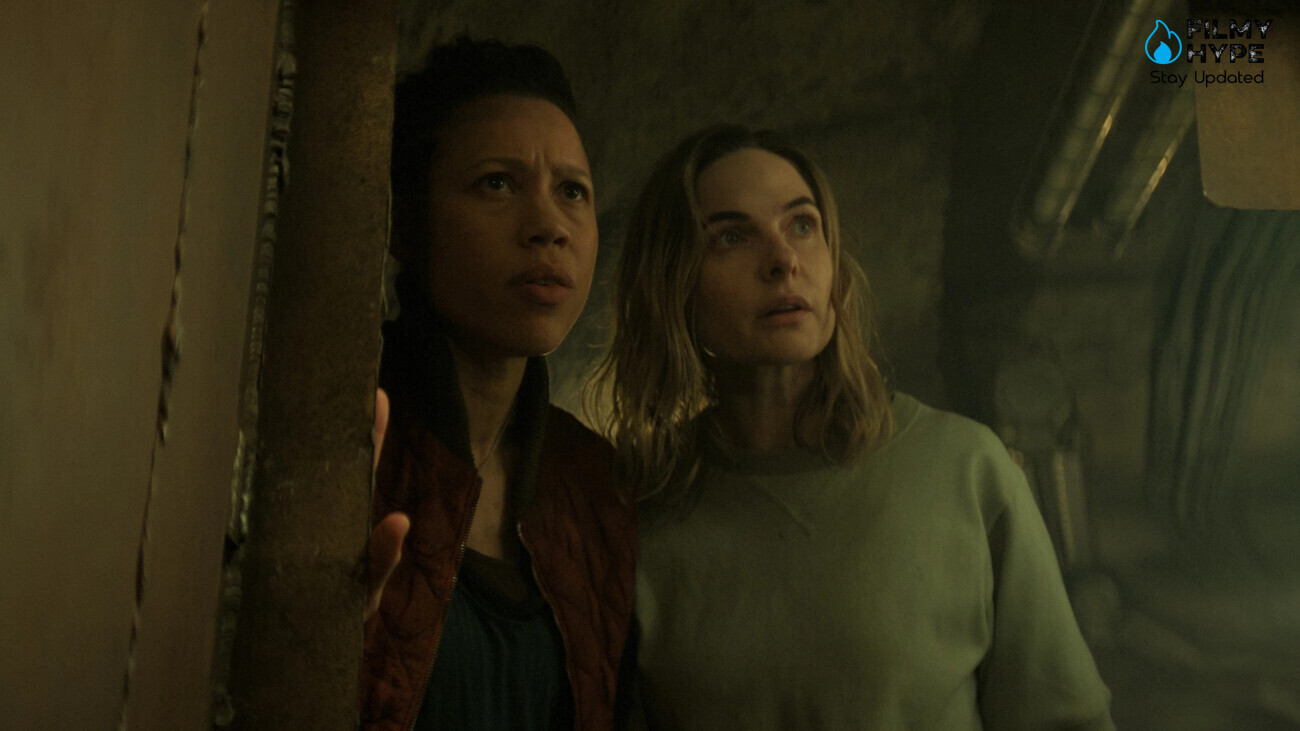
This confirms that whatever happened in that plane crash, it connects to something the government considers existentially dangerous. The “unknown force” that took control of the fighters raises obvious questions in the context of what we know about the silos. Was this an early manifestation of the technology that would eventually become the Algorithm? Was it a foreign power demonstrating capabilities no one was supposed to know about? The answer to this question likely holds the key to understanding why the silos were built in the first place.
What Did Sam Discover That Changes Everything?
Toward the end of the episode, Daniel’s investigation seems completely stalled. Henry has him cornered. The funding for Charlotte’s treatment hangs by a thread. The recording is gone. All the official channels are blocked.
Then Sam, Daniel’s contact at the Pentagon, reaches out through a disposable phone. He investigated despite the risk, and what he found, in his words, is “a very deep hole.” He assures Daniel that this information will change the course of the plot. The episode ends before he reveals what it is.
The possibilities are extensive. Did Sam find evidence that the U.S. government knew about the force that brought down the planes? Did he find records of early silo construction, dating back to before the public timeline suggests? Did he uncover the identity of whoever or whatever was responsible for the incident? His promise that the information is plot-altering implies that it doesn’t simply clarify the past. It probably has direct implications for the present, linking the 2040s conspiracy to the world Juliette inhabits centuries later.
Why Does Walker’s Tunnel Mechanism Matter?
Walker’s role in the episode may seem minor, but the mechanism she created to disguise the tunnel access is worth noting.
The door appeared sealed. It wasn’t. She engineered it to be passable while looking impassable, a piece of misdirection that allowed Juliette to reach the lower levels without detection.
This is classic Walker. She’s always been an inventor, a problem-solver, someone who thinks around obstacles rather than through them. But the mechanism also serves as a metaphor for the rebellion itself. Everything in this episode is about surfaces that don’t match reality. Sims appears loyal and isn’t. Amy appears compliant and isn’t. Bernard appears dead and isn’t. The silo appears stable and isn’t. Walker’s door is the physical embodiment of the episode’s central theme: nothing is what it seems.
What Does This Mean for the Rebellion Going Forward?
The episode ends with Juliette face-to-face with a living Bernard, and that reunion changes the strategic calculus entirely. Bernard ran the silo for years. He understands the Algorithm. He understands the pact, the Safeguard, the true purpose of the silo project. Whatever he knows, it’s knowledge the rebellion desperately needs.
But Bernard is also responsible for years of oppression. He enforced the rules that kept the silo docile. He authorized executions. He maintained the lie. Juliette has no reason to trust him, and every reason to want him dead. The question of whether they can work together, whether Bernard can be an asset rather than a liability, is going to drive the next phase of the story.
Sims, meanwhile, is now operating on borrowed time. Every day he maintains his cover is a day Camille could discover the truth. His position is precarious in the extreme. He’s protecting Bernard, protecting Juliette, lying to his wife, and serving an AI that would have him killed if it knew what he was doing. The tension of his double life is unsustainable. Something has to break.
The past timeline has its own momentum. Sam’s discovery is poised to unlock the origins of the silo project. Helen and Daniel, despite the government’s threats, are not backing down. The conspiracy they’re uncovering is the foundational mystery of the entire series. Episode four of season three just brought that mystery closer to the surface than it’s ever been.