
My Daughter’s Father Netflix Ending Explained: Undoubtedly, “My Daughter’s Father” (original title: El Otro Padre) has quickly become one of the most talked-about Mexican series in the Netflix catalog, and it is not difficult to understand why: its history mixes family drama, unexpected ties, and the urgency of a race against time that keeps the viewer glued to the screen until the last minute. Others wait like coiled springs, needing only the right crisis to snap loose and tear through everything.
The secret at the center of My Daughter’s Father belongs to the second category. When Julieta needs a kidney transplant to survive, the medical urgency forces open a door that Maca, her mother, has kept locked for two decades. The DNA test confirms what Maca has always known and never said: Ricardo, the man who raised Julieta, is not her biological father. That title belongs to Emilio, a man from Maca’s past whose existence she buried so deeply that even she may have half-convinced herself he didn’t matter.
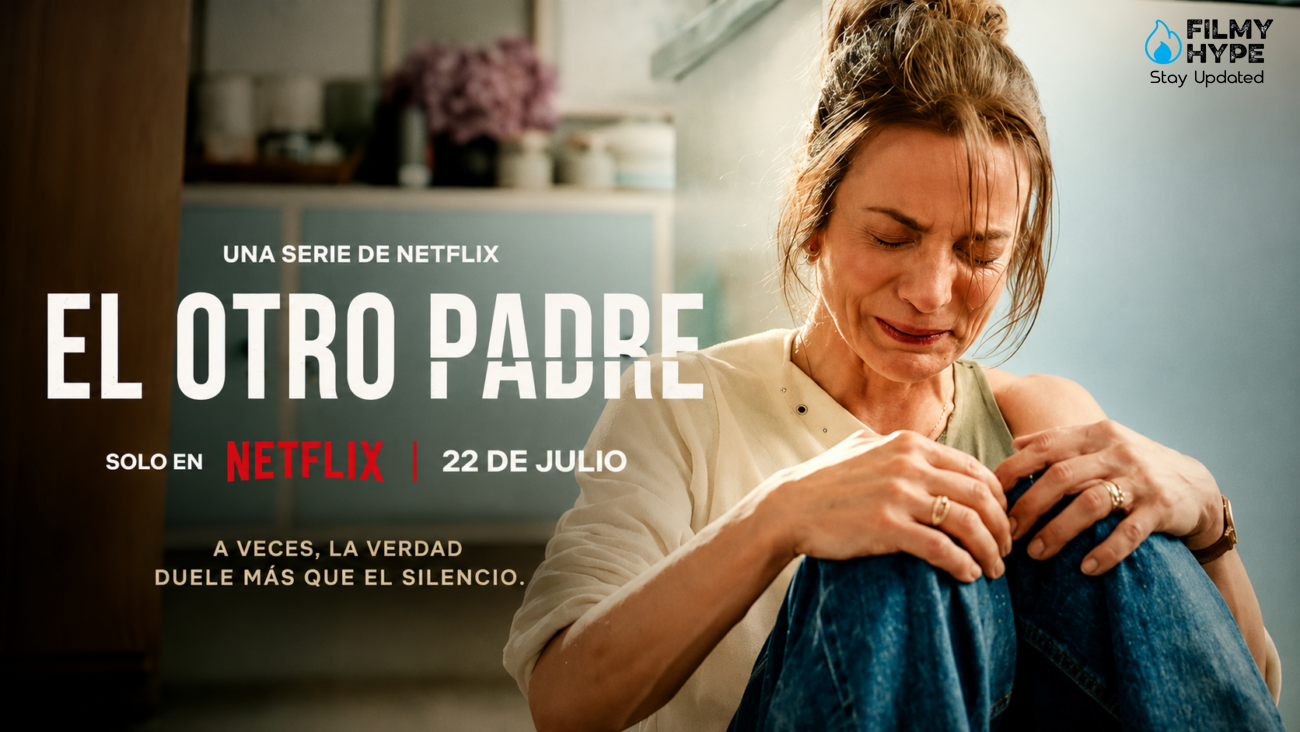
My Daughter’s Father Netflix Ending Explained: Who Saves Julieta and What It All Means?
The series finale, titled The Limits of Forgiveness, doesn’t try to solve every problem the revelation creates. It can’t. Some damage is permanent. What it does instead is focus on the one question that matters most urgently: will Julieta get the kidney she needs to live? The answer, after a season of evasion and resistance, is yes. But the way that yes arrives, and what it costs everyone involved, is where the show finds its real meaning. However, its ending left many with questions that deserve to be answered, since the juliet’s destiny and the possibility that he will be able to get the kidney transplant that his life needs is the central question surrounding the outcome of the series, and which is answered until the last moment.
Starring Silvia Navarro, Manolo Cardona, and Erik Hayser, the production follows a doctor whose search for a donor kidney for his daughter ends up revealing a secret that he had hidden for more than two decades. According to the official synopsis of Netflix, it all starts when Juliet needs an urgent kidney transplant. However, medical studies show that Ricardo, the man who has always raised her as his daughter, is not compatible because he is not her biological father either. So, the medical research uncovers an old relationship between Maca and leads Emilio, the young woman’s real father, triggering a crisis that tests two families.
Emilio’s Choice
For most of the series, Emilio is the wild card. He’s the biological father who didn’t know he was a father, the man from the past who suddenly has a daughter he never met, and a life-or-death decision to make. His initial resistance is understandable in the abstract—he has his own family, his own responsibilities, his own shock to process—but the show doesn’t let him off the hook. Julieta is dying. Every day of hesitation is a day she doesn’t have.
In the final episode, Emilio stops hesitating. He agrees to be tested, to donate, to do the thing that only he can do. The series frames this not as a moment of heroic redemption but as a basic moral calculation. Julieta didn’t choose any of this. She didn’t ask to be born into a web of lies. She didn’t ask for her mother’s infidelity or her father’s ignorance or the genetic lottery that left her kidneys failing. Emilio’s decision to help isn’t presented as forgiveness of Maca or absolution for himself. It’s presented as the bare minimum decency requires: a child is dying, you can save her, so you do.
The show is smart enough to let the complexity linger around the edges of that choice. Emilio’s own family is affected. His wife, his children—they didn’t sign up for this either. The donation doesn’t erase the damage the revelation caused in their lives. It just means that Julieta gets a chance. Sometimes that’s all the victory you get.
What Happens to Maca and Ricardo
If Emilio’s arc is about a man finally doing the right thing, Maca and Ricardo’s is about a marriage facing the consequences of a lie that’s been compounding interest for twenty years. The DNA test doesn’t just reveal Julieta’s paternity. It reveals Maca’s infidelity, her years of silence, and her choice to let Ricardo believe something that wasn’t true. The show doesn’t give her an easy way out. She decided to keep the secret, and she made it again every day for two decades. The crisis didn’t create the problem. It just made the problem visible.
Ricardo’s response is what holds the emotional center of the finale. He could have walked away. He could have decided that the betrayal was too deep, the lie too long, the marriage too broken to salvage. But the show draws a careful distinction between his relationship with Maca and his relationship with Julieta. His wife may have deceived him. His daughter is still his daughter. The years he spent raising her, the bond they built, the love he gave and received—none of that is invalidated by genetics. He is still Julieta’s father in every way that actually matters, and the finale honors that by keeping him in the fight even as his marriage crumbles.
Maca, for her part, has to sit with the wreckage. Her argument—that she kept the secret to protect her family—is exposed as the self-serving rationalization it always was. Protection would have meant honesty, however painful. Protection would have meant giving Ricardo the truth and letting him decide what to do with it. What she did instead was protect herself, and the finale doesn’t pretend otherwise. The marriage may or may not survive. The show leaves that question open, because some questions can’t be answered in a single episode. What’s clear is that the life Maca and Ricardo had before the crisis is gone. Whatever comes next will have to be built from scratch.
What Does the Ending Really Mean?
The finale of My Daughter’s Father is built around a structural contrast. One family finds hope: Julieta gets her donor, the transplant becomes possible, and a future opens up that was closing fast. Another family is left in pieces: the marriage that was supposed to be the foundation of everything has cracked, maybe beyond repair. The show refuses to let one outcome cancel out the other. Saving Julieta is a triumph. It’s also not enough to fix what broke along the way.

That’s the show’s central insight, and it’s more honest than a lot of family dramas are willing to be. The distinction between origin and upbringing isn’t just a plot point. It’s the thesis. Emilio is Julieta’s biological father. His body can give her something that no one else’s can, and he chooses to give it. That matters. But Ricardo is Julieta’s father in the sense that he actually shapes a life. He was there for the fevers and the homework and the slow accumulation of years that turns a child into an adult. The series doesn’t ask us to choose between those two kinds of fatherhood. It asks us to recognize that both exist, that both are real, and that the circumstances that brought them into being are messy and painful and impossible to fully reconcile.
The title of the finale, The Limits of Forgiveness, is doing a lot of work. Forgiveness has limits. Some things can’t be undone. Some wounds don’t heal cleanly. But within those limits, the show suggests, there’s still room for the things that matter most. Julieta gets a chance to live. Ricardo remains her father, even if the word now carries a different weight. Maca faces the truth she spent twenty years avoiding. Emilio does the right thing, however late. It’s not a happy ending in the traditional sense. It’s an ending that acknowledges how much has been lost while still insisting that what remains is worth fighting for.