
Unabomber Netflix Movie Review and Ratings
Cast: Russell Crowe, Jacob Tremblay, Shailene Woodley, Annabelle Wallis, Marc Menchaca, Alexander Ludwig, Matthew Kevin Anderson, Michael Laurence, Steven Ogg, Tanya Clarke, Mark Camacho, David Webster, Bruce Ramsay, Emily Lê, Michael Buie, William Kosovic, Jace Fleming
Director: Janus Metz
Streaming Platform: Netflix
Filmyhype.com Ratings: 3/5 (three stars)
Seeing Janus Metz’s bland Unabomber, we wonder why, after the exhaustive and definitive 2017 series (Manhunt, starring an excellent Paul Bettany), Netflix wanted to focus again on the figure of Ted Kaczynski, known to most precisely by the infamous nickname of the Unabomber. An all-too-overused story-between fiction, documentaries, and true crime-that attempts to differentiate itself in Metz’s feature film, being told as if it were a kind of origin story capable of illuminating the more hidden aspects of one of the most influential criminals in contemporary history. Really, however, we don’t grasp the meaning of this operation, other than that—legitimate and perhaps primary with respect to streaming production logic—of quickly climbing the ranking of the most-watched films.
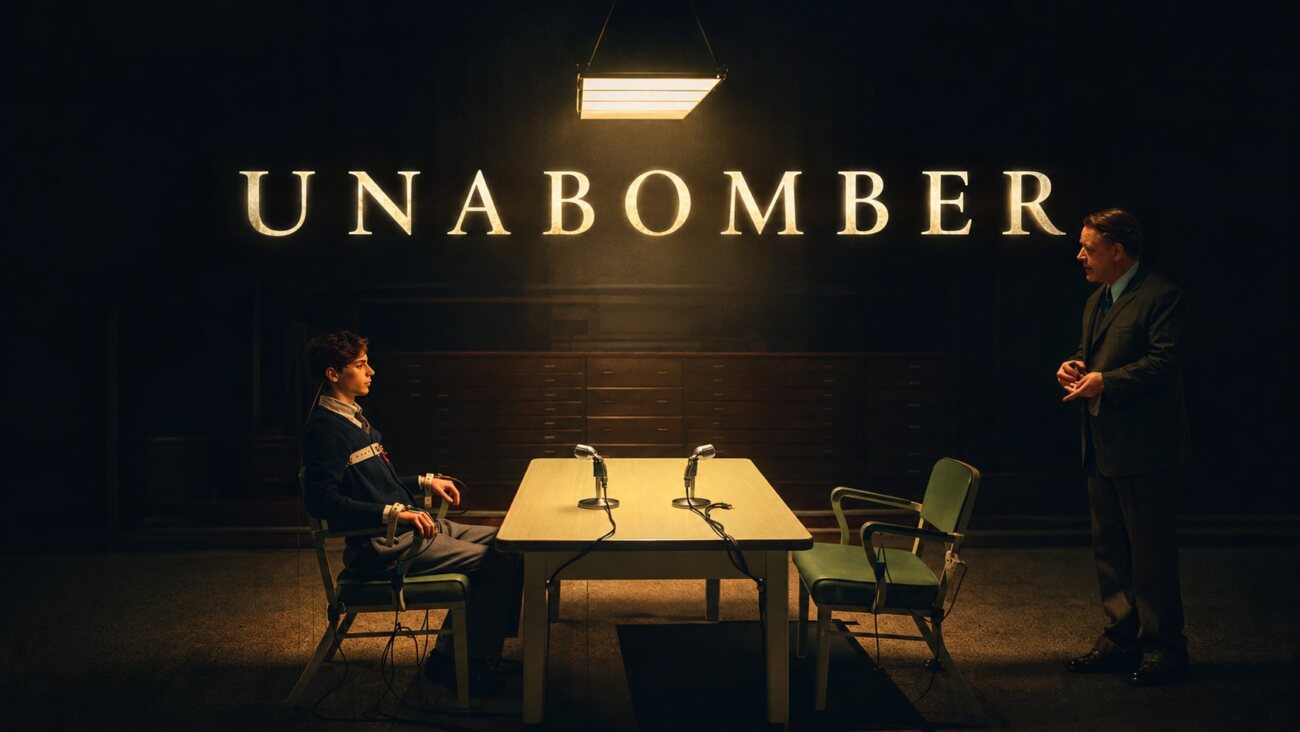
How does a child prodigy, who entered Harvard at just sixteen, transform into a terrorist responsible for a campaign of attacks that lasted nearly twenty years? Janus Metz’s Unabomber seeks the answer, especially in the college years of Ted Kaczynski (played by Jacob Tremblay) and in the psychological experiments conducted by Professor Henry Murray, to whom Russell Crowe lends his face. In parallel, the FBI investigation follows, which many years later will lead to the capture of the Unabomber. A structure that promises to connect the formation of man and the search for the criminal, but which ends up suggesting too simple explanations for a story that has never been simple…
Unabomber Netflix Movie Review: The Story Plot
In 1958, Ted Kaczynski arrived at Harvard when he was just sixteen years old. He was an exceptional talent for mathematics, much younger than his classmates and ill-equipped to fit into an environment where his intelligence was not enough to overcome a profound difficulty in relationships with others. It is in this context that he enters the orbit of psychologist Henry Murray and agrees to participate in a controversial study: the students involved must expose their beliefs and then see them attacked during harsh comparisons recorded and conducted under strong psychological pressure. Kaczynski actually participated in Murray’s experiments, and it is this episode in his biography that most attracted the screenwriters’ attention: the locked rooms, the glass behind which Murray observes the experiments, and Ted’s progressive loss of confidence.
For a moment, it’s as if Unabomber managed to watch Kaczynski before he became the criminal we all know. And the young age of the lead actor, Jacob Tremblay, helps to restore the distance between the boy’s exceptional intelligence and his evident emotional immaturity. His Ted has the ability to be arrogant, vulnerable, irritating, and scared within a few shots. In contrast, Russell Crowe instead works on a more controlled register and makes Murray a presence that is both reassuring and disturbing, even if the film ends up giving him too much weight in the protagonist’s subsequent journey.
Unabomber Netflix Movie Review and Analysis
In some ways, this new rereading of Unabomber seems to be trying to copy—unsuccessfully—the Mindhunter atmosphere, but ultimately what results is much more like a long episode of CSI, without the same adrenaline or pace. Moreover, between one feature film and another (nothing unforgettable, it must be said), the Danish director confronted seriality by directing episodes of some rather important shows. So the introspection and darkness sought by the script, which mixes the two timelines, are rather a sketch, or rather a trace that would like to be bold but which, as is customary, ends up replicating a pattern in which everything appears the same, making the work incapable of reflecting on the (many) words that overlap from scene to scene. On the one hand, the thriller and the crime; on the other, a kind of dysfunctional biopic that clumsily borders on the coming-of-age novel.

There is the not-so-veiled reasoning about Ted as an anti-social, anarchist, quasi-political individual and, last but not least, markedly intelligent and theoretically admirable in his battles, however fought—and here there is all the difference in the world—with obviously the wrong weapons. Given his background, without dwelling on poetic license, Unabomber Ted Kaczynski is therefore the direct product of those United States that, later, found themselves hunting him in a tortuous and spectacular manhunt. A clear and interesting contradiction, even if the film is objectively incapable of exploiting it, except through a series of catchphrases and smug redundancy. Now, speaking of counter-senses, as young Ted says in a sharp dialogue, we too “are responsible for violence by paying taxes and thus financing governments that perpetrate crimes and wars.” While it may be food for thought, such a sentence would have deserved a completely different stage.
The film lasts about an hour and forty minutes and quickly focuses on an extremely complex criminal story. This could be a limitation: perhaps this story would have deserved more time, and perhaps a serialized story would have been more appropriate for the story. But despite this, the film succeeds in its intent to captivate, push for reflection, and entertain from beginning to end. The story proceeds through two timelines that alternate with good balance. The first takes us to Kaczynski’s youth, when at just 16 he landed at Harvard and took part in a personality study conducted by psychologist Henry Murray (Crowe) and funded by the CIA. The second takes place decades later, during the investigation that will lead the FBI to narrow the circle around the Unabomber until its identification and arrest in the 1990s.
The most interesting thing is that ‘Unabomber’ doesn’t focus entirely on attacks or the most violent images—a very common pattern lately in the serial and cinematic approach to true stories and, especially, the narrative of violence—but tries to focus on what exists before the violent act and the circumstances that accompany the transformation of a brilliant young man into a criminal. It is precisely this aspect that makes the film interesting because it allows us to observe the journey of a boy of just sixteen years old, gifted with an extraordinary intelligence, passionate about philosophy and driven by great ambitions, until his transformation into a man capable of becoming a terrorist.
The vision flows quickly, and the constant transition between past and present works well. Even the direction manages to convincingly condense, in just one hundred minutes, a story that has marked American criminal history for almost twenty years. Sure, we’re far from the level of ‘Dahmer,’ but this new Netflix true crime still manages to be engaging and bring attention back to a story that deserves to be remembered. If Monster 4 disappointed you, ‘Unabomber’ can be a good alternative. It’s not a masterpiece and perhaps runs a bit too fast, but it offers several interesting insights and builds a fast-paced and intriguing crime story.
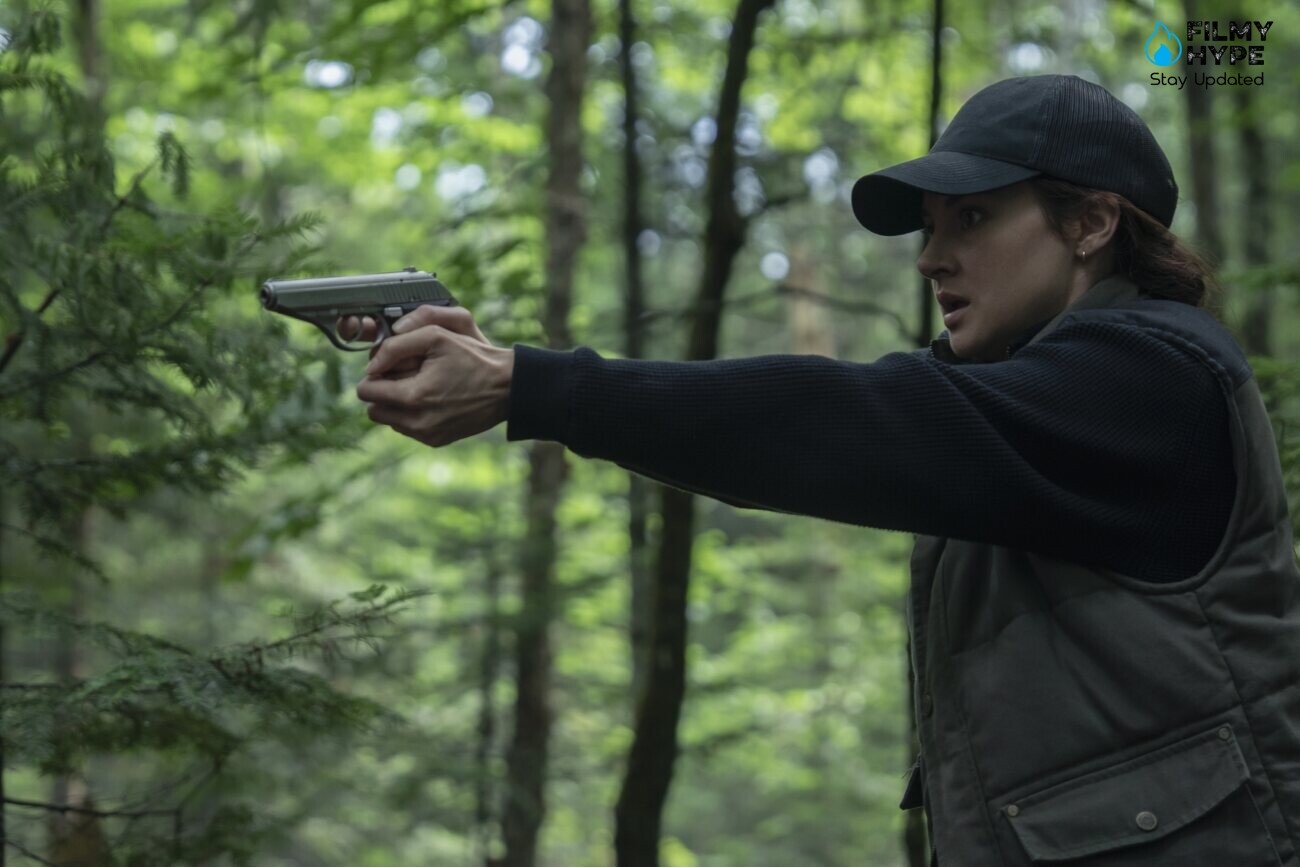
At Harvard in the late 1950s, the 1990s and the long hunt for the Unabomber alternated. Shailene Woodley plays Joanne Miller, an FBI agent trying to find her way into Kaczynski’s manifesto and writings. The film thus attempts to bring together two very distant moments: while Murray tries to enter the mind of young Ted, decades later the investigators try to reconstruct that same mind through the words he left behind. The idea on paper is effective, but the second narrative line seems far too standard, with investigations proceeding through bureaucratic intuitions and obstacles as in most detective thrillers. Joanne herself, moreover, definitely possesses the depth of Ted and Murray, ending up becoming a mere accompanying figure towards an already known conclusion. The result is a film divided into two parts that do not have the same strength.
The most sensitive issue arises when Unabomber tries to directly connect Harvard’s experiments with what Kaczynski would become. Understandably, a film needs to select events and build narrative connections, but here simplification risks becoming an explanation. In particular, the film attributes to the Harvard years an importance that known facts do not allow us to establish with equal certainty. Kaczynski’s mental health issue is also much more controversial than some narrative choices suggest. After his arrest, he received a diagnosis of paranoid schizophrenia, which he refused, while other specialists made different assessments. Recounting Kaczynski’s pressures and lived experiences is legitimate and interesting, but using them to implicitly construct the origin of the Unabomber instead means approaching a cause-and-effect relationship that the film cannot demonstrate.
It’s a shame because Unabomber would have a much more uncomfortable issue on its hands: some of Kaczynski’s criticisms of technology, the loss of autonomy, and the concentration of power have not disappeared with him. They continue to circulate and, in some cases, have found new readers in the very digital age he rejected. The interesting problem would then be to understand how ideas capable of intercepting real fears can coexist with the deliberate choice of violence. However, the film prefers to focus on the psychological origin of the character and ends up paying less attention to this very contradiction. And, when he uses images and recordings of the real Kaczynski in the finale, the distance between the complexity of the real man and the explanation constructed in the previous scenes becomes even more evident. What holds the narrative together is, above all, Tremblay, capable of playing Ted without looking for easy previews of the future monster.
Unabomber Netflix Movie Review: The Last Words
Unabomber finds his best part in his Harvard years and in a convincing Jacob Tremblay but loses strength when he tries to turn a complex biography into an overly tidy explanation of the birth of a terrorist. Unabomber is another variation on the theme that tells the original story of one of the most cited and narrated criminal characters on the big and small screen. A perspective that would like to be different but ends up fitting into a scheme that adds little and ultimately proves extremely canonical.