


Spoiler warning: this article covers the full ending of Monster: The Lizzie Borden Story.
By the time Monster: The Lizzie Borden Story reaches its finale, Ryan Murphy and Ian Brennan have already made clear, over several episodes, that they believe Lizzie killed her father and stepmother. That’s not really the show’s lingering question. What the ending is actually interested in is something trickier: what’s left of Lizzie Borden once the murders are behind her? That’s where the finale gets genuinely compelling — and also where it starts taking some real liberties with the historical record.

Ella Beatty’s Lizzie gradually stops being simply the young woman we’ve followed through the Fall River house and becomes something closer to a symbol — of female rage, repression, and a hunger for freedom. And through Sarah Paulson’s Aileen Wuornos, the series carries that symbol forward roughly a century. But how much of that is actually grounded in fact? Was Aileen Wuornos genuinely fixated on Lizzie Borden? Did Lizzie herself actually take part in the fight for women’s suffrage? These are questions worth approaching carefully, because Monster takes considerable creative license with both.
Monster: The Lizzie Borden Story Ending Explained: How Does the Finale Actually End?
The finale catches up with Lizzie years after her trial. She was acquitted, secured the inheritance she wanted, and now lives in a home far grander than the one she grew up in. On paper, she should finally be free. And yet she’s still trapped — just inside a different kind of cage.
Lizzie’s life is now surrounded by people who know her only by reputation, by cats, by the lingering shadow of what happened, and above all, by her own legend. Even Emma, who continues living with her for a time, seems motivated more by a sense of familial obligation than genuine closeness. Meanwhile, popular culture has fully absorbed Lizzie Borden as a figure — we see her face down a little girl who shows up at her door on Halloween dressed as her, complete with a toy hatchet. Books and retellings of the case keep circulating.
The same society that legally acquitted her continues, informally, to believe she’s guilty. That’s the central paradox the ending sits with: Lizzie won her trial, but lost any real control over what her own identity means to everyone else. Who she actually is stops mattering. What exists now is simply “Lizzie Borden” — a character, a story people tell. In response, Lizzie starts going by a different name: Lizbeth.
Why Does Bridget Come Back to Lizzie?
One of the finale’s most significant threads involves Bridget, played by Vicky Krieps. The two women had separated after the murders — Bridget tried to build an entirely new life elsewhere, while Lizzie went through arrest, trial, and acquittal. When Bridget eventually returns, she admits that even her attempt at a fresh start never delivered the freedom she’d hoped to find.
At the same time, the story of the bloodthirsty Countess that Bridget had been telling Lizzie earlier in the season finally reaches its conclusion — the woman who once seemed to embody strength and independence is ultimately discovered and walled up alive. In a sense, Lizzie has been walled up alive too. Not literally, but inside her own myth. Bridget’s return becomes an opportunity to build a life with the one person who genuinely knows both versions of Lizzie — the fragile young woman from the start of the story, and the one capable of picking up an axe. Honestly, the relationship between these two women feels like the real emotional backbone of the season, arguably more than the murders themselves. It begins as a story about discovering freedom, and ends as an attempt to figure out how to actually live with what that freedom cost.
Why Does Lizzie See Her Parents in the Woods?
Before settling into her new life with Bridget, Lizzie seeks out something resembling absolution. Alone in the woods, she prays and imagines the dead gathering around her. Andrew and Abby no longer appear as monsters to be fought — they show up as ghosts. Whether they’re meant to be read as literally supernatural is almost beside the point; the scene functions primarily as a window into Lizzie’s own psychology.
She’s gotten everything she wanted. Her father can no longer control her. Abby can no longer humiliate her. The money is hers. The house is hers. She’s free to see whoever she wants and live however she pleases. And yet she isn’t actually free — because removing the people who oppressed you doesn’t automatically erase what they left behind inside you. The dead, in this vision, seem to welcome her rather than condemn her, nudging Lizzie toward something like forgiveness. But it’s worth being precise here: this isn’t a legal acquittal. She already has that. This is a personal one. She has to find a way to convince herself she’s actually allowed to keep living.
Did Lizzie Borden Really Take Part in the Suffrage Movement?
This is where things get genuinely complicated. In the finale, Lizzie and Bridget are drawn toward the broader fight for women’s emancipation and suffrage, turning the end of their story into something resembling the birth of real political activism. It’s a striking image. It’s also not something supported by the historical record.
The most substantial sources documenting Lizzie’s life after the trial — including the extensive archive held by the Fall River Historical Society, which maintains what it describes as the world’s largest collection of material related to Lizzie Borden — cover her private life, correspondence, family relationships, and the years she spent at her home, Maplecroft, in real detail. None of that material points to any meaningful role for Lizzie as an organizer or public figure within the suffragist movement. That absence matters, because the American women’s suffrage movement of this era was anything but obscure or undocumented.

By the time the show’s story reaches the years following Lizzie’s acquittal, there were already active suffrage organizations, prominent leaders, journalists, and activists across the country whose work is extensively documented. Journalist Elizabeth Garver Jordan, for instance, actually covered the Borden trial in real life and later became genuinely involved in the suffrage cause — she’s well-documented as a journalist, writer, and advocate for women’s voting rights. Lizzie Borden isn’t documented that way.
None of this necessarily means Lizzie opposed women’s right to vote. It simply means there isn’t enough historical foundation to support the version of her as an active suffragist that the finale presents. Those are two very different claims. What the show does is take a real, well-documented historical arc — the decades-long fight that eventually led to the ratification of the 19th Amendment in 1920 — and write Lizzie into it. That’s a thematic choice, not a biographical one.
Why Does Monster Turn Lizzie Borden Into a Feminist Figure at All?
This is probably the boldest creative swing the season takes. The real Lizzie Borden was tried and acquitted for the murders of her father and stepmother, and the case remains one of the most famous mysteries in American criminal history. Strictly speaking, the historical record doesn’t even support the basic premise the show builds everything on — that she actually committed the murders.
Monster doesn’t hesitate on that point, though. It commits fully to her guilt, then works backward to construct a plausible emotional path that gets her there: domestic confinement, a fraught relationship with her own body, financial control held entirely by men, marriage treated as the only acceptable life path for a woman, suppressed sexuality, an overbearing father, and the vastly different freedoms available to men versus women of that era. That’s the origin of the show’s feminist framing of Lizzie — not necessarily because the historical Lizzie Borden was a committed feminist activist, but because her story provides useful raw material for examining what it meant to be a woman constrained by that particular time and place.
The National Women’s History Museum has pointed out how genuinely valuable the trial remains as a historical artifact, in part because the sheer volume of testimony and documentation it generated offers a real window into what 1892 American society considered normal, or abnormal, for a woman of Lizzie’s social standing. That’s an important distinction to hold onto — Lizzie Borden can absolutely be meaningful to the study of women’s history without needing to have literally been a suffragette. The finale, in my view, pushes that connection further than the evidence really allows. There’s a real difference between using Lizzie’s story to explore the broader condition of women in the late 19th century, and retroactively assigning her a specific political role we simply have no solid evidence she ever held.
Was Aileen Wuornos Actually Fixated on Lizzie Borden?
Here’s another significant liberty the show takes. In the series, Aileen Wuornos finds something like spiritual comfort in Lizzie’s story — she reads about her, visits the Borden house (now operating as a bed and breakfast), and even confronts a vision of her directly. The show draws a fairly direct line connecting the two women.
Historically, though, this connection is unsubstantiated. There’s no solid evidence that Aileen Wuornos built any kind of personal fascination around Lizzie Borden, or that the Borden case served as a documented influence on her own crimes. Notably, even Netflix’s own framing of the character, when introducing her, describes this relationship as part of the show’s narrative construction rather than established biography. Ian Brennan and Ella Beatty have both spoken openly about wanting to draw a thematic thread between the two women, centered on female anger across different historical moments. So this isn’t a biographical discovery that Aileen Wuornos genuinely admired Lizzie Borden — it’s something Murphy and Brennan imagined as a creative choice.
So Why Include Aileen Wuornos at All?
Because she’s not really serving the plot — she’s serving the show’s central argument, and that’s a meaningfully different thing. Lizzie Borden and Aileen Wuornos became two of the biggest figures in American true crime, separated by nearly a century, with genuinely different outcomes. Wuornos killed seven men between 1989 and 1990, was convicted of six murders, and was executed in Florida in 2002. Lizzie, by contrast, was acquitted entirely. Their actual legal outcomes couldn’t be more different. So the show reaches for a different kind of connection entirely: anger.
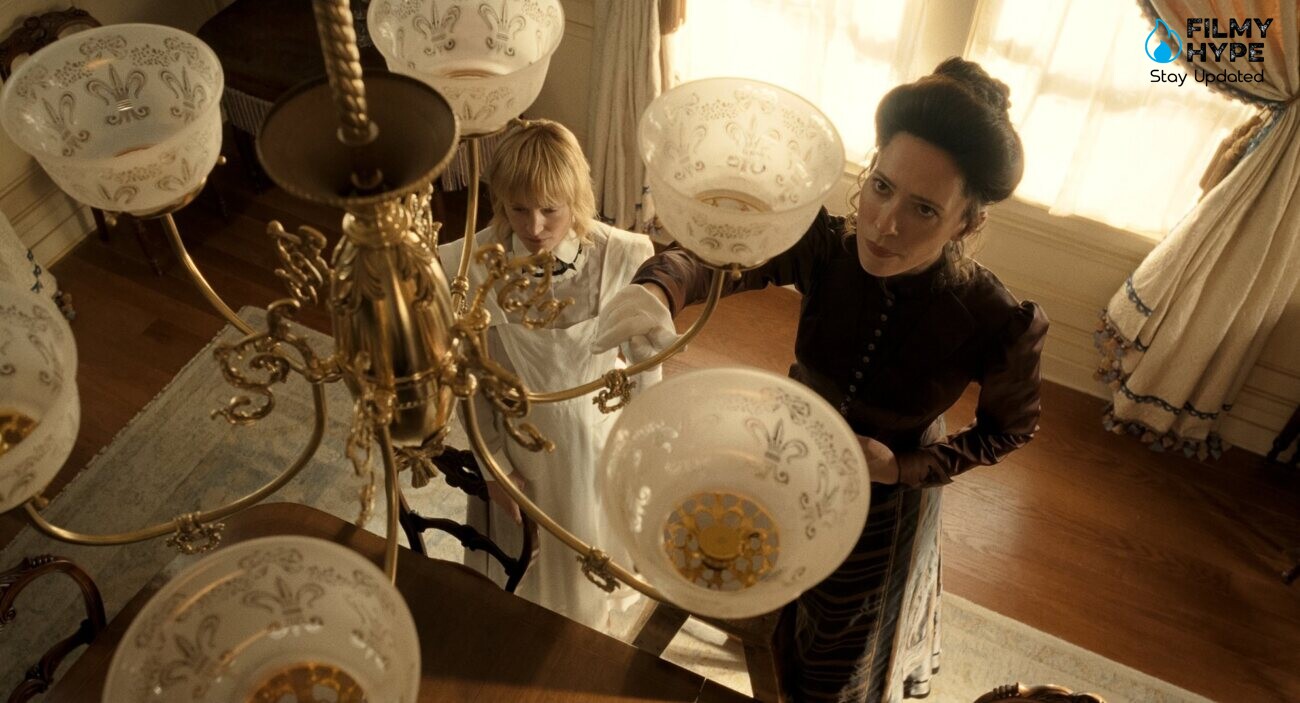
Ella Beatty has spoken directly about this, framing it as a kind of legacy of female anger and how women have historically responded to the conditions imposed on them. Ian Brennan has echoed that, describing Wuornos as a way of tracing that thread throughout the season. That’s why the show has Aileen imagining Lizzie — not because their real biographies are actually connected, but because Monster wants them to be. In the show’s internal logic, Aileen looks at Lizzie and sees someone who turned her own powerlessness into violence, which is exactly how Aileen understands her own actions. The tragic asymmetry between them is the point: Lizzie is acquitted and becomes a legend. Aileen is sentenced to death.
How Does Lizzie Get Found Not Guilty?
After the murders, the investigation ends up approaching Lizzie, although the society of the time has difficulty even accepting that a woman of her social class could have committed such a brutal crime. The absence of definitive physical proof is essential. Lizzie and Maggie have eliminated some of the evidence, and the accusation depends largely on clues and contradictions.
Also coming into play is Nance O’Neil, played by Jessica Barden. Although historically Lizzie met the actress after the process, the series alters the chronology and turns Nance into a sort of Lizzie’s trainer before and during the trial. It teaches her to control her image and play before the jury the role of a woman incapable of committing such an atrocity. Emma, played by Billie Lourd, also ends up helping her sister with her testimony. The result reproduces the historical outcome: Lizzie Borden is found not guilty and leaves court a free woman. But that freedom is much less complete than I expected.
What Happens to Lizzie and Emma After the Trial?
The final episode, titled Carnival, advances several years and places part of the story in 1908. Lizzie now lives in a large mansion, has replanted her beloved cherry trees, enjoys electricity, and shares the property with a huge number of animals. Financially, he has achieved the life he never had at his father’s house. However, the acquittal has not managed to erase the Borden surname from the collective memory. Emma lives with her, but the weight of the murders has destroyed her little by little. She drinks, consumes opium, and admits that she never really managed to escape because her family name haunts her wherever she goes.
During dinner, Lizzie even plays with different theories about who could have murdered Andrew and Abby. He talks about a possible Portuguese thief, his uncle John Morse, and even an alleged illegitimate son of Andrew. Of course, the viewer knows the truth she is hiding. The coexistence between the sisters ends up becoming unbearable. Emma understands that she has dedicated a good part of her life to protecting Lizzie and finally decides to leave. Before doing so, he makes it clear that he knows perfectly well what happened and hopes that one day he will be able to recognize it.
Why Maggie Returns to Lizzie?
The big surprise of the final episode is Maggie’s return. After helping Lizzie with the murders and staying away during the trial, she attempted to build another life. She married and lived for years on a farm with a man she ended up despising. From time to time, he kept secretly visiting Lizzie. One night, he appears again, entering the basement of the mansion, and the two meet again. The scene makes it clear that the bond between them never disappeared despite the years of separation.
Maggie’s situation later worsens when her husband becomes suspicious of her money and her absences. She even imagines murdering him with an axe, repeating the same pattern of violence that marked her past. But this time he makes another decision. Maggie abandons her husband and returns permanently to Fall River. She no longer wants to go hidden in basements or keep their relationship a secret. He decides to walk through the front door and stay with Lizzie. The ending thus grants them a life that the season had long presented as impossible.
Ending Explained: What Does the Last Scene With Aileen Wuornos Mean?
After receiving the injection, Aileen appears to open her eyes again. In front of her are Lizzie and Maggie. The two have arrived to accompany her towards what the series presents as a safe place where her actions can be understood and forgiven. It doesn’t mean that Lizzie and Maggie have actually been waiting for Aileen in some kind of literal continuity of the story.
The sequence functions as a representation of the last moments of Wuornos and, above all, as the thematic conclusion of the entire season. Lizzie sought forgiveness after building a new life with Maggie. Aileen, who had a radically different destiny, symbolically finds that same forgiveness when she is about to die. The fantasy ends when the series returns to reality. The doctors disconnect Aileen’s body from the stretcher, close the curtain before the people who have come to witness her execution, and the continuous sound of the monitor confirms her death.
What Does the Ending Actually Mean?
At its core, the ending is about who gets to own a story once it’s out in the world. In this version of events, Lizzie commits the murders — but from that point forward, she loses any real control over what those murders come to mean. The courtroom produces one version of Lizzie. The newspapers produce another. Women who see something rebellious in her create yet another. The little girl dressed as her for Halloween carries her own version. Aileen Wuornos, nearly a hundred years later, builds her own version too. And finally, Ryan Murphy and Ian Brennan construct one more, for Netflix.
That’s part of why the connection between Lizzie and Aileen ultimately works better than the suffragist angle. The Lizzie-Aileen link is openly, unapologetically symbolic — two women reshaped by American culture into archetypes of female violence. The suffragist thread risks being read as historical fact, when the evidence supporting it is genuinely thin. There’s a deeper irony sitting underneath all of this, too: Monster spends its runtime critiquing how Lizzie was turned into myth, while simultaneously constructing a brand-new myth of its own. This time, she isn’t simply the axe-wielding spinster from the old nursery rhyme — she’s repressed, queer, in love, rebellious, a victim of a patriarchal system, and ultimately positioned as adjacent to the fight for women’s emancipation.
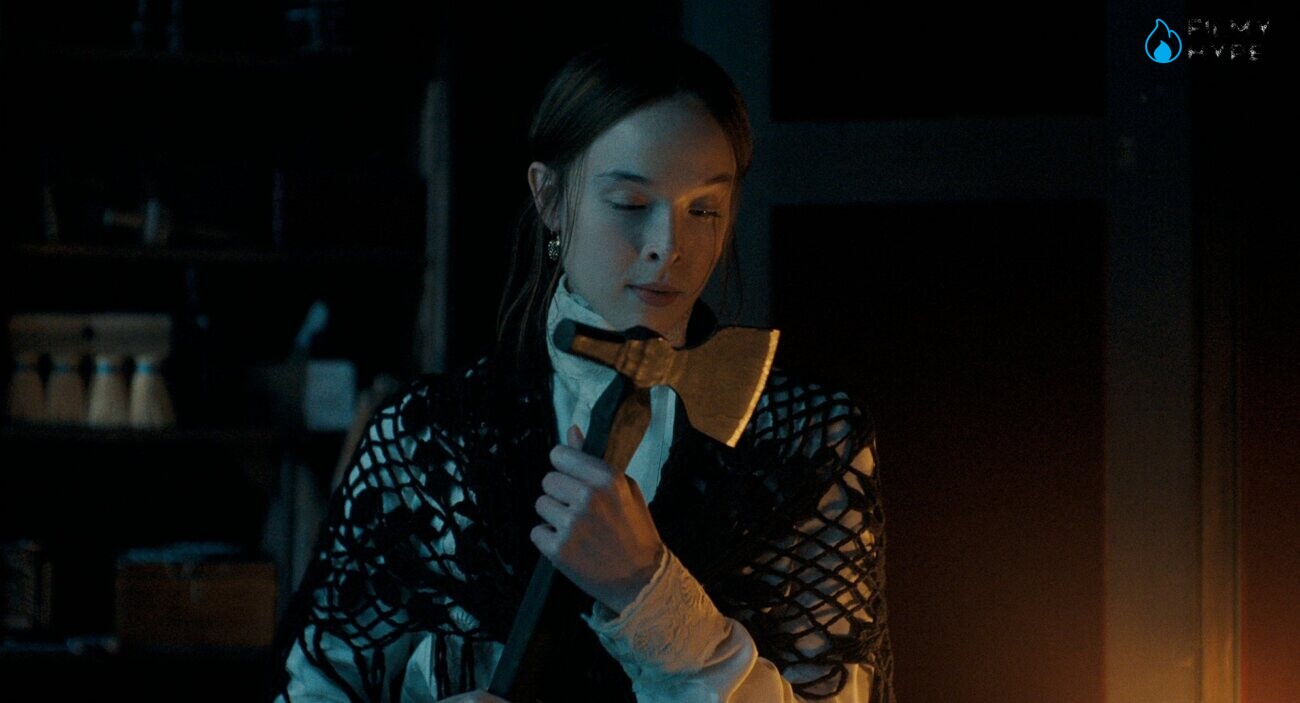
Most of those traits belong specifically to Monster’s version of Lizzie, not necessarily to the historical woman on record — and that distinction is worth holding onto. There’s a lot to sit with in this ending. On one hand, the show’s underlying goal is genuinely compelling: take one of the most infamous “monstrous” women in American criminal folklore and ask who actually decided to label her that way. On the other hand, the series sometimes seems so taken with its own answer that it starts blurring the line between understanding someone and absolving them entirely.
Lizzie is acquitted by the court. Then she attempts to personally absolve herself. And by the end, the show itself almost seems to want to grant her a kind of historical absolution too, folding her into a much larger, genuinely important story of women’s emancipation. But the actual historical record is messier and less comfortable than that. We don’t actually know who killed Andrew and Abby Borden. There’s no solid evidence Lizzie played any real role in the suffrage movement. And there’s no reliable evidence that Aileen Wuornos ever built her own criminal identity around Lizzie Borden at all. Maybe that gap — between what we can actually prove and the tidy story we’d prefer to tell — is the real monster sitting underneath this ending.