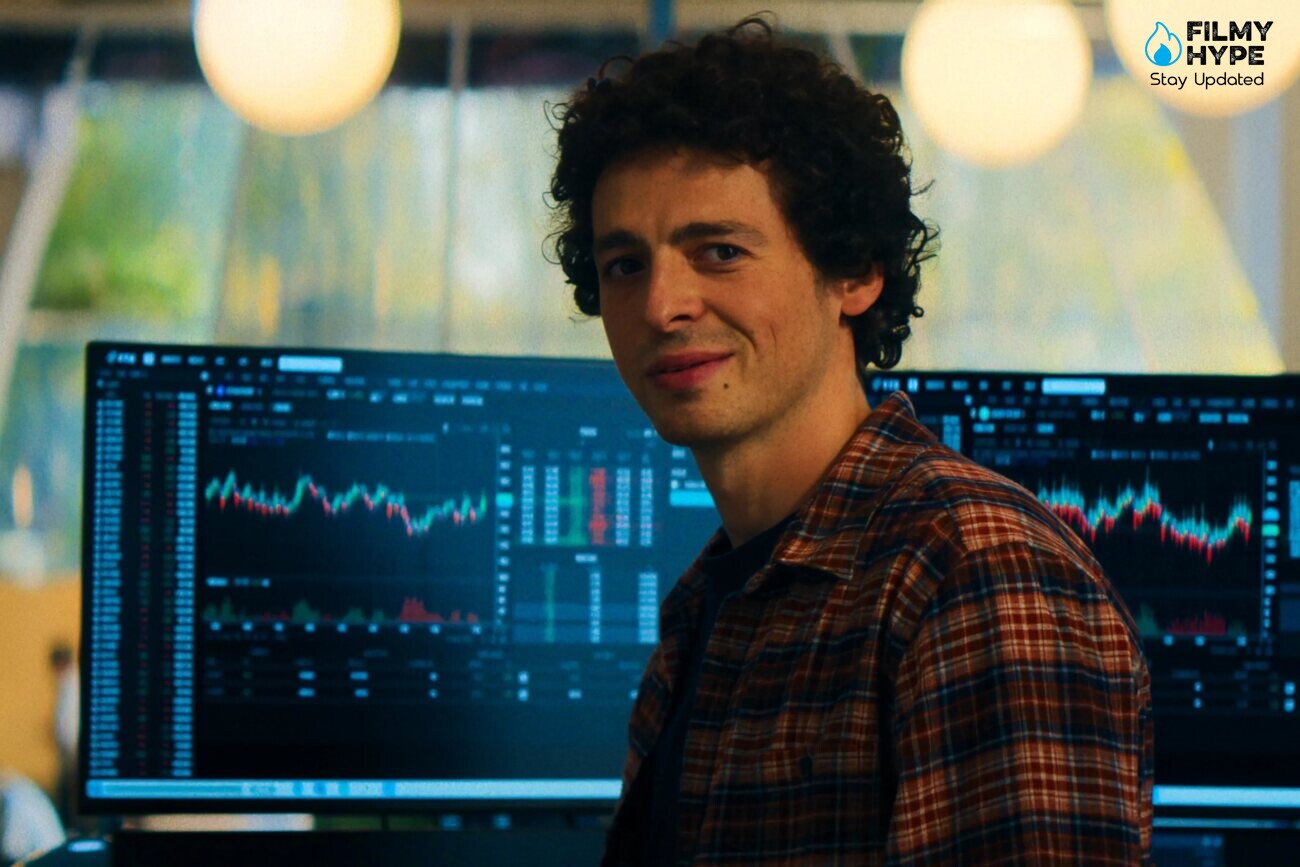


The Altruists Series: The story of Sam Bankman-Fried and Caroline Ellison already feels like something Netflix would invent. Two brilliant young people, convinced they were smarter than everyone else, building a cryptocurrency empire on a foundation of idealism and fraud. A collapse that erased billions of dollars. A trial that captivated the world. And at the center of it all, a woman whose loyalty to a man she loved—or thought she loved—led her directly into the path of federal prosecutors.

The Altruists, the new Netflix series arriving this fall, stars Julia Garner as Caroline Ellison, the woman the tabloids dubbed “Lady Crypto.” It’s inspired by the true story of what some have called Gen Z’s Bonnie and Clyde—a comparison that flatters both of them more than they deserve. Bonnie and Clyde were outlaws on the run. Bankman-Fried and Ellison were finance nerds who convinced themselves they were changing the world while quietly using other people’s money to fund their lifestyle. The series promises to explore not just the mechanics of the fraud but the strange, codependent relationship at its heart. To understand what’s coming, it helps to know what actually happened.
The Altruists Series: The Early Years
Caroline Ellison was born in 1994 to parents who both taught at MIT. She was, by every account, exceptionally bright—the kind of student who excels at math competitions and gets into Stanford without breaking a sweat. She graduated in 2016 and went to work at Jane Street Capital, a quantitative trading firm that recruited heavily from elite universities. It was there that she met Sam Bankman-Fried, a fellow young trader who shared her interest in a movement called Effective Altruism.
Effective Altruism sounds benign, even noble: the idea is to use your resources to do the most good possible, focusing on causes where your contributions can make the greatest measurable difference. But in practice, it also provided a philosophical framework for people like Bankman-Fried and Ellison to justify enormous wealth accumulation. The more money you made, the more good you could eventually do. The ends would justify the means—even if the means involved building a financial empire on increasingly shaky ground.
The Rise of Alameda and FTX
In 2018, Bankman-Fried asked Ellison to join him at Alameda Research, a cryptocurrency trading firm he was starting. She accepted. The work was volatile, high-stakes, and consumed nearly every waking hour. But it was also exciting—the kind of opportunity that comes along once in a generation, and Ellison was smart enough to know it.

The following year, Bankman-Fried launched FTX, a cryptocurrency exchange that would eventually reach a valuation of $32 billion. Ellison took over leadership of Alameda Research. On paper, the two companies were separate entities with separate finances. In practice, the boundaries were blurry from the start.
The crypto boom of 2020 and 2021 made FTX a household name. Bankman-Fried became a public figure, cultivating an image as a quirky genius who slept on beanbags and planned to give away his fortune. Ellison stayed mostly behind the scenes, running Alameda and trying to manage the increasingly complicated web of financial arrangements that kept both companies afloat.
The Lifestyle
According to investigations by the Wall Street Journal and other outlets, approximately $10 billion in customer funds was transferred from FTX to Alameda Research over the course of the companies’ operations. Some of that money was used for trading. Some of it was used for things that had nothing to do with legitimate business.
Bankman-Fried and his inner circle—which included Ellison—lived in a penthouse in the Bahamas, where the companies were headquartered. The lifestyle was excessive in a way that seemed almost purpose-built for a Netflix adaptation: parties, drugs, video game marathons, and what multiple sources described as polyamorous relationships within the leadership group. Ellison and Bankman-Fried were, at various points, romantically involved, though the exact nature of their relationship remained complicated and often ambiguous.
The Effective Altruism philosophy still got mentioned in interviews, but it became increasingly difficult to reconcile with the reality of how the money was being spent. The people who were supposed to be saving the world were mostly just enjoying themselves.
The Collapse
The end came quickly, the way these things usually do. In November 2022, a news report questioned the relationship between FTX and Alameda Research, raising concerns about whether customer funds were being used to prop up Alameda’s failing positions. The report triggered a run on FTX—customers rushing to withdraw their money, only to discover that the funds weren’t there to give them.
Within days, both FTX and Alameda Research filed for bankruptcy. The $32 billion valuation evaporated. Ellison lost her position. Bankman-Fried resigned. And federal investigators began looking into what had actually happened behind the scenes.
The Legal Aftermath
Ellison cooperated with prosecutors. This turned out to be the most consequential decision of her life. She pleaded guilty to fraud charges and agreed to testify against Bankman-Fried, providing the kind of insider account that prosecutors needed to build their case. Her testimony was detailed, specific, and devastating. She described how Alameda had access to a line of credit from FTX that was ultimately funded by customer deposits. She described the pressure from Bankman-Fried to hide losses. She described a culture where lying about the numbers became routine.
Bankman-Fried was convicted and sentenced to 25 years in prison. Ellison, because of her cooperation, received a much lighter sentence: two years, along with the confiscation of $11 billion in assets. She began serving her sentence in November 2024 at a correctional facility in Connecticut.
Her time in prison was relatively brief. After reductions and adjustments, she was admitted to probation in October 2025 and released permanently on January 22, 2026, having served approximately 14 months.
What the Series Will Explore
The Altruists arrives at a moment when the story of FTX has already been picked over by journalists, documentarians, and true crime enthusiasts. But the series promises something different: a dramatic reconstruction that focuses less on the mechanics of the fraud and more on the psychology of the people involved. Julia Garner, who has built a career playing complicated women in over their heads, seems perfectly cast as Ellison—smart, ambitious, complicit, and ultimately trapped by choices she made before she fully understood their consequences.
The title is pointed. Effective Altruism was supposed to be about doing good. Instead, it became a justification for accumulating wealth at any cost, a philosophy that allowed smart people to convince themselves that their excesses were actually virtues. The series will presumably explore how that kind of self-deception works, how two intelligent people could look at a fraud worth billions of dollars and see themselves as the heroes of the story.
Caroline Ellison is free now. She served her time, lost her fortune, and will spend the rest of her life as a footnote in someone else’s cautionary tale. The woman the tabloids called “Lady Crypto” is now just another person trying to figure out what comes next. The series will give audiences a chance to understand how she got here. Whether it makes her sympathetic is another question entirely. Some stories don’t have heroes. They just have people who made terrible choices and have to live with them.