


One Hundred Years of Solitude Part 2 Family Tree Explained: The first thing to understand about the Buendía family is that they are not trying to confuse you. The confusion is the point. Gabriel García Márquez constructed his novel so that names repeat across generations with the inevitability of a curse—Aurelianos tend toward solitude and lucidity, José Arcadios toward impulse and desire—and keeping track of who is who requires accepting that the family itself has never been particularly interested in distinguishing one generation from the next. They’re trapped in a circle. The names keep coming back because the patterns keep coming back, and the patterns keep coming back because no one ever stops to understand them.
Netflix’s adaptation, which returns for its second and final season, covers the back half of the novel: the arrival of the railroad and the banana company, the massacre of the workers, the four-year rain, and the slow, inexorable extinction of the family line. The cast of characters expands significantly from Part 1, and even readers familiar with the book may find themselves pausing to remember which Aureliano is which. Here is a guide to the major figures of Part 2, how they relate to each other, and where they fit in the family tree that stretches from the founding of Macondo to its final erasure.
One Hundred Years of Solitude Part 2 Family Tree Explained: Easy Guide
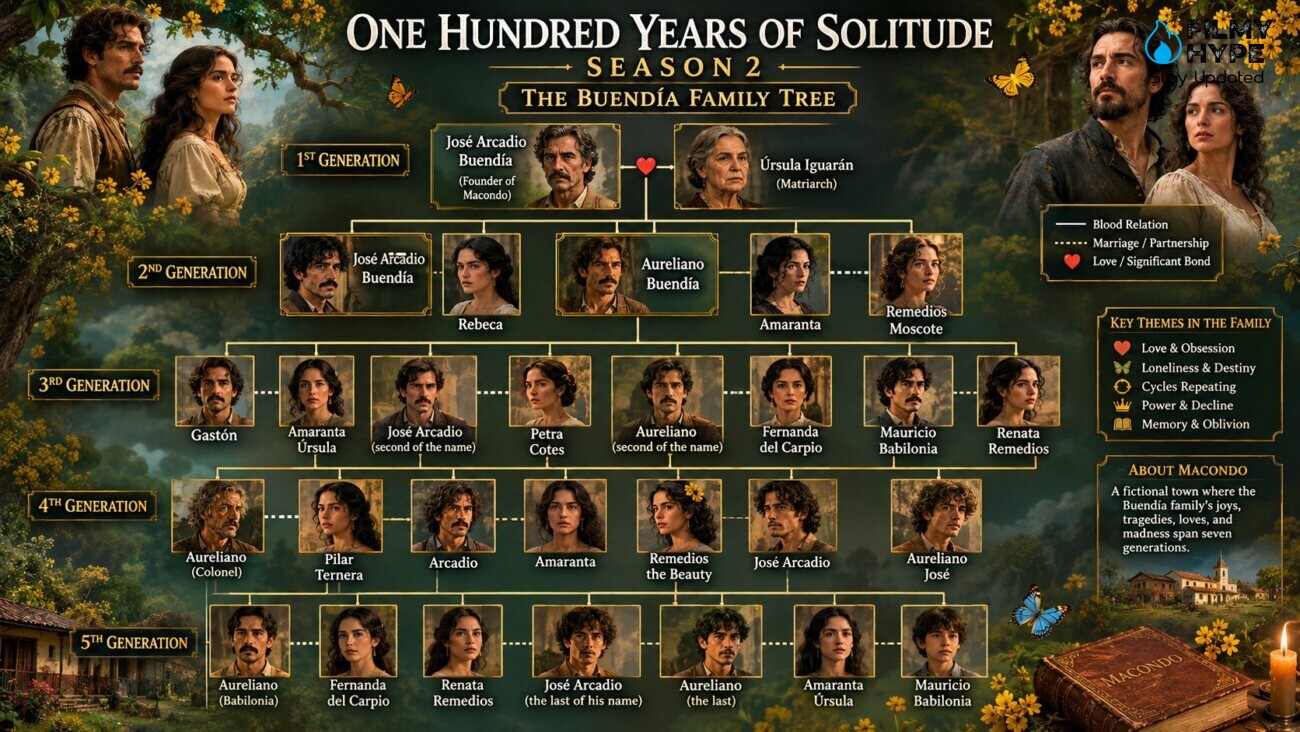
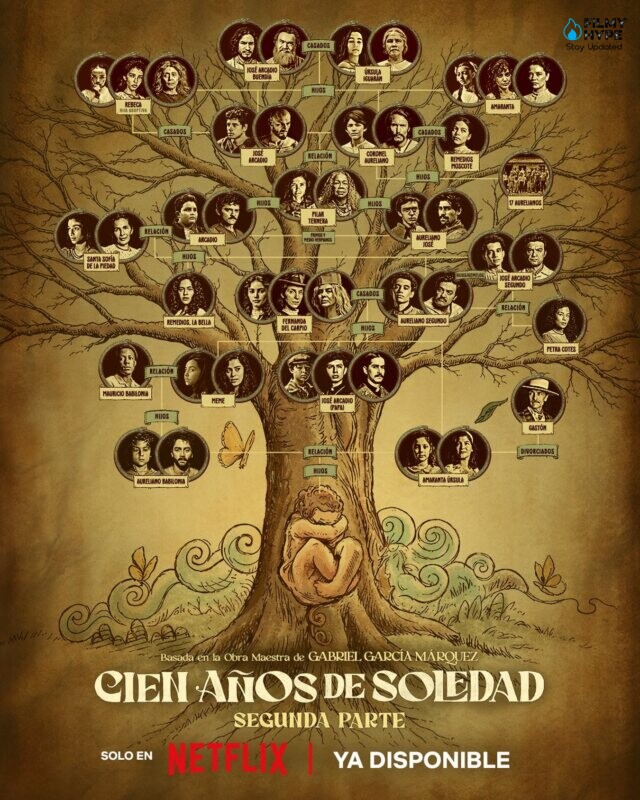
The Buendía family line begins with the founding couple, José Arcadio Buendía and Úrsula Iguarán, who leave their village of origin to found Macondo. They had three children: José Arcadio (the firstborn), Aureliano (who becomes a colonel), and Amaranta. Two other children entered the household: Rebeca, whose parentage remains mysterious, and Arcadio, the illegitimate son of José Arcadio Jr. and Pilar Ternera.
Arcadio, raised in the Buendía home, married Santa Sofía de la Piedad and had three children: the twins José Arcadio Segundo and Aureliano Segundo, and Remedios la Bella. Aureliano Segundo married Fernanda del Carpio, a rigid, aristocratic woman who fundamentally changed the character of the household. They had three children: José Arcadio, Amaranta Úrsula, and Renata Remedios—known as Meme.
Meme had a secret relationship with Mauricio Babilonia, a mechanic always accompanied by yellow butterflies. Their son, Aureliano Babilonia, was passed off as a foundling and raised in the Buendía house without knowing his parentage. He eventually has a relationship with Amaranta Úrsula—his aunt, though neither of them knows it—and their child, born with a pig’s tail, is the last of the Buendía line. The child dies. The family ends. Macondo is erased.
Cast and Characters of the Second Season:
- Claudio Cataño: Colonel Aureliano Buendía
- Marleyda Soto: Úrsula Iguarán
- Julian Roman: José Arcadio Segundo and Aureliano Segundo (double interpretation of the twins)
- Jorge Quintero: Young version by José Arcadio Segundo and Aureliano Segundo
- Carla Baratta: Fernanda del Carpio (adult version)
- Laura Taylor: Fernanda del Carpio (young version)
- Margaret Rose of Francis: Fernanda del Carpio (another adult version)
- Angela Cano: Petra Cotes (young version)
- Licinia Alzate: Petra Cotes (major version)
- Maria Adelaida Puerta: Amaranta Úrsula
- Juanita Molina: Meme (Renata Remedios)
- Estefania Piñeres: Amaranta Úrsula (another stage)
- Emmanuel Restrepo: José Arcadio (son of Fernanda del Carpio and Aureliano Segundo)
- Daniella Reyes: Remedies, the beautiful one (early stage)
- Violetta Avendaño: Meme (Renata Remedios, young stage)
- Maurice Babylon: Central character in the second generation
The Key Characters of Part 2
Aureliano José is the son of Colonel Aureliano Buendía and Pilar Ternera. He was left in Amaranta’s care when his father went off to war, and the arrangement proved disastrous. Aureliano José grew up in love with his aunt—a love that was never consummated, but that haunted both of them. His pursuit of Amaranta and his inability to escape the pull of that impossible desire mark him as one of the family’s early casualties, a young man destroyed by the same confused longings that will echo through later generations.
Remedios la Bella is the daughter of Arcadio and Santa Sofía de la Piedad, and she is the most purely innocent figure in the entire novel. She is not simple or naive; she is something closer to untouched, a person so disconnected from earthly concerns that the world’s corruption cannot reach her. Her beauty is legendary and lethal—men who desire her tend to die. She spends her days unclothed when she pleases, eats with her hands, and moves through Macondo in a state of prelapsarian grace. Her departure from the story is one of Márquez’s most famous images: she ascends to heaven while folding sheets, rising into the sky as if gravity had simply forgotten to hold her.
José Arcadio Segundo and Aureliano Segundo are the twin sons of Arcadio, and they are a study in how the family’s patterns reproduce themselves. José Arcadio Segundo becomes the political conscience of the family. He works to bring the railroad to Macondo, participates in the modernization of the town, and eventually becomes the key witness to the banana company massacre—the mass killing of striking workers that the authorities will deny ever occurred. He spends his final years in Melquíades’ room, guarding the memory of the dead while the rest of Macondo accepts the official lie.
Aureliano Segundo takes the opposite path. He marries Fernanda del Carpio but lives primarily with his mistress, Petra Cotes, whose presence seems to bring almost supernatural abundance. The livestock multiply at impossible rates. Wealth flows in. Aureliano Segundo spends his days in extravagant celebration, a man who has chosen pleasure over politics and who will eventually watch both the wealth and the pleasure drain away when the rains come.
Fernanda del Carpio is arguably the most significant addition to the Buendía household in Part 2. She was raised to believe she belonged to an aristocratic lineage, educated in a convent that prepared her to marry into nobility. What she married instead was Aureliano Segundo and the chaos of Macondo. Her response is to impose order through rigidity: rules, appearances, religious observance, the suppression of anything that doesn’t fit her image of what a proper family should be. She is the antithesis of Úrsula, who held the household together through flexibility and love. Fernanda holds it together through control, and the control eventually strangles everyone under it—including her daughter Meme, whose tragedy is the direct result of Fernanda’s refusal to accept a love that didn’t meet her standards.
Renata Remedios, called Meme, is Fernanda and Aureliano Segundo’s daughter. She falls in love with Mauricio Babilonia, a mechanic whose arrival is always heralded by yellow butterflies. The butterflies connect him to the yellow flowers that fell over Macondo when José Arcadio Buendía died—another link in the chain of repetitions that bind the family. Their relationship is secret, passionate, and doomed. When Fernanda discovers it, she arranges for Mauricio to be shot. He survives but is paralyzed for life. Meme stops speaking entirely, her silence a refusal to participate in a world that has taken everything from her. Fernanda sends her to a convent. What Fernanda doesn’t acknowledge is that Meme is pregnant.
Mauricio Babilonia is the mechanic with the yellow butterflies, a figure of almost magical realism in his own right. He loves Meme genuinely, and his destruction at Fernanda’s hands is one of the novel’s cruelest moments—not because he dies, but because he’s left alive and immobilized, a reminder of what was taken from both of them. His son will be the last Buendía.
Aureliano Babilonia is the child of Meme and Mauricio, raised in the Buendía house without knowing his true parentage. He is the final reader of Melquíades’ manuscripts, the one who will discover that the entire history of his family was written a century in advance. His relationship with Amaranta Úrsula—his aunt, a fact neither of them knows—produces the pig-tailed child, fulfilling Úrsula’s ancient fear of incest and bringing the family line to its genetic conclusion. Aureliano Babilonia is the character through whom the novel’s metafictional structure becomes visible. He reads about himself reading. He learns his fate at the exact moment it arrives. He is the Buendía who finally understands, and the understanding comes too late to save anyone.
Amaranta Úrsula is Meme’s younger sister, raised largely away from Macondo. She returns with her husband, Gastón, full of energy and determination to restore the crumbling family home. Her affair with Aureliano Babilonia is passionate and doomed in equal measure. She is the last woman of the Buendía line to love, and her death in childbirth—hemorrhaging after delivering the pig-tailed baby—closes the cycle that began when Úrsula first feared what might happen if the family turned inward on itself.
How the Patterns Work
The Buendía family tree is not difficult to memorize if you understand the logic behind the repetitions. Aurelianos are withdrawn, contemplative, prone to isolation and sudden flashes of insight that don’t translate into action. José Arcadios are physical, impulsive, driven by desire in all its forms—sexual, material, territorial. The women of the family often serve as the stabilizing force, but they are also subject to the same circular logic. Úrsula tries to prevent the birth of the pig-tailed child for decades, but cannot. Fernanda tries to impose order and creates destruction. Amaranta renounces love and is consumed by the renunciation.
The names repeat because the lessons don’t get learned. Each generation believes it is living something new, and each generation is wrong. Melquíades’ manuscripts, which contain the entire history of the family written in advance, are not a prophecy in the sense of a prediction. They are a record of what happens when people refuse to recognize the patterns they’re trapped in. The tragedy of the Buendías is not that they are cursed. It’s that they keep making the same choices and expecting different outcomes. Macondo is destroyed not by the wind but by the accumulated weight of a century of solitude—the isolation that comes from being unable to see beyond the self, the family, the endlessly repeating name. The family tree, for all its branches, grows in a circle. The final season shows that circle closing.
The series presents characters such as Fernanda del Carpio, who arrives at the Buendía house to impose her family and social authority, and the twins José Arcadio Segundo and Aureliano Segundo, who represent the different facets and destinies of the lineage in the final stretch. Other roles, such as Amaranta Úrsula, Meme, and Petra Cotes, gain relevance in this cycle, and Macondo’s universe expands its reach with the inclusion of actors and versions of the characters at different ages.
The season is made up of eight episodes, each titled in reference to key events or figures: The armistice, The queen of Madagascar, Fernanda del Carpio, The innocent train had arrived, It was October 11, There were more than three thousand, It rained for four years and a final episode that seals the fate of Macondo and the Buendías, which will be released on August 26 as a feature film.
Under the direction of Laura Mora and Carlos Moreno, the production faces the challenge of adapting the crudest and most complex passages of the book, especially the violence and tragedy of the banana company. The presence of new characters and the interpretation of recognized actors generate expectations among followers, who carefully observe how the story is resolved and how the transformation of the town and its lineage is represented.
The second season of One Hundred Years of Solitude thus concludes the adaptation of one of the greatest references in Latin American literature, marking a milestone in Netflix productions in the region and opening García Márquez’s universe to new generations.
The second season of One Hundred Years of Solitude begins its premiere on Netflix on Wednesday, August 5, 2026, the day on which the first seven episodes of this long-awaited installment will be available. The release marks the return of the adaptation of Gabriel García Márquez’s work with the final stretch of the story of the Buendías and Macondo family.
The final closing of the series will come shortly after: the grand finale, a special episode that functions as a feature film, will premiere on Wednesday, August 26, 2026, on the platform. This final chapter is directed by Laura Mora and is conceived as the outcome that completes the television adaptation of the novel.