


11 Best Psychological Serial Killer Miniseries: There’s a particular kind of dread that the best serial killer miniseries can create. It’s not just about the jump scares or the body count, though those are certainly part of the formula. The really good ones burrow under your skin because they’re not just showing you what the killers did. They’re asking why. What made them? What cracked open inside them? What combination of circumstance, compulsion, and sheer broken wiring turned a person into a predator? These are uncomfortable questions, and the miniseries format—compact, contained, designed to be consumed in a few sittings—is uniquely suited to exploring them without overstaying its welcome.
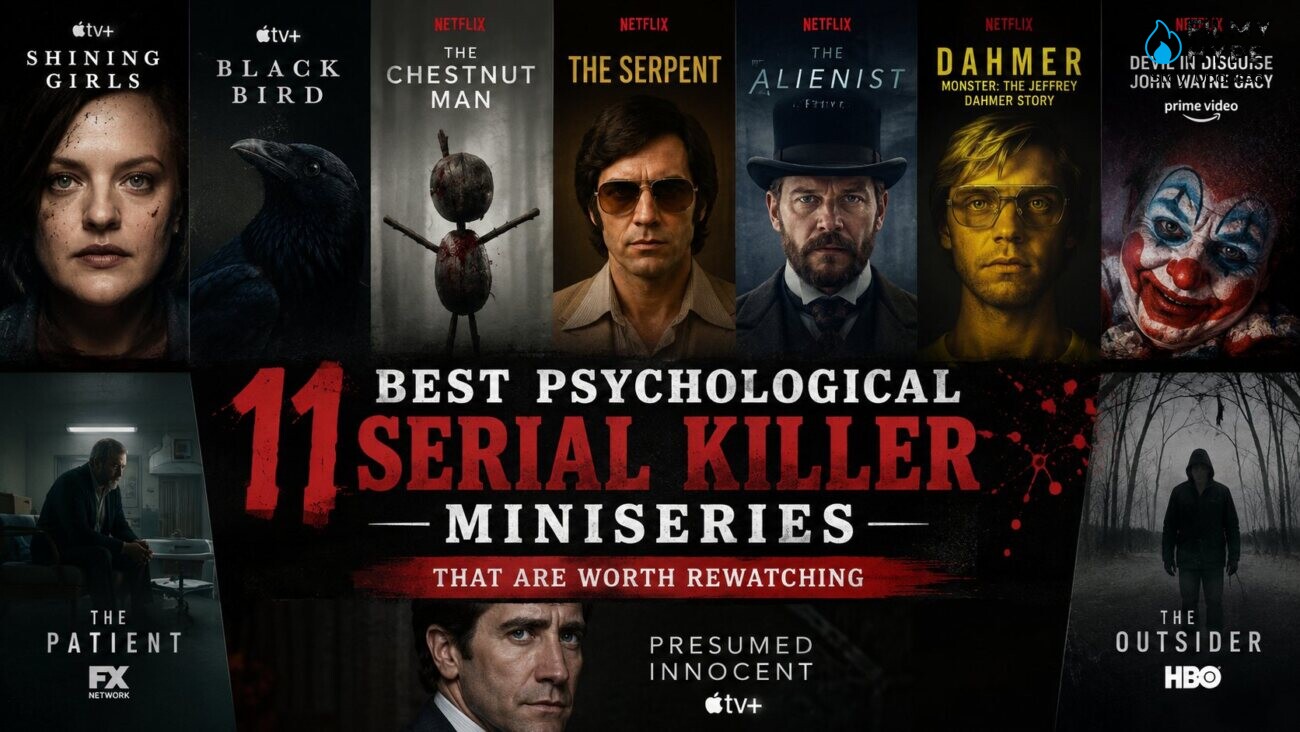
11 Best Psychological Serial Killer Miniseries
The shows on this list aren’t for everyone. They’re violent and dark and occasionally almost unbearable to watch. But they’re also, at their best, genuinely illuminating. They use the framework of the crime thriller to dig into psychology, trauma, systems of power, and the ways violence ripples outward long after the actual killing stops. Here are eleven of the best.
Shining Girls (Apple TV)
Elisabeth Moss stars as Kirby Mazrachi, a newspaper archivist in Chicago whose life was completely derailed six years ago when she was attacked and left for dead. She survived, but her reality has never been stable since. Things shift around her—her desk is suddenly on a different floor, she’s married in one moment and single in the next, her hair changes length between scenes—and she’s the only one who notices. When a fresh murder seems connected to her own assault, Kirby partners with a veteran reporter played by Wagner Moura to track down the killer.
What makes Shining Girls extraordinary is the way it weaponizes its central conceit. The killer isn’t just a murderer. He’s someone who can move through time, and the series uses that ability to explore how trauma destabilizes identity. Kirby can’t trust her own memories. The ground keeps shifting under her feet. The show, produced by Leonardo DiCaprio and based on Lauren Beukes’ novel, turns the procedural format inside out. Moss is phenomenal—fragile and fierce in the same breath—and the eight-episode run means the mystery tightens rather than drags. It’s about violence against women, but it’s also about survival and the long, impossible work of putting yourself back together after someone tried to take you apart.
Black Bird (Apple TV)
Taron Egerton gives the performance of his career as Jimmy Keene, a former high school football star turned drug dealer who’s been sentenced to ten years in prison. Then the FBI makes him an offer. There’s a suspected serial killer named Larry Hall already locked up, but he’s due for appeal, and the authorities don’t have enough to keep him behind bars. They need a confession. They need someone to go into the maximum-security prison where Hall is being held, befriend him, and get him to talk. In exchange, Keene walks free.
What follows is based on a true story, and the series never lets you forget how high the stakes are. Hall, played with unnerving stillness by Paul Walter Hauser, is a man who speaks in half-truths and misdirections. He’s polite, soft-spoken, seemingly harmless—exactly the kind of predator who thrives because no one believes someone so unassuming could be capable of such violence. Egerton and Hauser’s scenes together are a masterclass in tension. Keene has to make himself vulnerable enough to earn Hall’s trust while never revealing what he’s actually after. The series is only six episodes, and it uses every minute to build toward a confrontation that’s less about physical violence than about the slow, careful dismantling of a killer’s defenses.
True Detective (HBO, Season 1)
It’s been over a decade since the first season of True Detective aired, and it still casts a long shadow over the genre. Matthew McConaughey’s Rust Cohle and Woody Harrelson’s Marty Hart are two Louisiana state detectives assigned to a ritualistic murder that seems connected to a sprawling network of abuse and occult practice. The case spans seventeen years, and the series moves between timelines, showing how the investigation consumed both men’s lives in different ways.
What separates True Detective from countless imitators is the depth of its central performances. McConaughey’s Cohle is a nihilist philosopher trapped in a detective’s body, and his monologues—about time being a flat circle, about the meaninglessness of human consciousness—could have been insufferable in lesser hands. Instead, they’re hypnotic. Harrelson’s Hart is the more conventional cop, but his personal life is a slow-motion disaster, and the series is just as interested in his failures as a husband and father as it is in the case they’re trying to solve. The eight episodes build to a conclusion that’s surprisingly hopeful for a show this bleak, suggesting that even in a universe without inherent meaning, the fight against darkness still matters.
The Chestnut Man (Netflix)
This Danish series opens with a discovery that immediately signals the tone of what’s to come. A young woman has been murdered. Her body was mutilated. And at the crime scene, detectives find a small figure made of chestnuts. It’s a doll, the sort of thing a child might make, and it links the murder to a missing persons case from a year earlier, the daughter of a politician who disappeared without a trace. As more bodies turn up, each with another chestnut man, the investigation goes into territory darker and more personal than anyone could have imagined.
The Chestnut Man operates in the tradition of Scandinavian noir: gray skies, complicated detectives, violence that’s matter-of-fact rather than sensationalized. The two leads have the kind of tense, gradually warming chemistry that makes procedural partnerships satisfying to watch. The mystery is genuinely intricate, with twists that feel earned rather than pulled from nowhere. And the chestnut men themselves—small, fragile, handmade—become creepier each time they appear. There’s a second season that shifts focus to a different case, but the first is a self-contained story that rewards close attention.
The Serpent (Netflix)
Charles Sobhraj was real. That’s the thing you have to keep reminding yourself while watching The Serpent. The charming, multilingual jewel thief who preyed on Western tourists traveling the “hippie trail” through Southeast Asia in the 1970s wasn’t a fictional creation. He drugged them, robbed them, killed them, and used their passports to build an empire of false identities. By the time he was caught, he was suspected of at least a dozen murders, possibly many more.
Tahar Rahim plays Sobhraj with a charisma that makes you understand why his victims trusted him. He’s magnetic, attentive, the kind of person who makes you feel like the most important person in the room. The series unfolds across multiple timelines, intercutting Sobhraj’s crimes with the efforts of a Dutch diplomat, Herman Knippenberg, to piece together what’s happening to the tourists who keep disappearing. Jenna Coleman plays Sobhraj’s girlfriend and accomplice, Marie-Andrée Leclerc, a woman whose complicity is complicated by her own status as one of his victims. The eight episodes are tense and claustrophobic, capturing the specific horror of being trapped in a foreign country with someone who means you harm while everyone around you assumes you’re just another traveler having the time of your life.
The Alienist (Netflix)
Set in 1896 New York, The Alienist follows an unlikely trio of investigators: Dr. Laszlo Kreizler, a psychologist—or “alienist,” in the terminology of the time—who believes that criminal behavior can be studied and understood; John Moore, a newspaper illustrator; and Sara Howard, a police secretary determined to become the department’s first female detective. They’re brought together by a series of brutal murders of young boys, street children whose deaths the police seem perfectly willing to ignore.
Dakota Fanning, Daniel Brühl, and Luke Evans form the central trio, and the period setting gives the series a texture that distinguishes it from modern procedurals. The investigation unfolds without forensic technology, without psychological profiling as a formal discipline, without any of the tools contemporary detectives take for granted. The team has to invent their methods as they go, and the series is as interested in the birth of criminal psychology as it is in the murders themselves. The second season shifts to a different case involving a kidnapped infant, but the first is a complete, satisfying arc.
Dahmer — Monster: The Jeffrey Dahmer Story (Netflix)
Ryan Murphy’s anthology series launched with this ten-episode examination of one of America’s most notorious serial killers, and the result is harrowing. Evan Peters plays Jeffrey Dahmer as a man whose loneliness has curdled into something predatory. The series traces his progression from troubled teenager to active killer, but it devotes equal time to the systemic failures that allowed him to operate for so long—the police who returned one of his victims to him because they didn’t take a distressed Black teenager seriously, the neighbors who reported strange smells and sounds and were dismissed, the cultural indifference to missing young men who weren’t white or wealthy.
The series is controversial for good reason. Some of the victims’ families have spoken out about being retraumatized by the production. That’s a legitimate criticism, and it’s worth sitting with the discomfort of whether a show like this should exist at all. What’s undeniable is that Peters’ performance is extraordinary, and that the series is more interested in the social context that enabled Dahmer than in the lurid details of his crimes. It’s a hard watch. It’s supposed to be.
Devil in Disguise: John Wayne Gacy (Peacock)
John Wayne Gacy is the reason “killer clown” became a cultural archetype. He performed at children’s parties as Pogo the Clown. He was active in his community, a businessman, and a local Democratic Party volunteer. He also murdered at least thirty-three young men and boys, burying most of them in the crawl space beneath his house. The disconnect between his public persona and his private crimes is what makes his story so uniquely disturbing.
This Prime Video series stars Gabriel Luna, known for his work in The Last of Us, and it focuses on the investigation that finally brought Gacy down. The final victim, a teenager named Robert Piest, disappeared in 1978, and the search for him led police to Gacy’s door. The series reconstructs the slow, painstaking process of building a case against a man who seemed, to almost everyone who knew him, entirely normal. The climax—the excavation of the crawl space, the discovery of body after body—is rendered with grim restraint. The horror speaks for itself.
The Patient (FX Network)
Steve Carell in a serial killer drama sounds like a setup for dark comedy. The Patient is not a comedy. Carell plays Alan Strauss, a therapist still grieving the death of his wife, who is kidnapped by one of his patients and held captive in a basement. The patient, played by Domhnall Gleeson, reveals that he’s a serial killer. He wants Strauss to help him stop. If Strauss refuses or fails, the consequences will be lethal.
The series is essentially a two-hander, with Carell and Gleeson spending most of the ten episodes in that basement, talking. Gleeson’s killer is desperate, self-loathing, and terrifying precisely because he understands how broken he is. Carell’s therapist has to navigate his own grief while trying to find a way out of a situation that offers no obvious escape. The confined setting and the psychological intensity make for a series that’s closer to a stage play than a conventional thriller. It’s about the limits of therapy, the nature of compulsion, and whether some people are beyond help.
The Outsider (HBO)
Stephen King’s novel gets a ten-episode adaptation that starts as a crime drama and slowly reveals itself to be something stranger. An eleven-year-old boy is found murdered in a small Georgia town. The evidence points overwhelmingly to Terry Maitland, a local Little League coach and family man. There are eyewitnesses. There’s forensic evidence. The case seems open and shut—except that Maitland has an airtight alibi placing him in another city at the time of the murder. Both things can’t be true. And yet both things appear to be true.
Jason Bateman stars and directs the first two episodes, playing against type as a man accused of an unspeakable crime. Ben Mendelsohn is the detective whose certainty slowly crumbles. Cynthia Erivo arrives as a private investigator with an unusual skill set, and the series pivots from procedural to something more supernatural. The entity at the center of the story is one of King’s most unsettling creations—a predator that feeds on grief, that takes the shape of other people’s pain. The pacing is deliberate, almost meditative, but the atmosphere of creeping dread is sustained across all ten episodes.
Presumed Innocent (Apple TV)
This one’s a bonus entry, because it’s not about a serial killer in the traditional sense. But it belongs on this list because of how thoroughly it excavates the psychology of violence and accusation. Jake Gyllenhaal stars as Rusty Sabich, a Chicago prosecutor whose colleague and former lover is found murdered. Evidence starts pointing toward Rusty. He claims he’s innocent, but the case against him is strong, and the trial becomes a public spectacle that threatens to destroy his career, his marriage, and his freedom.
The series is based on Scott Turow’s novel and the 1990 film starring Harrison Ford, but it expands the story into an eight-episode format that allows for deeper exploration of the characters. Gyllenhaal is excellent at playing men whose surfaces are calm and whose depths are turbulent. The series keeps you uncertain about his guilt until the final episodes, and even then, the resolution is more complicated than a simple verdict. It’s about the legal system’s capacity for truth, the damage that accusation inflicts regardless of outcome, and the uncomfortable reality that sometimes we can’t fully know the people closest to us.
Why We Keep Watching
The serial killer miniseries persists as a format because it satisfies something that longer series often can’t. It provides the satisfaction of a complete story, with a beginning, middle, and end, without requiring the kind of multi-season commitment that can feel exhausting. It allows for darkness that would be unsustainable over the years of storytelling. And at its best, it uses the figure of the killer not as a source of lurid fascination but as a lens through which to examine the world that produced him—the failures of institutions, the vulnerabilities of victims, the thin line between normalcy and monstrosity.
The shows on this list aren’t always easy to watch. Some of them will stay with you in ways you might not want. But they’re all, in their different ways, interested in something more than body counts and jump scares. They want to understand. That curiosity, however dark, is worth following.