My Tennis Maestro Review: A Coming-of-Age Story with Pierfrancesco Favino?
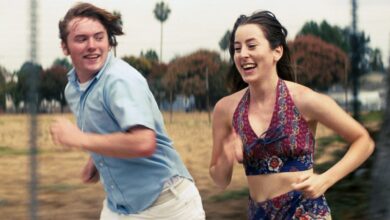
My Tennis Maestro Review (Il maestro): There is a summer that marks the end of childhood and the beginning of a more complex journey. In My Tennis Maestro, presented out of competition in Venice, Andrea Di Stefano weaves melancholy and Italian comedy to tell that suspended moment in which the desire for freedom clashes with the weight of expectations. Against the backdrop of Italy in the late eighties, made up of peripheral sports clubs, family-run guesthouses, and sunny streets, the film builds an intimate tale about the relationship between a boy in search of himself and an adult trying to make sense of his past. The story follows thirteen-year-old Felice (Tiziano Menichelli), a fragile tennis talent, but crushed by his father’s ambition. To prepare him for the national tournaments, he is entrusted to Raul Gatti (Pierfrancesco Favino), a former tennis player who lives on regrets and half-truths, famous only for a distant round of 16 at the Foro Italico.
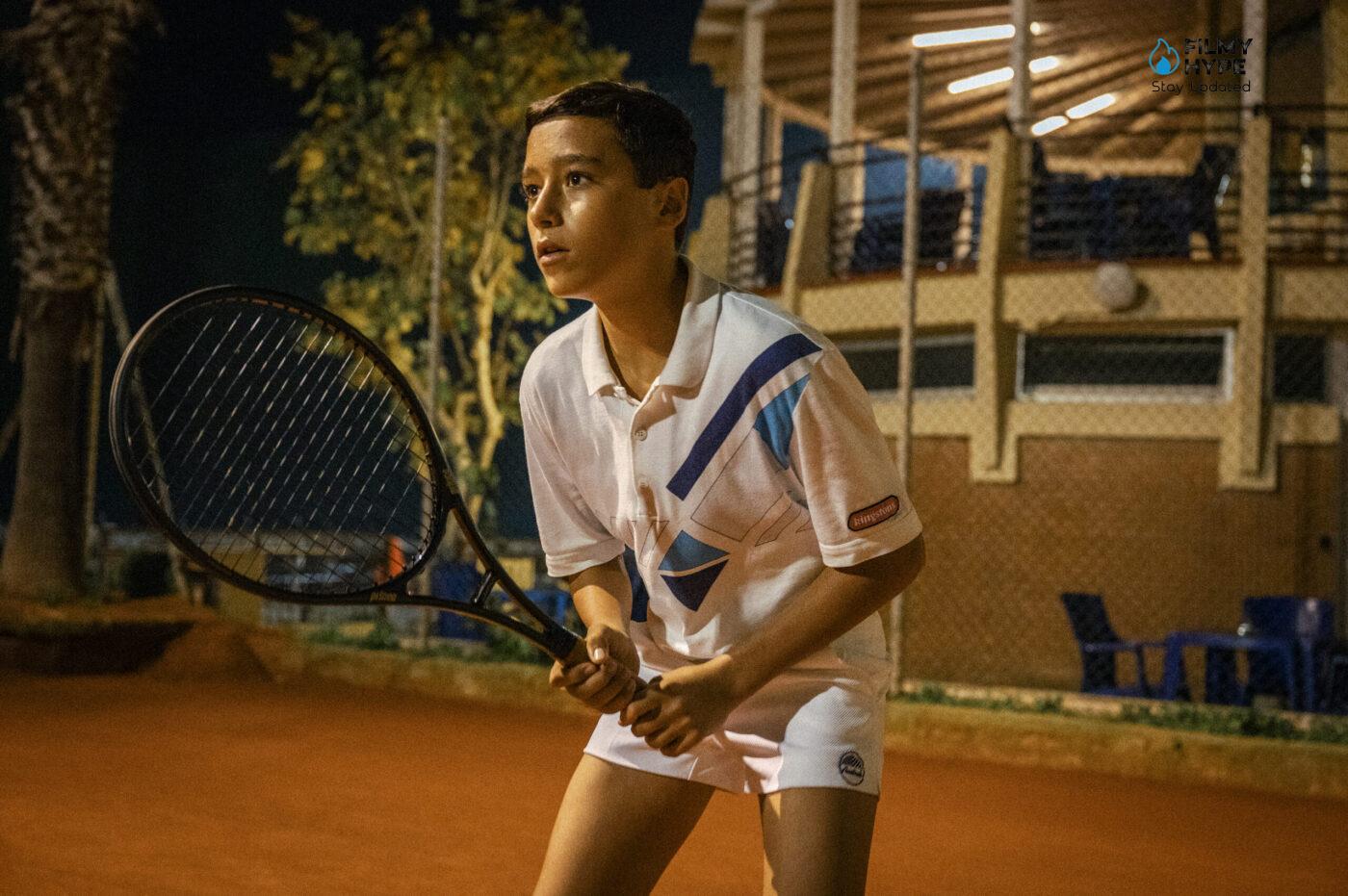
The journey along the Italian coast is not made up of triumphs, but of lost matches, anonymous rooms, and repetitive days that become fertile ground for a close confrontation. Felice understands that he cannot live only to satisfy others; Raul learns that even an unfinished career can generate something new if shared with those who still have the strength to believe. A work that catapults the public into the Eighties, in an era when tennis in Italy oscillated between myth and frustration: on the one hand, the failed glory of Panatta and Barazzutti, on the other, the popular fever for a sport that promised discipline and success. The story of a teenager full of expectations and a man incapable of managing his own legacy is inserted into this scenario. The photography of Matteo Cocco captures the warm and melancholy light of the Italian coasts, the editing of Giogiò Franchini builds a rhythm that alternates falls and rebirths, while the music of Bartosz Szpak emphasizes the irony and pain of a shared path. Also in the cast are Giovanni Ludeno, Dora Romano, Valentina Bellè, Astrid Meloni, ed Edwige Fenech. A production of Indigo Film and Indiana Production, supported by Vision Distribution and Sky, which intertwines a sports story and emotional training.
My Tennis Maestro Review (Venice 82): The Story Plot
We are at the end of the 80s and we follow the very young tennis player Felice, passionate about this sport whose aspirations, however, seem more dictated by the meticulous and schematic preparation imposed by his father than by personal inclination: between iron routines, patterns and beliefs taken from books, the father realizes that as a telecommunications engineer he cannot make his son leap further. He thus hires Raul Gatti, a former tennis champion who reached the round of 16 at the Rome Internationals, and entrusts him with the task of traveling with his son and preparing him for the national tournaments that summer. Raul Gatti, however, is a problematic person whose talent has never really materialized for his parents’ character limitations and immediately comes into conflict with the rigorous methods with which the boy is trained, leading to a sequence of defeats. It is only the beginning of a journey in which My Tennis Maestro will find the opportunity for a new beginning, while the young Felice will have to learn to savor the taste of freedom.
Felice is thirteen years old and has too much weight on his shoulders: that of his father’s ambitions. After years of training and sacrifices, the decisive moment arrives: the national tournaments. The father, unable to listen to him as a son but seeing him solely as a project to be perfected, entrusts him to Raul Gatti (Pierfrancesco Favino), a former tennis player who flaunts a glorious past but lives among lies and failures. From here, a journey along the Adriatic coast was born: from tournament to tournament, one defeat after another, between formative matches, moments of freedom that illuminate an unexpected but necessary summer. An unexpected bond grows between Raul and Felice, made up of clashes and confidences, to the point of redefining the very meaning of “master”.
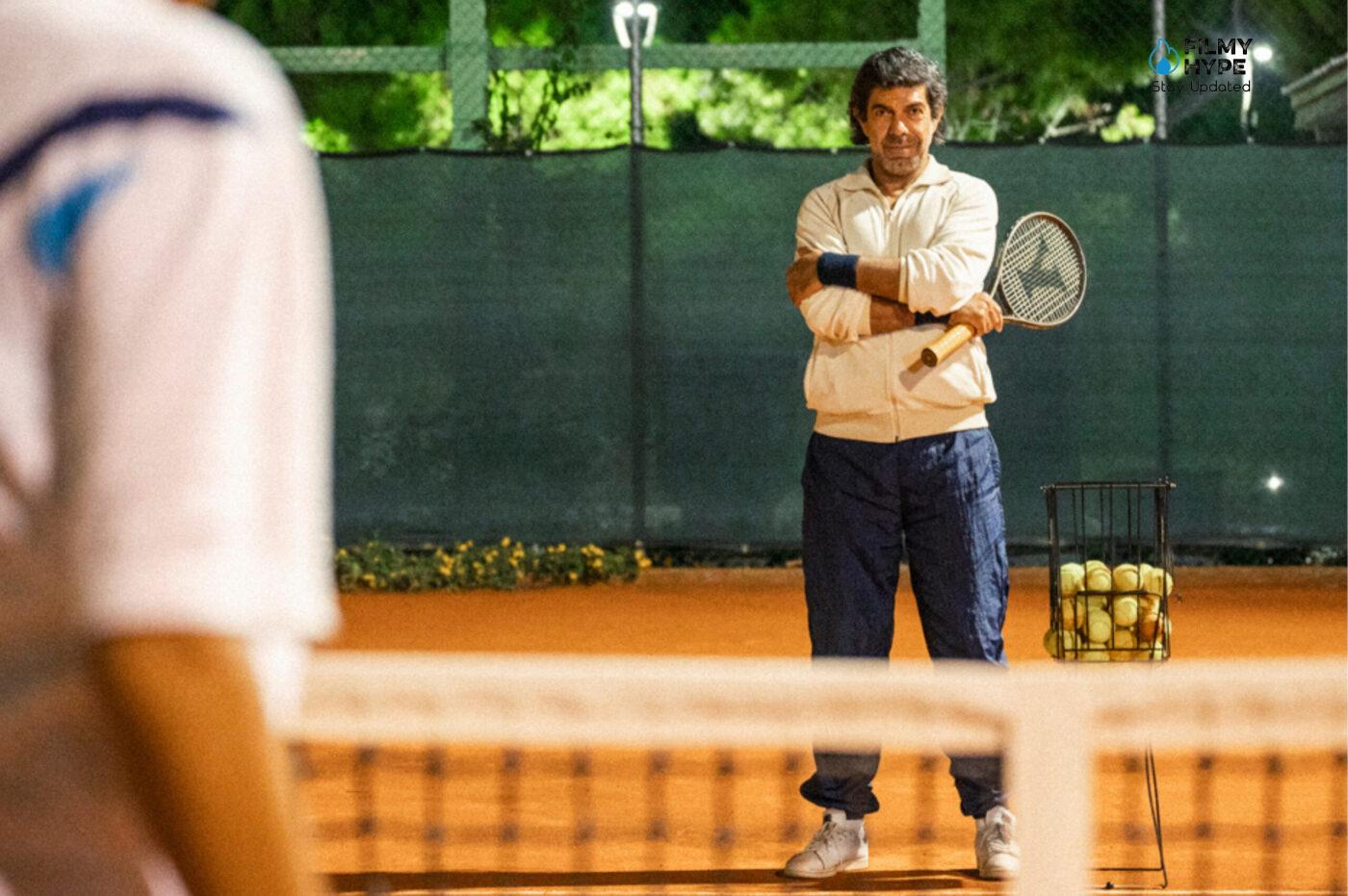
Below the sports surface, My Tennis Maestro investigates the fragility of family bonds and the search for emotional balance. The film is about fathers who don’t know how to be, and children forced to bear the burden of entire genealogies. Tennis becomes a metaphor for life: every exchange of the ball is a mood swing, and the transition from regional to national corresponds to the step towards adulthood. Raul faces the ghosts that slowly resurface, while Felice experiences choosing for the first time. One is irresponsible and unruly, the other a victim of paternal rigor: opposing people who meet, recognize, and teach each other a different way of being in the world. Who really is My Tennis Maestro? Probably both, because both slowly understand how to fill a void.
My Tennis Maestro Review and Analysis
The film captures the melancholy magic of summers that mark the transition from adolescence to adulthood. There is no nostalgic rhetoric, but the realization that some moments, even if seemingly ordinary, become watersheds. The dusty fields, the car journeys, the days marked by training and waiting return a suspended atmosphere, in which every experience seems destined to leave a lasting mark. It is an unforgettable summer, which is imprinted in the memory of the protagonists and also in that of the spectator. The heart of the tale is the bond between Raul and Felice: a boy who needs guidance and a man who never really lived up to his ambitions. And it is precisely this imperfection that makes him credible as a mentor. Favino interprets Raul as a man full of defects, capable of lying and getting lost, but also of giving moments of unexpected generosity. The film thus becomes a tribute to My Tennis Maestros who teach more with their falls than with trophies. Raul’s lesson is not to win at any cost, but to stay in the exchange, not to stop playing even when the result is already scored.
Tiziano Menichelli turns out to be surprising: intense, natural, perfectly immersed in the role of a fragile but determined teenager. His acting restores the uncertainty and silent rebellion typical of that age. Favino, for his part, offers one of the most measured interpretations of recent years: abandon the tendency to dominate the scene and let the character emerge with its contradictions, giving the audience genuine laughter and moments of sincere emotion. Together, they create a vibrant and authentic dynamic, which gives body and soul to the film. Here, tennis. Sport, which in Italy until five years ago occupied the second, if not third page, is now in revival on the wave of collective enthusiasm towards the new hero Jannik Sinner, the South Tyrolean herald around whom the beautiful country gathers as a cohort. No one here would have dreamed of making a film like this before. Which obviously doesn’t look at but also follows the post-Challengers, the film by another Italian like Luca Guadagnino (who first had to migrate overseas to find the success he found), with which tennis was anointed and blessed as the most cinematic, sexiest sport, the most receptacle of tensions and impulses.
With My Tennis Maestro, we are on a completely different side, of course, but his existence originates from this rediscovered fascination. This now unites everyone a little, as it unites the paths of the unlikely pairing of Raul and Felice. The first (Favino) is a master and former promise of tennis never fulfilled, an emblem of Italic inspiration with a hairy chest, all arms, and a little head. One who chooses between the egg today and the hen tomorrow, “the hen today”, unbearable in the way he cuts through the air with jokes and charm, and yet irresistible behind those teardrop glasses and cuffs that he never takes off. The second (Tiziano Menichelli) is a thirteen-year-old prodigal son who trains and does small tournaments from morning to night, who, one summer, instead of going on holiday, is entrusted to the teachings of Raul to make the big leap. With him, Felice takes a peek at life outside the grids of the checked notebooks imposed on him by his father (Giovanni Ludeno), full of notes on how to shoot forehand and answer backhand, in the hope that his son there will become the sample synthesized in a test tube that “fixes the whole family”.
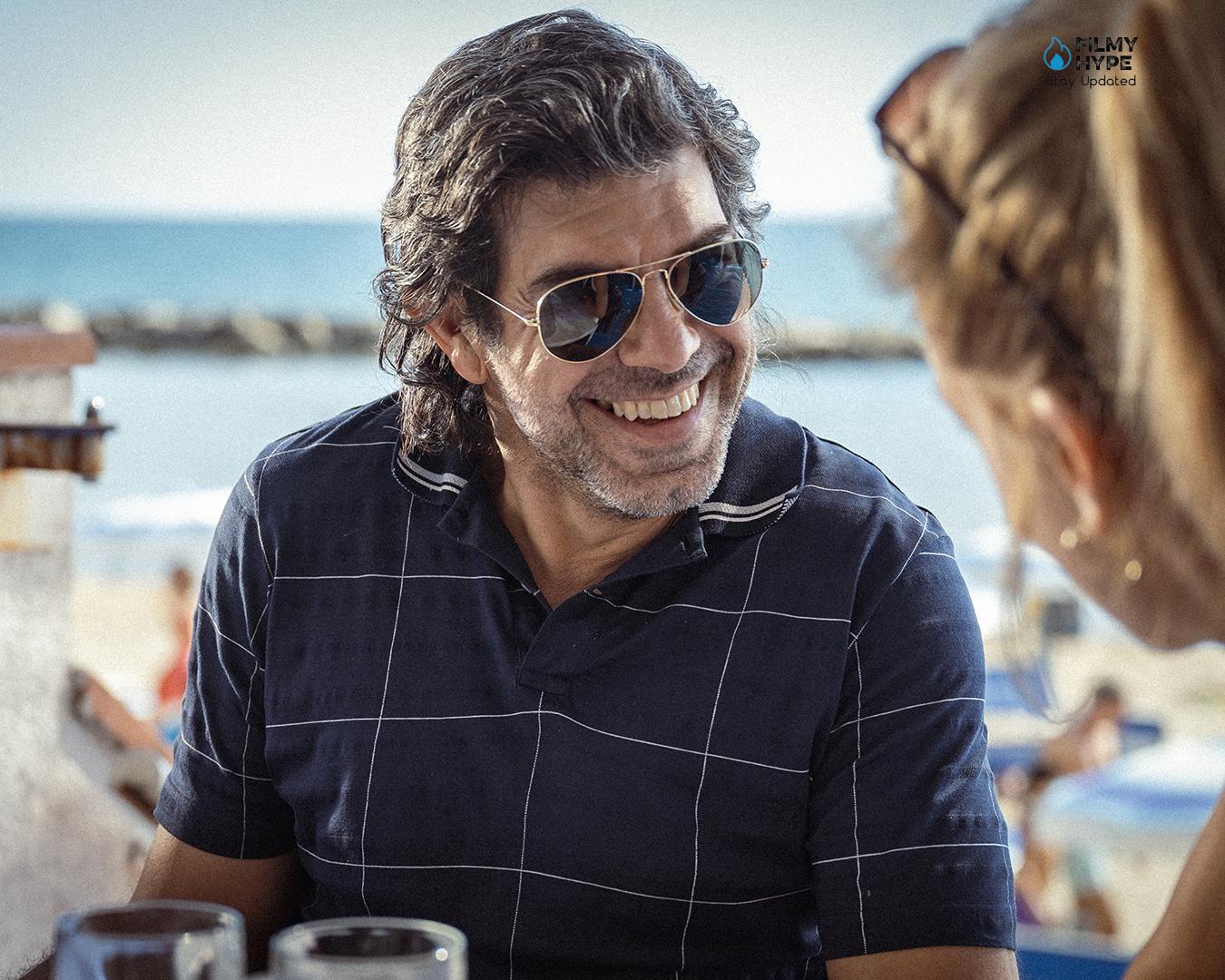
The two set off together for a grand tour of national tournaments, and on the road, and sports films in My Tennis Maestro is Italy, which had started dreaming of success with Berlusconi’s TVs and often fell for it, trying. There are sacrifices, aspirations, questions of money, things to account for, melancholy wide open over the sea, but with a smile wet with salt. Because, like all sports films, in My Tennis Maestro, sport is never really the heart of the discussion. While Felice does push-ups, trains, and sweats, Raul negligently enjoys the small pleasures that distance him from certain dark thoughts, so he takes medicine that he really doesn’t want to take. The screenplay by Di Stefano and Ludovica Rampoldi, in a pleasant balance between serious and facetious, based on the teachings of Italian comedy, draws a bizarre complicity from the two (on the road) before a difficult mentor-student relationship (the sports film).
At a certain point, the sport almost disappears. To be precise, in the second part of the film, which comes after a drastic turning point, perhaps too lopsided for the somewhat mechanical change of pace that it gives to the story. Of course, Raul is more of a protagonist than Felice. It is his struggle and it is his defeats that the film rereads through Felice’s struggles and defeats on the pitch, who begins to understand that it is also important to realize in time that perhaps he is not the phenomenon that came to earth that dad thought I would be. The underdogs, the underdogs, remain so. And commenting on them in the first half is a melancholic tone that stirs beneath the surface, between a drama that filters through the cracks scattered here and there and a modest humor, an antechamber of sighs. Except then for this elbowing tone until it rises above and makes everything clearer, more identified, in short, more canonical. A defect, probably in volume: The teacher lasts over two hours and doesn’t handle them all too well. But it is a kind film with kind characters (including the small role cut out for Edwige Fenech), because they are full of common defects and bruised moods to deal with between tears and smiles.
Nowadays, when the name of Pierfrancesco Favino appears in a film, a guarantee of quality is thought of. In fact, the actor also confirms his talent in the role of a tennis master with a passion for women. His performance on the screen is fun in the lightest moments and intense in the dramatic ones, where all the fragilities of his character are shown nakedly. The man, like a chaotic puzzle, must match all his boxes with those of little Felice, played by Tiziano Menichelli, who is also very credible on screen. The two will have to know each other, learn to love each other, and above all, detach themselves from their previous beliefs. Raul must learn to live and, above all, to appreciate life, even coming to terms with his past; while Felice will have to learn about life from another perspective, linked by strange patterns, routines, trying to understand that when we really live, there are no rules that can establish our path.
The film wants to celebrate imperfection, not victories nor great successes as we have been accustomed to for some time now, in which success seems to be the only goal to pursue, whether in fiction or in reality. My Tennis Maestro wants to show the other wonderful side of our life: failure, the one that makes us cry and despair, but that helps us to feel truly alive, to pursue our goals by proving stubborn and capable. The making of the film, however, is not intended to be too dramatic nor to describe the events too seriously. Nay, My Tennis Maestro, is dotted with iconic moments, which make you laugh and smile in pure taste. In this film, you smile. Raul smiles despite everything; he smiles above all thanks to Felice, who rarely smiles, because he is too busy winning and realizing his father’s dream so as not to disappoint. There is no shortage of jokes, not even funny elements, as well as more intense ones. Unfortunately, however, some passages work less within the film, without necessarily compromising the entire narrative arc.
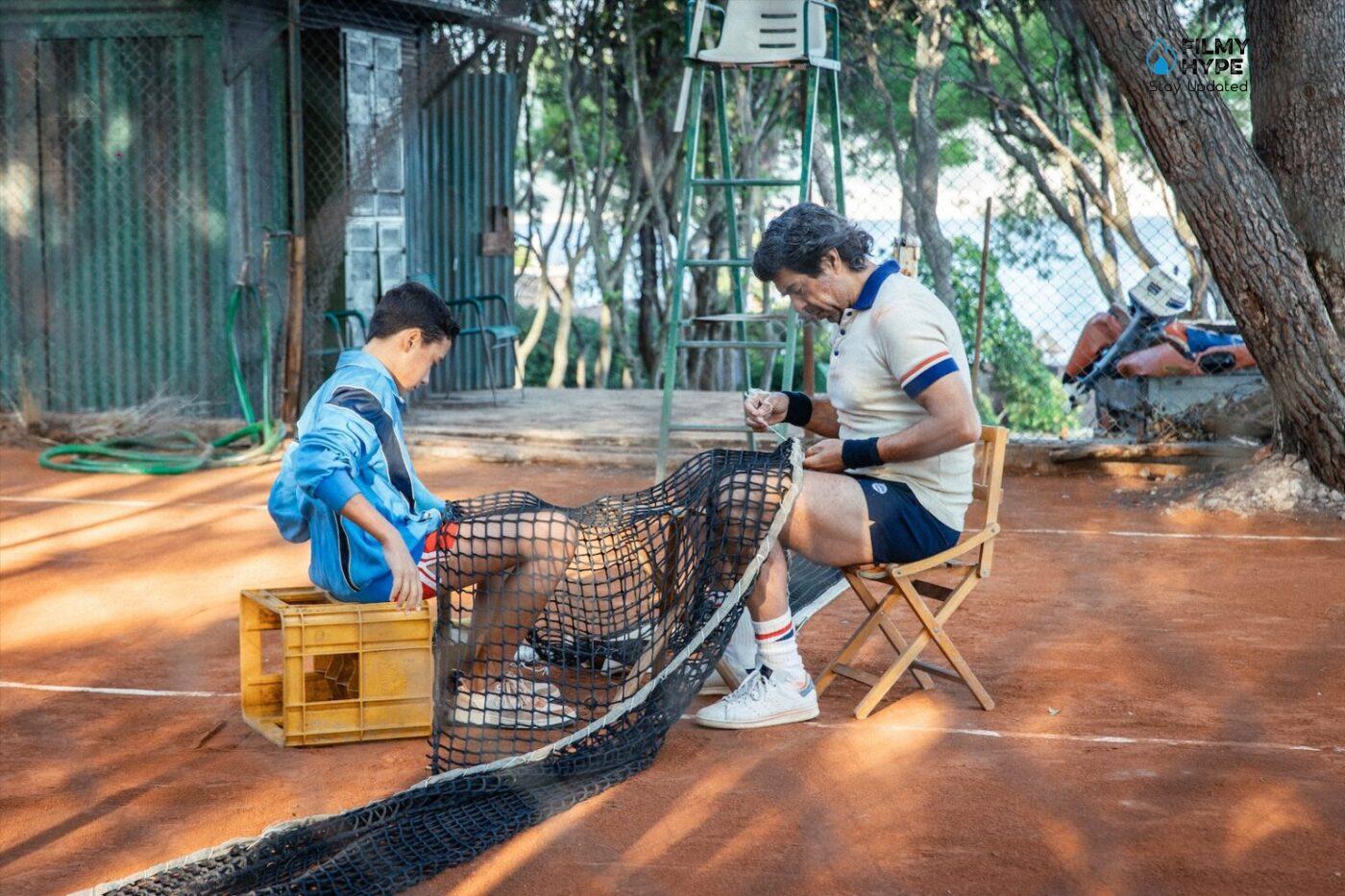
A mix that works and finds its meaning in the relationship between the two protagonists, a story of two losers that the two actors skillfully bring to the screen. While the young Menichelli is a surprise, Pierfrancesco Favino proves himself to be a solid confirmation in a performance that alternates lightheartedness with intensity and conveys all the suffering of Raul Gatti. His performance is successful not only because he is the soul of Gatti, but also because he manages to support and sustain the credibility of his co-star Felice, who is reflected and benefits from his skills. Like two players in a tennis match, where every shot stimulates the opponent, rather than defeating him. Andrea Di Stefano follows them and supports the film’s characters, constructing a narrative and visual context that never loses pace and exploits various staging devices to give the narrative the right momentum, crafting a story that underscores the value of defeat and the lessons it can teach us, becoming a fundamental new starting point.
My Tennis Maestro is a film that excites without artifice, capable of alternating lightness and pain with great naturalness. Favino offers one of his most vulnerable performances, restoring to Raul the desperation and vitality of a half-man, while Tiziano Menichelli convinces with spontaneous and incisive acting. Some secondary characters are cartoonish, caricatures perhaps intended to amplify the contrast between the two protagonists. The balance evoked by tennis –between attack and defense, between control and abandonment – becomes an image of life itself, of the constant need to balance desires and limits. It is bittersweet work, which makes you laugh and cry, which allows you to empathize with two destinies that are apparently distant but united by the same search for freedom. A coming-of-age movie, but also a failure movie, on the possibility of being reborn and finding, at least for a summer, a master on the other side of the net.
My Tennis Maestro Review (Venice 82): The Last Words
My Tennis Maestro is a film that talks about tennis but actually tells much more: growth, falls, and the possibility of getting back up. Andrea Di Stefano builds a story balanced between comedy and melancholy, with a delicate gaze that leaves room for silences and small gestures. Pierfrancesco Favino plays Raul with measure, giving an interpretation that entertains and moves, while the young Tiziano Menichelli surprises with intensity and naturalness. The strength of the film lies precisely in the relationship between the two protagonists, which becomes the beating heart of the story. Even with some narrative predictability, the film manages to restore the freshness of an unrepeatable summer and the value of an encounter that leaves its mark.
Cast: Pierfrancesco Favino, Tiziano Menichelli, Giovanni Ludeno, Dora Romano
Directed By: Andrea Di Stefano
Streaming Platform: At the Venice Film Festival 2025
Filmyhype.com Ratings: 3/5 (three stars)