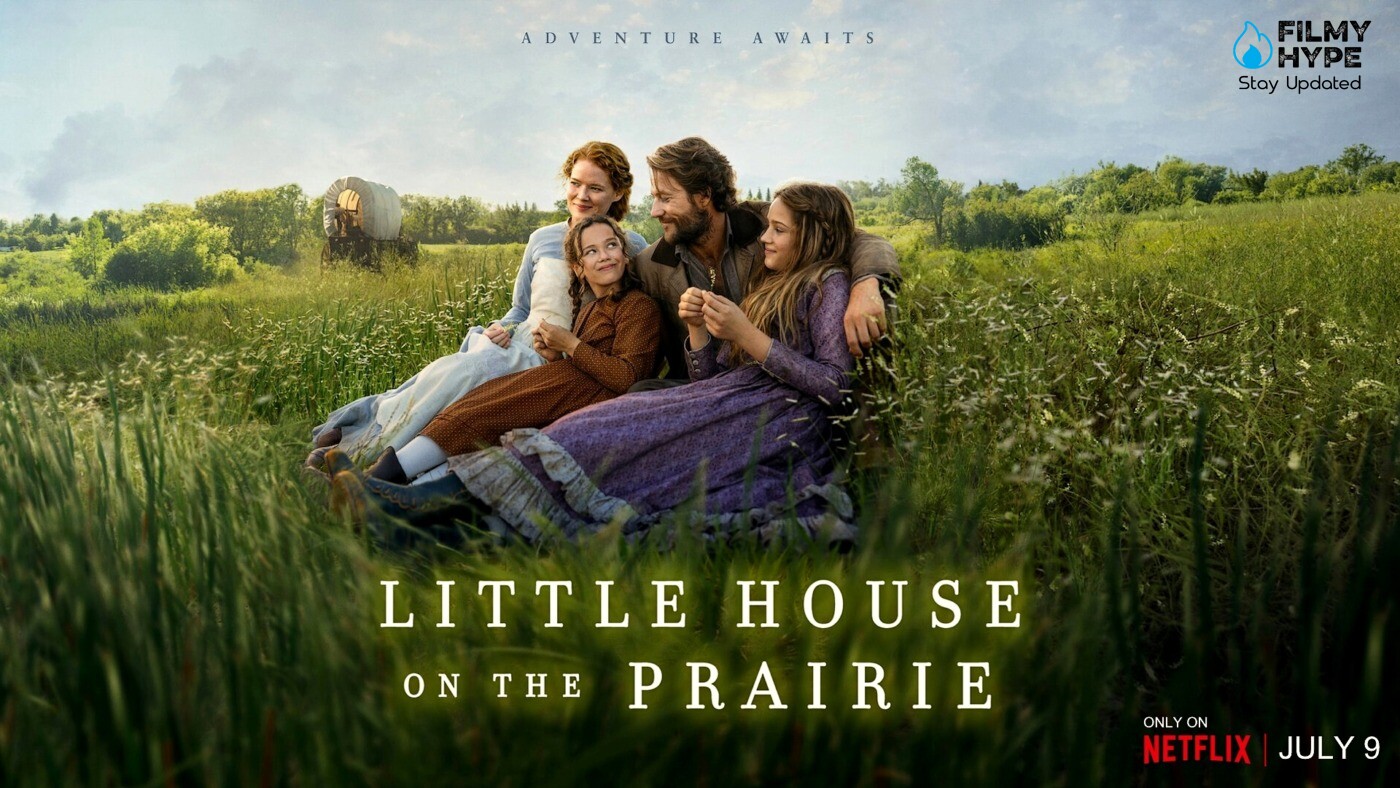
Tag: Crosby Fitzgerald

  • Little House on the Prairie Review: Netflix Brings A Classic Back To Life With Intelligence And Heart?

    Little House on the Prairie Review: Netflix Brings A Classic Back To Life With Intelligence And Heart?

    Cast: Luke Bracey, Crosby Fitzgerald, Alice Halsey, Skywalker Hughes, Warren Christie, Jocko Sims, Meegwun Fairbrother, Alyssa Wapanatâhk, Wren Zahewenim Gotts. Rebecca Amzallag, Kowen Cadorath, Xander Cole, Thosh Collins, Barrett Doss, Michael Hough, Ryan Robbins, Maclean Fish, Mary Holland

    Created By: Rebecca Sonnenshine

    Streaming Platform: Netflix

    Filmyhype.com Ratings: 3.5/5 (three and a half stars)

    Some stories span generations without losing their value. Little House on the Prairie belongs to this category. Following the success of the landmark series starring Michael Landon, Netflix is revisiting Laura Ingalls Wilder’s semi-autobiographical novels with an adaptation that could have been limited to a nostalgic life. Instead, he chooses a more difficult path: respecting the spirit of the original work, updating its perspective without distorting its identity. The result is a series that never tries to be cynical or provocative. It tells the story of the American frontier through the eyes of a little girl, but without ignoring its contradictions, alternating moments of family lightness with more mature reflections on the price of progress, poverty, and the meaning of building community. Not everything works out the same way, especially in the middle of the season, but the sincerity with which he tackles his characters makes this return surprisingly successful.

    Little House on the Prairie Review
    Little House on the Prairie Review (Image Credit: Netflix)

    The Ingalls family saga and their adventure along the Wild West route have captivated entire generations of viewers. Did this TV classic, based on the novels by Laura Ingalls Wilder (1867 – 1957), really need a reboot? Despite a story that is at times boring and prissy, this novel undoubtedly deserves credit for having given space to the voice of Native Americans, enriching the story with raw reality and less poetic invention. More than a pure Western, NBC’s work (broadcast in Italy first on Rai and then on Fininvest channels) was a family epic that centered on feelings and drama, capturing the vast audience that made it an eternal cult. What, then, are we to expect from this new reimagining? Will it stay true to the spirit and atmosphere of the original, or will it change skin to appeal to different viewers?

    Little House on the Prairie Review: The Story Plot

    The story follows the Ingalls family as they move from Wisconsin to Kansas, where Charles and Caroline hope to build a new life with their daughters, Laura and Mary. It is a journey of sacrifice, economic hardship, and constant danger, but also of hope and the desire to start over. The structure remains that of the family tale, with episodes intertwining small everyday events and larger problems, but Rebecca Sonnenshine also introduces a broader reading of the conquest of the West. The series addresses the relationship between settlers and the Osage population, the racism still present in post-Civil War America, and the illusions fueled by the promise of new lands to conquer. It does so without turning into a dark or didactic historical drama. These elements coexist with the warm and adventurous tone that has always characterized Little House on the Prairie, but add nuances that make the story richer than the 1970s series.

    Little House on the Prairie Review and Analysis

    The real strength is Laura once again. Alice Halsey gives a surprisingly natural performance, managing to restore all the energy, curiosity, and impulsiveness of the protagonist without ever making her artificial. Laura is stubborn, courageous, often causes trouble, and looks at the world with an enthusiasm that makes every discovery an adventure. Alongside her, the relationship with her sister Mary also works very well, different in every way: more thoughtful, disciplined, and aware of family responsibilities. Their bond is one of the most successful elements of the season and restores all the complexity of the relationship between two sisters forced to grow up too quickly.

    Luke Bracey also convinces as Charles Ingalls. He doesn’t try to imitate Michael Landon and builds a more vulnerable character, often forced to deal with bad decisions and guilt. Crosby Fitzgerald instead offers a more modern Caroline, without losing the quiet strength that has always defined the character. The biggest risk was turning Little House on the Prairie into a nostalgic operation or, conversely, completely revolutionizing it. Netflix avoids both paths. The series retains the atmosphere of sunsets, wooden houses, crops, village festivals, and small domestic moments that made the franchise famous, but broadens the perspective on themes that often remained in the background in the novels and the original series. The presence of the Osage community does not simply serve to update the story, but also allows us to show the consequences of American expansion from the perspective of those who were losing that land. The same goes for the character of Dr. George Tann, who adds a further layer of reflection on the society of the time.

    Little House on the Prairie
    Little House on the Prairie (Image Credit: Netflix)

    Those looking for a radical rereading may still find it too prudent. Those who fear that the source material will be distorted will likely find that the series remains faithful to the fundamental values of the books: family, solidarity, and the ability to face difficulties together. The central part loses some of the pace, and some episodes follow very classic narrative patterns, with conflicts that resolve predictably. Some secondary subplots would also have deserved more depth. These are limits that, however, weigh less thanks to a convincing cast, splendid photography, and direction that continuously enhances the great landscapes of the frontier. The series also strikes a good balance between emotion and simplicity, almost always avoiding slipping into rhetoric. More than reinventing Little House on the Prairie, Netflix chooses to remember why this story continues to thrill nearly a century after the novels were published. And he does so with respect, sensitivity, and an increasingly rare sincerity in contemporary television.

    Little House on the Prairie not only tells us reality, but indulges in dream sequences in which the characters come to terms with their ghosts, shortcomings, and remorse. Everything remains suspended in that limbo where we meet those who are lost, where our mistakes and our suffering dwell. They don’t make peace with what happened in the real world, but they recognize its presence, becoming aware of the burden they carry within them. One thing that is never easy to indulge in when during the day your only priority is to stay alive. Because that’s what happens in Little House on the Prairie: you fight to stay whole amid fires and devastating fevers.

    The story is there. The underlying idea is inspiring. And it also convinces the will to start from the origin of everything. But this unfortunately doesn’t erase some obvious weaknesses that made this first season the closest thing to a Western-style This is Us. This is a TV series that can afford the luxury of focusing only on feelings, because it lives and breathes thanks to the inner journey within its characters. The problem arises when this same formula is lowered into the Western genre. Little House on the Prairie has in its hands a very different matter, made up of historical faults, survival, and moral questions left hanging. And this is precisely where the remake gets it wrong: for fear of taking risks, it takes refuge in melodrama, holding back stories that actually need to breathe.

    Little House on the Prairie Series
    Little House on the Prairie Series (Image Credit: Netflix)

    Guilt is, in fact, one of the main themes of the remake, but it is explored with the constant anxiety of saying the wrong thing. And so, the less risk you have, the less damage you risk doing. But with such premises, it’s a shame to see Little House on the Prairie limited at too many times to being just a TV series in which you win together and lose alone, especially when you feel the need to adapt it to a contemporary television that uses family and personal dynamics as a lockpick to talk about other things. And it is precisely in this sense that Little House on the Prairie appears dull, suspended in limbo almost as much as its own protagonists. It belongs to both today and tomorrow, but never scratches in a definite way in either way. She is blurry, confused, intimidated by her own potential. And so he decides –without reason– to take the easy way out.

    Unlike the historical adaptation, which almost immediately moved the action to Minnesota, this first season makes a precise philological choice, focusing entirely on the events of the original novel set in Kansas, within the indigenous Osage reservation. The premise follows tradition: Charles “Pa” Ingalls moves from Wisconsin to Independence, Kansas, in search of land to farm. However, Sonnenshine’s script immediately introduces the geopolitical and ethical elements. In the second episode, a key dialogue between Charles and neighbor John Edwards highlights the thematic core of the series: land claimed by settlers is not legally available, government treaties are on the high seas, and the shadow of the railroad threatens private investment. Where the original text extolled ownership and self-sufficiency, the reboot introduces the concept of precariousness and the urgency of community cooperation. A parallelism, this, that resonates strongly with contemporary socio-economic anxieties related to housing accessibility.

    The most critical, yet most ambitious, point lies in the representation of the Osage community. The series introduces the Mitchell family, led by translator William (Meegwun Fairbrother), as they try to mediate the inevitable wave of migration. The series shows the native characters in their cultural and political autonomy, explicitly raising the question of the complicity of the Ingalls in the expropriation of indigenous lands.

    Little House on the Prairie Netflix
    Little House on the Prairie Netflix (Image Credit: Netflix)

    However, the ethical cleansing operation shows the side of a certain idealization. Historically, the real Caroline Ingalls harbored the deep-seated racial prejudices typical of the time (elements that prompted the American Library Association to remove Wilder’s name from its Lifetime Achievement Award in 2018). The reboot chooses the path of forced conciliation, showing Caroline and White Sun (Alyssa Wapanatâhk) capable of overcoming barriers in the name of motherhood. While this choice modernizes the narrative, it also risks slipping into a historically dubious moral equivalence.

    Technically, the series is positioned at the high end of streaming productions. Ari Wegner’s cinematography (The Power of the Dog) and direction by an all-female team (including Sarah Adina Smith and Sydney Freeland) enhance Kansas’s open spaces with a striking, effect-avoiding naturalistic aesthetic “TV set”. The main limitation lies in the management of rhythm and tone. Despite the ideological update, the series fails to fully emancipate itself from the franchise’s signature didactic rhetoric. Some story arcs resolve with excessive linearity within the three episodes, and the tendency to insert moralizing monologues or folk musical interludes risks flattening the dramatic conflict. The antagonistic core, represented by speculators Eli and Jemma James (Michael Hough and Mary Holland), sometimes slips into the caricature of the bigoted bourgeoisie, depriving the story of a real dialectical counterpart.

    Intercepting audience desires and changes is never easy, and beyond the nostalgia effect, renewing such a long-running series has involved difficult choices. Compared to the 1970s work, this new version of Little House on the Prairie pushes the pedal of the Western genre significantly further, both in aesthetics and storytelling. The epic of the Ingalls, suspended between boundless prairies and a hostile land, is narrated with greater historical accuracy, albeit with some obvious poetic license. The tones become darker and more painful, even if the inevitable dose of good feelings that permeated the original work remains intact (resulting, at times, a little forced). Central themes such as colonialism, occupation, and racism are addressed in a toned-down manner so as not to upset the target audience too much, but they remain central throughout all eight episodes, offering a good basis for reflection to the more attentive viewer.

    Alternating behind the camera are five female directors who have perfectly captured the majesty and danger of the American prairie. The direction enhances a cast that remains at an excellent level for much of the series, especially for the main characters. The latter are supported by careful writing, capable of bringing out fears, desires, and the internal contrasts that drive the various secondary storylines. We can therefore say that Little House on the Prairie is a rather successful reboot; sure, it’s quite a departure from the ’75 series, but at the same time, it somehow retains its spirit for talking about community and inclusion, in a balance that’s perhaps sometimes problematic but perfect for a light, fluid, and enjoyable viewing experience.

    Little House on the Prairie Review: The Last Words

    Netflix brings Little House on the Prairie back to the screen with a new series inspired by the novels of Laura Ingalls Wilder. More than just a remake, it is an adaptation that keeps the spirit of the original work intact, enriching it with greater attention to the historical and social context. With a compelling cast and an emotionally charged family tale, the series manages to win over both longtime fans and those new to the Ingalls family. Combines a cinematic aesthetic and a strong inclusive sensibility with a narrative structure that remains fundamentally conservative in its need for resolution and stability. While simplifying the harshness and contradictions of real frontier life, the series achieves its commercial and cultural goal, offering an accessible, formally curated narrative that has already been renewed for a second season. A half-successful political redesign, but undoubtedly effective in terms of serial entertainment.

    STAR RATING FILMYHYPE 3.5