
Stranger Things Season 5: The Complete Guide With Everything You Need To Know Before The Premiere
Stranger Things Season 5: For nearly a decade, Stranger Things masterfully operated on a double premise: the idyllic, visible surface of a small town and the terrifying, invisible reality lurking just beneath. The visible was Hawkins, Indiana town of bike rides, school dances, and family dinners. The invisible was the grotesque dimension known as the Upside Down, a threat born from a government experiment that went horribly wrong. As we approach the final chapter—an epic, three-part finale releasing on November 27, December 25, and January 1, 2026—the stakes have never been higher. Hawkins is now an open wound, a bleeding scar between two worlds. Before the premiere of Season 5 of Stranger Things, it’s time to revisit the labyrinthine mythology, the crucial revelations, and the lingering questions that will define the end of this era.
Officially, the penultimate countdown to the end of one of the most acclaimed series of the last decade began. Nine years after its premiere, Stranger Things is preparing for its fifth and final season. Although it is clear that nothing lasts forever and sooner or later everything ends, in this case, they decided to extend the farewell as much as possible. Netflix adopted a dynamic already known for this final installment and, instead of releasing all the episodes in one day, it will do so in three parts. Because if fans waited three and a half years to return to Hawkins, one more month doesn’t make a difference, right? As can be seen in the trailers, many things are expected to happen, since the eight chapters will have durations of between one and three hours. The first four, corresponding to “Volume 1′′, arrive on the platform on Wednesday, November 26. Below, we tell you everything you need to know before starting to say goodbye to Upside Down.
Stranger Things Season 5: How It All Began: The Origin Story of Stranger Things
The story of Stranger Things began on a rainy night in 1983 with the disappearance of a boy named Will Byers (Noah Schnapp). But this was never just a simple missing persons case. From the very first season, the show hinted that Hawkins was built upon a silent, seismic fracture: the Hawkins National Laboratory.
The Upside Down: A World Frozen in Time
The Upside Down wasn’t merely a parallel dimension; it was a decaying, biological replica of our world, frozen in time on the date of its creation: November 6, 1983. It’s a twisted negative of reality, governed by a hostile, alien intelligence. This dimension first bled into our world through fleeting, terrifying leaks: a flickering lightbulb, a faceless creature in the walls, and ultimately, a gateway that should never have existed.
Eleven: The Accidental Vector
It was through this crack that Eleven (Millie Bobby Brown) emerged. Raised in the lab by the manipulative Dr. Martin Brenner (Matthew Modine), she was treated as a weapon before she was ever allowed to be a person. Her incredible psychic powers, which she never asked for, became the key to both the problem and its potential solution.
Vecna: Henry Creel, From Experiment to Architect of Chaos
Season 4 of Stranger Things didn’t just add a new monster; it fundamentally rewrote the entire mythology. The arrival of Vecna—a psychic predator who attacks his victims from within their own minds—was revealed to be the series’ long-awaited central explanation.
Vecna is not a new entity. He is Henry Creel (Jamie Campbell Bower), the first and most powerful test subject of Dr. Brenner, designated “001.” A boy who discovered his terrifying powers in childhood, murdered his family, and was captured and studied. The laboratory, long thought to be the source of the anomalies, was actually the prison where Henry’s humanity was stripped away.
The pivotal moment came in 1979. During a confrontation, a young Eleven, using powers she didn’t fully understand, didn’t kill Henry—she banished him. He was hurled into the formless, primordial dimension that would become the Upside Down. It was there that he mutated, interpreted the dimension’s logic, and molded its very substance.
The Mind Flayer: A Masterpiece of Manipulation
This revelation re-contextualized everything. The towering, shadowy Mind Flayer, presented as the ultimate villain in Seasons 2 and 3, was not the mastermind. It was a manifestation, a form of pure power that Henry Creel discovered and shaped to his will. The Demogorgons, the Demodogs, the particles of the hive mind—they were all extensions of a single, vengeful consciousness: Vecna.
This created a perfect narrative circle. Vecna explained why Hawkins was always the epicenter, why the original portal never truly closed, and why the story has always been tethered to 1983. The battle is no longer a series of disconnected threats but a linear, personal war between the first boy of the experiment and the girl who cast him into a hell he then made his own. This clash is the absolute core of Season 5 of Stranger Things.
Eleven, Will, and Their Inextricable Link to the Upside Down
The heart of Stranger Things has always been two characters uniquely marked by the Upside Down long before they understood its true nature.
Will Byers: The Living Sensor
Will was never just a passive victim. His psychic connection to the Upside Down—the visions, the chills, the ability to sense the Mind Flayer’s presence—has been a persistent symptom of a deeper truth. He perceives the dimension because a part of him still belongs to it. Season 5 of Stranger Things must finally answer the question that has haunted Will since the beginning: Why him? What is his ultimate role in a story that promises “to return to the origin”?
Eleven: The Moral Weight and The Power
Eleven carries the burden of being the only one capable of standing against the world she helped open. She has lost and regained her powers, uncovered the lies in her own memory, and faced Henry in a mental duel that proved their conflict is fought in the realm of the mind as much as the body. The final season must resolve this twisted relationship: it is not merely a battle of good versus evil, but a reckoning between two products of the same trauma—one who chose to destroy, and one who is fighting to repair.
Hawkins: The Cursed Town on the Brink
The finale of Season 4 of Stranger Things left Hawkins in a state of apocalyptic collapse. It is no longer the recognizable anchor of the series. Four massive, volcanic rifts now tear through the town, allowing the toxic atmosphere of the Upside Down to bleed into our world freely. The falling ash, the dying vegetation, and the sense of impending doom signal that the invasion is no longer a hidden threat—it is here.
Hawkins has become a quarantined, militarized no-man’s-land, a space caught between two realities. This setting dictates the tone for the final season. The narrative, which sprawled across California and Russia, is now contracting back to its original geography. All our heroes are returning to the epicenter.
Hopper (David Harbour) is back from a Soviet prison, battle-hardened and ready. Joyce (Winona Ryder) returns, knowing this is the final stand. The older teens—Steve (Joe Keery), Nancy (Natalia Dyer), and Robin (Maya Hawke)—are reunited, facing a monster that is now out in the open. And Max (Sadie Sink), in a coma with her mind trapped between worlds, is a living symbol of the stakes. Hawkins itself is now both the battlefield and the prize.
The Heart of the Story: The Original Group in Season 5 of Stranger Things
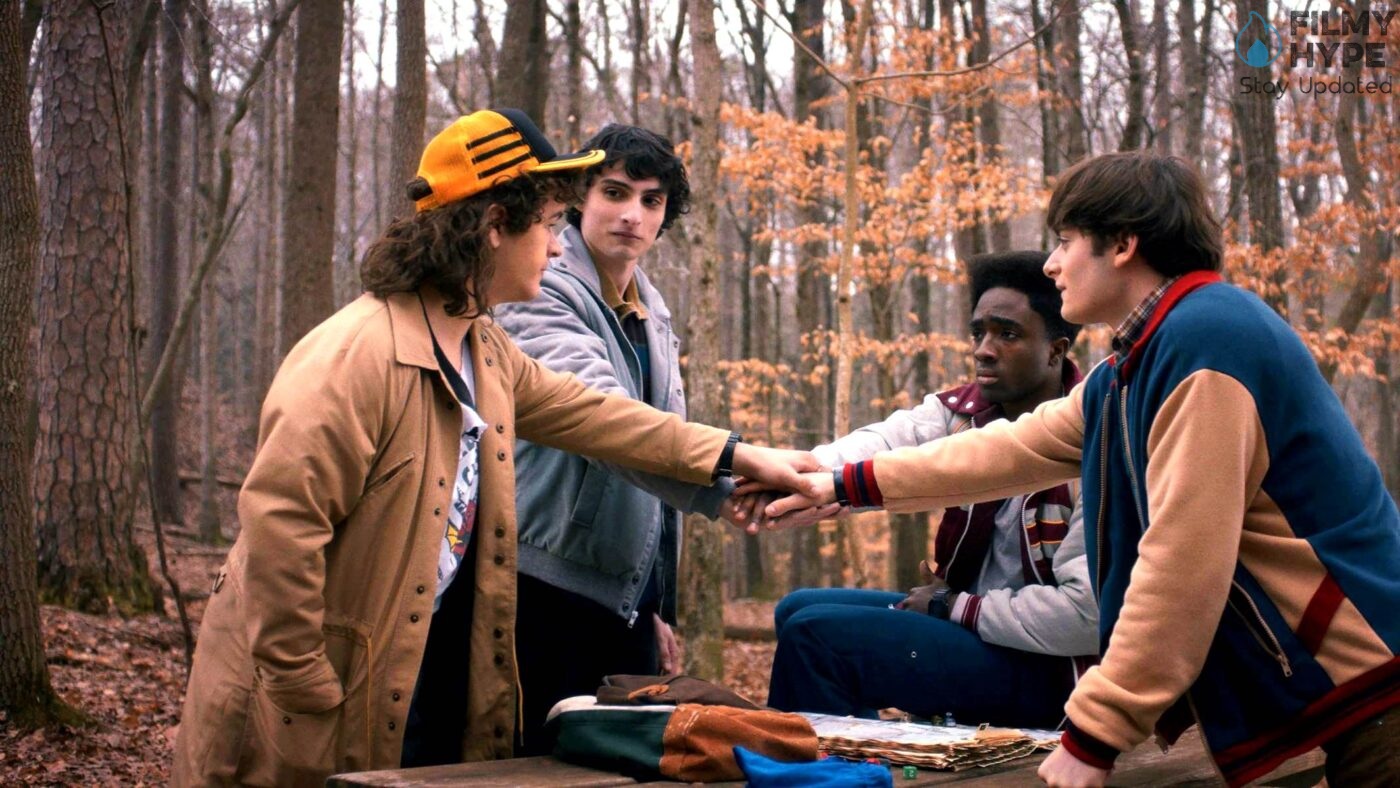
Beyond the monsters and mythology, Stranger Things is a story about the bonds forged in fire. The original Party—Mike (Finn Wolfhard), Dustin (Gaten Matarazzo), Lucas (Caleb McLaughlin), and Will—have grown from boys playing in a basement to young men fighting a war. Eleven found her first true family with them. Steve Harrington evolved into the series’ heart, a reluctant but fiercely loyal big brother. The relationship between Hopper and Joyce has been a slow burn built on shared loss and resilience.
Season 5 of Stranger Things carries the immense responsibility of giving these characters a satisfying, coherent conclusion. The Duffer Brothers have promised a “circular” ending—a return to the tone, intimacy, and core friendships of the first season. They have confirmed there will be no new creatures; the scale will grow through emotional concentration, not endless escalation.
The final battle is shaping up to be less of a traditional epic and more of a reckoning: a final collision between the root of the experiment (Vecna) and the lives he has forever altered. Stranger Things has always been at its best when balancing heart-pounding horror with genuine human emotion. If it can stick the landing with that same precision, the circle that began with a lost boy and a girl on the run can close not with a bang, but with the quiet, earned peace of a story finally, fully told. And then, perhaps, Hawkins can stop being a wound and become, at last, a memory.





2 Comments