
Stranger Things Season 5: Eleven’s Powers Explained — The Complete Breakdown
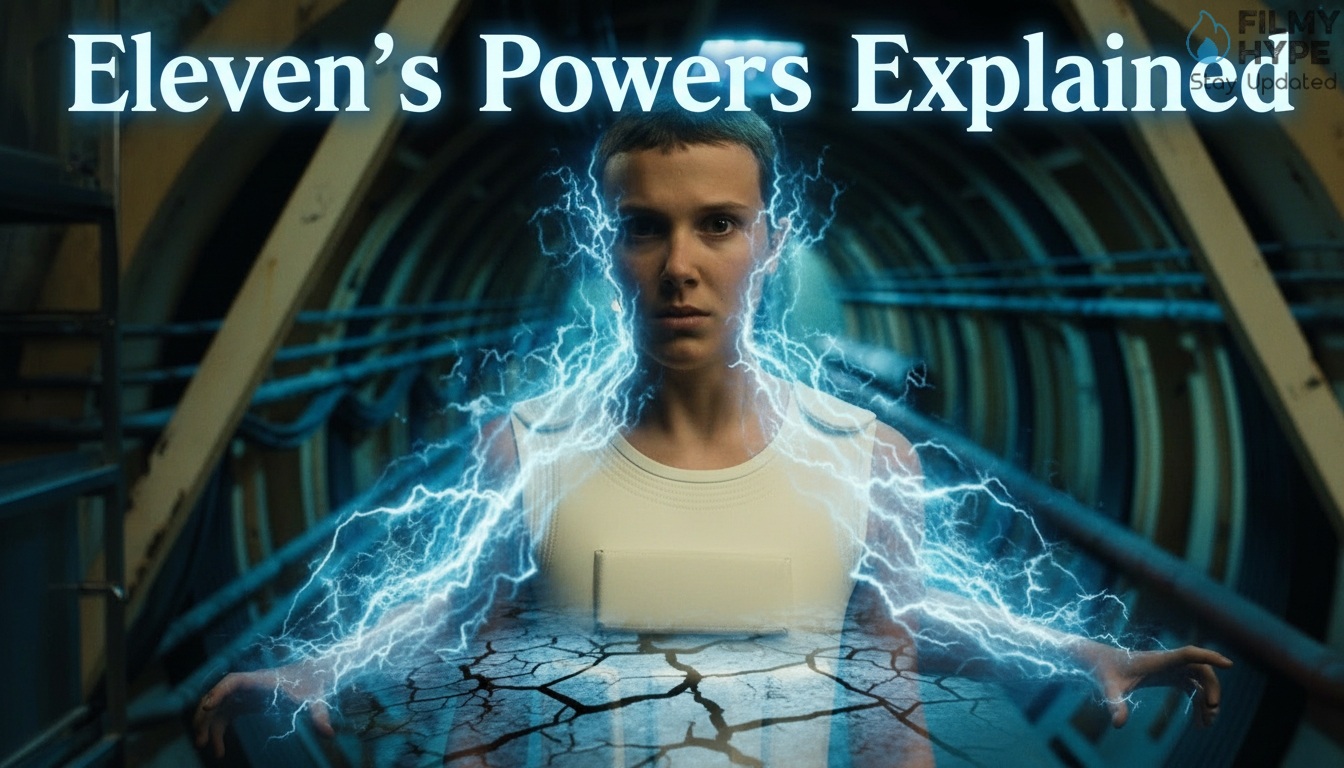
Stranger Things Season 5 reshapes everything we thought we understood about Eleven’s powers, transforming her abilities from raw bursts of telekinetic force into a complex emotional, psychic, and dimensional framework. As Hawkins faces a threat built not on brute strength but on design, intention, and memory, Eleven must confront a truth that has never been clearer: power alone is not enough. In this comprehensive breakdown, we explore how her abilities evolve, what limits she faces in Season 5, and why her connection to memory, identity, and human bonds becomes the decisive force in the final battle against Vecna.
Stranger Things Season 5: Eleven’s Powers Explained — The Complete Breakdown
Eleven’s Telekinesis: The Foundation of Her Power
Since Season 1, telekinesis has been Eleven’s signature ability—the one that defined her as both weapon and savior. She lifted vans, snapped bones, tossed Demogorgons, and closed dimensional breaches through sheer mental force.
But Season 5 reframes this foundational power with a sobering truth: while telekinesis remains strong, it is no longer sufficient.
We see that her telekinetic force, though still impressive, cannot pierce the organic wall of the new Upside Down, a structure reshaped entirely by Vecna after his near-defeat. This wall isn’t a barrier but a living membrane, one that recognizes authority. Eleven can push it, fracture it, vibrate it—but it heals instantly, defying her brute mental force.
Telekinesis, once her unstoppable weapon, becomes merely one tool in a battle where architecture—not strength—defines the rules.
The Void: Eleven’s Psychic Backbone Evolves
No power in Stranger Things is as visually iconic or narratively essential as the Void, the vast black mental space where Eleven finds people, memories, and emotional echoes.
In early seasons, accessing the Void required stimulus—sensory deprivation, water, or total silence. She could pinpoint anyone, anywhere, through sheer focus.
But in Season 5, this changes dramatically.
The Void becomes contested ground.
Vecna infiltrates it.
Deforms it.
Manipulates its structure.
The once-stable psychic sanctuary is now a shared battlefield. Eleven must navigate a space where she no longer holds exclusive control, transforming the Void into a dynamic, reactive system rather than a passive mental map.
This evolution forces Eleven to rely not only on focus but on memory, emotional clarity, and identity—shifting the Void’s purpose from detection to strategic resistance.
Memory Manipulation: The Key to Defeating Vecna
Season 5 makes one truth undeniable:
Memory is Eleven’s most advanced and most dangerous power.
We have seen glimpses before—her ability to enter others’ memories, reconstruct events, and even revive past experiences—but the final season elevates this ability into a decisive weapon.
Vecna controls dimensions.
Eleven controls identity.
Where he shapes landscapes, she shapes meaning. Where he manipulates ecosystems, she manipulates emotional architecture.
Season 5 emphasizes that Eleven must reconcile her own fractured memories—those involving Brenner, the lab, guilt, and her past—to wield this ability at full strength. Only by understanding herself beyond trauma can she counteract Vecna’s psychological design.
Her memory manipulation becomes not a passive viewing tool, but a method of rewriting narrative, allowing her to counteract the story Henry Creel tried to force upon her.
The Upside Down’s New Wall: Where Eleven’s Power Fails
One of the most striking Season 5 reveals involves the living wall inside the reshaped Upside Down. This massive organic barrier responds to Vecna’s intentions and heals instantly after impact.
Eleven’s attempts to break it highlight a crucial narrative shift:
She is no longer facing monsters—she is facing systems.
The Upside Down operates like a neural network now. Portals open and close like electrical signals. Energy flows through mental channels shaped by Vecna.
This explains why Eleven’s telekinesis is ineffective:
She is trying to damage a body whose nervous system belongs to someone else.
Her powers are not failing—
the world itself has been reprogrammed.
Amplification Through Emotional Bonds
From the moment she met Mike, Will, and the others, Eleven’s power has always grown stronger when anchored to emotional bonds. Season 5 amplifies this concept—literally and narratively.
Will once again becomes a psychic antenna for Vecna. Their connection deepens, not romantically, but structurally. Eleven senses what Will senses, and Will feels the echoes of Vecna’s design.
This creates a shared emotional ecosystem, a network through which power doesn’t accumulate—it circulates.
Amplification becomes:
Not love.
Not rage.
But synchronization.
This bond-based amplification is likely the key to overcoming the mental network that connects Vecna to the twelve missing children.
The Emotional Physics of Eleven’s Power
Eleven’s greatest limitation has never been strength—it has been guilt.
Her belief that she created Vecna, opened the first portal, and enabled countless deaths becomes a psychological choke point. Every time she fears hurting others, her powers constrict.
Season 5 reframes this guilt as a barrier she must dismantle. By shedding Brenner’s conditioning—seeing herself not as weapon or monster but as a person who chooses—she unlocks the ability to use her powers with deliberate intention rather than reactive force.
Her powers shift from explosive to precise.
From reaction to design.
This change mirrors the nature of her final enemy: Eleven must become a designer to defeat a designer.
The Future of Eleven’s Powers: Design vs. Destruction
As the final battle approaches, Eleven faces challenges that require more than force:
- She must disrupt the very architecture of the Upside Down.
- She must disconnect Vecna’s psychic network of missing children.
- She must use the Void as a strategic landscape, not just a sensory tool.
Season 5 positions Eleven not as a weapon, but as an author—a character who can rewrite meaning, identity, and memory.
Her powers now depend less on what she can destroy and more on what she can choose to preserve.
This is the heart of Season 5’s message:
The girl who once closed a portal with a scream now shapes reality with intention.
Conclusion
Stranger Things Season 5 transforms Eleven’s powers from emotional explosions into a refined system of memory, identity, and psychic design. Her telekinesis remains iconic, but it is her ability to shape meaning—her understanding of herself, her relationships, and her past—that becomes the key to defeating Vecna.
The final conflict is not about force.
It is about story.
And Eleven is finally ready to write her own.