
Steal Season 1 Review: Prime Video Thriller that Deserves Your Attention
Steal Season 1 Review and Analysis
Cast: Sophie Turner, Jacob Fortune-Lloyd, Archie Madekwe, Andrew Howard
Created By: Sam Miller, Hettie MacDonald
Streaming Platform: Prime Video
Filmyhype.com Ratings: 3.5/5 (three and a half stars)
From January 21st All 6 episodes of Prime Video are available, Steal, a thriller mini TV series. Or, to put it straight, yet another impeccable thriller miniseries coming from across the Channel. Young Zara Dunne works as an administrative clerk at Lochmill Capital, one of the pension funds’ most esteemed in London, along with best friend and colleague Luke. Its routine is that of millions of employees in contemporary metropolises and, perhaps precisely for this reason, Zara feels responsible for the new arrivals, taking an intern under their wing on the first day of work. A day that will not be like any other for any of the staff, quickly turning into a nightmare when a group of armed robbers – masked and highly professional – raids the offices, taking those present hostages and forcing Zara and Luke to carry out financial transfers for millions of pounds, taken from ordinary citizens’ pensions.
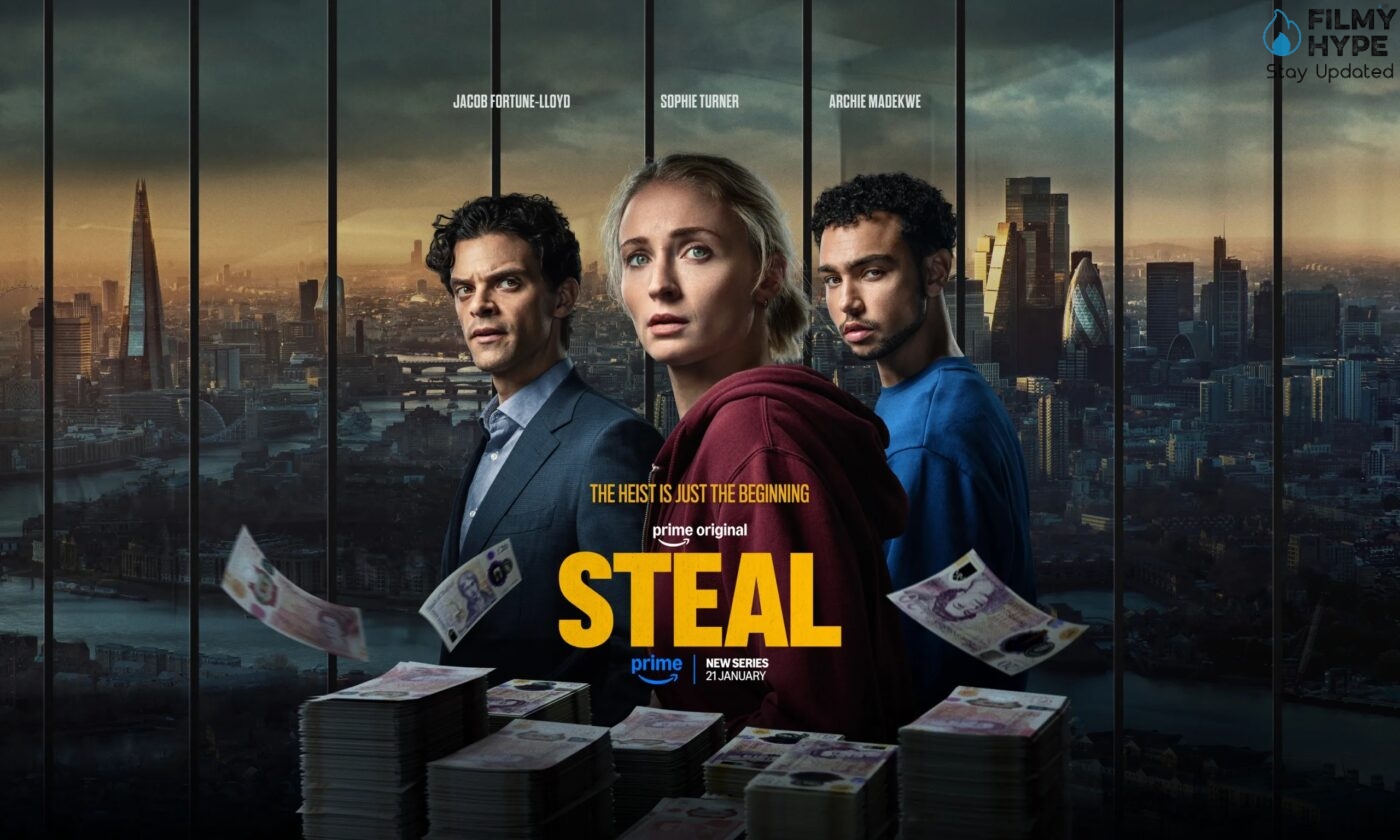
And if last year this genre was excellently represented on Prime Video by The Girlfriend and Lazarus (a little less from Malice), 2026 promises very well judging by (The Night Manager Season 2 and From) this new release featuring the protagonist Sophie Turner, the Sansa Stark from Game of Thrones who for Prime has also recently started playing the role of Lara Croft in the filming of a new series of Tomb Raider. Set in the heart of London finance, the series follows a group of office workers caught up in a heist of colossal proportions, relying on a cast led by Sophie Turner, in a role that expertly blends fragility and determination. Behind the high-tension thriller framework, Steal tries to question inequalities, individual responsibilities, and moral compromises, even when the narrative tends to expand beyond what is necessary. Far from the archetype of the blameless policeman, Covac struggles to maintain control of the investigation, especially when Zara and Luke become progressively involved in the disappearance of the stolen sums and the boundary between good and bad becomes more and more nuanced, episode after episode.
Steal Season 1 Review: The Story Plot
Lochmill Capital is a large investment firm based in one of the many skyscrapers in the City of London. Zara Dunne (Turner) works here, together with her colleague and friend Luke (Archie Madekwe, already seen in Saltburn), who deals with boring financial transactions decided by those who choose how to invest the pension funds of companies, unions, and workers in general. One day, however, Lochmill suffers the heist of the century, which causes £4 billion of pension funds to disappear into some tax haven.
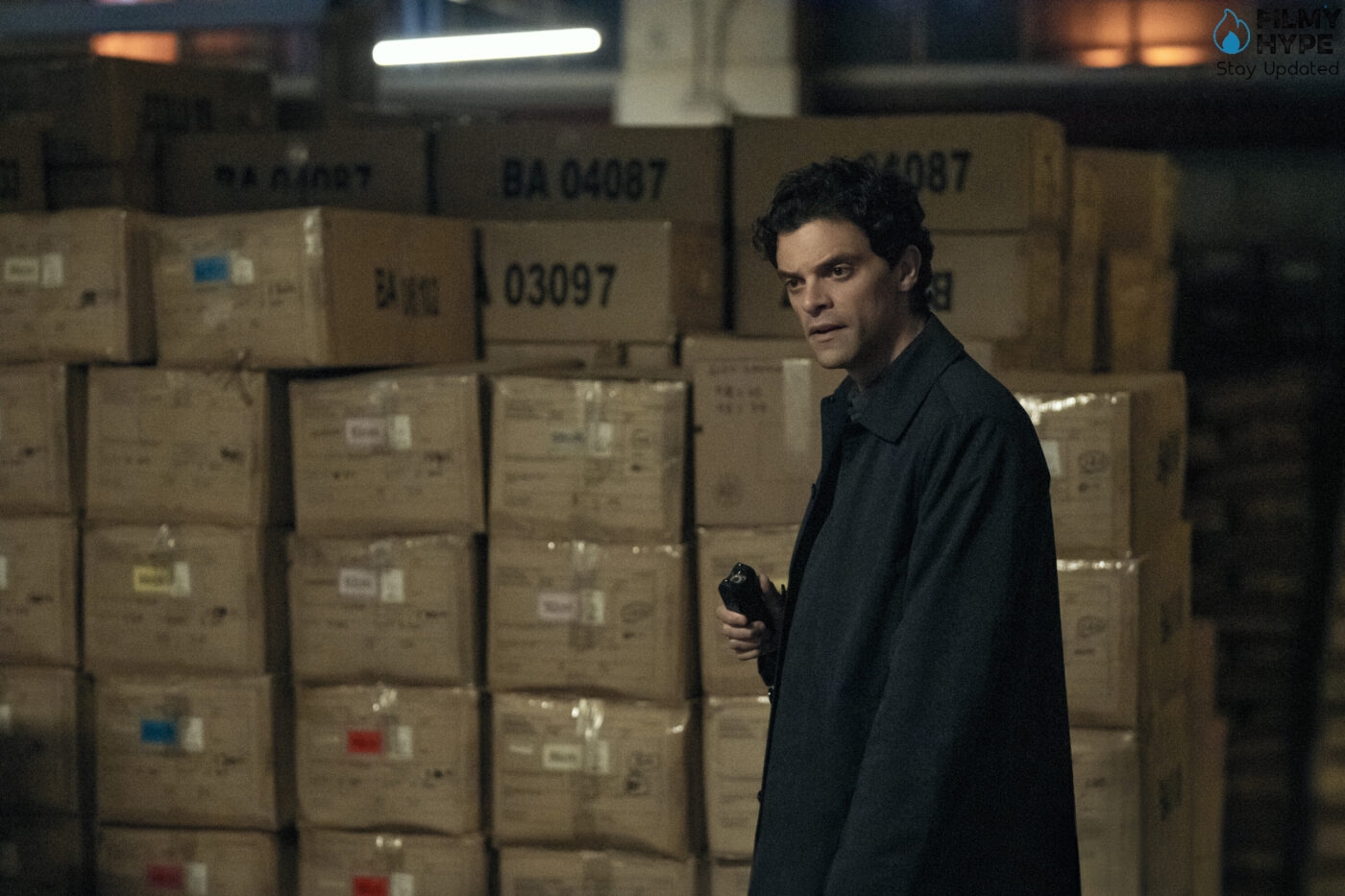
The robbery is carried out by a group of extremely ruthless and precise criminals, who answer to the orders of no one knows who. Discovering the identities of the robbers and the instigator will be up to Detective Rhys Covaci (Jacob Fortune-Lloyd, known for Bodies), who, in the meantime, must also solve its own significant gambling debt problem. And so, during his investigations, Covaci will discover that it is not easy to uncover the truth about a case that is shaking the country, and which, therefore, MI5 agents are also investigating, when you have something to hide.
Steal Season 1 Review and Analysis
We will never tire of highlighting the mastery of the British in packaging this type of TV series. In which the guilty and the innocent mix roles, in which the characters move around the scene like pawns in a game that is only understood at the end, to great satisfaction. Leaving nothing for granted, Steal tells an original and satisfying story that keeps you glued to the screen until a cheering finale. All this by showing us the frustrations, miseries, but also the impulses and intuitions of characters in whom, despite the not-so-everyday theme, it is difficult not to identify. As for the epilogue, we’re not spoiling anything for you except that this series seems to be coming at just the right time in history. But that was also luck.

British miniseries in six episodes, Steal uses the now overused dynamics of the contemporary thriller, high voltage and strong technological component to promise, right from the explanatory title, “the robbery of the century”. An ambitious operation which, after a high-adrenaline opening with the staging of the coup, however, risks sinking into a whirlwind of narrative contortions that are not always plausible. Betrayals, lies, traps, and twists follow one another without stopping, maintaining the constantly unstable truth and multiplying suspicions, until an epilogue that adds a further sudden revelation. In the screenplay, social drama ambitions coexist with class disparity and the need to meet such expectations, with a fair smattering of financial literacy that helps guide the logic of pension funds. The motto “steal from the rich to donate to the poor” thus emerges as a sort of involuntary moral condemnation, more declared than truly problematized.
The main strength of the operation lies in the interpretation of Sophie Turner, known to the general television public for her role as Sansa Stark in Game of Thrones. The actress finally finds a character that allows her to express an ambiguity that often remained unexpressed before, building a protagonist who escapes the label of passive victim. In a web of double-crossing and cross-suspicion, Turner proves he knows manage complex emotional registers, moving confidently in a context where no one is truly reliable.
What should distinguish Steal from analogous products is the attempt to graft a critique of class disparity in contemporary London, a reflection of a financial system that enriches the few and impoverishes the many. Zara embodies this condition: an intelligent young woman trapped in an alienating job, with no real prospect of change in a city with a prohibitive cost of living. Coming from a disadvantaged social context, as the conflictual relationship with her mother suggests, the temptation to change her life becomes too strong for her to ignore.
The problem is that these themes remain in the background, approached with a frustrating superficiality and entrusted to explanatory dialogues rather than a real dramatic construction. The series prefers to focus almost exclusively on the soul thriller, leaving ethics and social discourse to make timid forays before being quickly shelved. The obvious is thus made even more obvious, without any real maturation of the characters and with only the money to push his motivations, even when ethics tries to emerge here and there, only to be pushed back into the shadows almost immediately. One of the most solid elements of the series is the performance of Sophie Turner, who builds Zara as an unresolved character, far from any heroic role model. She is a young woman stuck in a frustrating job and a personal life marked by difficult family relationships and a constant sense of precariousness. Turner accompanies the character throughout the season with a believable evolution, letting out both fears and a growing ability to react without ever transforming her into an invincible figure.
The series starts with a very effective opening episode, capable of building tension and involvement thanks to a well-orchestrated robbery and a sense of concrete threat. Over the course of subsequent episodes, however, the narrative tends to broaden, multiplying revelations and deviations that do not always maintain the same initial strength. Some steps related to financial mechanisms become more explanatory than necessary, slowing the pace and weighing down a story that would have benefited from greater synthesis. It is the classic risk of seriality, where the initial strong idea struggles to sustain a longer arc.
The most interesting theme of Steal – Robbery remains the relationship with money and the system that governs it. The series depicts a distant and opaque financial world, where few manage huge flows of capital while those working at the base remain trapped in a state of permanent frustration. The resentment that runs through the characters is never openly justified, but is shown as a force that makes the crime itself possible. However, the series often seems to stop at the realization of the problem, without finding a real narrative direction to delve fully into it.

Next to Zara, secondary characters are less defined. Rhys Kovac remains an interesting but underexplored figure, while Luke ends up being used more as an emotional lever than as a fully developed character. Even antagonists, while functional to the plot, rarely leave a lasting impression. Steal – The Robbery thus remains an engaging and well-acted series, capable of starting with great strength and entertaining until the end, but which struggles to close the circle with the same incisiveness with which it opened. The real strength of this series is Sophie Turner. You have to talk about it seriously because he does an amazing job.
Her character, Zara, works in a company that manages pension funds. She looks like one of the many girls in London: elegant office, fashionable clothes, safe air. But it’s all smoke. Zara is a total mess. You see her for the first time, locked in the bathroom at work, with her nose bleeding from drinking too much the night before. And she drinks often, to forget that she is stuck in a shitty job and that he doesn’t have a real life outside the office. The only person he talks to is his mother, and when they see each other, they always argue. When the robbers arrive, Zara and her friend Luke are forced to carry out operations that empty four billion pounds from the pension accounts of normal people.
Four billion has been taken from workers who have worked hard all their lives. When the robbers escape, Zara decides to start investigating alone. And in this act, the series really gets into gear. Sophie Turner is very good. It makes Zara believable, true, full of flaws, but also of courage. He’s the kind of character who keeps you watching Steal even when the plot slows down. And after watching this series, the idea of seeing her do Lara Croft in the new Tom Raider isn’t so scary anymore. It fits perfectly. Jacob Fortune-Lloyd is Detective Rhys Covac, and he has that charm that makes you believe that a cop can team up with a civilian to solve a case.
Their relationship works, even if Covac has his personal demons that complicate things. The story gets complicated when corrupt billionaires, MI5, and so many other people interested in that money enter the picture. At some point, you don’t understand anymore who is with whom, who is good, and who is bad. And that’s the beauty of it. The biggest problem? The robbers have no personality. They’re generic guys who look like they came out of Die Hard. They have so little characterization that on the internet, they call them “The Tall One”, “The One with the Glasses”. The gang’s brains seem interesting at first, but then they disappear to make room for a violent, stupid guy who makes you wonder how he manages to use a computer. And the final twist is a bit too prepared. When you think back to everything that happened before, some things go wrong.

Steal – The Robbery is perfect for when you’re craving a television marathon. Six episodes that feel like a long movie. It has that right mix of action, suspense, and mystery that keeps you saying “okay, I see another one” until you get to the end. She’s not perfect; she has her flaws. The characters are sometimes too good or too bad, with no middle ground. Some scenes are too predictable. But overall, it works. It’s fun, it keeps you on the edge of your seat, and Sophie Turner makes you forget everything that’s not working. If you have a free afternoon or an evening on the couch, this series is worth your time. It’s not revolutionary, it won’t change your life, but for what it wants to be, it does it well. And with Sophie Turner in this state of form, it makes you want to see a second season. Maybe with a better story.
Steal Season 1 Review: The Last Words
Steal works well despite the clichés. Sophie Turner is extraordinary and carries the entire series on her shoulders with a believable and intense performance. The pace is great, perfect for seeing it all in one go. The robbers are poorly characterized, and the ending is built, but overall, it’s a solid thriller that entertains. Worth the viewing. Steal begins with a strong idea and a precisely constructed first episode, capable of keeping the tension high and immediately engaging the viewer.
The real strength remains the character of Zara, played by Sophie Turner, with a credibility that avoids any heroic drift. Over the course of the episodes, however, the series tends to expand, accumulating revelations and narrative deviations that end up weakening the initial impact. Themes related to the power of money and inequality are present and relevant, but often remain hinted at rather than explored. The result is an engaging series, well-acted, but less incisive than it promises.