
Stranger Things Season 5: What Is The Abyss? The Upside Down as a Wormhole, Explained
For years, Stranger Things led us to believe the Upside Down was a dark reflection of Hawkins—a parallel, contaminated dimension frozen in time. Stranger Things Season 5 dismantles that idea entirely. The Upside Down is not another world. It is a wormhole, an unstable bridge between our reality and a place of true terror: the Abyss, the primordial domain of Vecna. This isn’t just a lore correction. It’s a conceptual twist that redefines the entire series, reorganizes its mythology, and finally explains why the conflict was never just about Hawkins, or even Eleven. The enemy was always somewhere else.
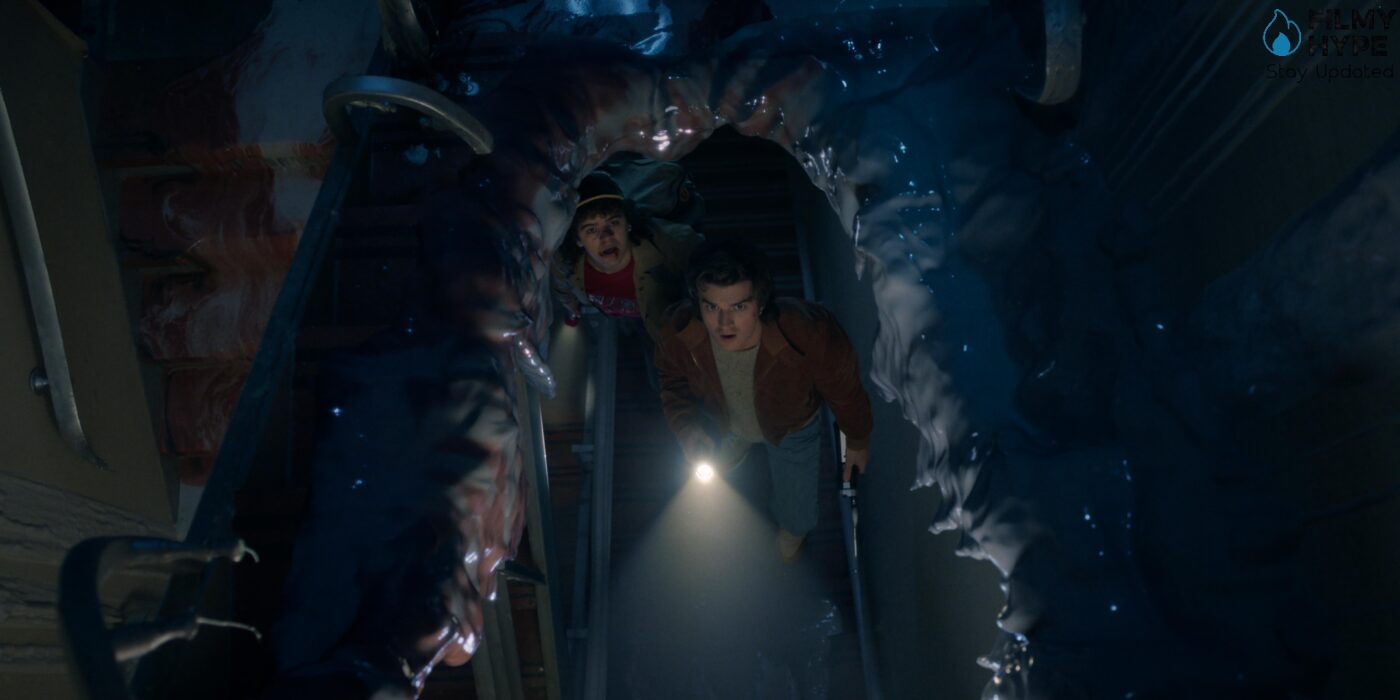
Stranger Things Season 5: What Is The Abyss? The Upside Down Was Never a World—It’s a Bridge
From this new perspective, many unexplained details suddenly make sense. The Upside Down has no life of its own. It doesn’t evolve. It doesn’t transform. It only repeats. It replicates. It’s frozen at the exact moment it was created because it isn’t a place where time flows naturally—it’s an artificially sustained tunnel. A bridge. And like any bridge, it exists only as long as something keeps it standing.
In Stranger Things Season 5, that “something” gets a name: exotic matter.
For the first four seasons, the Upside‑Down was portrayed as a contaminated parallel dimension that reflected Hawkins in a nightmarish fashion. Stranger Things 5 dismantles this view by presenting the Upside‑Down as the interior of a wormhole—a tunnel that connects two distinct points in space‑time.
- Key point: The Upside‑Down is not a destination; it is a transit corridor.
- Narrative impact: Monsters, the Mind Flayer, and demogorgons are not permanent residents of the Upside‑Down; they are entities passing through the wormhole.
The redefinition aligns the series with speculative physics, offering a logical explanation for why the Upside‑Down never evolves, why it appears frozen, and why it collapses when its energy source is disrupted.
What Is Exotic Matter in Stranger Things?
Exotic matter is unstable, negative energy—the theoretical physical basis of a traversable wormhole. In the show, it’s the glue holding the Upside Down together. The important thing isn’t the quantum physics of it, but its narrative consequence: if the Upside Down is a wormhole, then it is not a destination, but a transit. Nobody belongs there. Nothing is meant to stay. This revelation recasts the entire struggle. Our heroes weren’t battling an alternate dimension; they were trapped inside a dimensional fault line.
How Stranger Things Season 5 Changes the Rules
Until now, the Upside Down functioned as a stage: a hostile space where monsters lurked, and characters risked their lives. In Stranger Things Season 5, that space stops being a “place” and becomes a structure. Something that was built. Something that can—and will—collapse.
The difference between the Upside Down and the Abyss is now fundamental:
- The Upside Down imitates. It needs a reference point (Hawkins) to exist.
- The Abyss exists by itself. It is a primary, chaotic, and wholly alien environment.
The Upside Down is the haunted hallway. The Abyss is the house at the end of it.
This revelation comes through piecing together evidence from Hawkins Lab, Dr. Brenner’s recovered diaries, and Dustin Henderson’s razor-sharp reasoning: what surrounds the Upside Down isn’t a dimensional wall, but the boundary of a wormhole sustained by exotic matter. The Upside Down is the tunnel. The bridge. The toll road to Hawkins.
What Is The Abyss in Stranger Things?
The Abyss is not the Upside Down. It is the ancient, chaotic world that exists on the other side of the wormhole. In Dungeons & Dragons terms—the show’s constant touchstone—it embodies the plane of absolute chaos and evil.
The Abyss is the missing key to the entire series. It is:
- The original home of the Mind Flayer and creatures like the Demogorgon.
- The place where Eleven exiled Henry Creel in 1979.
- The formative territory where Henry ceased to be human and became Vecna.
- The hidden throne from which Vecna operates and plans.
For seasons, the characters searched for Vecna in the Upside Down. They tracked him, surrounded him, and tried to locate his base. But Vecna was never truly there. The Upside Down was just the corridor he moved through. His home was always the Abyss. That’s why they could never fully find him—he wasn’t just out of reach; he was in another world entirely.
The Upside Down Explained: How the Wormhole Works
The core scientific-fantasy premise of Stranger Things Season 5 is this: The Upside Down is a wormhole connecting Hawkins with the Abyss. It is not a mirror universe. It is an accidentally created unstable structure.
The Upside Down as a Bridge Between Worlds
A wormhole (or Einstein-Rosen bridge) theoretically connects two distant points in spacetime. In the show’s logic:
- One end is anchored in Hawkins (first at the lab, then spreading through the Gates).
- The other end opens into the nightmarish landscape of the Abyss.
- The Upside Down itself is the unstable tunnel in between.
This explains its incomplete, parasitic nature and its energy dependence. It’s not a world, it’s a scaffolding of one, created from the impression of Hawkins at the moment the bridge formed.
The series reveals that the Hawkins Laboratory, under Dr. Brenner’s direction, inadvertently created the wormhole. The critical moment occurred on November 6 , 1983, when Eleven, coerced by experimental procedures, made psychic contact with a demogorgon in a nascent void. This psychic resonance opened a breach in spacetime, forming the wormhole’s entrance.
- Key evidence within the show:
- Brenner’s diary entries describing an “energy anomaly” on the night of the incident.
- Dustin’s analysis linking the lab’s quantum‑field experiments to the emergence of exotic matter.
The laboratory’s ongoing experiments continuously feed exotic matter into the wormhole, keeping it open but also rendering it fragile.
Why the Upside Down Is Frozen on November 6, 1983
This has been the series’s biggest mystery, and Stranger Things Season 5 provides a coherent answer rooted in the wormhole theory.
The Upside Down is not frozen because of Will Byers’ disappearance. It is frozen at the exact moment the bridge was created. That moment is November 6, 1983, when Eleven—terrified and coerced during a sensory deprivation tank experiment—made psychic contact with a Demogorgon in the void. That psychic scream didn’t just find a monster; it ripped open a door.
The Upside Down is a snapshot, a mold of Hawkins taken in the nanosecond that the bridge was forced into existence. It doesn’t advance because it doesn’t have its own timeline. It is a footprint. Will Byers didn’t cause the freeze; he was simply the first person to stumble into a system that was already active and static.
The Upside‑Down appears to be a time‑locked snapshot of Hawkins on the night the wormhole was created. This phenomenon is explained by the nature of the wormhole:
- Instantaneous imprint – When the wormhole opened, a spatial imprint of the surrounding environment was captured as the tunnel’s cross‑section.
- Absence of an internal timeline – Because the Upside‑Down lacks its own flow of time, the captured imprint does not evolve.
- Stability requirement – The wormhole remains stable only while the exotic matter maintains the curvature that preserves the imprint.
Consequently, every time a character traverses the Upside‑Down, they encounter a world that is perpetually frozen at the precise moment of creation.
Vecna’s Endgame: It Was Never About Invasion
Understanding the wormhole reveals Vecna’s true, apocalyptic plan. He doesn’t want to conquer Hawkins. He wants to reconfigure reality itself.
The Upside Down is useless to him as a final destination because it’s unstable—it’s a bridge. And bridges can be destroyed to create something new.
Vecna’s plan, as decoded by the party, involves:
- Weakening the structural integrity of both ends of the wormhole (Hawkins and the Abyss).
- Using the minds of his victims as psychic amplifiers to destabilize the exotic matter.
- Forcing the wormhole bridge to collapse catastrophically.
- Causing the Abyss and Hawkins to collide and merge permanently.
This isn’t destruction. It’s forced fusion. Vecna aims to remake the human world in the image of the Abyss, creating a single, twisted reality under his rule.
Implications for Stranger Things Mythology
The wormhole reinterpretation has several far-reaching consequences:
- Mythological expansion – The series moves from a locally confined horror to a multiversal conflict.
- Character arcs – Eleven’s role shifts from being the sole defender against a “mirror world” to a reluctant architect of the bridge that must now be closed.
- Narrative stakes – The conflict is no longer about preventing a single monster invasion; it is about preventing the collision of two entire universes.
- Future storytelling – The concept of exotic matter and wormholes opens possibilities for new dimensions, time‑travel elements, and scientifically grounded supernatural phenomena in subsequent seasons.
The Final Battle: Entering The Abyss
This redefinition elevates the scale of Stranger Things Season 5. The climax is no longer about defending a town, but about deciding which version of reality gets to exist. The final conflict shifts from the decaying corridors of the Upside Down to the terrifying landscape of the Abyss itself.
The Upside Down was never the real problem. It was the symptom. The bleeding wound between worlds. The Abyss is the infection.
And in this terrifying new understanding lies the series’ ultimate stakes: to finally close the door, to sever the bridge, someone may have to stay behind on the other side—in the heart of the darkness itself. The final season isn’t just a fight for survival; it’s a mission into the belly of the beast, to confront the source of the nightmare where it truly lives.
How the Wormhole Operates Within the Storyline
A wormhole, in scientific theory, connects two distant points in the fabric of space-time. In Stranger Things 5, the wormhole functions as follows:
| Endpoint | Description |
| Hawkins, Indiana | The physical location where the wormhole’s entrance is anchored. The entrance is concealed within the secretive Hawkins Laboratory. |
| The Abyss | The far‑end terminus of the wormhole, a realm of raw, chaotic energy. |
| The Upside‑Down | The interior tunnel that characters experience as a “world.” It is a transient conduit, not a destination. |
The wormhole’s unstable nature is reflected in its dependence on exotic matter. Any alteration to the exotic matter concentration causes ripples that manifest as structural failures in the Upside‑Down, leading to the appearance of “holes,” flickering lights, and the emergence of new threats.