It: Welcome to Derry Episode 1 Easter Eggs: A Deep Dive Into Stephen King’s Expanding Nightmare
It: Welcome to Derry Episode 1 Easter Eggs: In the universe of Stephen King, no story exists in a vacuum. The town of Derry, Maine, is more than just a setting; it’s a living, breathing character, an archive of traumas that refuses to be forgotten. It: Welcome to Derry, the highly anticipated HBO Max prequel series from Andy and Barbara Muschietti, understands this intrinsically. From its very first episode, the series functions as a masterfully woven tapestry, connecting threads from the 1986 novel, the 2017 and 2019 films, and the vast, interconnected King Multiverse.
It: Welcome to Derry Episode 1 Easter Eggs: A Deep Dive Into Stephen King’s Expanding Nightmare
Every faded poster, every whispered name, and every hidden symbol is a piece of a larger puzzle. This isn’t just fan service; it’s narrative archaeology. For those ready to return to the cursed town, here is a comprehensive tour of the main Easter eggs and references in It: Welcome to Derry Episode 1, and what they reveal about the horror to come.
The Hanlon Legacy: Leroy and the Keeper of Derry’s History
The series introduces us to one of its central protagonists: Major Leroy Hanlon (played by Jovan Adepo), an African-American pilot who arrives in Derry in 1962. The surname is your first major clue. In the original story, Mike Hanlon is the lone member of the Losers’ Club who remains in Derry, becoming the town’s librarian and the guardian of its horrific history.
Andy Muschietti has confirmed that the series is heavily inspired by the “Interludes” from King’s novel—the sections written from Mike’s perspective that detail Derry’s bloody past. The presence of Major Hanlon suggests a direct lineage. Is he Mike’s grandfather? A relative who establishes the family’s grim duty of chronicling the town’s evil? Leroy Hanlon isn’t just a new character; he is the potential point of origin for the hereditary memory that defines the Hanlon name.
The Uris Family Tree: Teddy and Stanley’s Connection
Another surname echoes from the future: Uris. In the episode’s credits, we see Rabbi Uris, Don Uris, and Mrs. Uris, confirming the presence of Stanley Uris’s family decades before he joins the Losers Club. The connection is solidified with the character of Teddy (Mikkal Karim Fidler). While his last name isn’t spoken aloud, a quick shot of his school locker reveals cruel graffiti: “Teddy Urine.”
This is the same insult hurled at a young Stanley Uris in It: Chapter One. Given the 1962 setting, Teddy is likely Stanley’s uncle or older cousin, establishing another family destined to be scarred by the entity lurking beneath Derry.
The Music Man: When the Silver Screen Becomes a Portal
The episode opens in a Derry cinema, where the first victim, Matty Clements, is sneaking into a showing of “The Music Man,” the 1962 musical about a con man in a small town. This is not a random choice. The song Matty hears, “Ya Got Trouble,” becomes a ghostly refrain throughout the episode. In the musical, it’s a satirical number about false moral panics; in Welcome to Derry, it’s a chillingly literal warning.
The horror culminates in the finale when the children project the film in the abandoned theater. Matty’s specter appears within the movie itself, holding a demonic baby and declaring, “You are the reason I am here,” before hurling the creature through the screen. The sequence is a masterstroke: it transforms entertainment into invocation, and the cinema—a symbol of 1960s innocence—into a direct portal for Pennywise’s evil.
Paul Bunyan: A Statue of Forgetting and Future Fear
Around Derry, posters and newspaper articles promote a new civic project: a statue of Paul Bunyan, the mythical lumberjack. For fans of It: Chapter Two, this is a massive payoff. Decades later, that very statue will spring to life in a delirious sequence to attack an adult Richie Tozier (Bill Hader).
This Easter egg reinforces a core theme of King’s Derry: the town actively erects monuments to “progress” and “community” to掩盖 the rot festering beneath. They are built on a foundation of denial, and Pennywise is more than happy to animate these symbols of forgotten sins.
Alvin Marsh: The Sins of the Father, Carved in Wood
In a subtle but deeply disturbing background moment, Margie drags Lilly into the school bathrooms. As the camera pans, a heart is carved into a door with a name inside: Alvin Marsh.
This is the abusive father of Beverly Marsh (Sophia Lillis) from the original timeline. The inscription reveals that in 1962, Alvin is just a teenager himself—a boy who has not yet committed the violence that will traumatize his future daughter. It’s a tiny detail that speaks volumes, turning Derry into a town where trauma is a generational inheritance, and children are doomed to suffer from sins their parents haven’t even conceived of yet.
The Turtles: Cosmic Luck and Cold War Fear
The cosmic turtle, Maturin, is a pillar of Stephen King’s multiverse, representing the benevolent force of order that opposes the chaos of It/ Pennywise. Welcome to Derry introduces this symbol in several clever ways.
First, outside the high school, a civil defense poster features “Bert the Turtle” with the slogan “DUCK AND COVER.” Later, a man dressed as Bert hands out pamphlets about nuclear safety. Then, in a key character moment, Matty gives Lilly a small turtle toy from a Cracker Jack box, telling her, “Turtles bring luck.”
The exchange is a perfect metaphor: Lilly trades her plastic rocket (the desire to escape) for the turtle (grounded permanence). In Derry, luck is a relative concept, and no one truly escapes what lies beneath.
Flash and Detective Comics: Muschietti’s DC Connection
The series also winks at the directors’ filmography. In one scene, Teddy’s father confiscates a Flash comic book, telling him, “Enough fantasy.” Andy Muschietti, of course, directed The Flash (2023). Later, Teddy is seen reading an issue of Detective Comics featuring Batman and Robin battling Clayface—a villain confirmed for James Gunn’s upcoming DC Universe slate. These are fun, self-referential nods that connect Derry to the broader world of its creators.
Echoes of the Losers: Pennywise’s Personal Torment
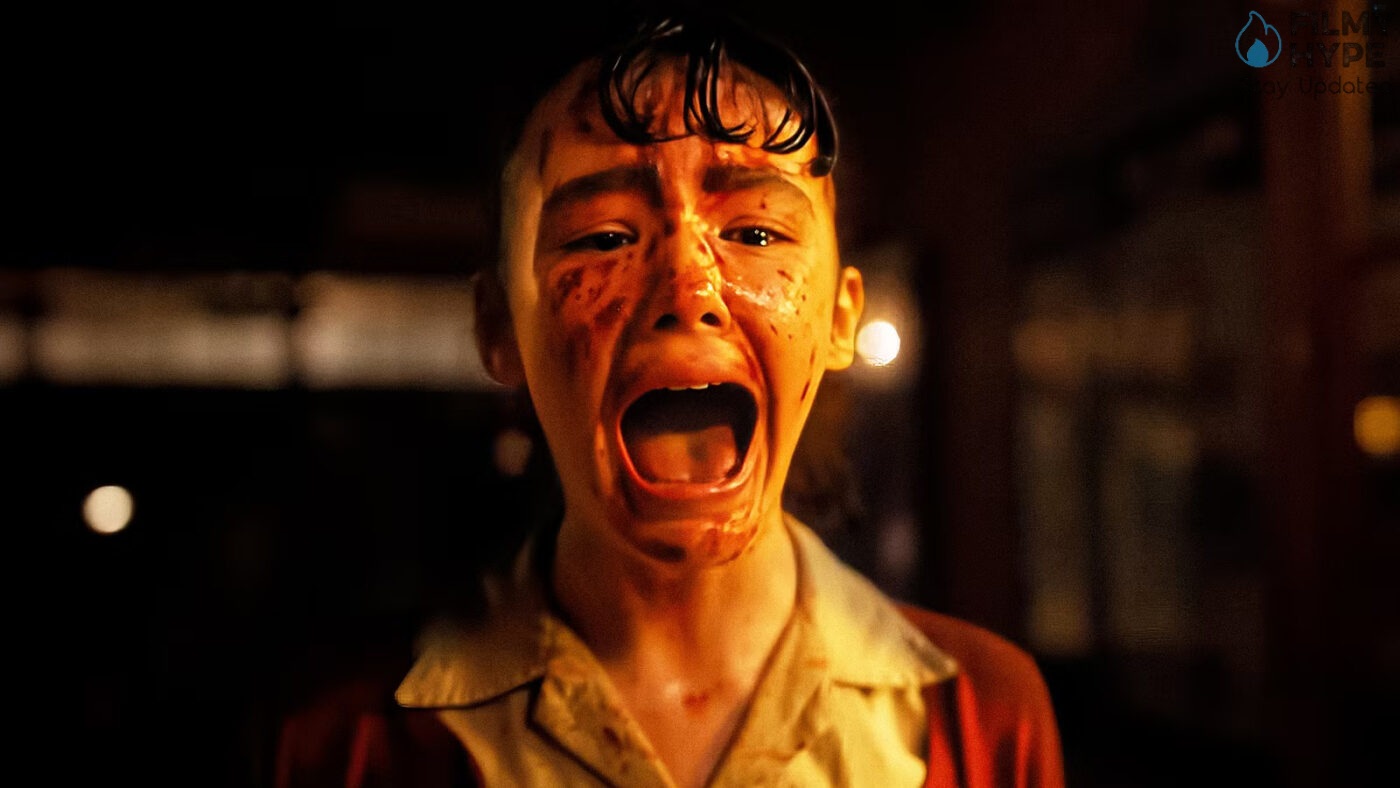
In a sequence shown at New York Comic-Con, Pennywise torments Lilly by taking the mutilated form of her deceased father, whispering, “Give dad a kiss.” This is a direct parallel to a scene in It: Chapter Two, where It uses the voice of Alvin Marsh to terrorize an adult Beverly in her childhood bathroom.
This confirms the series will maintain the core mechanic of Pennywise’s power: he doesn’t invent fear, he quotes it. He becomes the person, memory, or trauma that will most effectively break his victim, proving that Derry’s horror always seeps through the cracks of the domestic and the familiar.
The King Multiverse: “All Things Serve the Beam”
For eagle-eyed King fans, the episode is littered with broader connections. Look closely in the library, and you might spot a copy of the Bangor Daily News—the real-life newspaper of King’s hometown. Even more significantly, a fleeting shot reveals a sign with the motto: “All things serve the Beam.”
This phrase is central to King’s magnum opus, The Dark Tower, referring to the cosmic beams that hold all reality together. This isn’t just an Easter egg; it’s a declaration that Welcome to Derry is a firm part of the King Multiverse, where the battle between the Crimson King (and his servant, It) and the forces of the White (like Maturin) plays out across infinite worlds.
Conclusion: Derry is a Story That Never Ends
Every reference in It: Welcome to Derry Episode 1 is a building block in the town’s endless cycle of fear. The Muschiettis aren’t just making a prequel; they are conducting a visual archeology of a nightmare. The Easter eggs are more than decorations—they are the narrative itself, functioning like the footnotes in Mike Hanlon’s journal: fragments of a truth too terrible to behold all at once.
As Stephen King himself said after viewing the episode, it’s “amazing” and “terrifying.” With his blessing, Welcome to Derry promises to be the definitive expansion of a horror mythos, proving that in Derry, the past is never dead. It’s not even past.