
Ballad of a Small Player Netflix Review: A Cinematic Gem and Gambling With The Algorithm
With Ballad of a Small Player, now available at Netflix, Edward Berger abandons the trenches of Nothing new on the Western Front to immerse yourself in the glittering hell of Macau, among gaming tables, neon lights, and men who bet what’s left of their souls. At its core is Colin Farrell- intense and restless as ever, as a free-falling con man. Based on the novel by Lawrence Osborne, the film chronicles gaming addiction as a slow descent into self-loss, with the opulent, controlled style that sets Berger apart, but also with a visual ambition that ends up overwhelming the substance. Ballad of a Small Player, at least from the point of view of his player, it’s a good film. Or, at least, it is at least acceptable according to a quantity directly inverse to possible expectations. Directed by Edward Berger and written by Rowan Joffé, as well as based on the novel of the same name by Lawrence Osborne, it makes the most of the place as the main character, which, needless to say, is the most interesting part of the film.
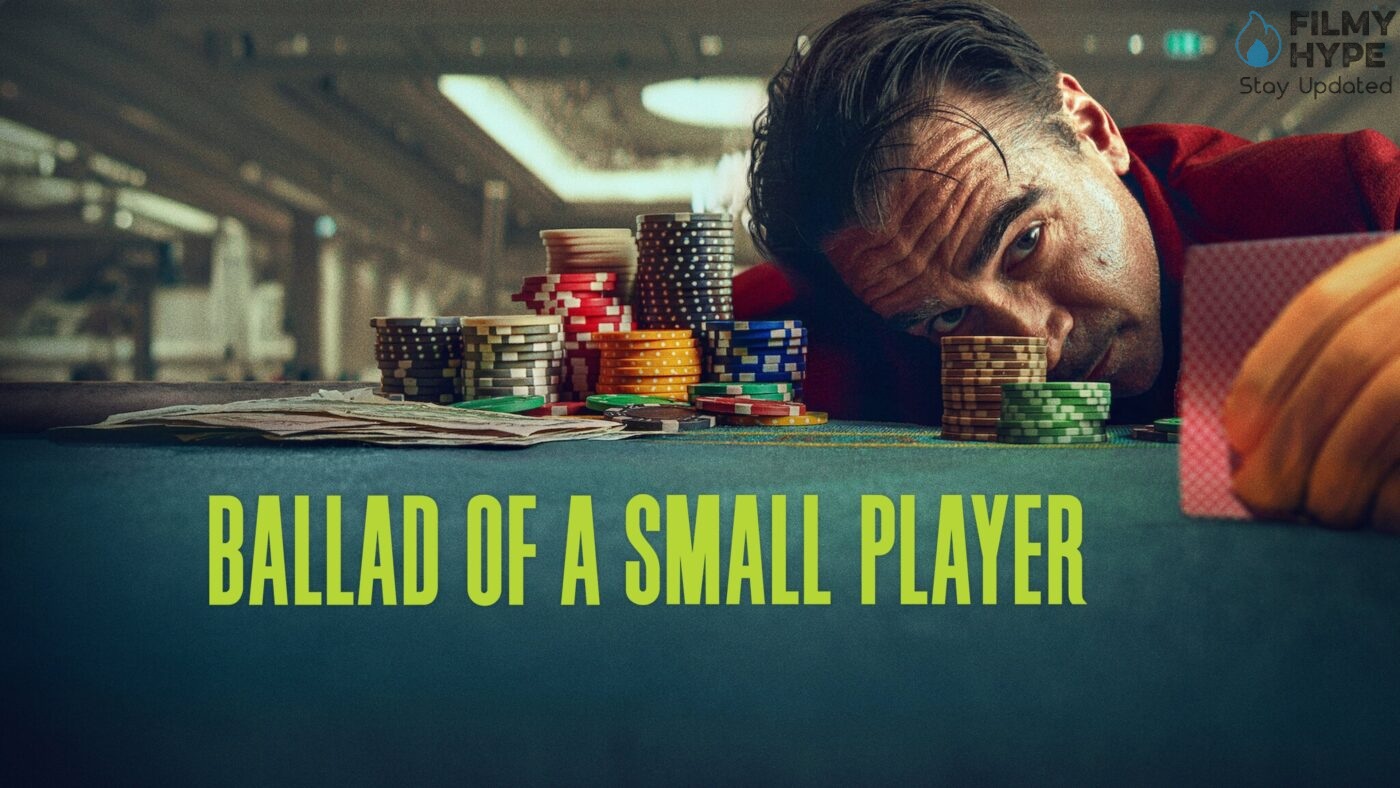
“The city of miracles in a land reclaimed from the sea. But I no longer believe in miracles”. It debuts on Netflix on October 29, 2025. Ballad of a Small Player, a film directed by Edward Berger (the director of Conclave and of Nothing New on the Western Front), written by Rowan Joffé, and based on Lawrence Osborne’s 2014 book Ballad of a Small Player. The cast of the film includes the names of Colin Farrell and Tilda Swinton. And then there are Fala Chen, Alex Jennings, Deanie Yip, and many others. A cinema film in every way – and a competition film, without a doubt – inserted into a platform. A bet against the algorithm, basically. But let’s go in order and start with the plot. Arrived on Netflix after the transition to the Telluride Film Festival, Ballad of a Small Player, however, tries to summarize the psycho-physical state of a man consumed by his addictions through a journey that aims (too much) at effect and less at substance.
Ballad of a Small Player Netflix Review: The Story Plot
The story, the synopsis tells us, is that of Lord Doyle (but that’s not his real name), who hides in Macau, has a pair of “magic” gloves with him, and spends day and night in the casinos, drinking heavily and gambling the little money he has left. Time passes, and the knots, as per tradition, come home to roast. And the country tries in every way to deal with rapidly increasing debts and a series of defeats. Lord Doyle meets the mysterious and fascinating Dao Ming. Then, surprise: Cynthia Blithe appears, a private investigator who is hunting the lord. As Doyle tries to reach safety, the boundaries of reality begin to tighten around him. This is the version without too many spoilers. A preview of the plot that leads us to the first, but fundamental deception: the film is ‘sold’ as a thriller. Or rather: a psychological thriller.

To tell the psycho-physical state of a man consumed by his addictions through a journey where vice, greed, danger, and an attempt at redemption mix, there is only one other place besides Las Vegas that could act as a backdrop, namely Macao, an autonomous region on the south coast of China, also known as the gambling capital of the world. And this is where the London writer on the pages of the 2014 book and the Austrian filmmaker in his transposition set the misadventures of Lord Doyle, a handsome, fully dressed Briton who staggers between casinos, destroying every suite he stops in. It will be baccarat that initiates him into the laws of chance, and so, due to some unfortunate series, Doyle could find himself in rather serious trouble. Cigarette in the mouth and glass of Dom Pérignon in the hand, in fact, man is left penniless after having squandered a capital grabbed at home for which he is also wanted, while debts increase because the cards at the table continue not to turn. Lord Doyle, in his flamboyant velvet clothes, then relies on China’s Dao Ming, who works in a casino, to find a way out before it’s too late.
Ballad of a Small Player Netflix Review and Analysis
Except that this choice of Netflix ‘category’ is a deception. The film is a ballad, as the title suggests. It’s metaphorical. It’s a fairy tale at times. It’s bizarre at times. It’s cold in others. As the title suggests, it’s the story of a little man. A story set in a land ‘torn from the sea’ (one of the first lines) and with an exotic and metaphorical charm at the same time: Macau. A colossal casino city, a pirate hideout, Las Vegas to the nth degree. A place where our protagonist “barely lives”. He is alone –or almost alone – among his sins and walks along the border between life and death. Marking the time of this story are the approaching Feast of Hungry Spirits and creditors. The ghosts of Christmas past, basically. As someone said, you don’t run away from it even if you’re Eddie Merckx (this is easy, come on).
And there’s more. The deception of the category risks damaging the film. The viewer who expects a thriller risks being irremediably disappointed. And, above all, he risks losing what is a real gem. Edward Berger’s direction is first-class, and Joffé’s writing is good. But what really shines – in addition to a Colin Farrell in a state of grace eating the scene and also the sofa where you are sitting and a Tilda Swinton who is an absolute and mathematical certainty – is the photography of James Friend (it is no coincidence that he won an Oscar with, surprise, Nothing New on the Western Front). LED, fire, tables, indoor, outdoor, night, day. Fountains dancing, gloves that remain forgotten, cards that bend, flames that rise. Pure magic. The image of Ballad of a Small Player is an integral part of the narrative. At times, it is itself the narrative. If we add to this Berger’s reckless (in a good sense, at times dreamlike and at times unexpected) shots, that’s it (yes, it was intentional).

And then the writing. It is a film that derives from a book, but Joffé’s pen manages to bring back to the screen the facets of a gambler in every way, the complications of a life in pursuit, and the desperation that hides in the few blind spots of a constantly festively lit world. As always, to better enjoy it, the original language is essentially mandatory. Bottom line: Edward Berger has created a true cinematic gem. A challenge – is still a film about gambling and obsessions – to the algorithm. How much do bookmakers give it to? Colin Farrell brings to life a man consumed by addiction and guilt. His Lord Doyle does not have the charm of the damned player nor the lucidity of the swindler: he is a survivor who continues to lie to himself. Tilda Swinton, elegant and impenetrable, embodies the figure that brings him back to reality, while Fala Chen represents an unlikely lifeline in a world where piety does not exist. Berger tries to describe addiction as loss of control and identity, but his direction, too attentive to aesthetic construction, dampens the sense of desperation that the character should convey.
Berger builds a story where the fall of the protagonist seems written from the beginning. Lord Doyle is trapped in a repeating destiny, like a match he cannot win. Every redemption attempt turns into a new mistake, a gesture that drags him even deeper. The film is striking for its visual elegance and the precision with which it stages the moral unraveling of its protagonist, but it remains distant: the emotion never really explodes. The ballad of a small player is a refined and hypnotic work, but also a cold one, as if ruin could only be observed from afar. Lord Doyle is a half-man, and the journey he undertakes – according to Berger’s staging – leads him to clash with the greed of a Western mentality devoted to success. A wrong and dangerous identification (and also current, given the collapse of collective identity in the name of individuality), which the protagonist will end up paying for directly. The transformation (at times monstrous) by Farrell deals with the destruction of a man fleeing towards the “kingdom of Ghosts”.

If Berger’s direction continues straight (without giving up some dreamlike moments), the writing seems to digress too much. Too indecisive and too much crooked, as well as excessively dispersive. As a result, the tone ends up blowing, losing strength, inertia, and essence. A construction defect, which can be perceived especially in the last part (one hour and forty hours in duration). Half a sin, in short. However, the narrative crossroads on which it rests remain well imprinted. Ballad of a Small Player: rely on unpredictable fate or lucid choices? A question that naturally remains suspended, and which Berger refers to as the unquestionable judgment of the spectator. Who has read Osborne’s bestseller, defined by experts as the most beautiful novel about contemporary China since the Human condition of Malraux, he will already know the fate of the protagonist, on the contrary those who will come into contact with him for the first time through the film Berger will be able to explore the “infernal circle” into which the latter is thrown following the unfortunate main character. The Austrian director, using the excellent photography saturated with James Friend, immerses us in this circle made of acid and neon colors, which gradually becomes more and more suffocating to draw the trajectories of the fall.
In this sense, the chosen frame and the aesthetic-formal packaging are, without a doubt, fundamental and perfect elements to fuel a work that speaks of obsessions, fallibility, money, possession induced by desire, craving, gambling addiction, and, first and foremost, addictions that consume and crush. In this sense, the setting and the aspect in which the central figure is swallowed work perfectly, contributing substantially to the rise and fall of anxiety-provoking temperature. This is an oppressive sensation in whose exponential growth the person who was cast to play Lord Doyle actively participates, that is, Colin Farrell. The Irish actor unleashes yet another chameleonic performance, giving life to a (at times monstrous) transformation of a human being grappling with a self-destructive parable. Convincing is the one that appears much more in terms of weight than the shoulder on duty, i.e, Tilda Swinton, here in the guise of private investigator Cynthia tasked with hunting down the protagonist. The British actress, for her part, manages with yet another eccentric figure to give a good dose of unpredictability to the story. The same one that, however, partially fails in the overall economy of the rewriting process, with a screenplay that loses a lot of the feverish and vibrant narrative power of the literary matrix.
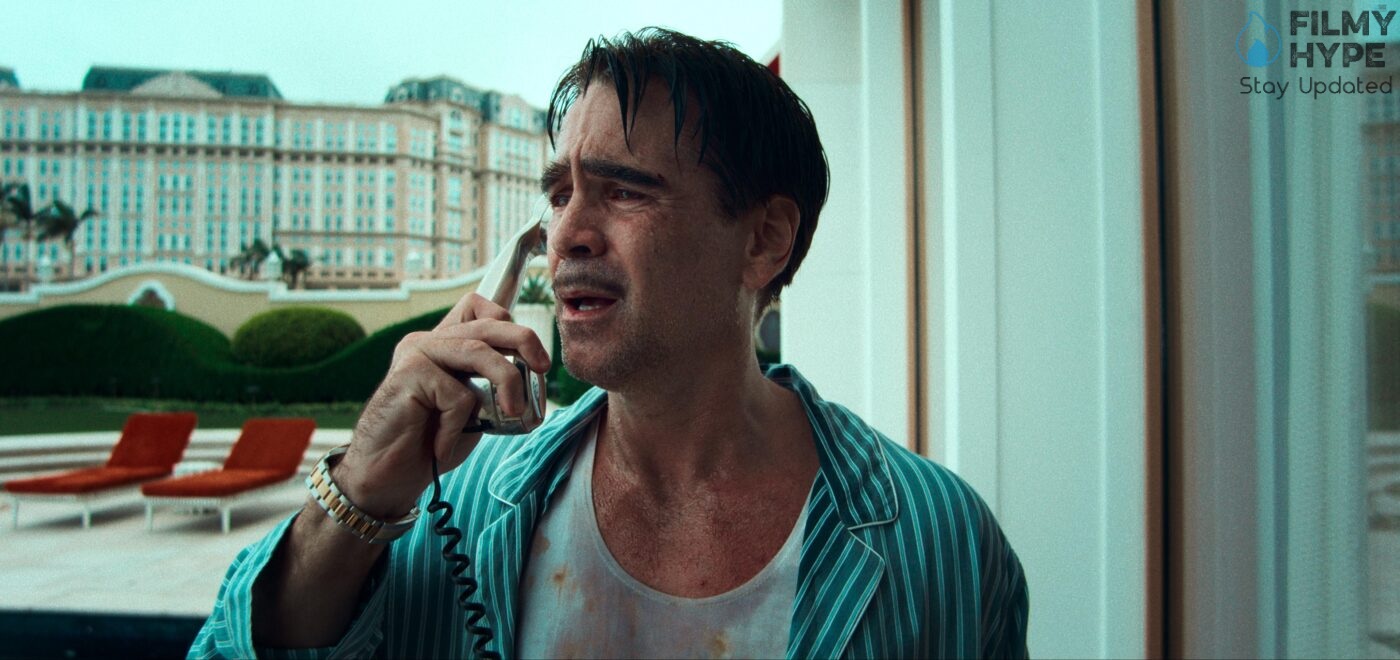
The transposition of the bestseller of the same name by Lawrence Osborne from 2014, signed by the award-winning Edward Berger, unfortunately, a rewriting process pays off that disperses compactness and unpredictability, undeniably fixed and strong points of the literary matrix. Fortunately, the rise and fall in temperature does not disappear, as does the high anxiety-provoking level caused by the settings and the self-destructive parable of the protagonist, here played by the usual chameleon Colin Farrell, flanked by an equally effective performance of Tilda Swinton, dealing with a crushed character with addictions that is really complicated to manage. But the Irish actor with the versatility that sets him apart does admirably. The packaging, the Macau setting and above all the acid and saturated photography with which are also valuable and functional to the story James Friend painted really impactful images.
Ballad of a Small Player Netflix Review: The Last Words
With Ballad of a Small Player, Edward Berger builds a visually sumptuous but emotionally distant drama. Colin Farrell holds up the entire film with an intense and desperate performance, as a man devoured by play and remorse. The formal elegance and photography of James Friend transform Macau into a hypnotic mirage, but behind the glossy surface lies a tale devoid of authentic participation. The result is a film that captivates style and atmosphere, but that never really manages to touch the soul. The obsessions of a man consumed by gambling, made tangible by Colin Farrell’s physical evidence. Edward Berger adapts Ballad of a Small Player into a neon film, which is based on the protagonist and the location, A fascinating and sweaty Macau. On the other hand, the writing loses fire, causing the tone to fade. Ultimately, however, a certain charm remains, as does the adherence of history to an era devoted to individual success. Whatever the cost.
Cast: Colin Farrell, Tilda Swinton, Alex Jennings, Jason Tobin, Fala Chen, Deanie lp, Adrienne Lau, Margaret Cheung, Alan K. Chang
Directed By: Edward Berger
Streaming Platform: Netflix
Filmyhype.com Ratings: 3.5/5 (three and a half stars)






One Comment