Ballad of a Small Player Ending Explained: What Secret Dao Ming is Hiding and What Happened to Doyle?
BEWARE, SPOILER ALERT. Based on the 2014 novel by Lawrence Osborne, “Ballad of a Small Player” is a British Netflix film that tells the story of Lord Doyle (Colin Farrell), a gambler who escapes his past and his debts. While hiding in Macau, he meets an enigmatic woman at a baccarat table. Could she change his disastrous life? What happened to the man who is about to lose his soul? The psychological thriller directed by Edward Berger (“No News on the Front” and “Conclave”) and written by Rowan Joffé begins with Doyle preparing to play with the money he has left in the hope of getting out of the hole he finds himself in due to his gambling addiction. But first, you must look for another casino to continue your bets, since you owe 352,000 Hong Kong dollars (about 45,000 US dollars) to the hotel where you are staying.
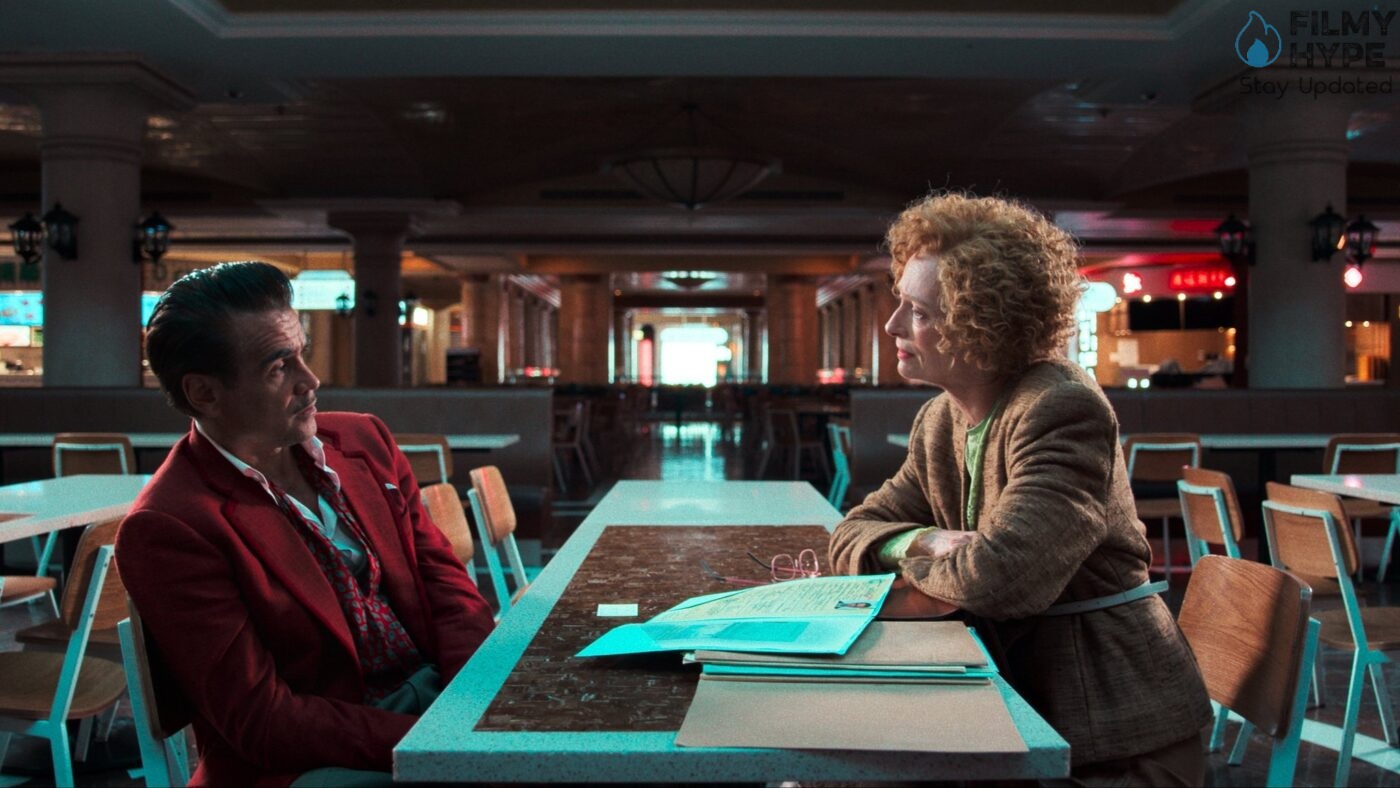
Besides, private investigator Cynthia Blithe (Tilda Swinton) tracks him down. She works for the company Strick and Garland and seeks to recover the million pounds sterling that the protagonist of “Ballad of a Small Player” owes an old woman wealthy woman whose portfolio she managed. In fact, after their first meeting, he reveals that Doyle is not a Lord and that his true identity is Reilly, a working-class Irishman. Colin Farrell reached the top of Netflix with Ballad of a Small Player, a mystery, black comedy, and psychological film, where he plays a character called Lord Doyle, a High Roller gambler (Hundreds Who Bet Thousands of Dollars in a Single Night), whose luck runs out unexpectedly.
Lord Doyle lives in Macau, the betting capital of the world (a city that looks like Las Vegas on steroids), and is convinced that he only needs one major victory to change his luck forever, but that is where he gives himself a reality hit: he has a million-dollar debt that he must pay, and he has only 3 days to do so. Farrell’s character leads a fast-paced life, full of excesses and high-risk bets, but all of this has consequences, and he is forced to deal with them. Doyle is in trouble, especially because he is not who he says he is, and the truth always finds a way to come to light, and in this case, the consequences are not going to be new at all. The thing is that the eccentric Lord Doyle is actually a man named Brendan Reilly and he stole over a million pounds from a client, so he has to do his best to get enough funds to pay everything he owes and avoid be discovered (Reilly pretends to be dead and becomes Doyle to start over until Cynthia, played by Tilda Swinton, finds out). When he believes that all is lost, a woman named Dao Ming (Fala Chen) appears, who could be his salvation.
Ballad of a Small Player: Summary Recap
The plot of the film is set in the casino world of Macau, China, where Lord Doyle moves after being overwhelmed by debt in the UK. In the Chinese city, he enjoys his stay in a luxury hotel, but is unable to pay the bill. We see that his room is littered with clothes, ties, and empty Champagne bottles. He lives by getting drunk at night and continuing to gamble. Although he is disheveled and scruffy, he attempts to present himself as an elegant and composed man. Furthermore, the sums of money he bet go beyond what he could really afford. Therefore, Lord Doyle in Macau is pretending. His real name is Riley, and he is not a rich man, as he would have everyone believe. His real addiction seems to be constantly living with his back against the wall. Throughout the film, he always goes to a fancy restaurant, where he gorges himself on food, planning his next move. He goes into cardiac arrest one day and is saved by Dao Mang, a kind-hearted and mysterious woman, who works in one of the casinos he frequents. The latter pays his bill and takes him to a shack on site, where she treats him. It all happens as citizens celebrate the Hungry Ghost Festival. This event explains their concept of the afterlife: souls and people with an addiction are condemned in the realm of the Hungry Ghosts, where one is never sanctified.
Ballad of a Small Player Ending Explained: What Secret Dao Ming is Hiding and What Happened to Doyle?
But Doyle remains obsessed with recovering the money he lost in the game. He insists that he is going through a rough patch and that his luck is about to change. After losing the little he had to the formidable “Grandma” (Deanie Ip), Doyle receives a proposal from the usurer Dao Ming (Fala Chen): a line of credit to try to get out of his financial troubles. When Dao Ming notices that Doyle is in too much debt, he walks away from him. However, their paths cross again after the suicide of a Chinese businessman. After spending a night together during the Hungry Ghost Festival, Dao Ming disappears, but leaves a mysterious number written on Doyle’s hand.
Doyle is cornered. He cannot return to the hotel because he has a large debt that he cannot pay, and because Cynthia Blithe threatens to report him to the authorities if he does not return the old woman’s money. Desperate, he tries to extort expatriate Englishman Adrian Lippett (Alex Jennings), but discovers that he was the one who ratted him out. The little money he takes from him is only enough to pay for a luxurious dinner. Doyle escapes across the bay to Hong Kong, where he feasts. Dao Ming reappears shortly before he suffers a heart attack. When he wakes up, he is on Dao Ming’s houseboat, which represents an oasis of calm amidst the hustle and bustle of the casino. That night, they both open up, and she compares him to the hungry ghosts at the festival. Furthermore, he reveals that the number in his hand is proof.
What Happens to Doyle at the End of Ballad of a Small Player?
Little by little, the character of Colin Farrell becomes more and more trapped in the hole he dug himself, but Dao Ming seems to be what he needs to change his destiny. The two meet during a game in which he is facing a woman who is something of a legend in the betting world, and who quickly realizes that he is not as good as he pretends to be. Dao Ming tries to help him, but what he doesn’t know is that she is not doing it out of the goodness of her heart, but because of her job, lending money to desperate people. First, she doesn’t want to give Doyle money, but after the suicide of a desperate man (in which the two meet again), she recognizes something in him and believes that they can help each other, so they spend the night together during a festival, and then disappear again.
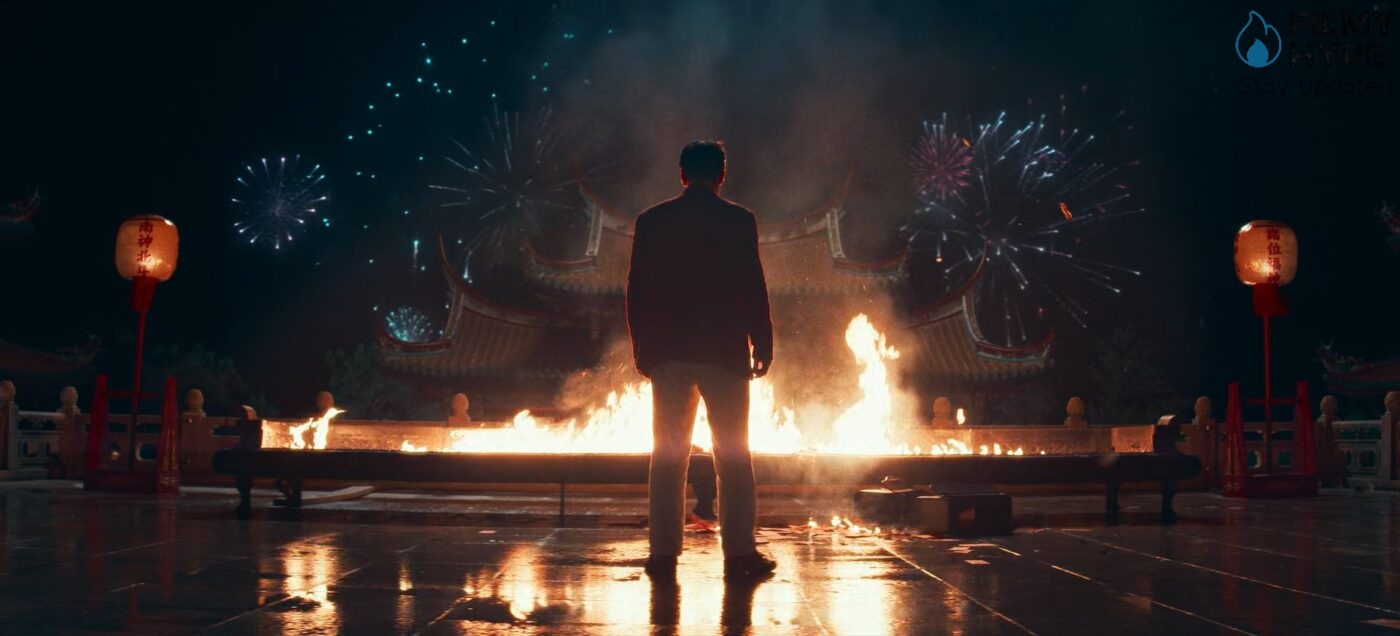
The next morning, Doyle wakes up with a number written on his hand and intends to get money to pay off his debts and avoid a tragic fate. Eventually, he discovers that this number is a code, which leads him to the money that Dao Mingg had saved, and that he intends to use to play again and, this time, try to win. Surprisingly, that’s what starts to happen. Doyle seems to be lucky again, but the casino manager thinks he’s cheating or playing with a “ghost” and tries to get him out of the place, but he convinces him to make a final bet, which ends up winning. That victory is what gives you enough money to pay off your debt, and more. Doyle tries to find Dao Ming to give him the rest of the money so that she can also change her luck, but there he finds out that she died on the night of the festival, so he ends up burning that money, instead of using it to continue betting.
Ballad of a Small Player Ending Explained: Redemption, Ghosts, and a Final, Fiery Offering
The final act of Ballad of a Small Player leaves viewers in a haze of Macau cigarette smoke and existential dread. Just like its protagonist, Lord Doyle, the film deals its cards with a shaky hand, blurring the lines between reality, hallucination, and the afterlife. If you’ve just finished the Netflix film and are left wondering what truly happened, you’re not alone.
Let’s break down the haunting ending of Ballad of a Small Player, piece by piece, to uncover the meaning behind Doyle’s collapse and his poignant final gesture.
The Setup: Doyle’s Descent into Hell
By the time we reach the climax, Lord Doyle is a broken man. Drowning in gambling debts, his body weakened by a bad heart and too much champagne, he is also haunted—quite literally—by the ghosts of people he has swindled and wronged. His desperation is a vicious cycle: to repay his debts, he needs money, and to get money, he believes he must win at the tables. It’s a trap, and he’s caught firmly in its jaws.
His last, fleeting hope appears in the form of Dao-Ming, a moneylender plagued by her own guilt. She no longer wants to enable gamblers, as her loans often lead to tragedy, like the debtor who jumped off a bridge. On the Hungry Ghosts Festival, the very night a desperate Doyle pleads for her help, Dao-Ming has already decided to end her own life. She shares one last, quiet moment with him on the beach, a moment of human connection before she walks into the sea.
When Doyle awakes, she is gone. But she has left a cryptic message scribbled on his palm: the numbers “31 07 2005.” A date. A key. But to what?
The Mystery: The Number, The Hut, and the Bags of Cash
Driven by desperation and a clue from Dao-Ming’s apartment (a postcard of Lamma Island), Doyle seeks out a remote hut. This is where the film masterfully introduces its central ambiguity.
Did any of this really happen?
We must remember that Doyle suffered a severe heart attack shortly before this. He has vivid hallucinations, like imagining a full lunch with Dao-Ming, who, by then, was already dead. So, when he travels to Lamma Island, finds the hut, uses the number (which we can infer is a lock combination) to open a shed, and discovers two bags full of cash—is this real, or is it a dying man’s fantasy?
There are two compelling interpretations:
- The Literal Survival: Doyle survived the heart attack, found the real money Dao-Ming had hidden (perhaps money her own mother refused, symbolizing a past she couldn’t escape), and used it to go on an incredible winning streak, becoming the “Great Player” he always dreamed of being.
- The Afterlife Theory: Doyle died in that restaurant. The entire sequence after his heart attack is his soul’s journey in a Buddhist purgatory (Naraka), wrestling with his demons. The story of a gambler winning every hand in the afterlife, which his friend Adrian once told him, is now literally his reality—a final chance to settle his karmic debts before moving on.
The True Meaning: Guilt, Illusion, and the Final Offering
Regardless of which interpretation you lean towards, the film’s emotional core remains the same: Doyle is consumed by guilt. He isn’t just guilty about his debts; he’s guilty about Dao-Ming’s death and the purity of the connection they briefly shared.
This guilt becomes the anchor that drags him back to “reality.” After his fantastical winning spree, he returns to the Rainbow Casino, where a grandmother reveals the brutal truth: Dao-Ming is truly gone. This shatters his illusion.
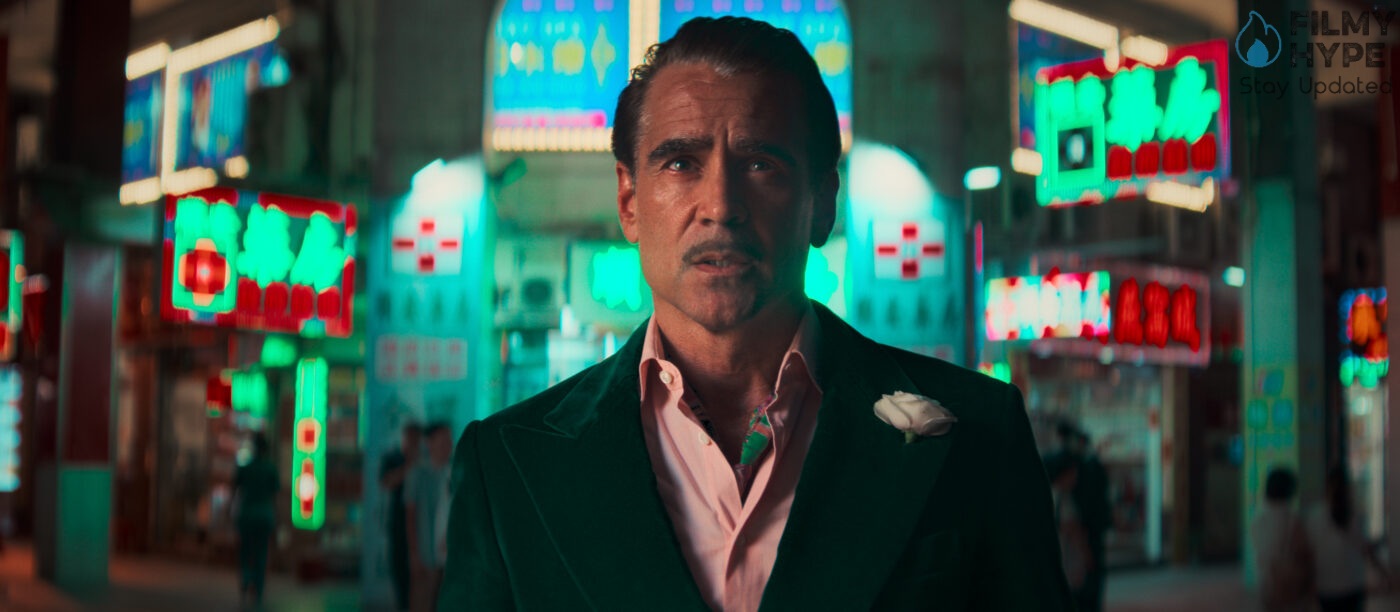
He realizes he can never repay her. The money is meaningless to a ghost. But then, he remembers their conversation on the beach about the Hungry Ghosts Festival, where the living burn offerings for the deceased.
This memory sparks his final, profound act of redemption.
The Ending: Burning the Money
In the film’s powerful final scene, Doyle doesn’t pay off a debt. He performs a ritual. He takes both bags of cash—the very object of his and Dao-Ming’s torment—and burns them as an offering to her spirit.
This act is layered with meaning:
- It Starves the “Hungry Ghost”: The film frames gambling addiction as a “hungry spirit.” The more you feed it (with money, with hope), the hungrier it gets. By burning the money, Doyle is finally starving the addiction that destroyed his life and contributed to Dao-Ming’s despair.
- It’s a Symbolic Repayment: He is symbolically returning what he stole, not just from Dao-Ming, but from life itself. It’s his way of mending their relationship and giving her the peace she sought.
- It Rejects the Cycle: Dao-Ming hid the money, unable to use it due to her own guilt. Doyle, by destroying it, breaks this cycle. He chooses humanity over currency, peace over profit.
An Open Ending: Peace or Perpetual Punishment?
So, did Doyle find peace? The film intentionally leaves it open.
If he is alive, he has likely overcome his addiction, having learned a brutal lesson about the cost of his actions. If he is dead, this entire journey was his soul’s path to atonement, allowing him and Dao-Ming to finally be free.
Ballad of a Small Player is not a simple story of a gambler’s luck. It’s a poignant reflection on addiction, the weight of guilt, and the fragile possibility of forgiveness. Whether in life or death, Doyle’s final gesture—releasing his obsession into the flames—is a heartbreaking and hopeful crumb of reclaimed humanity. He has, finally, stopped playing.
Who Dies in Ballad of a Small Player?
Is Dao Ming a ghost? After Dao Ming disappears, Doyle sees her again, but it soon begins to becomes clear that she is not really there. What is unclear is whether she is a ghost (as the casino manager says) or a figment of Doyle’s imagination, who created her to try to survive the situation she found herself in. Is Doyle dead? It must be remembered that Doyle has a heart attack at one point in this story, and that there are situations and moments in the film in which it seems that he is in a kind of limbo (like that scene on the beach, where he is alone and watching the city), in addition, Lippett (who is also a gambling addict and poses as a prince) tells him an anecdote about a gambler who dies and reaches hell. All we see could be Doyle’s journey through the underworld, but there’s really nothing to confirm that he died. Rather, it seems that he managed to survive and that this whole experience led him to realize his mistakes and failures, and to take a different path (that’s why he doesn’t use the money he was going to give to Dao Ming), at least for the moment.
What Does the Maldita Suerte Credits Scene Mean?
The scene seen during the credits shows the meeting between Cynthia (who is actually called Betty) and Doyle, which turns into an eccentric scene on a dance floor (according to Tudum, Tilda Swinton the specifically requested) which, according to the film’s creators, is a taste of the different life Doyle could have, plus it ends on a more positive note.
“It all came from the relationship I saw between Tilda and Colin. It is a delight for the public, it fills you with joy and happiness, it is a dance, a celebration of life. It is a celebration of the lives of these two characters. And that maybe they will have a new beginning”, said the director Edward Berger to Tudum.