
Agatha Christie’s Seven Dials Review: An Adaptation Short on Biting on Netflix
Agatha Christie’s Seven Dials Review and Analysis
Cast: Mia McKenna-Bruce, Helena Bonham Carter, Martin Freeman, Edward Bluemel, Nabhaan Rizwan, Corey Mylchreest
Direction: Chris Sweeney
Streaming Platform: Netflix
Filmyhype.com Ratings: 3.5/5 (three and a half stars)
The new Netflix series “Agatha Christie’s Seven Dials?” is worth watching. The elements for this miniseries to be a success are all there. It is inspired by a novel by the queen of detective fiction, has a very intriguing title in itself, features the cast of actors of the calibre of two-time Oscar nominee Helena Bonham Carter (Harry Potter, Corpse Bride, Sweeney Todd, Charlie and the Chocolate Factory) and is composed of only three episodes, an element that, to today’s audiences who prefer increasingly shorter narratives, you might like it a lot. But is it really as good as this series looks? Netflix’s 2026 began with a literary mystery, with interesting adaptations, each in a different way. After Leak from modern thrillers by Harlan Coben and Run Away from the novel of the same name by Alice Feeney, it’s the turn of a great classic: Agatha Christie’s Seven Dials, revisited with a nod to contemporaneity.
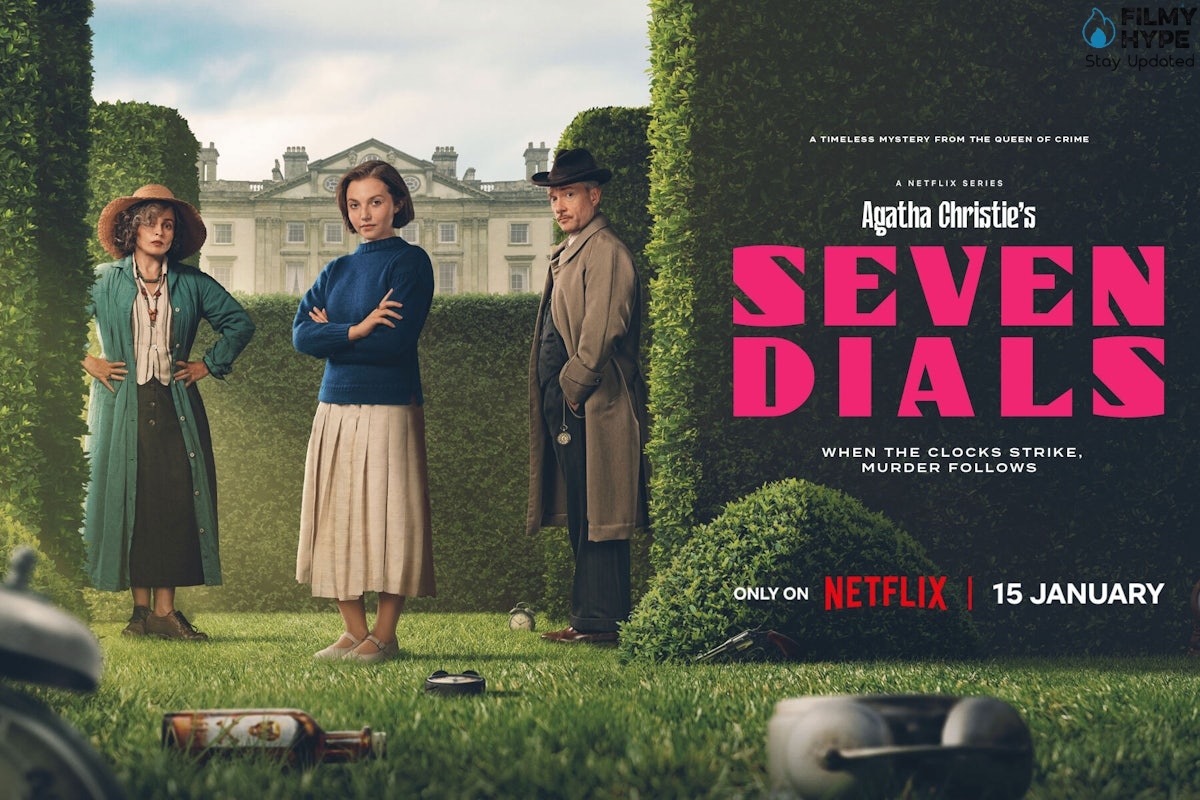
A work that is not part of the investigations of Poirot or Miss Marple, the most famous characters born from the pen of the queen of detective fiction, but two lesser-known ones: the young heiress Bundle Brent and Superintendent Buttle. The title clearly seems to refer to Gerry Wade’s alarm clocks being put in his room as a joke for being an eternal sleepyhead, even when he’s on holiday at someone else’s house, as in this case. But the truth, as often happens, may be lurking somewhere else. While the police archive the case as an accidental death, Bundle – heiress with insatiable curiosity and very attached to the victim – decides to investigate on your own behalf. Challenging her mother’s authority and the pragmatism of Inspector Battle of Scotland Yard, the girl enters a jumble that soon turns out to be broader and more dangerous than expected, between secret societies and state secrets capable of putting the fate of the nation at risk.
Agatha Christie’s Seven Dials Review: The Story Plot
The story revolves around Lady Eileen “Bundle” Brent, a bright and curious young woman who finds herself embroiled in a mystery that began almost as a joke and soon transformed into something more serious. The story proceeds with a loose rhythm, alternating investigation, irony, and period atmosphere, focusing more on the charisma of the protagonist and the pleasure of the story than on the construction of a truly complex puzzle. The result is an elegant and accessible mystery, designed to entertain rather than surprise, which focuses on the charm of the characters and the setting, often leaving the investigative tension in the background. The result is a miniseries that is easy to watch, but struggles to leave a mark. The story begins with a seemingly inexplicable death: a young man found lifeless after a night marked by a prank involving alarm clocks scattered throughout his room.
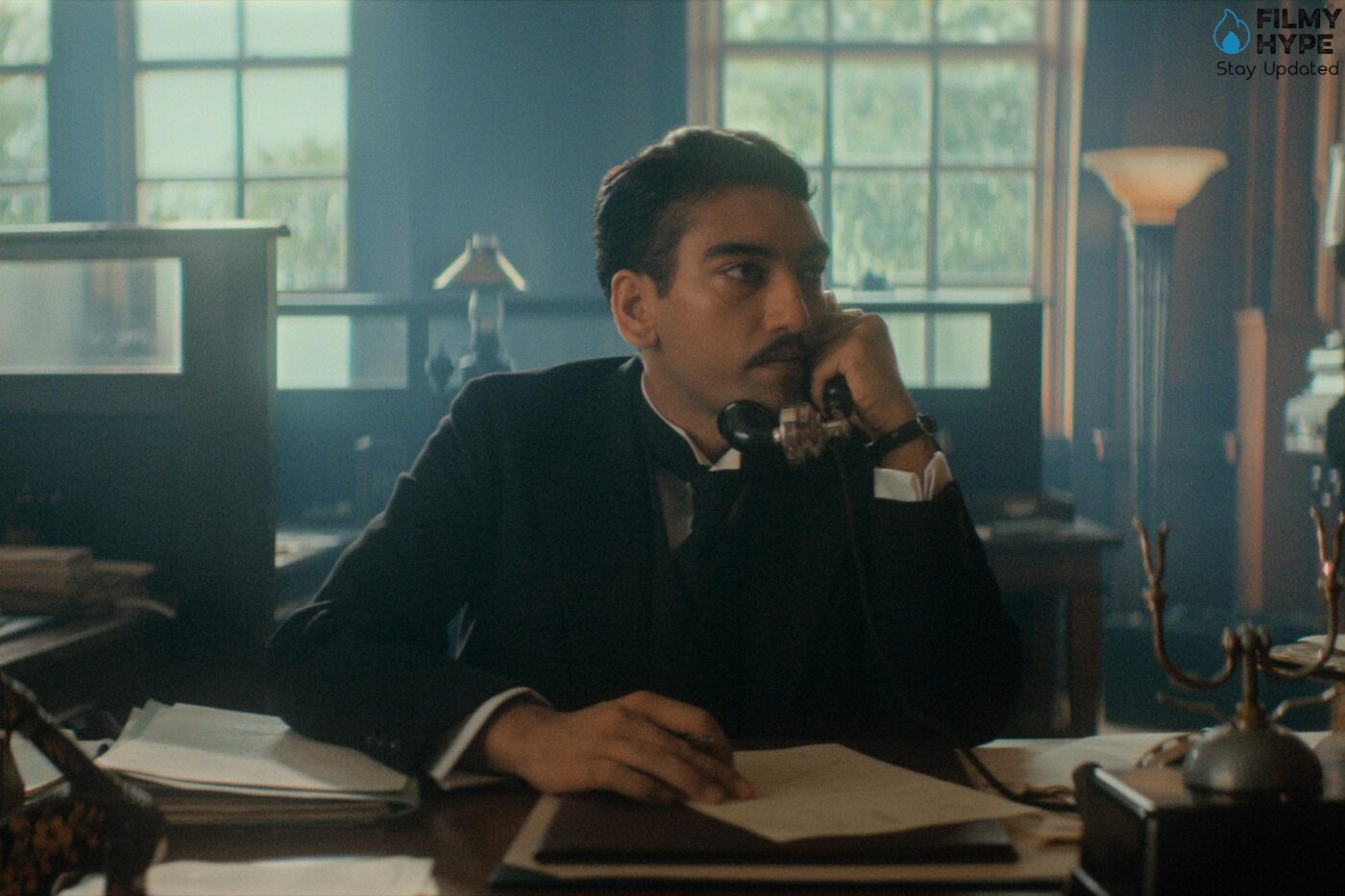
The “seven quadrants” immediately become a recurring motif, more evocative than truly threatening, and the narrative sets in motion, following the classic tracks of the whodunit. The problem is not the structure itself, but the way it is managed. The series progresses by adding clues, characters, and subplots, but rarely builds any real investigative tension. Revelations often come in explanatory blocks, more told than discovered, and the sense of danger always remains muted, as if the story were afraid of actually getting its hands dirty. The mystery works mechanically, but remains predictable, also because the limited number of truly relevant characters reduces the room for doubt.
Agatha Christie’s Seven Dials Review and Analysis
If on the surface this series seems irresistible, mixing the fascinating settings of early twentieth-century England with the noir atmospheres of classic detective stories, plus there’s Helena Bonham Carter, who has always given us great performances, watching the series immediately makes you realize how, in reality, it’s all smoke and no roast. The direction is the most convincing aspect of the entire product, but the story, the character development, and the screenplay do not win, do not hold the attention high, and do not create an emotional bond with the audience. Even the constant tension, typical of crime stories, is not strong enough and does not push us to become attached to the protagonists, poorly characterized and therefore uninteresting, nor does it make us curious to discover who and what is behind the crime. “The fault” for all this certainly lies in the brevity of the series.
We’re used to very short stories now, from 6 to 8 episodes, but wrapping an entire mystery novel in a series of just three episodes can only be rushed and unengaging. Furthermore, the narrative static nature and the speed with which the characters are presented to us, never truly explored, makes the vision too detached. And when emotions are missing from a story, everything is missing. If Agatha Christie’s Seven Dials, It Does It Mostly Thanks to Mia McKenna-Bruce. Her Bundle Brent is lively, determined, and ironic without being caricatural. She is a protagonist who moves naturally in a world that would like her to be marginal, and the series is aware that it must entrust her with its own balance. McKenna-Bruce manages to make credible a figure who would easily risk appearing too contemporary for the historical context, finding a meeting point between modern spirit and period setting. Whenever the narrative slows down or gets lost in functional dialogue, it is she who brings the focus back to what matters. The same cannot be said for many secondary characters, often reduced to narrative functions or simple social archetypes, more decorative than truly incisive.

The presence of names like Helena Bonham Carter and Martin Freeman promises much more than the series can deliver. Bonham Carter offers a controlled and distant portrait of Lady Caterham, interesting but intermittent, while Freeman enters the scene with a role that feels more like an investment in the future than a truly central element in the present. The problem is not the quality of the interpretations, but the writing: many characters appear and disappear without a trace, and some dynamics are abandoned before finding significant development. The result is an unbalanced ensemble, in which the charisma of the actors does not always find a narrative counterpart. Visually, Agatha Christie’s Seven Dials is a curated series: costumes, sets, and locations convey an elegant and glossy 1920s England, with occasional openings towards more exotic settings. However, this aesthetic richness never translates into true vision.
The direction accompanies the story without interpreting it, limiting itself to illustrating the events. The result is a pleasant but anonymous staging, which rarely uses space or rhythm to reinforce the mystery. Even moments of revelation, traditionally central to the genre, are unmemorable. At the end of the three episodes, Agatha Christie’s Seven Dials reveals itself for what it is: a product designed to entertain without disturbing, closer to a reassuring reinterpretation of the classic detective story than to a true reinvention. It’s not a bad series, but it’s a series that consistently plays the downside, preferring familiarity to risk. Those who seek an elegant mystery, led by a charismatic protagonist, will find bread for their teeth. Those hoping for an adaptation that would truly renew Agatha Christie will likely be left feeling like they’ve seen something already known, carefully packaged but without urgency.
This story, which moves through the 1920s and 1930s in England, through dark, smoky alleys and elegant, ruined houses, has just the flavour of the classic detective story of the past, weaving together various storylines to throw viewers off. A work of simplification, compared to the original novel, just as happened with The Thursday Crime Club. And of modernization: the paper volume was already full of an ante-litteram feminism thanks to the character Bundle. A young woman of marriageable age who receives various marriage proposals – even in a tragicomic way – but who is above all interested in remaining independent and getting busy with investigations. Which here becomes a primary necessity – Gerry should have asked her to marry him, rather than a delight as in the original paper version.

In both cases, Lady Eileen becomes increasingly involved, but in the adaptation, some additional, missing, or modified choices appear superfluous and useless, since the underlying message would have arrived anyway. The “simplification” of the case in the adaptation also reduces the number of suspects, but this does not mean that the surprise effect is missing; in fact, the endings of the three episodes that make up the miniseries are perfect connections between one chapter and the next. What shines, in addition to the superb writing and elegant staging, is the cast. Three interpreters above all: Mia McKenna-Bruce, who gives Bundle tenacity and sweetness, immediately making us fond of his stubbornness and his talent as an amateur detective. Helena Bonham Carter is a perfect Lady Catheram, an out-of-touch matriarch and hostess living in an age that no longer exists and struggling to give way to the nouveau riche (a theme also addressed in Downton Abbey).
Martin Freeman returns to yellow after Watson in Sherlock and becomes a perfect Battle, torn between rigor and going against the rules, between one’s investigative intuition and having to manage Bundle’s frenzy. Not forgetting the others, a great little group of young talents. A murder mystery so successful, despite the changes, that we would like a new tradition from Netflix: an Agatha Christie mystery miniseries (perhaps without Poirot and Miss Marple) every January. There’s a (yellow) world out there all to discover. And to be adapted. But as we were saying, here too we are faced with a stale ploy in which things are said rather than shown. And Bundle is the character this mistake reflects on the most.
The young woman is described as intelligent, witty, and smart. Constantly. Every single character remembers over and over again how smart she is, how much her intelligence has brought her to where she is in that moment, how different she is from everyone else. Her mother tells her, her friends praise her, Gerry, the first victim, a camp luminary, reminds her of her, and the superintendent and agent of Scotland Yard, Battle, played by Martin Freeman, is impressed by her. Besides words, the actions she performs do not do justice to the portrait that is made of her. At the level of thrillers and intrigue, Agatha Christie’s Seven Dials is very weak. Director Chris Sweeney prefers to aim for an exquisitely 1930s atmosphere and focus on the settings that are the most successful elements. The initial intentions are to paint the English upper middle class with all the rot that good families hide, instead of focusing on the classic tension of detective stories. A choice that would be applauded if it were well made. Unfortunately, everything remains too superficial, with a lightness that does not match the story being staged.
If you pay attention, solving the case is very simple, too simple. Part of the beauty given by Christie’s novels is given by the game, by the playful side of reading, which pushes the reader to look for connections, to make theories, and investigate together with the protagonist. So let’s go back to Bundle and its bizarre characterization. The constant references to her intelligence remain words; the woman investigates roughly, and the different phases of the investigation, as well as its resolution, are not due to her sagacity, but to chance and luck. What’s the point of having an intelligent protagonist if she doesn’t act like one?

The good work of the main interpreters must, however, be acknowledged. Mia McKenna-Bruce and Martin Freeman bring Bundle and Superintendent Battle to life with just the right panache, characters who have already appeared in a previous Christie novel, never adapted for the small screen. The absence of that background is felt, leaving some areas of shadow in their relationship, so much so that the most incisive figure ends up being Lady Caterham, played by Helena Bonham Carter, although relegated to a role that, in fact, comes closer to a full-bodied cameo. A further limitation is represented by the large supporting cast. With many characters hastily introduced and little space to characterize them, orienting oneself becomes complicated, and the game of hypotheses –essential for any mystery – loses its effectiveness. When the truth finally comes out, the revelation is predictable, despite an ending set on a train that tries to liven up a staging that until then had remained rather stilted. If the series gets good numbers in terms of views, a second season already appears around the corner, with the very open epilogue ready to relaunch the adventures of Bundle and Inspector Battle.
Agatha Christie’s Seven Dials Review: The Last Words
Agatha Christie’s Seven Dials is a compelling, if sometimes needlessly modernized, adaptation of such a classic. The cast is excellent, the writing and direction are refined, and the episode structure is compelling, albeit with a few too many changes to advance the main themes, adding that of disgraced nobility. We liked it so much that we would like more, maybe every year. A miniseries that relies on the charisma of its heroine to compensate for a predictable investigation, choosing the path of light entertainment rather than a true reinvention of the classic mystery. Agatha Christie’s Seven Dials brings to the small screen one of the least incisive novels by the very famous English writer, entrusting a small but combative protagonist and a seasoned investigator with the task of unraveling a more complex murder case than expected. But in a landscape dominated by increasingly sophisticated whodunits and a now savvy audience, the mystery remains on the surface, and the suspense never really comes through.






One Comment