
There’s a moment that’s been hanging over The Rings of Power since the title was first announced. It’s the promise embedded in the name itself, the event that defines the Second Age of Middle-earth, the act that turns a dark lord from a schemer in the shadows into the existential threat that will echo across thousands of years of history. Sauron forges the One Ring. And after two seasons of setup—of disguised identities and whispered manipulations, of rings crafted for elves and dwarves and men, of Mordor rising from ash and volcanic fire—the show is finally ready to deliver.
“This is the season where Sauron makes the One Ring in the volcano,” co-showrunner Patrick McKay tells Empire in their new cover story. The sentence is simple. The implications are everything. Season 3, arriving on Prime Video November 11, is being positioned as the moment The Rings of Power stops building its world and starts burning it down.
The Rings of Power Season 3 Will Finally Show Sauron Forge: The Villain Steps Into the Light
For two seasons, Charlie Vickers’ Sauron has been a shape-shifter. He arrived as Halbrand, the scruffy, reluctant king of the Southlands, a man who seemed to be running from something. He spent Season 1 earning trust, particularly Galadriel’s, before the mask slipped in the finale. Season 2 saw him operating more openly as Annatar, the Lord of Gifts, manipulating Celebrimbor into forging the rings that would eventually corrupt Middle-earth’s greatest civilizations. But even then, he was still playing a part. Still hiding behind a fair face and a silver tongue.
Season 3, by all accounts, dispenses with the disguises. “We have a full-on villain this season, in a way that was quite different before,” says co-showrunner J.D. Payne. Sauron is in Mordor. He’s in Barad-dûr, the dark tower that will become synonymous with his reign. And he’s done pretending.
“This third season is darker, more dangerous,” McKay adds. “No one is safe.” That phrase—no one is safe—is the kind of thing showrunners say when they want to signal that the stakes have genuinely changed. The first two seasons had deaths, certainly, but they operated within the guardrails of a story that was still introducing its pieces. Season 3 sounds like it’s removing those guardrails. Characters you’ve spent years with may not make it to the end. The darkness that’s been gathering on the horizon is finally rolling in.
The Forging Sequence
The creation of the One Ring isn’t just a plot point. It’s one of the foundational images of Tolkien’s entire legendarium. The dark lord, in the fires of Mount Doom, pouring his cruelty and his malice and his will to dominate all life into a single golden band. The words inscribed in the Black Speech. The moment that connects everything—the rings given to the dwarves and men, the corruption of the Nazgûl, the war of the Last Alliance, Isildur’s failure, and, thousands of years later, a hobbit standing at the Cracks of Doom with the fate of the world in his small hands.
The show knows the weight of what it’s attempting. Vickers certainly does. “The first day I walked onto that set, I cried,” he tells Empire. “What an amazing privilege and honour to be able to tell that story.” The production treated the sequence accordingly. “We were doing the Ring across two weeks, because the sequence is so long,” Vickers says. Two weeks for a single scene, or a series of scenes, centered on a single act. That’s the kind of time you spend when you know you’re filming something that will be picked apart frame by frame by one of the most passionate fanbases in the world.
McKay doesn’t undersell the result. “The single most ambitious, technically challenging sequence we’ve ever done on the show,” he says. “Charlie’s performance is absolutely staggering. We never could have prepared for it.” There’s a note of genuine awe in the quote, the sense that whatever Vickers did on that set, it surprised even the people who wrote the words he was performing.
The Bombs Start Exploding
The showrunners have described the first two seasons as a long fuse. “The first two seasons were all about building out this world,” McKay explains. “But throughout that time, we’re lighting all these fuses and setting all these stories in motion. The third season is when all those bombs are starting to explode.”
It’s an apt metaphor. Season 1 had to introduce a sprawling cast across multiple locations, establish the political dynamics of the Second Age, and convince audiences that a Lord of the Rings series without Frodo or Aragorn was worth their time. Season 2 tightened the focus, deepened the character work, and ended with some genuinely satisfying payoff—Celebrimbor’s fate, the reveal of the Stranger as Gandalf, Sauron’s return to Mordor.
Season 3 is where the architecture those earlier seasons constructed gets tested. The rings are out in the world. The elves have their three. The dwarves have their seven. The men will soon have their nine. And Sauron is about to forge the One Ring that binds them all. The stage is set for the corruption of the Nazgûl, the downfall of Númenor, and eventually the Last Alliance of Elves and Men. The show has five seasons planned, and Season 3 sounds like the hinge point—the moment the story pivots from setup to catastrophe.
The Man in the Tower
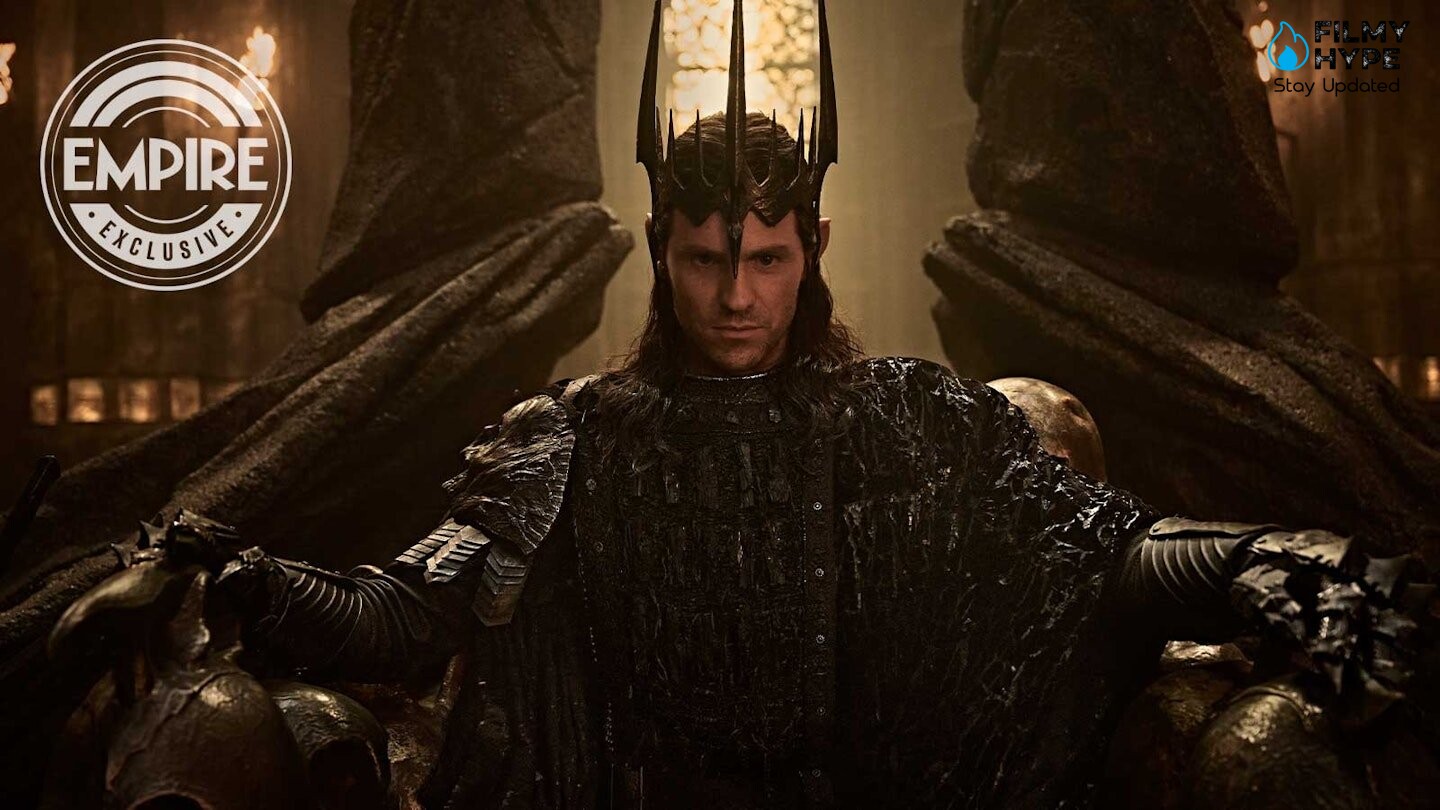
The exclusive image accompanying Empire‘s cover story shows Vickers as Sauron in Barad-dûr. The costume, the setting, and the whole visual language suggest a character who has fully stepped into his power. This isn’t Halbrand brooding in a forge. This isn’t Annatar smiling his way through Celebrimbor’s workshop. This is the Dark Lord in his seat of power, and the image alone communicates how far the show has come from its beginnings.
Vickers has been one of the show’s quiet strengths. His performance as Halbrand was compellingly ambiguous—charming enough to make you understand why Galadriel trusted him, dangerous enough to make you nervous whenever he was in a scene. His Annatar was silkier, more controlled, the mask of a being who’s had centuries to perfect the art of seeming benevolent. Now the mask is off entirely, and the challenge for Vickers is to make Sauron terrifying without the benefit of ambiguity. Pure villainy is harder to pull off than moral complexity. If the showrunners are already calling his performance “staggering,” that’s a good sign.
The Larger Picture
The Rings of Power Season 3 arrives November 11, continuing the show’s established pattern of a new season every two years. The full Empire cover story, based on three days spent on set and featuring interviews with McKay, Payne, Vickers, Morfydd Clark, Robert Aramayo, Daniel Weyman, and more, hits newsstands July 30.
Meanwhile, the broader Middle-earth screen universe continues to expand. The Lord of the Rings: The Hunt for Gollum, directed by and starring Andy Serkis, is slated for December 2027. But for now, the center of gravity is firmly with The Rings of Power. The show has survived the initial wave of discourse that greeted its first season, found its footing in its second, and now arrives at its third with the confidence of a production that knows exactly what it’s doing and where it’s going.
Sauron is in Mordor. The forge is lit. The One Ring is about to be made. And as the showrunners keep reminding us, no one is safe. The bombs are exploding. All that’s left is to watch them fall.