The Beauty Season 1 Review: Ryan Murphy Turns Perfection Into a Viral Nightmare?
The Beauty Season 1 Review and Ratings
Cast: Evan Peters, Rebecca Hall, Ashton Kutcher, Anthony Ramos, Jeremy Pope, Isabella Rossellini, Bella Hadid
Direction: Michael Uppendahl, Alexis Martin Woodall
Streaming Platform: FX Network
Filmyhype.com Ratings: 4/5 (four stars)
Crazy. Irreverent. Brutal. Brilliant. “The Beauty”, the Ryan Murphy’s new thriller series about the obsession with beauty, is phenomenal. Prepare for great things because this title, created by one of the brightest minds on the small screen and based on the comic series by Haun and Jason A. Hurley, is ready to glue you to the screen and become the new serial phenomenon of the year. Available on FX Network from January 22nd with the first 3 episodes, and then continuing with one a week, every Thursday, up until the eleventh episode, “The Beauty” boasts a stellar cast to say the least, where a surprising Ashton Kutcher stands out, giving us the best performance of his entire career alongside an impeccable Isabella Rossellini. But there are also Evan Peters, Rebecca Hall, and even some Italian extras like Riccardo Scamarcio and Tommaso Basili.
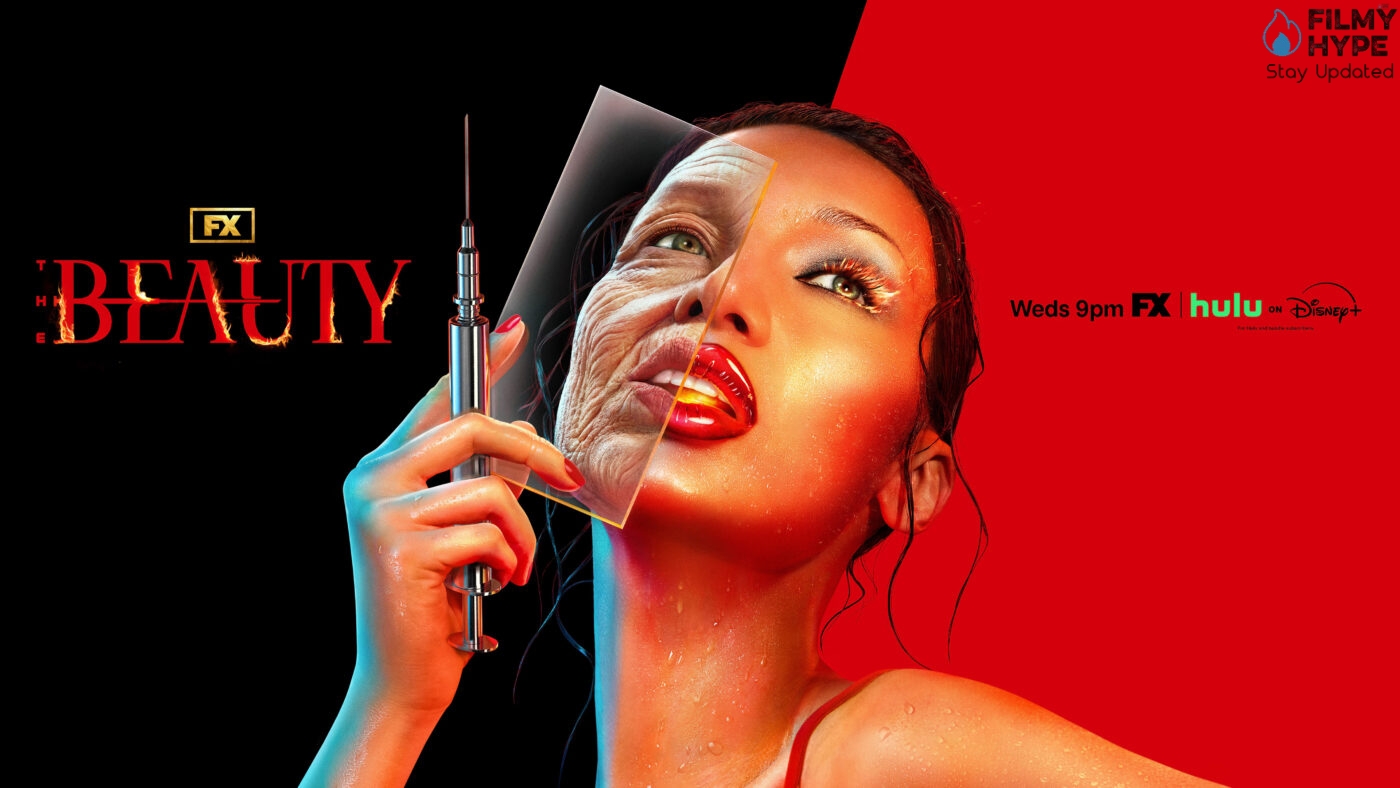
The Beauty marks a return to family territory for Ryan Murphy: one in which pop entertainment mixes with shouted satire, often obvious, sometimes surprisingly centered. It does not aim for realism, it does not seek refinement or prestige”, it does not pretend to have a single lucid and conclusive thesis. It’s more of a carousel of contemporary obsessions – beauty standards, pharmacology as an existential shortcut, predatory capitalism, social culture – disguised as an international procedural and unrestrained body horror. The central idea, taken from the comic of the same name, is deliberately brutal in its simplicity: there is a substance (which later became a virus) capable of making anyone “perfect”. Perfection, however, is not free: the bodies, after a spectacular “glow-up” phase, collapse in a gruesome way. And the most cynical –and most Murphyan– insight is that not even horror really stops the question: if beauty were truly within reach, how many people would accept the risk?
The Beauty Season 1 Review: The Story Plot
In the FX series “The Beauty”, the world of high fashion is turned upside down when some international supermodels begin to die under mysterious and gruesome circumstances. FBI agents “Cooper Madsen” (Evan Peters) and “Jordan Bennett” (Rebecca Hall) are sent to Paris to uncover the truth. As they delve deeper into the case, they learn about a sexually transmitted virus that transforms ordinary people into physically perfect beings, but with terrifying consequences.
Their investigation brings them directly into the crosshairs of “The Corporation” (Ashton Kutcher), a shadowy tech billionaire who has secretly created a miracle drug called “The Beauty” and who is willing to do anything to protect his trillion-dollar empire, even unleash his deadly hitman, “The Assassin” (Anthony Ramos). As the epidemic spreads, “Jeremy” (Jeremy Pope), a desperate outcast, becomes embroiled in chaos in search of purpose; meanwhile, agents rush to Paris, Venice, Rome, and New York to stop a threat that could alter the future of humanity. “The Beauty” is a global thriller that asks: What would you be willing to sacrifice for perfection?
The opening scene, set in Paris, is a statement of intent: a model on the catwalk, water as obsession, escape, chaos, escalation, and the final explosion. It’s a hyperkinetic set-piece reminiscent of a Murphy “action movie-like”, more interested in immediate shock than slow construction. It works because it’s consciously exaggerated, and because it sells the series as a high-consumption product: episodes that end in a relaunch, a new revelation, a new shock. And here lies one of its most obvious merits: even when the series stumbles over writing or thematic coherence, it rarely becomes “still”. It’s the kind of show that makes you say “one more” more out of inertia and morbid curiosity than out of genuine emotional involvement.
The Beauty Season 1 Review and Analysis
At the center of the investigation are Cooper Madsen and Jordan Bennett, FBI agents played by Evan Peters and Rebecca Hall. The choice to make them partners on a romantic level also immediately eliminates a classic tension (the “will they/won’t they”) and shifts the dynamic to complicity: dry jokes, impeccable style, a certain taste for cool poses. It is an effective engine for taking the viewer from Paris to Rome, Venice, and beyond, with the constant feeling that the series loves iconic places as much as it loves “perfect” bodies. Yet, right here, a contradiction emerges: The Beauty would like to criticize aesthetic standards, but builds much of its visual pleasure on those same standards. It’s a tension that could become interesting if the series truly dared to look inside itself; instead, it tends to pause a step earlier, preferring to use the obsession with beauty as narrative fuel rather than as an object of genuine self-criticism.
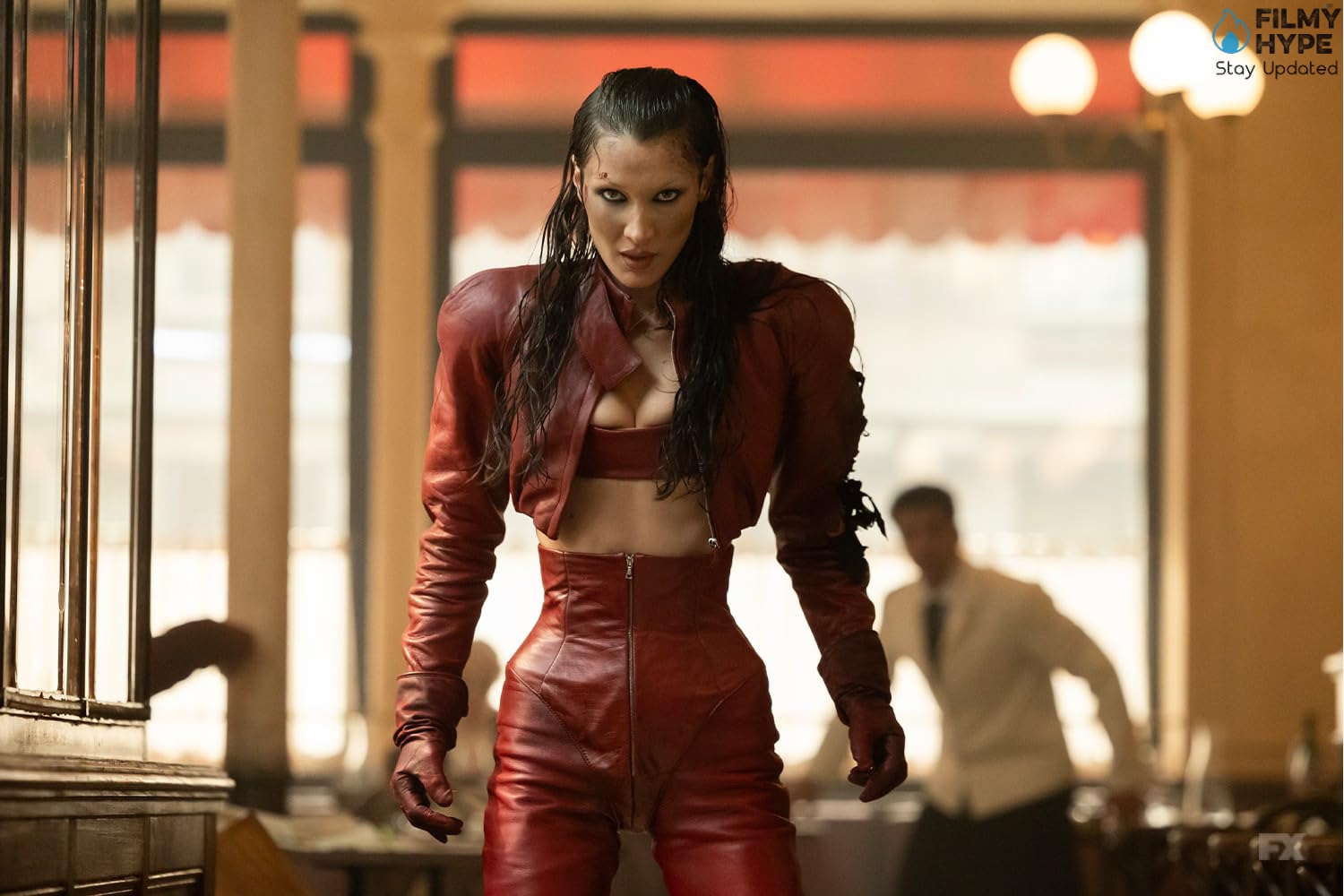
The most disturbing (and potentially most fertile) element is the idea that the “cure” becomes a sexually transmitted virus. There, the series openly plays with a metaphor that recalls the idea of desire as risk and the body as political territory. But The Beauty never insists enough on a single direction: it touches on social discourse, then runs away towards action, then returns to the grotesque, then indulges in lateral episodes. This instability is his trademark: Murphy often throws out huge themes and uses them as a showcase for impactful scenes, larger-than-life characters, and twists “from the final episode” strung throughout. The result is that the series can feel, depending on the moment, like satire, thriller, camp, body horror, or almost like a very rich and very dirty soap.
The billionaire behind the phenomenon – the Corporation played by Ashton Kutcher – embodies a predatory power that does not need to be subtle. He is a character more symbolic than psychological: you don’t have to really understand it, you have to hate it enough to make the investigation urgent. His world is one of control, “branding” life, physical elimination of problems. For this reason, the killer played by Anthony Ramos also enters the scene, a repetitive but functional figure: the man who cleans the tracks and transforms the series, when necessary, into an action-thriller. Here, The Beauty strikes an intermittent balance between fun and flatness. When villains are used as plot accelerators, they work; when the series lets them wander around in circles between spurious dialogue and serial sadism, the feeling of Murphyan déjà vu is felt.
One of the most interesting –and also most frustrating– aspects is that The Beauty seems to be at its best when it moves away from the protagonists and puts “normal people” in the foreground. In those moments, satire becomes more concrete: the despair over a “wrong” body, the promise of an aesthetic rebirth as social redemption, the sadness behind the aspiration to perfection. These are episodes that suggest what The Beauty could be if it really chose a direction: a series less eager to amaze and more capable of digging. The problem is that this trajectory never becomes dominant: as soon as an episode finds an emotional center, the series starts again with another explosion, another character, another revelation. It’s Ryan Murphy’s typical “buffet” effect: a lot to taste, little that stays on. Your considerations also come into play here, which are perfectly in line with what emerges from the reviews: The Beauty has all of Murphy’s typical flaws. It is excessive when it is needed, but also when it is not needed. Sometimes it’s deliberately trashy and therefore enjoyable; other times it’s just redundant, insistent, more tedious than funny. When it accumulates subplots and deviations, the series risks a continuous disorientation effect, giving the impression of constantly changing direction without ever really stopping at a central idea.
Yet there is a reason if The Beauty remains hard to give up. It is a product that knows the language of binge: rhythm, shock, glamour, cliffhanger, cast of recognizable faces, and an aesthetic that alternates luxury and disgust. Even when the series is not “good” in the classic sense, it is entertaining in the Murphyan sense: drags you into a world where everything is too much, and asks you not to ask too many questions. It doesn’t always work, but when it does, it becomes that guilty pleasure you look at knowing it’s manipulating you – and accepting it. Murphy builds The Beauty like a cross between dystopian science fiction, body horror, and extreme and fierce criticism of pharmaceutical capitalism. The result is a series that –at least from watching the first episodes (the ones we were allowed to preview) – does not simply, trivially, question the dangers represented by the aesthetic standards of today’s society, but it aims to reflect on the economic and political implications of the concept of perfection and what happens when that supposed ideal ends up overturning absurd market logics. Who decides who deserves to be considered handsome? Who decides who is destined to pursue and then achieve perfection? And above all: what remains of humanity when the body becomes a financial asset?
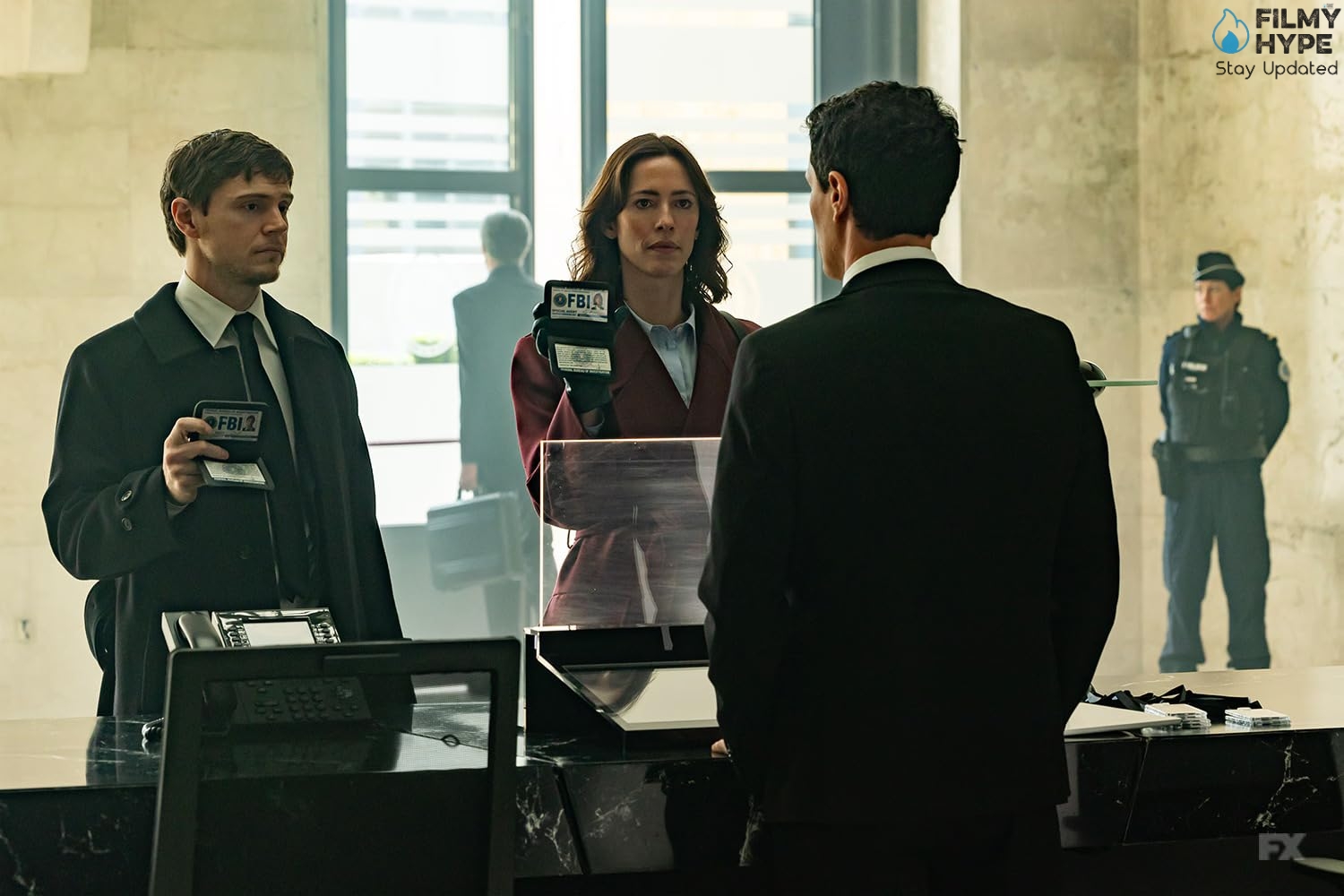
Leading the viewer into this disturbing scenario are FBI agents Cooper Madsen and Jordan Bennett, played by Evan Peters – Murphy’s fetish actor – and Rebecca Hall, undisputed protagonists of the very first episodes (and almost certainly also of those to come), called to investigate a series of seemingly inexplicable cases involving “perfect” models and individuals who literally exploded from within. Peters delivers measured and believable proof as a cynical and disillusioned investigator, while Hall manages to lend moral solidity and gravity to his character, making him an essential emotional counterweight in a world that continually tends toward the absurd. Among the most incisive characters presented in the first episodes is certainly that of Jeremy Pope, who embodies one of the most bitter declinations of the discourse on the obsessive pursuit of beauty: that of the individual convinced that physical perfection is a right, a shortcut to obtaining desire, recognition, and power.
At the same time, already from the second episode the series opens its gaze to the opposite front: that of the company – “The Corporation” – that created the “miracle drug”, introducing us not only to the character of Byron Forst, charismatic and ambiguous CEO played by Ashton Kutcher, emblem of a power that presents itself as a saving innovation but operates according to ruthless logics, but also that of the lethal hitman “The Assassin” played by Anthony Ramos, whose dynamics and interactions are sure to open up to the show’s most disturbing and potentially memorable moments. Visually, The Beauty does not give discounts. The vulnerability of bodies –which forces us to come to terms with our daily obsessions– is central from the opening sequences, which persist throughout the rest of the narrative, often difficult to sustain. The mutations of the same are immediately represented with a maniacal care for detail: skin that boils, bones that deform, teeth that fall out. The body, in The Beauty, is the place where the failure of the utopia of perfection manifests itself.
The problem with The Beauty is that the enormous amount of ideas put into play could struggle –episode after episode– to find a truly harmonious structure. From the very beginning, narrative construction proceeds by accumulation, mixing investigation and conspiracy, sex, power dynamics, philosophical reflections, explosions of violence, and moments of dark humor. In the long run, this approach could be disorienting: the hope is that the series will find a more solid balance, making the central discussion of why human beings are willing to destroy themselves to feel perfect more layered and satisfying. The tone isn’t always consistent either: the series works best when it embraces its more grotesque and perverse side, contrasting the dazzling images (and a perfectly fitting soundtrack!) with the horrors of the body. On the contrary, in times when it takes itself too seriously, it risks dampening its subversive force. Yet, The Beauty remains in its premises a deeply stimulating series, in which it is clear the desire to reflect, in a deliberately exasperated way, on the contradictions of our present: the obsession with the image, the domination of corporations, the fear of aging, and the commodification of the body.
The hope is that, once we get to the heart of the story, The Beauty manages to achieve that same “perfection” that he tells and that he tries to question so ferociously, without limiting himself to being yet another (albeit entertaining) journey into a dramatized and clearly frightening version of the world we live in. The concept behind “The Beauty” It’s as simple as it is terrifying: what if there were an infection transmissible through intimate relationships that, instead of deforming, made people physically perfect? This premise, which overturns the conventions of the horror genre, becomes the core of a narrative that explores the contemporary obsession with beauty and aesthetic perfection. The first episode introduces viewers to the glossy world of Parisian haute couture, where glittering catwalks and photographers’ flashes hide a deadly secret. When the most celebrated supermodels on the international scene begin dying under inexplicable and gruesome circumstances, the production spares no macabre details. Murphy, a master at balancing glamour and gore, orchestrates visually stunning sequences where physical decomposition contrasts brutally with the impeccable aesthetics that characterized the victims until moments before death.
The direction uses the luxurious photography typical of fashion campaigns to create an alienating contrast with the horror elements. The rooms are meticulously crafted: from Parisian ateliers to luxury hotel suites, each location exudes opulence, making the violence that unfolds there even more shocking. This visual dichotomy becomes the stylistic signature of the series. Evan Peters and Rebecca Hall. They play FBI agents Cooper Madsen and Jordan Bennett, respectively, an investigative duo who carry complex emotional baggage and complementary investigative methods. Peters, a veteran of productions, Murphy, offers a multifaceted performance that oscillates between professional obsession and personal vulnerability.
Rebecca Hall, a British actress of international caliber, perfectly balances the intensity of Peters with a more methodical and cerebral approach. His Jordan Bennett represents the rational foil needed to navigate the increasingly murky waters of the investigation. The chemistry between the two protagonists is gradually built through dialogues with different subtexts and moments of tension that reveal not only the details of the case but also the cracks in their professional armor. The second episode significantly delves into their dynamics, showing how early discoveries begin to undermine their certainties. The international production of “The Beauty” takes full advantage of its substantial budget, taking viewers through some of the world’s most iconic cities. Paris, with its decadent elegance, serves as the perfect starting point. The fast-paced sequences set around the city and in the city’s historic districts add a level of European sophistication to the narrative.
The second episode anticipates the moves to Venice, Rome, and New York, promising a narrative scale rarely seen in television productions. Each location is not chosen randomly but thematically reflects the evolution of history: Paris for fashion, Venice for disguised decadence, Rome for the eternity of classical beauty, and New York as the center of financial power. What elevates “The Beauty” beyond the simple thriller is its ability to act as a distorting mirror of contemporary society. The obsession with Instagram filters, increasingly accessible cosmetic surgery, and the billion-dollar wellness industry-all these cultural phenomena are explored through the lens of the horror genre. The series asks a fundamental question that resonates in every scene: how far are we willing to go to achieve an ideal of physical perfection? And what happens when that perfection becomes accessible but carries a terrifying price? Murphy It doesn’t offer easy answers, preferring to let viewers confront their own relationship with beauty and body image.
Ryan Murphy’s “The Beauty” is a powerful social critique of a world that is increasingly devoted to beauty, perfection, and perpetual youth. In a society that pushes us to continually perform, in a world that no longer admits defect, imperfection, or illness, here comes the cure: an antidote to human limitations, a serum capable of giving us the best version of ourselves: always beautiful, young, attractive, and disease-free. But what are we left with if, in an instant, every glimpse of our humanity is erased? What’s the point of dreams if you no longer need to sacrifice yourself to get them? What does life taste like if you already have everything effortlessly? Well, these are questions we are driven to ask ourselves by watching this series, which is a denunciation but also almost a premonition about the future that awaits us.
One of the winning cards of this series is that it manages to weave together different genres of storytelling, creating a hybrid that surprises and convinces. It’s a splatter series-and it shouldn’t scare non-lovers because it’s necessary and functional to the story-but “The Beauty” is also a thriller, a sci-fi title, a drama, a rom-com, a horror story. Ryan Murphy, with “The Beauty”, creates a complex and chameleon-like story that shows how a series doesn’t have to be limited to a single genre, to rules already written and paths already traveled, but can, indeed, dare to make a difference in this world where series are now all the same. She is reckless, original, almost “bold” and, thanks to this very dare of hers, she opens the way to a new way of making TV series. And we definitely needed this revolution in the world of the small screen.
The Beauty Season 1 Review: The Last Words
“The Beauty” establishes in its first two episodes a solid foundation for what could become one of the most discussed thrillers of the year. The combination of an excellent cast, an ambitious international production, socially relevant themes, and the distinctive vision of Ryan Murphy creates a television product that challenges the conventions of the genre. The series is not for the faint of heart: the horror sequences are explicit and disturbing.
However, for those willing to face his provocations, “The Beauty” offers a television experience that is as much a police investigation as it is a philosophical exploration of the hidden costs of the obsession with perfection. With the premises set by these initial episodes and the promise of an escalation that will cross continents, “The Beauty” is a candidate to be one of the must-see series of the contemporary television scene. Ryan Murphy demonstrates once again his ability to transform seemingly simple concepts into layered narratives that entertain while forcing reflection.