

In Stranger Things, the Upside Down begins as a whisper—a metallic tang in the air, a forest that feels off, and a town that seems to breathe in reverse. First introduced in Season 1, it’s not a world but a wound. Hawkins’ doppelgänger is a decaying replica of itself, frozen in time on November 6, 1983, the night Eleven (Millie Bobby Brown) first tore open a portal. This inverted dimension is not a parallel universe but a corrupted reflection. Its trees are skeletal, its streets clogged with ash-like particles, and its thick air with a wet, organic texture. The Upside Down is a “wet eraser,” scrubbing away the rules of reality while mimicking the surface of Hawkins. Is it the true nature? A hostile ecosystem that reacts to trauma, shaped by human will and cosmic horror.
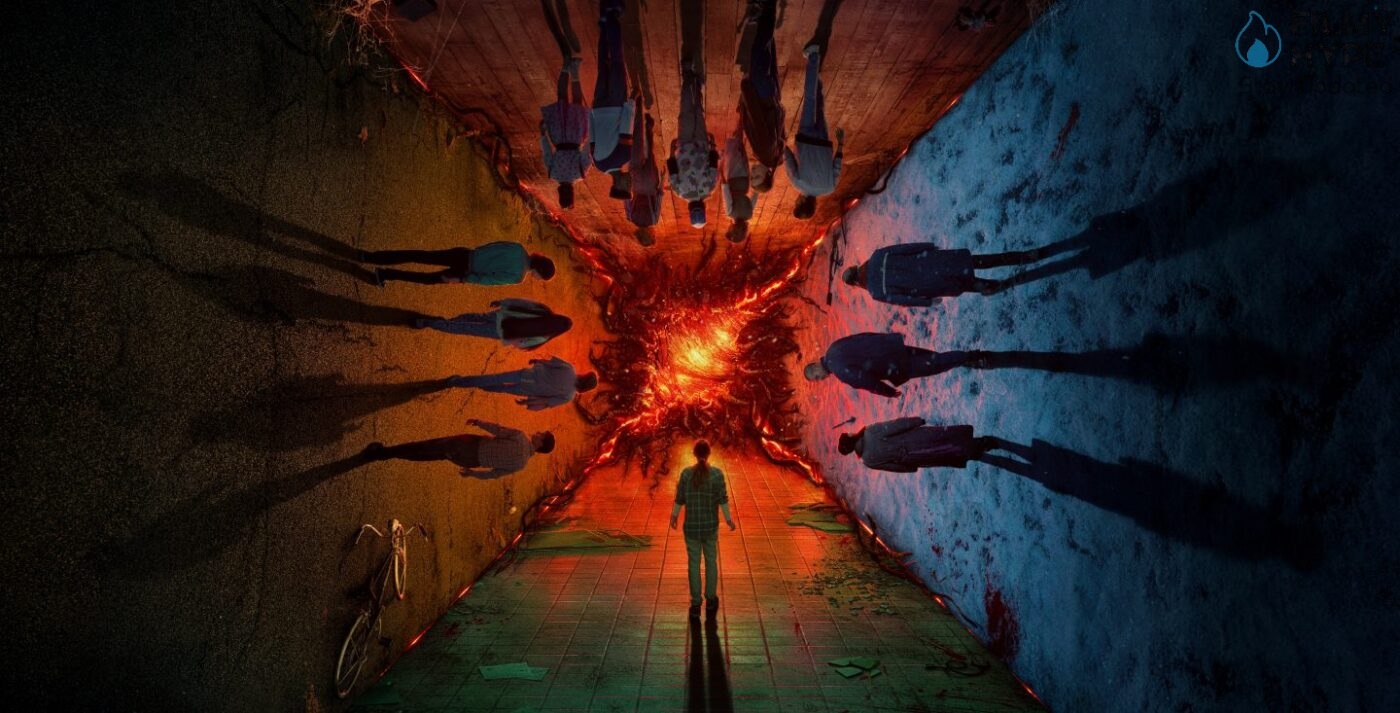
Stranger Things Upside Down Explained: Mythology of an Inverted Dimension
In reality, previous seasons were just the tip of the Iceberg. The first season showed that a portal to a parallel reality opened in Hawkins and that this reality was full of terrifying creatures that attacked anyone who crossed their path. The second season confirmed that this portal was not the only one, and now we know that new ones are opening in every place where victims have been found. In addition, the series implied that the Upside Down has been there for a long, long time, before Eleven existed or Dr. Brenner discovered Henry Creel’s (later Vecna) strange abilities. Creel (whose powers are not the result of an experiment, as in Eleven‘s case) became Vecna after killing everyone the children of the Rainbow Room and confront Eleven, who used all her strength to finish him off, which led to opening a portal and sending Henry to a strange world, where he suffered burns and ended up becoming a monster, feeding on people’s pain and He tortures them from their minds.
Stranger Things: The Biology of the Upside Down: A Hive Mind of Rot
The Upside Down’s ecosystem is neither plant nor animal but a hybrid hive network. Its roots, membranes, and filaments form a sensory web, acting as the exposed nervous system of a larger entity. Creatures like Demogorgons, Demodogs, and Vecna’s bat-like swarm are not independent beings but extensions of a collective consciousness.
Key Theories About Its Biology
- The Mind Flayer vs. Vecna: Initially, the Mind Flayer was believed to be the hive’s central intelligence. However, Season 4 rewrites this: the Mind Flayer is a construct created by Henry Creel (Vecna) to manifest his will. The Upside Down’s biology is reactive, not autonomous—it molds itself to the dominant consciousness.
- Henry Creel’s Role: When Eleven sent Henry to the Upside Down in 1979, he didn’t just survive; he rewired the dimension. His trauma and ambition turned the Upside Down into a weapon, proving it’s a canvas for the strongest mind.
- The Hive’s Purpose: The hive isn’t a hive in the insect sense. It’s an organic intelligence, where every creature is a limb of the same entity. This explains the coordinated attacks and the dimension’s ability to adapt to threats.
Henry Creel (Vecna): The Architect of the Upside Down
Henry Creel’s transformation into Vecna is the key to understanding the Upside Down’s evolution. Initially a victim of Hawkins Lab experiments, Henry fell into the Upside Down in 1979. There, he discovered the dimension’s plasticity, its ability to be shaped by a dominant will.
How Henry Remade the Upside Down
- From Victim to God: Henry didn’t just survive the Upside Down; he interpreted it. He built the Mind Flayer as a vessel for his rage, turning the dimension into a weapon to exact revenge on Hawkins.
- The Vecna Effect: The Upside Down’s biology responds to Henry’s trauma. When he becomes Vecna, the dimension mutates, creating new threats like the “Vecna” hive and catastrophic portals.
- The Final Season’s Stakes: Season 5 must resolve whether Henry’s influence can be undone—or if the Upside Down will forever be a reflection of his pain.
Portals: The Wounds Between Worlds
Portals in Stranger Things are not doors but infections. Each breach between Hawkins and the Upside Down allows the two realms to bleed into each other.
Types of Portals
- Psychic Portals: Created by Eleven or Henry using telepathy. These are the most dangerous, as they link minds across dimensions.
- Organic Portals: Generated by the Upside Down’s ecosystem, like the “wet hole” that traps Will Byers.
- Catastrophic Portals: The four-way collapse in Season 4, which merged Hawkins and the Upside Down into a hybrid space.
The final season must address whether these portals can be sealed—or if the two worlds are now irreversibly fused.
Will Byers: The Human Antenna
Will Byers (Noah Schnapp) is the linchpin of the Upside Down’s mythology. Initially seen as a victim, Will is later revealed to be a bridge between worlds. His sensitivity to the Upside Down’s vibrations (e.g., detecting Vecna) suggests a deeper connection.
Theories About Will’s Role
- Trauma as a Link: Part of Will’s consciousness remains trapped in the Upside Down, making him a living conduit. His emotions trigger Vecna’s attacks.
- The Final Key: The Duffer Brothers have hinted that Season 5 will return to Will’s origin. He may hold the secret to closing the portal—or becoming the Upside Down’s ultimate host.
Eleven: The Key to Closure
Eleven’s relationship with the Upside Down is paradoxical. She opened the first portal in 1983 but now seeks to close it. Her powers are not just tools—they’re a moral choice.
Why Eleven Matters
- The First Crack: Eleven’s experiment in Hawkins Lab created the Upside Down’s initial breach. Her guilt drives her to fix what she broke.
- The Final Battle: Season 5’s climax will likely pit Eleven against Vecna in a psychic showdown. Her ability to “close” the Upside Down may depend on her willingness to sacrifice herself.
Theories About the Upside Down’s True Nature
Stranger Things leaves the Upside Down’s origins intentionally ambiguous, but three theories dominate fan discourse:
- Pre-Existing Dimension: The Upside Down is an ancient, formless void that Henry “awoke.”
- Twisted Memory: It’s a replica of Hawkins created by Eleven’s trauma, a “world made of twisted memory.”
- Malleable Canvas: A dimension without inherent form, shaped by the strongest mind (currently Henry).
Season 4 leans toward the third theory: the Upside Down is a primordial space that gains structure when influenced by a dominant consciousness.
What Season 5 Must Answer
The final season of Stranger Things must resolve lingering mysteries:
- Why Hawkins? Why did the Upside Down replicate Hawkins in 1983? Is the town a random target or a cosmic fulcrum?
- Max’s Fate: Max (Sadie Sink) is trapped “between worlds.” Is she a bridge, a prisoner, or a new force in the Upside Down?
- The Final Sacrifice: Will Eleven have to die to seal the portal? Can Hawkins survive without erasing its history?
The Upside Down as a Metaphor
At its core, the Upside Down is a radical metaphor for trauma and duality. It’s not just a monster-filled dimension—it’s the shadow cast by human choices. Hawkins’ “normalcy” was an illusion; the Upside Down reveals the rot beneath.
The Final Choice
Stranger Things must decide whether the Upside Down is a force to be destroyed or a part of reality to be accepted. Henry turned pain into domination; Eleven must turn it into healing. The end of the series will hinge on whether the Upside Down is a landscape or a consequence.
Henry Creel Created It
According to a Reddit user, identified as SSpotions, it is possible that Henry Creel created the Upside Down when I was in Hawkins’ lab.
Henry spent time in a coma after killing his family and framing his father. Yes, it is possible that the Upside Down formed at that time, like a world he could escape to while in the hospital, and Eleven simply gave him a way to cross over into that world again when he used his powers to stop him.
But some say that the Upside Down and the world of Vecna are not the same. This is because the Upside Down is usually represented with the color black, while the world in which the villain takes its victims is red and seems to be frozen in time. The Wheeler house, for example, is filled with objects from a few years ago, which may point to Vecna waking up again when Eleven accidentally freed the demogorgon.
Eleven Created the Upside Down
Danny-Wah, another Reddit user, says that, as well as Henry Creel he created his own world (Mindscape) to escape reality, it is possible that Eleven she created the Upside Down, even without realizing it, while being tested by Hawkins Laboratory and abused by her peers, as a defense mechanism and a place she could escape to if she needed to.
The monsters could certainly be a representation of her own companions and everything she experienced. But the fact that Russia also has its own demogorgon may be a sign that Eleven had nothing to do with this.
Pyrohemian says that: “Eleven created the Upside Down. This theory is extracted from its interesting relationship with the demigorgon. Is it possible that she created both the Upside Down and the monster through her immense anguish during her imprisonment, manifesting it through her powers? This would mean that both the monster and the Upside Down are manifestations of his imagination or dark side”.
It is a Parallel Reality That Has Always Been There
In the first season of the series, the science teacher explains to Mike and his friends about how a parallel reality works, claiming that it would be a kind of mirror of what exists in the world in which they live.
This supports the theory that the Upside Down has always existed; it simply took a great force, like Eleven‘s, to break the barrier between the two realities, allowing them to intersect and its inhabitants to pass from one to the other. If so, the Upside Down is as old as the “normal” world.
Supposedly, Dr. Brenner somehow discovered that the Upside Down existed, which is why he was so interested in Henry Creel’s and Eleven‘s powers, before encountering the Demogorgon himself.
