
Last Samurai Standing Review: A New “Squid Game” On Netflix and No One Has Noticed!
Here’s a new one on Netflix, Squid Game,” and no one noticed. It’s called “Last Samurai Standing” and it’s a new Japanese survival game, set in the late 19th century, where former samurai must kill each other to win a prize pool of 100 billion yen. A bit like what happened with season 1 of “Squid Game”, this series was not advertised by Netflix at all. It simply appeared in the streaming platform’s catalog, attracting the attention mainly of fans of action series, samurai, and Japanese culture. But just seeing one episode is enough to immediately understand that we are faced with a new survival game, ready to conquer the whole world. There is a moment, looking at Last Samurai Standing, in which the viewer understands exactly what they are looking at. It is not a simple samurai variant of Squid Game, nor a belated legacy of the success of Shogun. It’s not a battle royal disguised as historical drama, nor a historical drama disguised as battle royal.
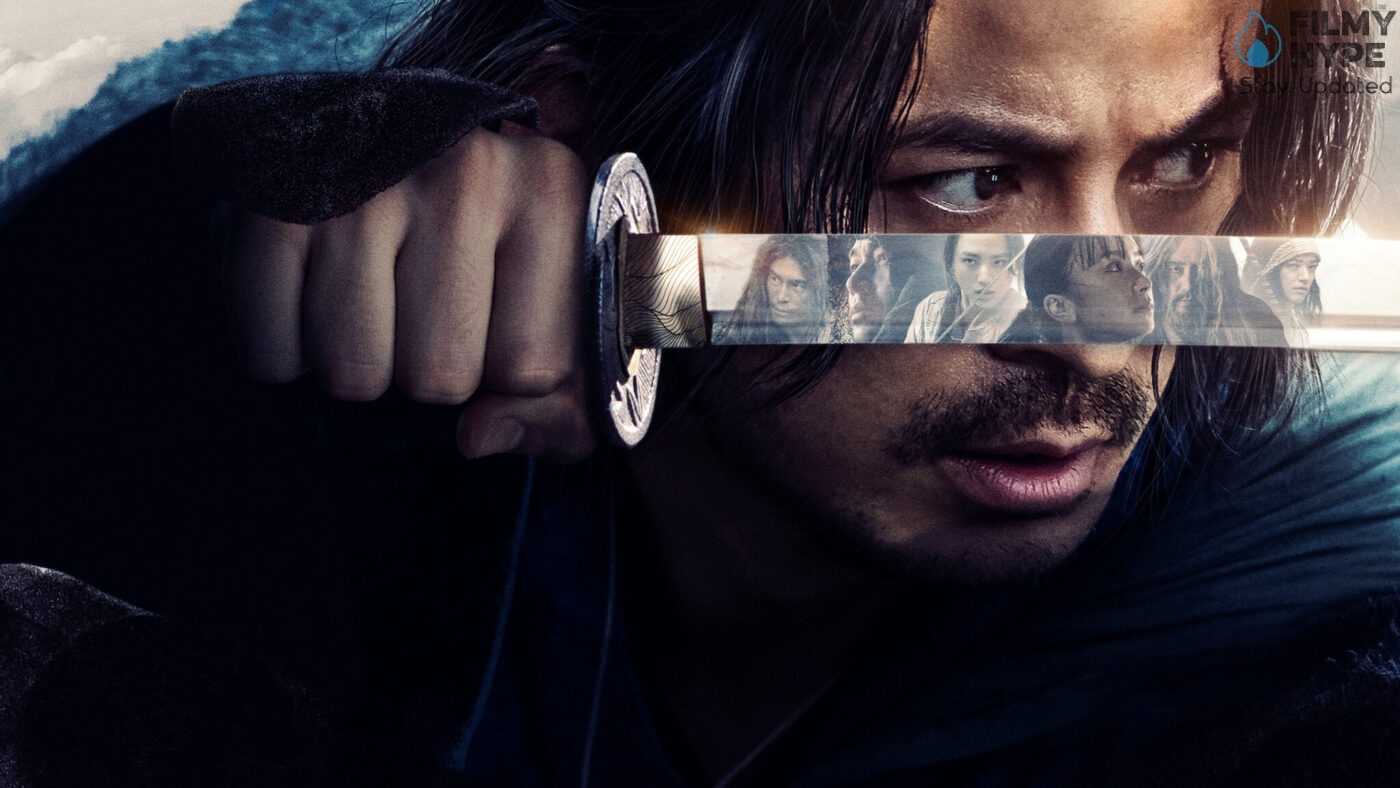
It is a work that lives in a liminal area, in a border where history meets choreographed violence, Zen contemplation breaks in blood, and 19th-century Japan turns into an arena where identity is put to death at a tag at a time. Advertised as a mix between Squid Game (Understatements. Vv., 2021 – 2025) and a chambara, the work is an adaptation of the novel Ikusagami by Shogo Imamura, from which a manga was also based, illustrated by Katsumi Tatsuwaza. Last Samurai Standing, it is, first of all, a lament. A dirge for the disappearance of the samurai. Not overwhelmed by a military defeat but by the victory of others. That of modernity, of rifles, of centralization. Of the industrial logic that replaces the code of bushidō. But this morning, rather than processing it in silence, the series the spectacularity transforms it into a ritual massacre that can be as ferocious as it is deeply emotional.
Last Samurai Standing Review: The Story Plot
The plot is simple. In 1878, in Meiji Restoration Japan, the samurai class was on its way to complete extinction. Sword art virtuosos are reduced to a life of hardship on the fringes of society, of which they were once the ideal pinnacle. Those who are not mercenary or brigand try to survive as best they can, perhaps dedicating themselves to their family. Shjiro Saga is one of the latter. A veteran of the Battle of Shiroyama, serving the emperor’s militias, Saga was one of those samurai who contributed to Japan’s sociopolitical change and its entry into modernity. In exchange, he received financial difficulties, PTSD, and the death of a daughter due to cholera. To prevent the same cruel fate from befalling his wife and other son, the samurai signs up for a mysterious martial arts tournament, the Kodoku, which will turn out to be a deadly game in which the various competing samurai will have to kill each other. The objective of the game is to collect tags and get to Tokyo, where the last survivor will be entitled to a large sum of money.
Last Samurai Standing Review and Analysis
It presents itself as an action series, with many violent scenes, but behind this compelling saga, in reality, there is a mix of history, sport, folklore, and spirituality that fascinates and glues you to the screen. Although the plot immediately refers us to giants such as “Squid Game”, “Last Samurai Standing” it proves to have its own personality and involves not so much the narrative aspect linked to the survival game – to which we are now more than used to it and perhaps even tired – but for his ability to delve into the psychology of the characters, showing us their soul and their internal torments, and telling with great depth one of the most fascinating pieces of Japanese history ever. This series, in fact, prompts us to reflect on the importance of having one’s own identity and the difficulty of reinventing oneself after dedicating one’s life to a single ideal. We discuss fraternal bonds, loyalty, mourning, anger, as well as willpower and love, all of which range from fights to the death, flashbacks, reflections on life, and twists.
A very interesting series, to be seen in one go, and which will glue you to the screen. And that’s not all, because “Last Samurai Standing” still has a lot to tell us, so start this journey, you won’t regret it. This creates narrative architecture based on linear progression through confrontation, as in a video game. The various characters and their fighting styles become archetypal incarnations of different aspects of an ideal Japanese spirit. Each clash, therefore, as in the tradition of fighting anime, becomes a clash between divergent worldviews – in this case, all attributable to the martial philosophy on which Japan until then had founded its identity. Saga represents, for example, honor, the noble Ukyo, the blind loyalty to a hierarchical system, the little girl Futaba, the proverbial Japanese grace and elegance, the brutal Bukotsu, the blind violence of a world governed by war, and so on. The person who organizes the game, to eliminate the samurai, seems to be made up of a group of managers of the nascent large Japanese industrial companies.
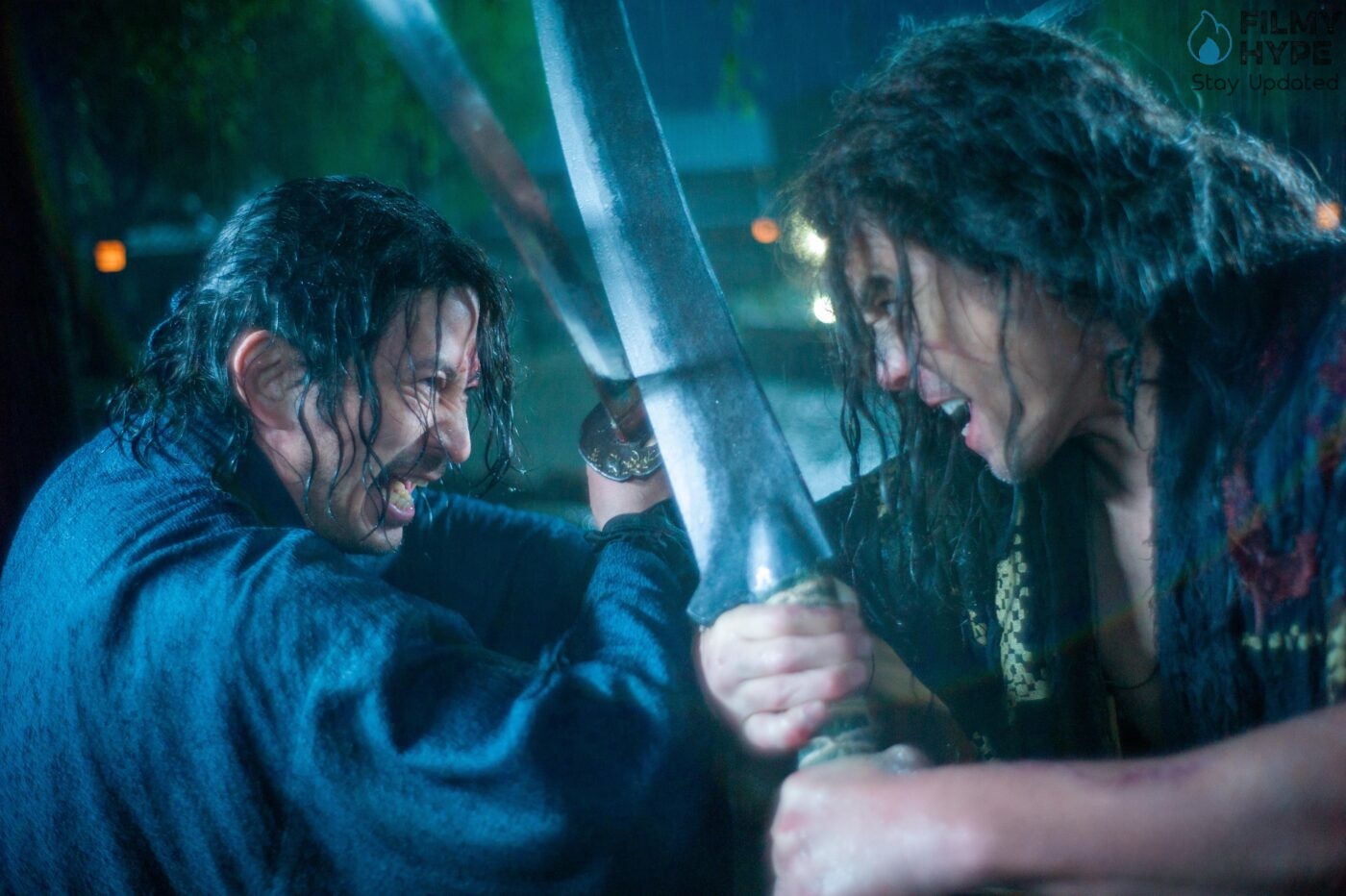
In short, in Ikusagami, rich capitalists enjoy seeing what remains of the noble Japanese spiritual/warrior tradition struggle and die, in the name of a new Westernized world oriented only to the material values of greed and profit. This metaphor goes even further, suggesting how a dark bureaucracy of extermination could arise from such a perversion, which closely resembles Nazism. That is, the ideology of absolute death, of which Japan itself, a few decades later, would become an ally and accomplice, not failing to lavish its share of horrors on neighboring countries. In this position statement, the series almost seems to be a Marxist theorem, in that it advocates the ineluctable confluence of capitalism into fascism. More curious, however, is the choice to oppose these atrocities with a different idea of violence, that of the samurai. For this reason, so much importance is given to individual clashes, up to a purely excellent final episode action. Sword art becomes the art of truth. Whoever wins will determine what aspect of bushido deserves to survive. From this perspective, a lot of importance has been given to choreographies, which are much more refined than the average of similar products and vary between fighting styles and, above all, staging styles that are even distant from each other.
Perhaps the references to the Japanese cinematographic tradition appear obvious and almost obvious. Seeing the series one cannot help but think of the masterpieces of the genre Harakiri (Kobayashi, 1962) – regarding the initial premises related to the destitution of the protagonist, his suffering close-ups and the dynamics of the main clashes – or The Samurai Challenge (Kurosawa, 1961) – the ideological clash between the native sword and the Western pistol, as well as the emphasis on a certain type of transversal katana cut, performed by warriors. More surprising, however, is the incorporation within the samurai aesthetic of typical elements of kung-fu movies from Hong Kong. The action is in this way truly astonishing in combining the realistic martiality of chambara with wuxia dynamism, complete with well-thought-out sequence shots, sometimes more acrobatic fights, and elements drawn from classics such as Drunken Master (Woo-Ping, 1978).
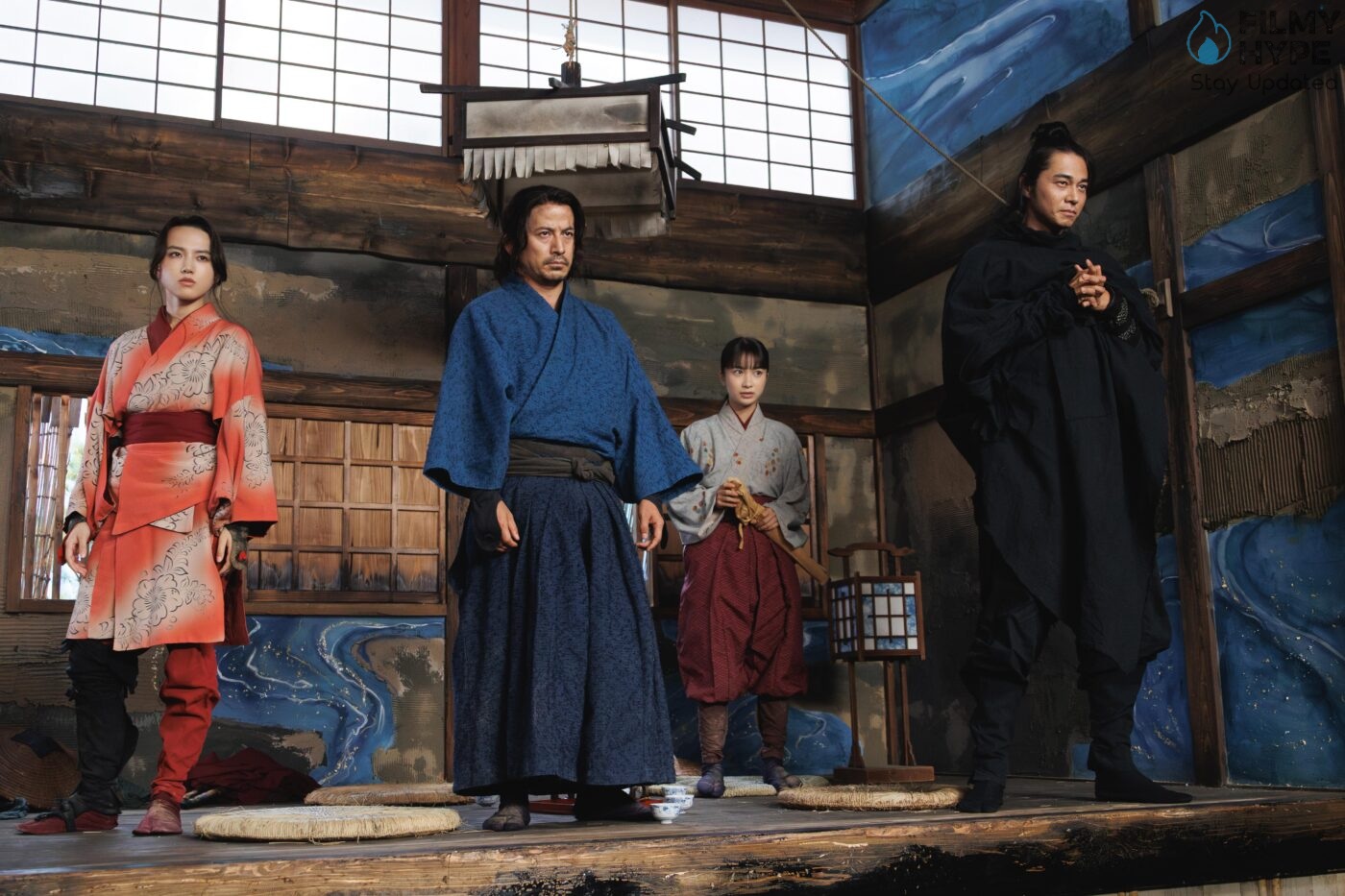
Next to him moves a group of characters who, although not always explored in depth, are struck by stage presence or narrative function. There is Futaba (Yumia Fujisaki), the naive and stubborn young woman who almost becomes the moral conscience of the group. Then there is Iroha (Kaya Kiyohara), an extraordinary warrior with restrained pain, capable of catalyzing attention every time she enters the scene. There are Kyojin (Masahiro Higashide), an ambiguous and ironic strategist, perhaps the most mysterious and promising character, and Bukotsu (Hideaki Itô)– pure brute-state violence, an antagonist that feels like something out of a video game as iconic as it is. And, finally, there is Gentosai Okabe, the legendary “white-haired demon”, whose stage presence recalls an omen of living death. Their entanglement works, even if the very nature of the competition prevents the series from giving everyone the space they deserve. Some flashbacks appear just long enough to suggest an interesting past, but other characters are eliminated before they can leave a real mark. But those who remain, really remain.
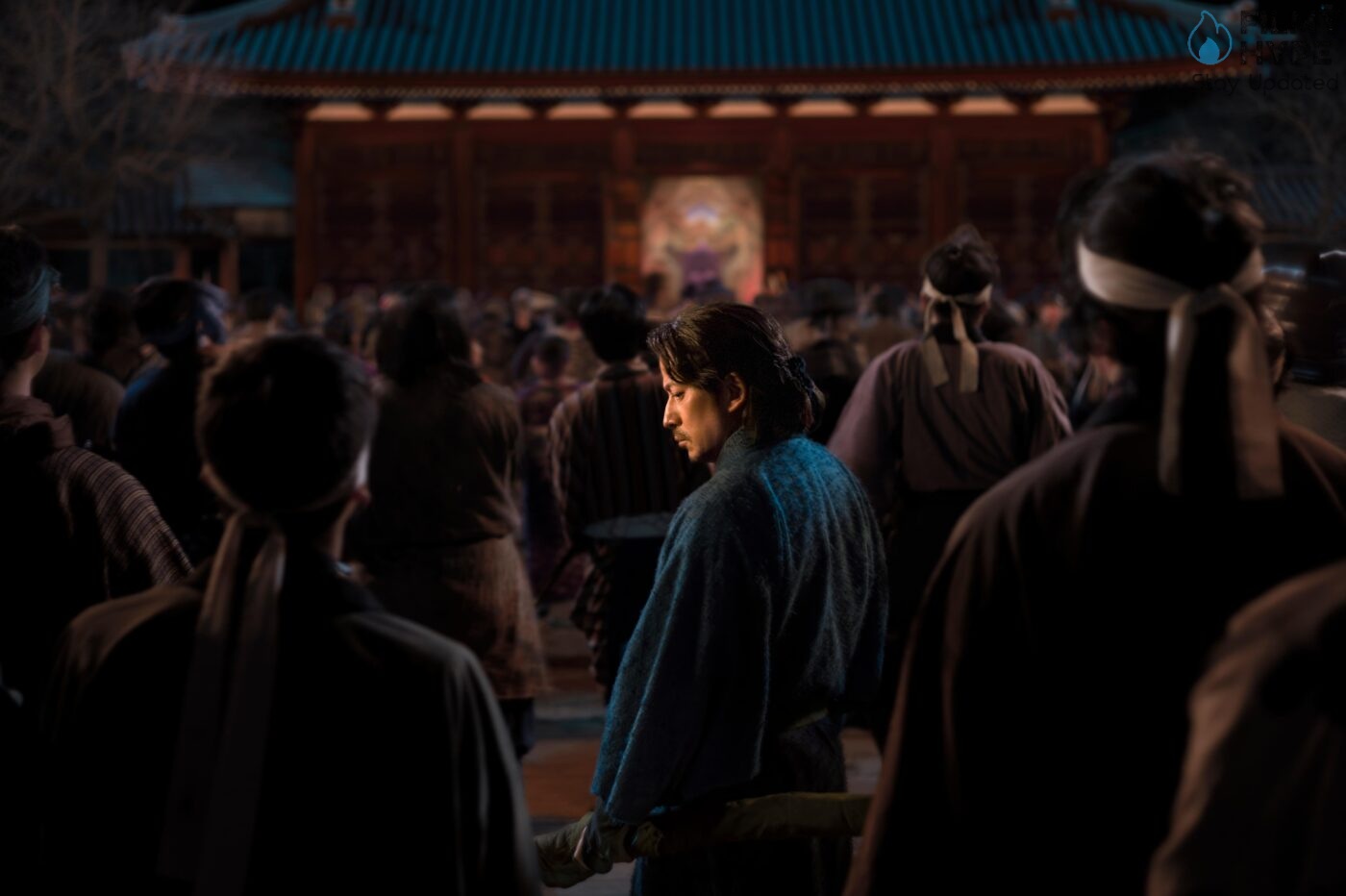
One of the most fascinating aspects of Last Samurai Standing it’s how he chooses to manage the pace. The direction of Michihito Fujii and Kento Yamaguchi moves constantly between very different registers, almost opposite, but surprisingly complementary. On one side, there is choreographed chaos made up of imposing battles and sequence shots that allow no breathing space. On the other hand, the series he knows how to stop and breathe, immersing himself in Zen silences and close-ups full of meaning. To these two souls is added a narrative construction that proceeds by stratification. Centellinate revelations, alliances that slowly crumble, a fabric of internal mythology that expands episode after episode. This balance, however, is not always perfect. The middle part of the season loses some momentum, especially as the story shifts to oligarchs observing the Kodoku from the height of their privilege. These are not useless sequences, but they slightly break the tension accumulated up to that point.
Everything changes, however, in the finale. The last episode is an explosion of pure cinema. Almost uninterrupted action, duels that chase each other without pauses, ambushes that emerge from the darkness, up to a final confrontation during a fireworks festival, which is probably the most evocative scene of the series. A moment where aesthetics, choreography, and drama converge in an almost hypnotic way. It is the clearest mission statement of the work: Last Samurai Standing. She wants to be remembered for the physical power of her images, for her body rather than for her speech, for her sword blow rather than for her dialogue. And in this, he succeeds perfectly. Visually, the series is one of the best Japanese productions of recent years. Photography uses autumn tones, natural light, deep shadows, and contrasts that seem painted. The bamboo forests, the temples, the villages, the muddy roads, the bridges over the Tōkaidō: each location is chosen not for beauty, but for narrative function.
Japan at the end of the nineteenth century was neither idealized nor softened: it was a tired, grey, wounded country. The sets integrate traditional elements with the first signs of modernity: Western watches, uniforms, firearms, and hybrid architecture. And everything dialogues with the characters: Shujiro’s worn clothes, Iroha’s traveling artist jacket, Okabe’s white and menacing dress. It is not only an accurate but an emotional historical reconstruction. It’s not setting: it’s context, it’s cultural memory that takes shape. If scenography builds the world, costume design is its soul. Per Last Samurai Standing, over 300 pieces were made tailor-made. Not decorations but identity testimonials. Futaba’s red and grey dress, with its delicate floral motifs, contrasts with his fragility and determination; Shujiro’s deep blue, worn and heavy, reflects his inner weight; Okabe’s black, almost monastic jumpsuit isolates him from the rest of the world, like a living omen. And then there is Iroha, in her travelling fairground jacket: it is not a warrior costume but a survivor’s one.
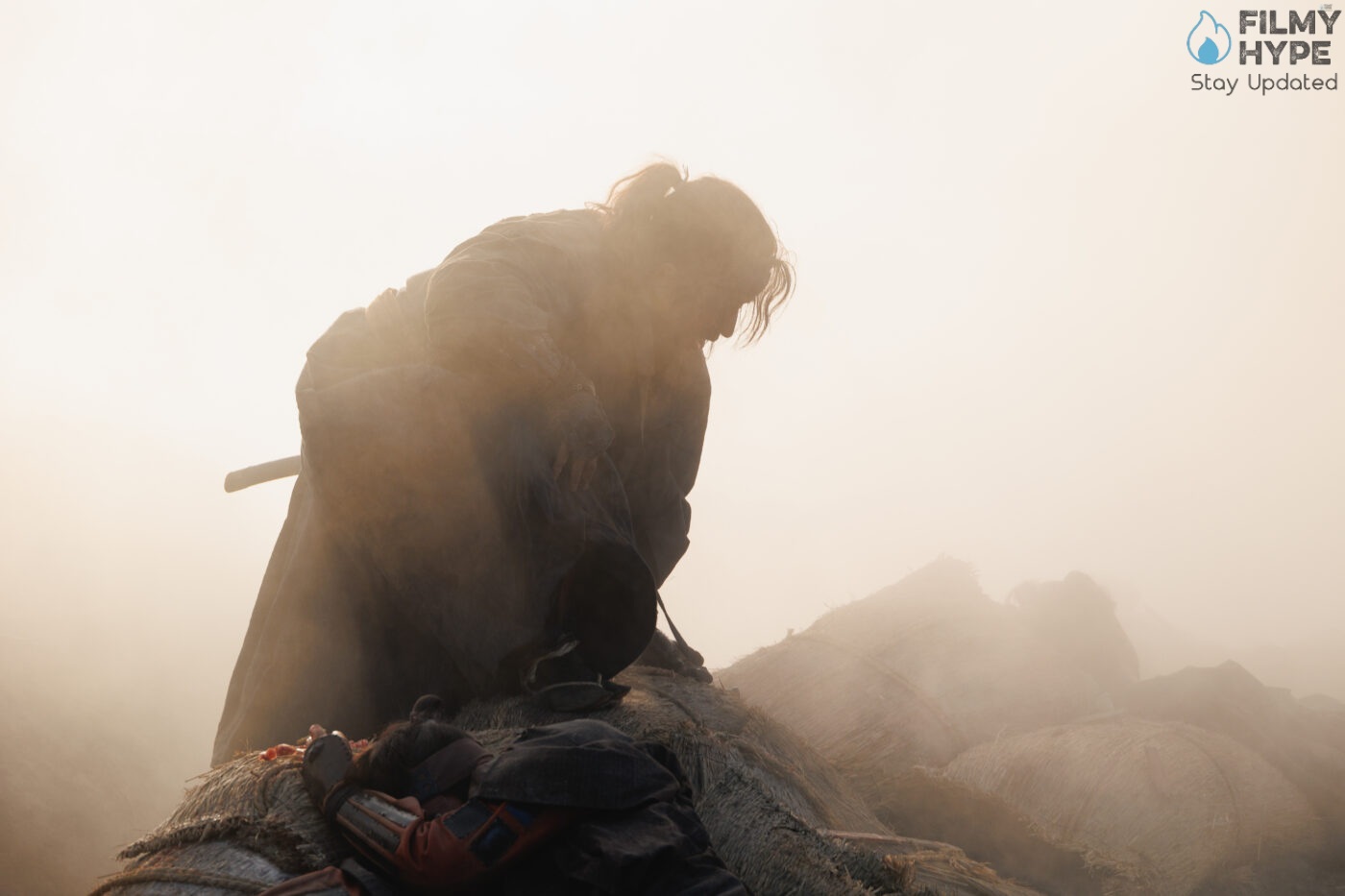
These dresses were not sewn to shine in the spotlight. They were forged to tell. Every crease, every stain, every embroidered detail is a sign of the story that the character wears. The series doesn’t need dialogue to make us understand who’s who: just look at what they’re wearing. The aspect in which Last Samurai Standing action is at its best. No scene was built just to fill in the running time. Each fight is shot with an almost maniacal focus on physicality, the heaviness of the shots, and the sweat that mixes with the blood. Everything is real, tangible, and often painfully authentic. Much of the credit goes to Junichi Okada, who not only plays Shujiro Saga but heads the entire compartment action. His approach is clear: combat is not free entertainment but language. Swords don’t just cut but communicate. Each lunge tells a thought; each parade holds an emotion. There are no choreographies as an end in themselves, only characters who speak with the blade.
The series is full of moments that could be taken and shown at the cinema without losing an ounce of power. The opening, with the opening battle shot in a long sequence shot, is a whirlwind of chaos and brutality reminiscent of the Normandy landings of Saving Private Ryan. The camera moves like an eye trapped in pandemonium, unable to look away as the world around it collapses. And it’s not an isolated case. There is the gigantic melee at the Kyoto temple, an example of choreographed chaos that hardly finds an equal on television. And there’s even a vicious melee inside a bank vault, an asphyxiating scene in which the confined space forces the characters to invent new, almost animalistic movements to survive. What makes everything believable is the absence of ostentatious visual tricks. Nobody thought “cool”, little perceptible CGI, no shortcuts. The entire cast moves with a mastery that is rarely seen in a television product. Last Samurai Standing has a narrative that puts action at the center, not to amaze but to reveal. And he succeeds magnificently.
Last Samurai Standing never claims to be a socio-political treatise, but at the same time refuses to be reduced to a simple blood show. His themes are not declaimed but emerge in detail, in the silent choices of the characters or in the trembling of a hand that no longer wants to brandish a sword. The first thematic node is the obsolescence of honor. The series continually questions what happens when a moral code, which has remained intact for centuries, is suddenly declared useless. Samurai are no longer warriors but unwieldy remnants of an age that no one is planning to save. In a world that rejects them, the bushidō crumbles, and only instinct remains, naked and raw survival, without romanticism and without illusions. It ties into this the wounded identity of every fighter. Each of the participants in the Kodoku is a man removed from history, forced to reinvent himself or succumb. The Meiji Restoration, for the series, is not a simple epochal transition but a real cultural amputation.
Yet amid this systemic brutality, Last Samurai Standing also finds space for a residual, fragile, and surprising humanity. Small gestures of pity. Glimmers that remind us that even within a game of death, there is still room for moral choice. It is a minimal but necessary light, which prevents the series from turning into a cynical festival of violence. It is important to underline that the series does not want to imitate Squid Game nor fit into his speech. Last Samurai Standing tells something completely different. The end of a collective identity and the despair of those who discover that the world has moved on without them. It is another wound, another era, another way of looking at survival. Last Samurai Standing is not a crystalline masterpiece. It has rhythm flaws, secondary characters sacrificed too soon, and the terrible flaw of not having been renewed yet. But it’s a series powerful, brave, and visceral.
It is a work that dares to take a hyper-coded genre like the battle royale and puts it back into a credible historical context, transforming violence into language and pain into memory. It’s a series that feels the weight of its tradition and doesn’t run away, it’s not ashamed of being brutal, it’s not afraid of being emotional. Last Samurai Standing is an excellent product, with few defects and many advantages. Certainly among the best actions of the year, and certainly one of the most original from a thematic point of view. It’s a series that feels on the skin, which digs into bones, which leaves the smell of blood and autumn leaves on. Whose beauty is appreciated after rather than during.
Last Samurai Standing Review: The Last Words
If the action is a strong point of the series, the intertwining of the stories of the individual characters is also well managed and builds credible and human characters, despite their symbolic/archetypal value. Among the few defects present in Ikusagami, instead, there is perhaps some insecurity of continuity in the initial episodes – characters who shave in one scene, to return in the next once again equipped with beards – and a rhetorical overabundance, as regards the explanations, in particular of the villain, linked to the obvious sociopolitical metaphor. But this last trait is more than a flaw in reality, a gender characteristic, found in many similar Japanese works, so in the end, appreciation depends on personal taste. Net of this Last Samurai Standing, it represents a very good vision which will not disappoint fans of oriental action cinema and lovers of the mythical figure of the samurai.
Cast: Junichi Okada, Yumia Fujisaki, Kaya Kiyohara, Masahiro Higashide, Shota Sometani, Taichi Saotome, Yuya Endo, Taiiku Okazaki, Kairi Jo, Takaaki Enoki, Yoshi Sakou, Satoru Matsuo, Toshihiro Yashiba, Daisuke Kuroda
Director: Michihito Fujii, Kento Yamaguchi, Toru Yamamoto
Streaming Platform: Netflix
Filmyhype.com Ratings: 4/5 (four stars)





2 Comments