


It Ends Movie Ending Explained: Four friends, a road that does not appear on any map, and kilometers that seem to never end. It Ends starts from an extremely simple premise to build a film in which the real mystery is not so much to discover where its protagonists are as well as understanding what that place represents. Day, Fisher, and James travel with Tyler, an old high school friend, when they end up trapped on a seemingly endless road. It doesn’t matter how much they drive: the landscape continues, they can’t find a way out, and stopping doesn’t seem like a good idea either. People appear from the forest and run screaming towards the vehicle when it is stopped for too long. At first they try to find rules and maintain a certain normality through jokes and conversations.

But when the days go by, and nothing changes, the question stops being how to escape and becomes a much more uncomfortable one: how long can you keep moving forward when you don’t even know if there is somewhere to go? It Ends is one of the most quietly devastating horror films of 2026. For most of its runtime, it’s a study in despair—four friends on an endless road, their sanity slowly eroding, their relationships breaking down under the weight of a situation that offers no escape and no explanation.
It’s a film about giving up, about the slow process of losing hope, about the moment when the will to keep going simply runs out. And then, in its final minutes, it becomes something else entirely. The ending doesn’t undo what came before. The film is still grim, still unsettling, still painfully human in its depiction of despair. But the final scene shifts the thematic weight of the entire movie, turning what could have been a purely nihilistic exercise into something unexpectedly hopeful. It’s a small moment, but it changes everything.
It Ends Movie Ending Explained: What Are the People Who Come Out of the Forest?
It Ends never explains it literally. We don’t know if they were other travelers stuck on the road, but they do seem to show what can happen when someone stops moving forward: they lie there or wander until the car piques their interest again. They are people who seem to have lost any purpose. In front of them, the protagonists still have one, even if it is as basic as continuing to drive. The road thus functions as a kind of limbo in which everyone ends up facing the same question: move forward or surrender.
Why Do Your Friends Abandon the Car?
As time goes by, the jokes stop working, the conversations run out, and the hope of finding a way out disappears. Tyler is the first to abandon the car. It simply stands by the road, eerily approaching the state of the people living in the forest. Later, Day and Fisher do the same, although they decide to leave together.
The three end up accepting that there may be nothing at the end of the road. James, on the other hand, refuses to give up. He is convinced that the road has to end somewhere, and he continues to drive completely alone for an impossible time to calculate. Find abandoned vehicles and more people who have given up, but moves on.
Does James Really Find the End of the Road?
Yeah. After driving for who knows how long, James finally arrives at a small dead end with a sign advertising “Road Ends”. The infinite road ended, but there is absolutely nothing there. There is no way out of the real world, no explanation for what happened, and no reward for having gone further than others. James gets what he had been looking for all along in the movie and discovers that it is of no use to him. Then he stops, turns around, and starts coming back.
What Does the End of Really Mean It Ends?
The road can be understood as a representation of adult life and the need to constantly move towards some goal even if no one can assure us what we will find when we achieve it. Friends react in different ways. Tyler, Day, and Fisher end up quitting, while James falls to the opposite extreme and turns reaching the end into an obsession. Only when he reaches his goal and discovers that there is nothing there does he understand that perhaps he was looking in the wrong direction. For the first time, stop wondering what will happen next and think about what you have left behind.
Is James Looking for His Friends Again?
Yeah. James walks down the road again and finds one of his friends practically motionless, as if he were beginning to become one of those people they had met during the trip. James picks him up and puts him back in the car.
Then the film recovers a little joke from the beginning. While they were still traveling together, they had argued over who would win in a fight: fifty hawks or a man with a gun. James asks him the same question again, and his friend, barely reacting, answers that probably the hawks because there are fifty of them. The conversation is nonsense, but that’s precisely why it works. It’s a small return to who they were before they got stuck on the road.
Is It A Happy Ending?
In its own way, yes. James can’t find a way out, and the film doesn’t confirm that one will exist either. What changes is the way you approach the trip.
After becoming obsessed with getting to the end, he realizes that there was no answer there. He returns, recovers his friend, and shares with him again one of those absurd conversations that previously seemed unimportant. Throughout the film, James searched for something at the end of the road and ended up discovering that what was truly important had been left behind. They may never escape, but the journey is no longer simply about moving forward. And above all, James no longer drives alone.
It Ends: The Final Twist That Completely Changes the Film’s Message?
The setup of It Ends is deliberately simple. James, Day, Fisher, and Tyler are childhood friends who’ve drifted apart. They reunite for a road trip, take a wrong turn, and find themselves on a road that doesn’t end. The gas tank never empties. Hunger never comes. The only constant is the road, the trees, and the crowds of desperate people who swarm the car whenever it stops.

The horror isn’t supernatural in the traditional sense. There’s no monster, no ticking clock, no specific threat. The danger is the situation itself—the slow, grinding erosion of hope. Each character hits their breaking point differently, and the film watches with unflinching patience as they fall apart.
Tyler is the first to go. His refusal to keep playing along with the rules of the road could be read as defiance, as a human refusal to accept the absurdity of their situation. But it reads differently in the context of the film. It’s surrender. He gives up, and his friends leave him behind in the woods with the other forgotten people.
Day and Fisher find some comfort in each other, but their attempt to take James’s choice away—to force him to stay with them rather than continuing his search for an exit—leaves them alone and somber. James, furious, drives off without them.
The film is unflinching in its depiction of these choices. These aren’t villains or heroes. They’re just people, worn down by circumstances they can’t control, making decisions that feel inevitable in the moment. The metaphor is clear: this is depression. This is suicidal ideation. This is what it looks like when the endless nature of existence makes giving up seem like the only rational option.
The Final Scene
James doesn’t give up. Whether it’s dogged determination or blunt curiosity, he keeps driving. He reaches the end of the road—and discovers that it literally just ends. There’s no exit. No revelation. No salvation. Just a dead stop.
For a moment, the film seems poised to end on the bleakest possible note. James sits there, facing the void, and the audience braces for the inevitable surrender. He’s alone now. His friends are gone. The road has no answers. What’s left to keep going for?
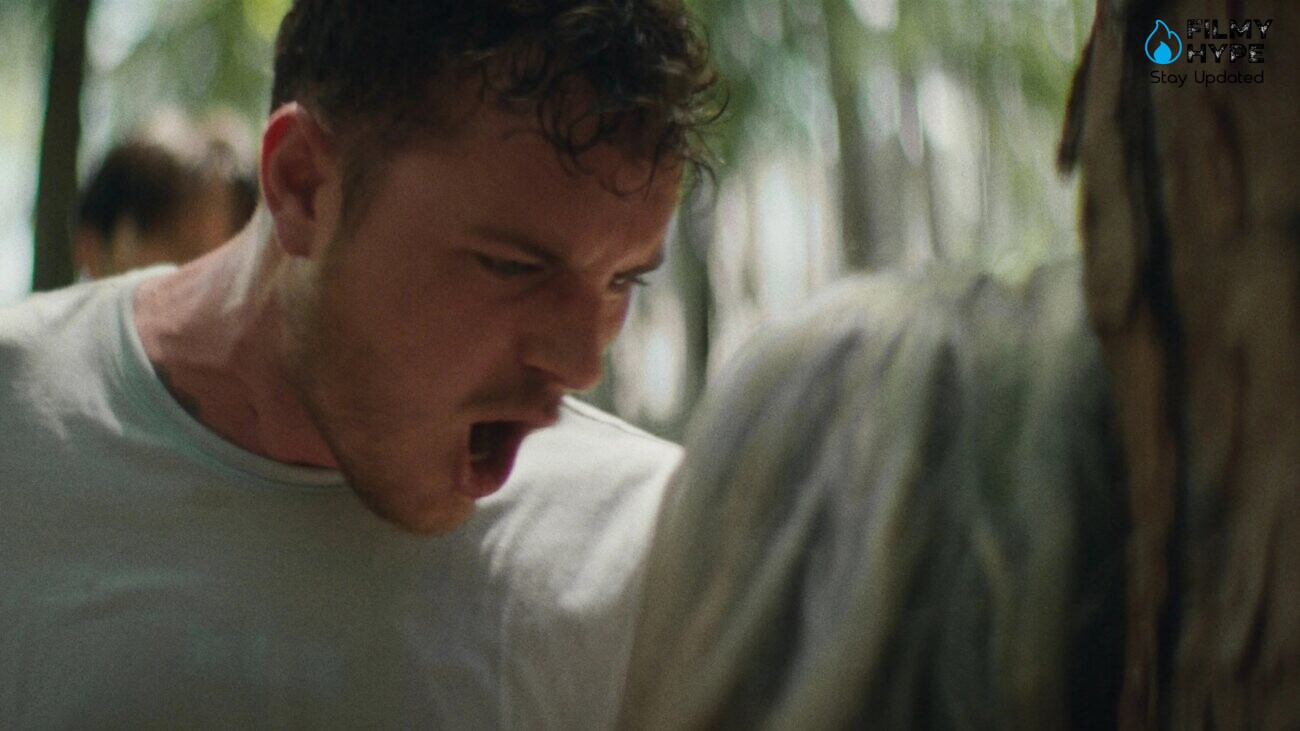
Then James does something unexpected. He picks up one of the people from the woods—someone who’s given up, someone who’s been left behind by their own group—and drags them to the car. Once inside, the person starts to regain their humanity. They join James in a reprisal of the jokey debate he was having with Fisher at the beginning of the film. The tone shifts. The oppressive weight of the endless road is still there, but it’s lighter now. James isn’t alone anymore.
What the Ending Means
The final scene transforms It Ends from a film about despair into a film about endurance. It doesn’t pretend the situation is resolved. The road is still endless. The people in the woods are still there. There’s no sign of salvation on the horizon. But James has done something extraordinary: he’s kept going. And more than that, he’s pulled someone else out of the darkness with him.
The film’s message, revealed only in these final moments, is that connection is the antidote to despair. The horror of the unexplained world is easier to bear when you’re not facing it alone. The group originally endured because they had each other—their conversations, their jokes, their shared history gave them a reason to keep driving. When they fractured, when they isolated themselves, the despair became overwhelming. James’s final act—reaching out, bringing someone else into the car—is a rejection of that isolation.
It’s a surprisingly hopeful note for a film this bleak. Maybe James can find his friends again. Maybe he can pull them out of their stupors, the way he pulled the stranger from the woods. Maybe they can endure together, or with new companions they meet along the way. Maybe they’ll never escape the road. But they won’t be alone. And that, the film suggests, might be enough.
Why the Ending Works
A more conventional version of It Ends would have ended with James alone, giving up, surrendering to the same despair that claimed his friends. That ending would have been consistent with the film’s tone. It would have been grim, powerful, and utterly hopeless.
But Alexander Ullom chose something different. The final scene doesn’t contradict what came before—it deepens it. The film is still about depression, about the endless nature of existence, about the temptation to simply stop. But it adds a crucial counterweight: the possibility of connection. The idea that even in the bleakest circumstances, reaching out to someone else can make the unbearable slightly more bearable.
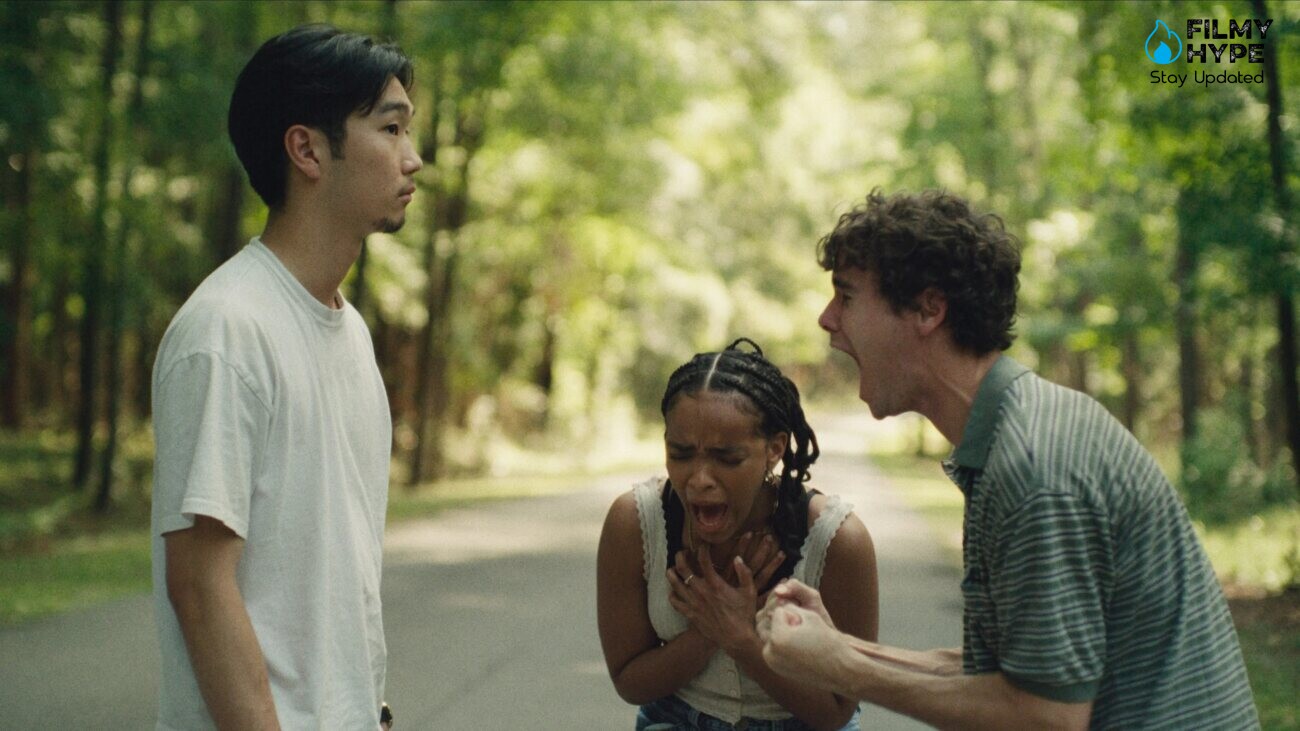
The shift is quiet. It doesn’t announce itself with swelling music or dramatic reveals. It’s just a man picking up a stranger, starting a conversation, and continuing to drive. But that small gesture changes the meaning of everything that came before it.
It Ends is still one of the grimmest films of the year. It earns that reputation honestly. But it’s also, in its final moments, one of the most hopeful. The road doesn’t end. The journey doesn’t stop. But you don’t have to make it alone. That’s the message. And it lands with surprising force after ninety minutes of watching people forget it.