


There’s a moment in House of the Dragon Season 3 Episode 7 that quietly explains something the show has been gesturing toward for a while. Helaena Targaryen has a dragon. She’s bonded to Dreamfyre, one of the oldest and most formidable creatures in the Targaryen arsenal. In Fire & Blood, George R.R. Martin’s source material, she used to ride regularly—she was a passionate flyer who loved the sky, right up until the murder of her son Jaehaerys in the Blood and Cheese incident. After that, she fell into a depression so profound she never mounted Dreamfyre again. The book ties her refusal to fly directly to grief.
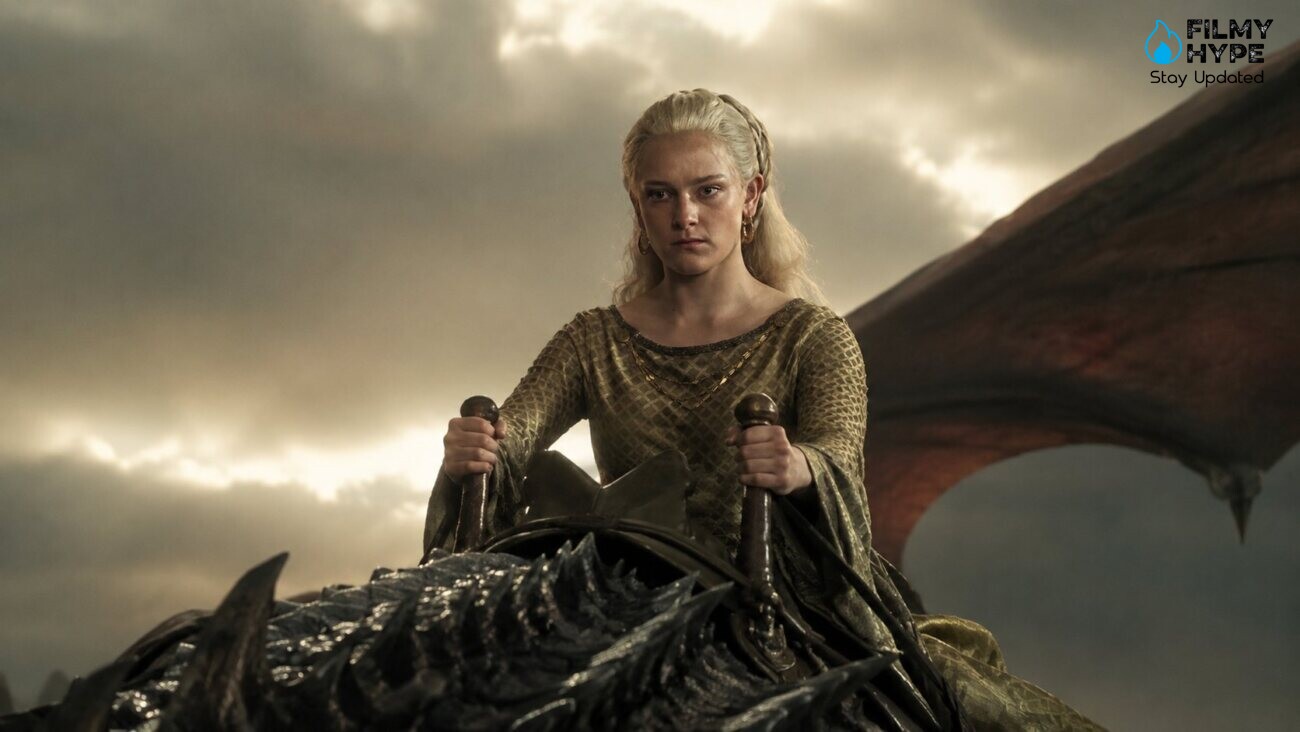
The show has taken a different path. Helaena has never been a rider in the series, even before Jaehaerys was killed. The reason why is finally spoken aloud in Episode 7, and it reveals something essential about how House of the Dragon is reimagining one of its most tragic characters.
Why Helaena Doesn’t Ride Her Dragon: What Helaena Tells Rhaenyra
The scene is quiet, almost intimate. Alicent is on her way to Harrenhal, sent by Rhaenyra on a mission to lure Aemond into a trap. Helaena, pregnant and confined to her chambers, has been experiencing visions—fragments of possible futures that come to her as a Dreamer, a Targaryen trait that runs through the family line. In one of those visions, she sees herself standing beside a horse while doors open before her. Then Rhaenyra wakes her, and the two women have a conversation that cuts to the heart of Helaena’s relationship with her dragon.
Rhaenyra asks directly: Did Aemond ask you to join the battle with him? Helaena nods. Then she explains something she’s apparently never articulated before. When she was young, she wanted to fly. But being with Dreamfyre—she uses the dragon’s name, Fuegoensueño in the Spanish translation, the same creature whose eggs Alys Rivers recently revealed hidden beneath Harrenhal—was too much for her. “It’s too much for me,” she says. The words are simple, but the weight behind them is enormous.
Helaena believes that dragons transform people. This isn’t a casual observation. It’s a conviction that connects her directly to her father, Viserys, who understood better than most that the Targaryens’ relationship with their dragons was never purely one of mastery. The dragons aren’t just weapons. They’re forces that reshape the people who bond with them. Viserys, after Balerion’s death, never took another dragon. Helaena, who has had Dreamfyre her entire adult life, has apparently never ridden her at all.
What the Vision Reveals
Later in the episode, Helaena has another prophetic dream. This one is more violent, more specific. She sees herself giving birth to the child she’s currently carrying, and the infant is taken from her immediately—ripped away in a moment of agony. Then the vision shifts. She’s on Dreamfyre’s back, flying over King’s Landing, while hundreds of citizens assault the Dragonpit. And she speaks the word that every Game of Thrones viewer knows by heart: “Dracarys.” Dreamfyre burns them all.
The vision is terrifying, and it’s also, according to the episode’s director, Nina Lopez-Corrado, the key to understanding Helaena’s refusal. In an interview with Entertainment Weekly, Lopez-Corrado explained that the vision shows Helaena what she’s capable of becoming if she gives in to the dragon. “Helaena feels a strong attraction to dragons, a feeling that divides her, because she believes that they do transform people and that, in essence, they have changed her entire world.”
The vision of herself burning King’s Landing isn’t a power fantasy. It’s a warning. “When she sees herself riding the dragon and sees Dreamfyre ravaging King’s Landing, internally, it hurts her deeply. I think deep down she knows that, being a Targaryen, there is almost no positive outcome for anything that is happening in this war within his family. And the dragons, as long as they exist, will maintain this internal turmoil in the Targaryens.”
That’s the core of it. Helaena isn’t afraid of Dreamfyre. She’s afraid of what Dreamfyre will make her become. She’s seen, with the clarity of a Dreamer, what happens when Targaryens unleash their dragons on the world. She’s watched her family tear itself apart with fire and blood. She knows that if she gets on Dreamfyre’s back, she’ll eventually be drawn into the conflict, and the part of herself that she values—the gentleness, the remove, the refusal to become a weapon—will be consumed.
The Difference From the Book
In Fire & Blood, Helaena’s grounding is a consequence of trauma. She loved flying. She was good at it. Dreamfyre was a source of joy. Then Jaehaerys was murdered in front of her, and the joy was extinguished. She never flew again, not because she had philosophical objections to dragons but because she was too broken to do anything at all. Her death, when it comes, is a suicide—she throws herself from a window in the Red Keep, and the book leaves open the possibility that Rhaenyra had her killed.
The show’s version is more active. Helaena isn’t grounded by grief. She’s grounded by choice. She’s made a decision, long before the war started, that she would not participate in the Targaryen cycle of violence. She would not become another dragonrider burning cities and ending bloodlines. The irony is that this decision doesn’t protect her. The war comes for her anyway. Her son is still murdered. She’s still pregnant with a child whose future is uncertain. She’s still a prisoner in the Red Keep. Her refusal to fly doesn’t keep her safe. It just means she faces the horror without the one tool that might give her some agency.
That’s the tragedy of Helaena in the show. In the book, she’s a victim whose suffering is so total that it annihilates her. In the series, she’s someone who saw the darkness coming and tried to opt out, only to discover that opting out isn’t an option. The dragons will transform you whether you ride them or not. The war will consume you whether you fight or not. The visions will show you what’s coming, and you’ll still be powerless to stop it.
What This Means for the Finale
Helaena’s vision of herself burning King’s Landing is unlikely to be literal—at least not yet. The show has been careful to keep her away from violence, to position her as the one Targaryen who might actually escape the family curse. But the vision suggests that the potential is there. Dreamfyre is waiting. The dragon is real, and Helaena is bonded to her. If something pushes Helaena past her breaking point—the loss of her child, the death of Alicent, whatever Ormund or Rhaenyra or Aemond does next—the woman who refused to fly might finally take to the sky. And if she does, the vision suggests she’ll be bringing fire with her.
The show has spent three seasons building Helaena as a figure of almost unbearable sympathy. She’s the one who never wanted power. She’s the one who saw what was coming and tried to warn people. She’s the one who refused to become what her family expected her to be. If the finale—or the seasons beyond—push her into the air, it won’t feel like a triumph. It’ll feel like the last failure of a family that destroys everything it touches, including the one person who tried to stay clean. Helaena doesn’t ride Dreamfyre because she believes dragons transform people, and she’s right. The question the show is asking, with one episode left in the season, is whether she can hold onto that conviction when everything else has been taken from her.